


Sell the Data, Not the Protocol
The opportunity: turn fragmented local building-permit records into a clean, cited feed for one metro, then make it callable by software and AI agents alike.
There's an idea circulating in the AI infrastructure world that sounds like free money: find a useful government database, wrap it in an MCP server, charge agents for access.
The premise is reasonable. Model Context Protocol went from an Anthropic side project to shared industry plumbing in about a year. When Anthropic donated MCP to the Agentic AI Foundation under the Linux Foundation on December 9, 2025, it reported roughly 10,000 active servers, more than 97 million monthly SDK downloads, and first-class client support across ChatGPT, Claude, Cursor, Gemini, Microsoft Copilot, and Visual Studio Code. OpenAI had wired remote MCP servers into its Responses API back on May 21, 2025. The specification published on July 28, 2026 dropped the initialize handshake and the protocol-level session entirely, so an MCP server now deploys behind ordinary HTTP infrastructure like any other API.

Agents will call a lot of external tools; that part is settled. What it doesn't settle is whether the server sitting in the middle is a business. A protocol is an adapter, and adapters get standardized, cloned, and eventually given away. The business is owning a stream of data that's genuinely hard to reproduce. So pick one commercially valuable category of local government records, normalize it better than anyone else for a narrow market, and sell the result. Building permits are the place to start: the records exist, businesses already pay for them, the upstream data is bad enough to create real work, and a permit shows up at the exact moment someone commits to spending money.
Here's the heist:
The money: Roughly 45 customers across four tiers clears $10K MRR. Shovels raised $6.5 million selling the same signal nationally.
Inside:
• Ten-jurisdiction MVP scope and source tiering
• Four-tier pricing from $99 to $1,500/month
• The provenance schema buyers pay for
• Six-week build and pre-sale sequence
Your first product doesn't need to cover America. Austin would do. So would Miami, or one cluster of suburbs running the same permitting software. Get ten to thirty messy sources working exceptionally well, then sell the clean signal.
Public Data That Nobody Can Actually Use
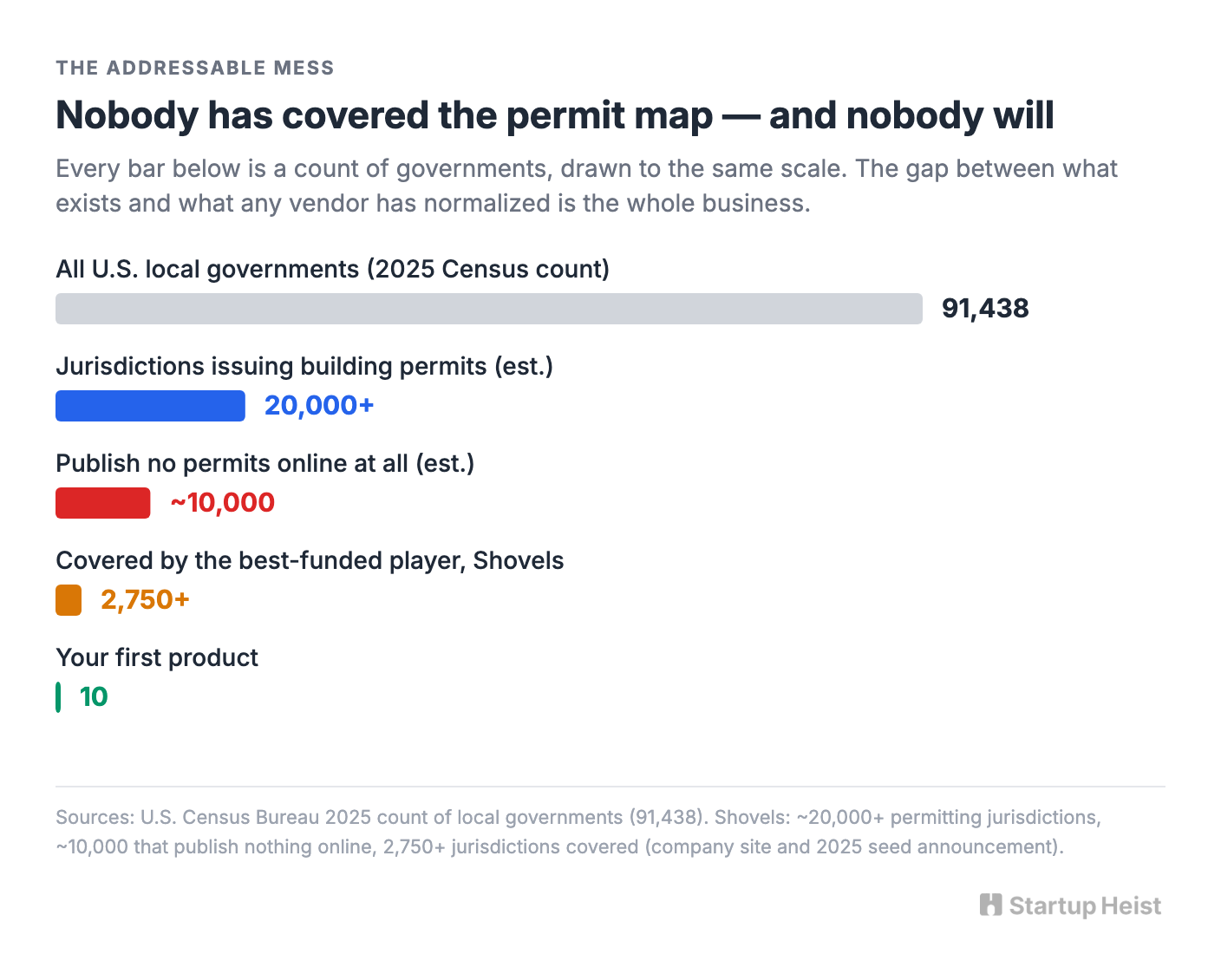
The Census Bureau counted 91,438 local governments in the United States in 2025, and the number keeps climbing as states create new special districts. Most of them publish something online, building permit data included, and "online" covers a lot of ground. It can mean a clean REST endpoint, an ArcGIS feature service, a nightly CSV, a Socrata dataset, a permit-search page built for human eyeballs, or a PDF that technically satisfies a transparency mandate while being nearly impossible to consume programmatically.
Field definitions diverge even within a single record type. One city publishes `permit_type = BP`. The next publishes `work_type = Building`. A third buries everything that matters in a free-text field reading `INTERIOR ALTERATION TO EXISTING TENANT SPACE`. Address and contractor formats shift from one town to the next. Dates can mean application, issuance, approval, inspection, or finalization. Valuations arrive missing, malformed, or as strings with dollar signs. A status that means one thing in one jurisdiction means something else next door. Then the portal changes and your pipeline breaks.
Socrata shows exactly where the gap sits. Its API is genuinely good, and with a registered app token you generally aren't throttled at all. What Socrata solves is publishing. Every city on it still exposes its own datasets under its own schema with its own vocabulary, and nothing in the platform converts fifteen municipal permit dialects into one commercial data model.
The opportunity lives one layer above the portals, and no government has any incentive to build it.
Why Permits Are the Right First Record
"Local government data" isn't a market. Court records, zoning hearings, tax assessments, procurement notices, restaurant inspections, and building permits have different users, different laws, and different economics. Serving all of them at once produces a demo instead of a company.
Start where someone can look at a single new record and say there is money attached to this. A permit tells you a house is getting a new roof, a restaurant is being gutted, a developer is breaking ground on multifamily, or a warehouse is going up. It tells you a contractor has just become active in a neighborhood, and that a property is about to need insurance, materials, financing, and labor.
Construction Monitor has been selling exactly this for over thirty years, turning building permit data into construction sales leads for subcontractors, material suppliers, and general contractors who want projects before their competitors find them. It moves 36,000-plus new residential permits a week through an API and weekly FTP dumps.
A building permit is valuable because it's an event. Something changed, someone is spending, and businesses will pay to hear about it first.
The Market Is Validated and Already Contested
This isn't an empty field, which is the good news and the warning. The strongest validation is Shovels, founded in 2022 by Ryan Buckley and Luka Kacil. Its feed advertises more than 174 million permit records, 3.55 million contractors, and 159 million parcels across 2,750-plus jurisdictions, covering roughly 85% of the U.S. population. In June 2025 it raised a $5 million seed led by Base10 Partners, bringing total funding to $6.5 million, on the pitch that permit data is scattered across more than 20,000 jurisdictions.
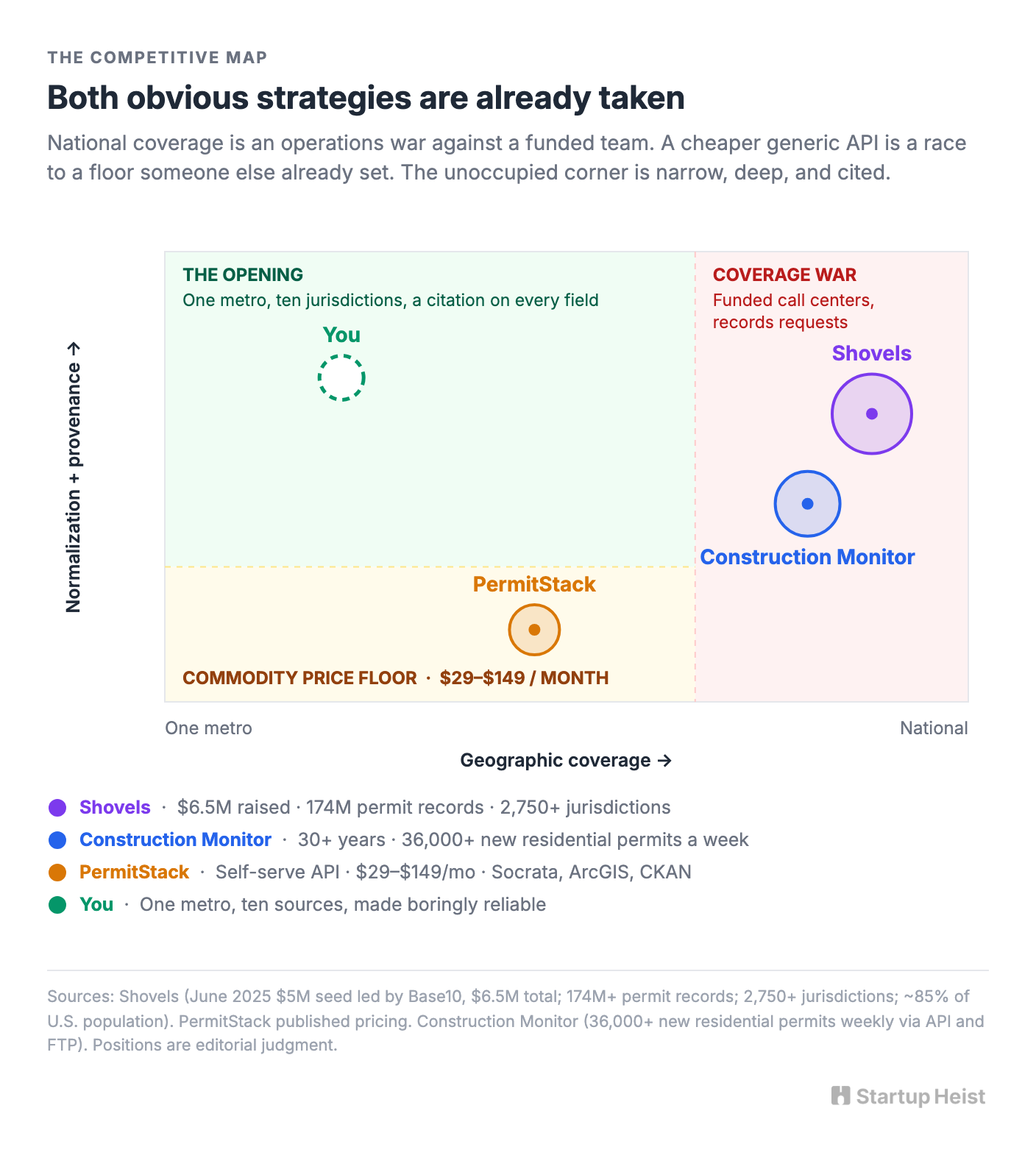
Read the second half of that story carefully, because it's the part that should change your plan. Shovels reports that roughly 10,000 U.S. jurisdictions don't publish permits online at all. Its answer is Project Storm: phone calls, relationship-building, and public records requests, jurisdiction by jurisdiction. In September 2025 it added 10 million permits that way, its most productive month on record. A funded team is running a call center against county clerks, and you don't want to race them.
The low end is occupied too. PermitStack sells self-serve permit API access from a free tier through paid plans at $29, $39, $79, and $149 a month, pulling from hundreds of government sources via Socrata, ArcGIS, CKAN, and CARTO connectors with daily refreshes. Its $79 plan includes 10,000 requests a day. So two obvious strategies are already dead: nationwide coverage is an operations war you'll lose, and a cheaper generic permit API is a race to a price floor someone else already set. The opening that's left is narrower and better.
What You're Actually Selling
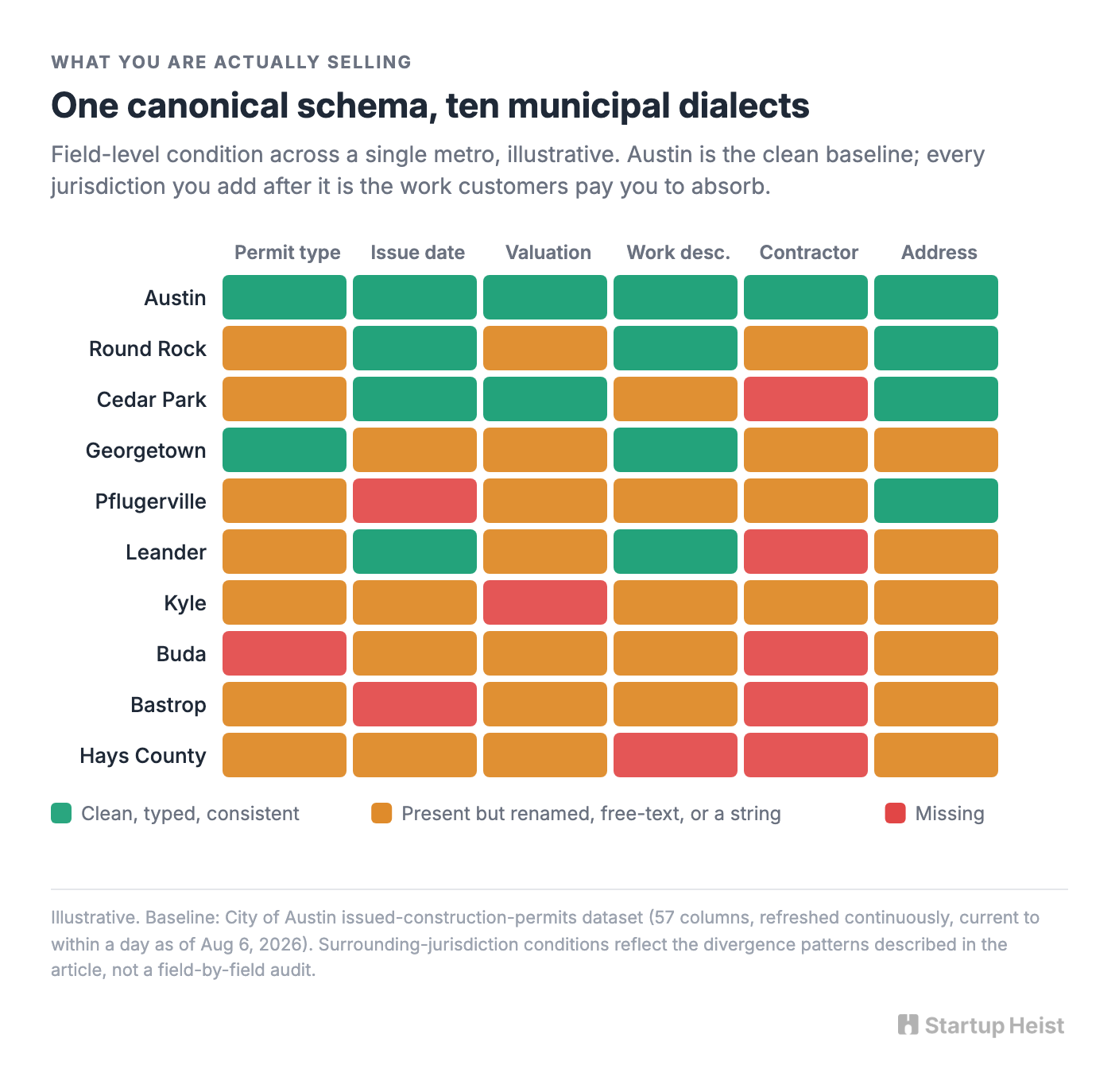
Say you build this for Austin. The city publishes an unusually good issued-construction-permits dataset: 57 columns covering location, permit type, work description, square footage, valuation, council district, expiration, and units, refreshed continuously. As of August 6, 2026 it was current to within a day.
The dataset isn't the product, though. Anyone can download it.
Unlock the Vault.
Join founders who spot opportunities ahead of the crowd. Actionable insights. Zero fluff.
“Intelligent, bold, minus the pretense.”
“Like discovering the cheat codes of the startup world.”
“SH is off-Broadway for founders — weird, sharp, and ahead of the curve.”


