


AI Can Write the Code. Sell the Debugging Gym.
AI coding assistants created a strange new bottleneck. Software teams can now produce code faster than they can confidently verify it, and the scarce engineering skill is sliding from producing code to judging it. Can an engineer tell when a plausible patch is wrong, trace a regression across three services, or form a hypothesis before asking an agent to regenerate the function? None of that shows up on a GitHub contribution graph.
So build the inspection layer: a GitHub-native debugging gym. It takes bugs a company has already fixed, rebuilds safe versions of them inside disposable sandboxes, and turns each one into a 20-minute drill that shows engineering leaders whether their people can still diagnose, repair and explain the code their AI wrote. It has nothing in common with LeetCode drills or video courses, and it carries no anti-AI agenda. The pitch fits in one line: AI writes code faster than your team can verify it, so rehearse verification on the bugs your own codebase already produced.
At first this looks like a niche developer tool, and it could stay one: a profitable vertical SaaS doing a few million dollars a year. Underneath sits a bigger company, a system that measures whether a software organization still has the human capability to operate an increasingly machine-written codebase.
Here's the opportunity at a glance:
The money: 250 teams at a $400 monthly average is $100K MRR. SadServers already charges businesses $245 a month for troubleshooting reps.
Inside:
• A six-step importer, from PR to sandbox
• AI-on vs. AI-off drill design
• Three pricing tiers that dodge the seat trap
• A 90-day plan and pilot cold email
The Job Moved Downstream
BairesDev's Q3 2026 Dev Barometer, published September 15, 2026, surveyed 705 developers in more than 60 countries. Forty-two percent said AI now writes at least half their code, up from 12% a year earlier. The hours didn't come back as free time. Sixty-seven percent spend more time reviewing AI-generated code, 52% spend more time debugging problems AI introduced, and only 21% still spend more than half their week writing new code. Only 7% say the ship decision has been handed entirely to AI. In BairesDev's Q1 2026 edition, 51% said accountability for AI-generated code sat with them personally.
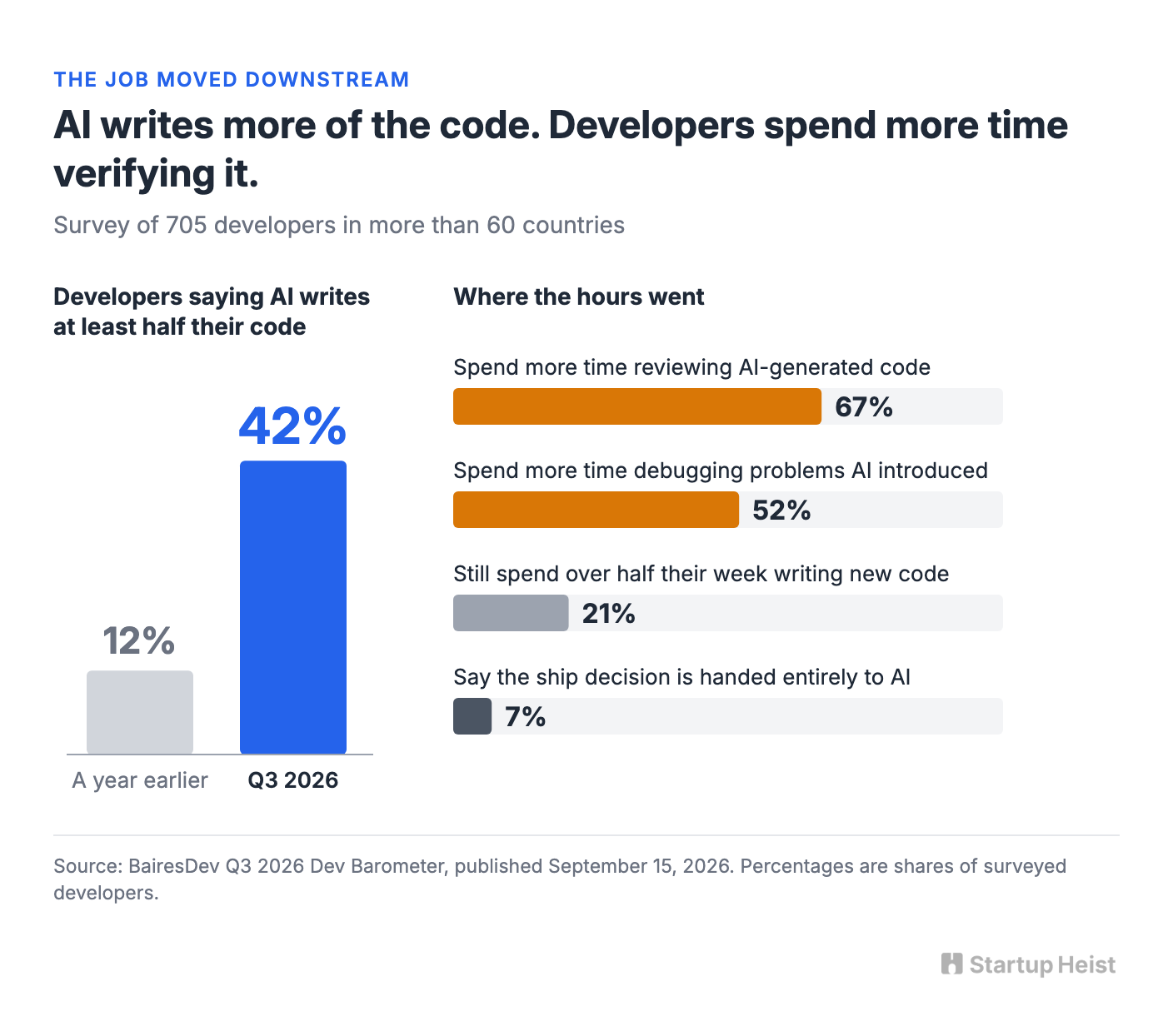
Personal accountability for code you didn't write is where this business starts. A developer who used to write 500 lines may now supervise 2,000, and the work shifts to reading, testing, rejecting, debugging and signing off on what ships. Stack Overflow's 2025 Developer Survey, with 49,009 respondents, found the same strain: 84% use or plan to use AI tools, yet 46% actively distrust their accuracy against 33% who trust it. The top frustration, cited by 66%, was AI output that is almost right but not quite, and 45% said debugging AI-generated code takes longer. Google's 2025 DORA report, drawn from nearly 5,000 technology professionals, calls AI an amplifier that magnifies a team's existing strengths and weaknesses alike.
Hiring platforms have already adjusted their technical interviews. On July 29, 2026, HackerRank published guidance against banning AI from interviews and recommended a format that could serve as this product's spec: "Give the candidate AI-generated code with a subtle bug and ask them to find it, using AI tools if they want. This tests verification skill directly." Employers now care less about whether an engineer can code like it's 2019 and more about whether they stay accountable when the machine does half the typing. Hiring tools test that skill one candidate at a time. Letting a whole team rehearse it on its own code is still an open lane.
The Heist
Say you manage 35 engineers. Six months ago your payments service had a nasty concurrency bug. A senior engineer spent half a day on it before it was fixed in PR #8,421, and today that bug sits buried in Git history, where this product can put it to work.
You install the GitHub App and nominate PR #8,421. The system rebuilds the repository at the commit before the fix, hides the original PR and its answer, confirms that a deterministic test reproduces the failure, and packages the scenario as a 20-minute exercise. An engineer opens it and reads: Payment callbacks are occasionally creating duplicate ledger entries. The regression test below fails intermittently. Diagnose the cause, implement a fix, and explain why your change is safe. They get a browser IDE, a shell and the test suite.
The product records the signals that matter: how long before they ran the first test, which files they opened, whether they reproduced the failure before editing, how many fixes they attempted and in which direction, whether the final patch passes both the target test and the regression suite, and whether their written explanation matches the real defect. A second mode repeats the drill with AI assistance switched on.
The manager then gets something more useful than a completion badge: Your team fixes auth-state bugs quickly, but only two people diagnosed the caching failures. New engineers consistently edit before reproducing. The billing service has thin debugging coverage outside its two maintainers. Old defects become the curriculum, and the engineer's behavior inside the company's own repository becomes the assessment.
Why Your Own Bugs Beat a Question Library
Companies already pay to measure coding ability. CodeSignal's entry Build plan runs $99 a month billed monthly ($79 on annual billing) and its Grow plan $599 a month. Engineers pay for realistic debugging practice too. SadServers, a LeetCode-style site for Linux troubleshooting, sells 125-plus broken-server scenarios for $9 a month to individuals and $245 a month to businesses, and CodeCrafters built a YC-backed business charging developers $360 a year to rebuild Redis and Git from scratch. Buglyst already offers 145 free debugging labs built from real open-source failures, with deterministic grading and a hidden regression suite.
Others are circling closer. HackerRank's Code Repository questions let an employer upload a project (a ZIP capped at 5 MB, or a public Git URL) and write bug-fix tasks against it, with an AI agent assisting setup. Uptime Labs sells incident-response simulations built from real-life incidents to SRE and on-call teams. Look at where each one ends: HackerRank serves a single hiring decision about a single candidate, Buglyst runs only on public code, and Uptime Labs drills coordination rather than the code itself. None of them mines your Git history for the authentication edge case that caused an outage, the query that worked at 10,000 rows and collapsed at 10 million, or the retry loop that double-charged customers, and none tracks whether your team gets better at those failures over time.
A company's bug history is compressed institutional knowledge, and most organizations throw it away after the postmortem. Turning it into reliable exercises, though, is much harder than it sounds.
The Yield Problem
Unlock the Vault.
Join founders who spot opportunities ahead of the crowd. Actionable insights. Zero fluff.
“Intelligent, bold, minus the pretense.”
“Like discovering the cheat codes of the startup world.”
“SH is off-Broadway for founders — weird, sharp, and ahead of the curve.”


