


The Trust Layer for the AI-Flooded Hiring Funnel
AI made it nearly free to manufacture a convincing job applicant. The opportunity is deciding which applicants have earned trust, and which ones need one more check before a recruiter spends an hour on them.
For a decade, hiring software fought friction. One-click apply, autofilled résumés, async video screens and remote interviews made it easy for good candidates to raise their hands. AI made it just as easy for everyone else. One person can now tailor hundreds of résumés, generate cover letters and script interview answers for close to nothing. Organized operators go further, with fabricated work histories, recycled identities, stand-in interviewers and deepfake video.

The math of the funnel broke. Submitting an application costs almost nothing, while reviewing one still costs human time. Greenhouse's 2026 benchmark data, drawn from more than 6,000 companies, shows applications per job rising from 116 in 2022 to 244 in 2025. Over the same stretch the average organization went from 10.4 recruiters to 4.6, and each recruiter's annual load climbed from about 1,600 applications to roughly 4,900.
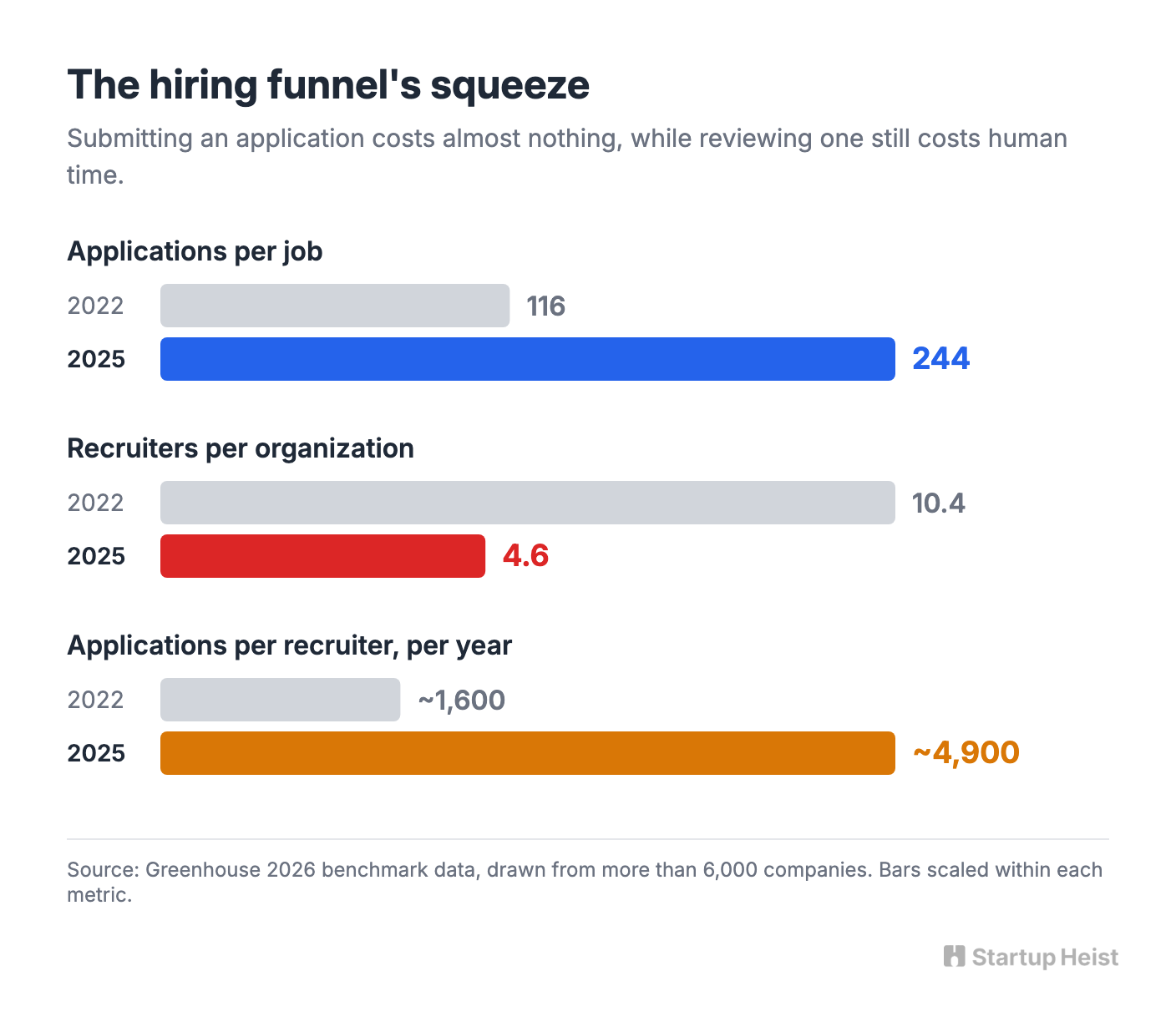
The business worth building sits in that gap. Call it a candidate trust router: a thin layer between application and interview that spots suspicious identity patterns, shows the recruiter the evidence, and escalates only the small share of applicants who deserve a harder look. Think of it as fraud triage for recruiting. Here's the opportunity in brief:
The money: 50 remote hiring teams at $499/month is $24,950 MRR, and 100 is $49,900. Endorsed starts near $747 a month and keeps Workable write-back on its Enterprise tier.
Inside:
• Four signal buckets for a six-week MVP
• Shadow Mode pilot and end-of-pilot report
• Volume-band pricing from $299 to $999
• Cold email template and prospect filter
Two Problems Share One Label
"AI applicants" covers two very different behaviors. The first is ordinary candidates using ordinary tools. Someone asks ChatGPT to tighten a résumé bullet. A non-native speaker cleans up a cover letter. In a late-2024 Gartner survey, 39% of candidates said they used AI somewhere in the application process. You may find that annoying, but it isn't fraud.
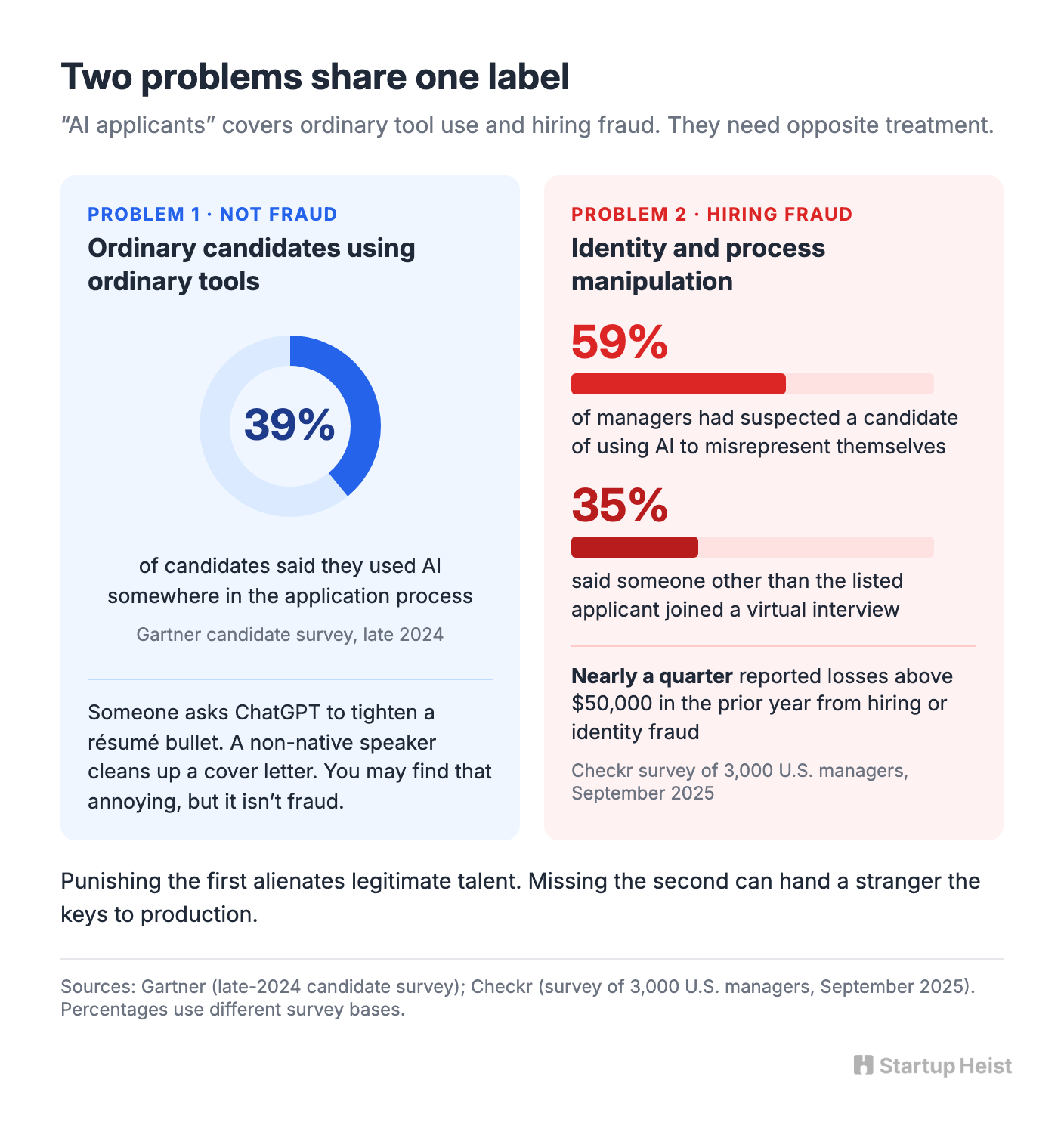
The second is hiring fraud, meaning identity and process manipulation: one phone number behind several candidate names, a résumé duplicated across identities, a claimed location that contradicts every other signal, a different person showing up to the interview. Checkr surveyed 3,000 U.S. managers in September 2025 and found that 59% had suspected a candidate of using AI to misrepresent themselves, and 35% said someone other than the listed applicant had joined a virtual interview. Nearly a quarter reported losses above $50,000 in the prior year from hiring or identity fraud.
Those two groups need opposite treatment. Punishing the first alienates legitimate talent, and missing the second can hand a stranger the keys to production.
When a Fake Applicant Becomes a Breach
On January 23, 2025, the FBI warned that North Korean IT workers were using AI and face-swapping during video interviews to land remote jobs at U.S. companies, then extorting employers by holding stolen code and data hostage. The same alert carried a recommendation that reads like a product spec: cross-check HR systems for other applicants with the same résumé content or contact information, because these operators reuse phone numbers, especially VoIP numbers, and email addresses across résumés for supposedly different people.
On June 30, 2025, the Justice Department announced coordinated actions that included searches of 29 known or suspected laptop farms across 16 states and the seizure of 29 financial accounts, 21 fraudulent websites and roughly 200 computers. In one week of June searches alone, the FBI seized about 137 laptops.
Once a fake remote engineer can hold production credentials, the problem stops belonging only to recruiting. It becomes an insider-risk event, and insider risk comes with a security budget.
The Product to Kill First
The tempting first build is an AI résumé detector: feed in the résumé, return "87% probability this was written by AI." Even a perfect detector answers the wrong question. Recruiters need to know whether the candidate is a real person, whether the résumé belongs to them, and whether the person who interviews is the person who gets hired. Authorship tells you almost nothing about any of that.
The clever-sounding variant fails too: slip suspicious applicants a strange puzzle or hidden instruction and see if a bot trips. Modern agents handle odd instructions well, and real people with disabilities or language differences stumble on them. California's automated-decision regulations, in effect since October 1, 2025, warn that puzzles or games that elicit disability information can count as an unlawful medical inquiry. No employer wants its candidate experience summed up as "we tried to trick you into proving you're human." The winning product decides when an additional check is justified and stays out of the way the rest of the time.
The Incumbents Already Proved the Market
The big applicant tracking systems (ATS) moved fast. Greenhouse sells Real Talent, which scores phone, email, IP and location signals and hands heavier identity checks to CLEAR. Ashby shipped native fraud detection to all customers on September 16, 2025, drawing on device, IP, email and phone signals, with bulk checks and fraud statuses in the pipeline. Lever added Fraud Signals in its Spring 2026 release, checking email validity, virtual phone numbers, bot-like application behavior and work-history consistency. All three leave the final call with the recruiter.
Standalone players are further along than a founder might hope. Endorsed claims 700+ signals, integrates with most major ATSs including Workable, and charges $249 per user per month on its Growth plan, billed annually with a three-seat minimum, which works out to roughly $747 a month to start. Huntress, a cybersecurity firm, reported that 23.2% of its applicants were flagged as fraud risks between September and November 2025 after adopting Endorsed. An early-access startup called Flagable already promises flags and insights inside Workable profiles. The market is real, and fraud detection alone is no longer a company. What remains open is the mid-sized team that incumbents haven't yet served cheaply and cleanly, and the way in is to sell the escalation decision itself.
Sell the Escalation Decision
Call the product Applicant Risk Inbox: a Workable-first recruiting-security add-on for remote technical hiring teams. Every new applicant gets quietly checked for explainable inconsistencies. Most candidates experience nothing. A smaller group earns a visible recruiter note, Review before scheduling, and only the highest-risk cases go to identity verification.
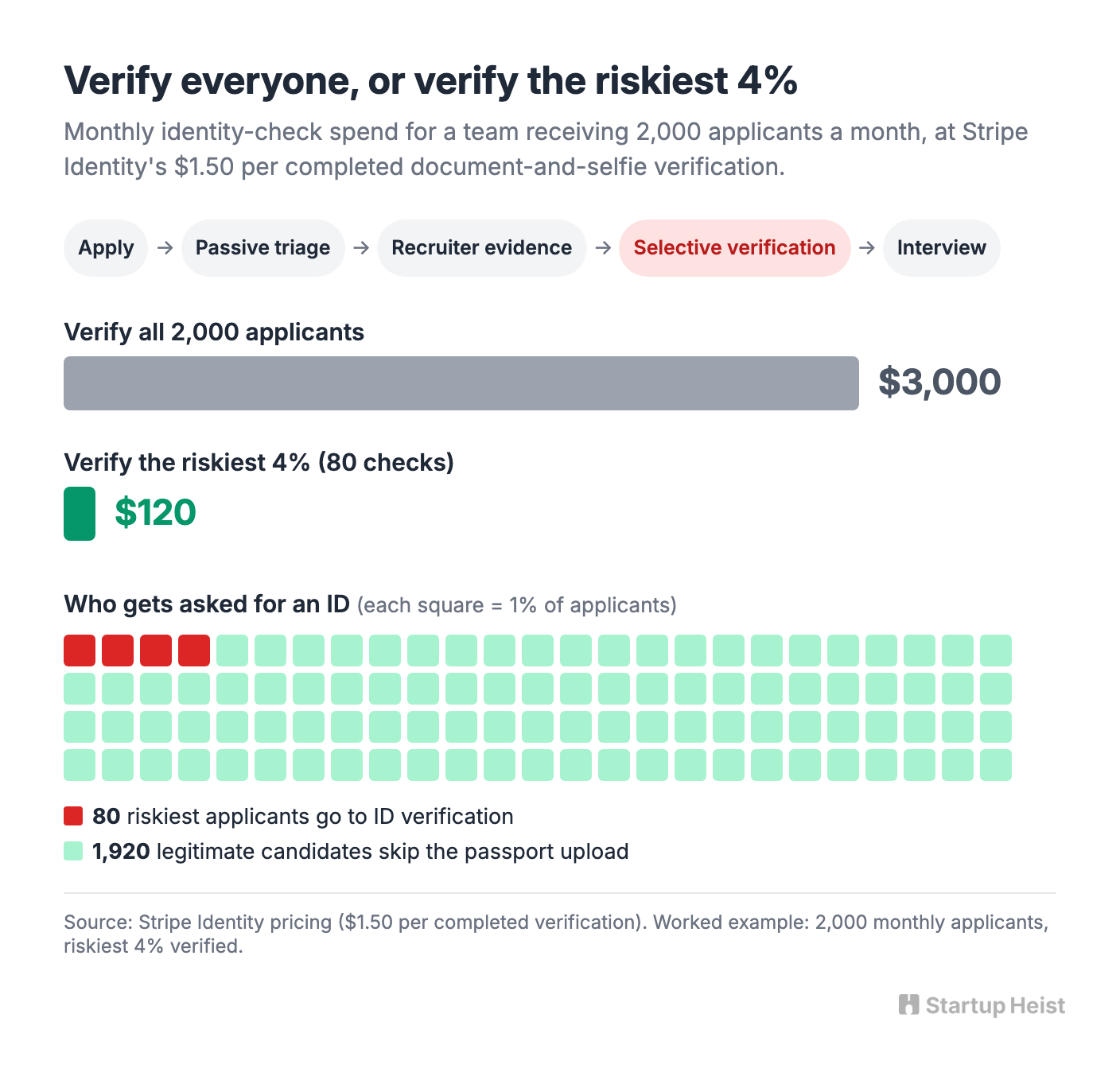
The workflow runs apply → passive triage → recruiter evidence → selective verification → interview, in place of forcing everyone through ID checks at the door. The economics of that ordering are the whole business. Stripe Identity charges $1.50 for a completed document-and-selfie verification. Verify all 2,000 monthly applicants and you spend $3,000 before anything else. Verify the riskiest 4% and you run 80 checks for $120, while sparing 1,920 legitimate candidates from uploading a passport photo because they clicked Apply. The incumbents are converging on the same principle, that friction should rise with risk, and a small team can ship it first to the customers they underserve.
Why Workable First
Unlock the Vault.
Join founders who spot opportunities ahead of the crowd. Actionable insights. Zero fluff.
“Intelligent, bold, minus the pretense.”
“Like discovering the cheat codes of the startup world.”
“SH is off-Broadway for founders — weird, sharp, and ahead of the curve.”


