


Chrome Just Turned Ad Bloat Into Sales Intelligence
The raw data is public. The business is knowing which publishers are worth calling before everyone else learns how to read it.
On September 15, 2026, Google made a new class of publisher intelligence public. Chrome added four experimental advertising metrics to the Chrome User Experience Report, better known as CrUX: how many ads users see, how much of the viewport those ads occupy, how many network bytes they consume, and how much CPU time ad frames burn. The numbers come from aggregated real Chrome sessions, the same field data behind Core Web Vitals, and anyone can query them for any eligible site, including sites they don't own.
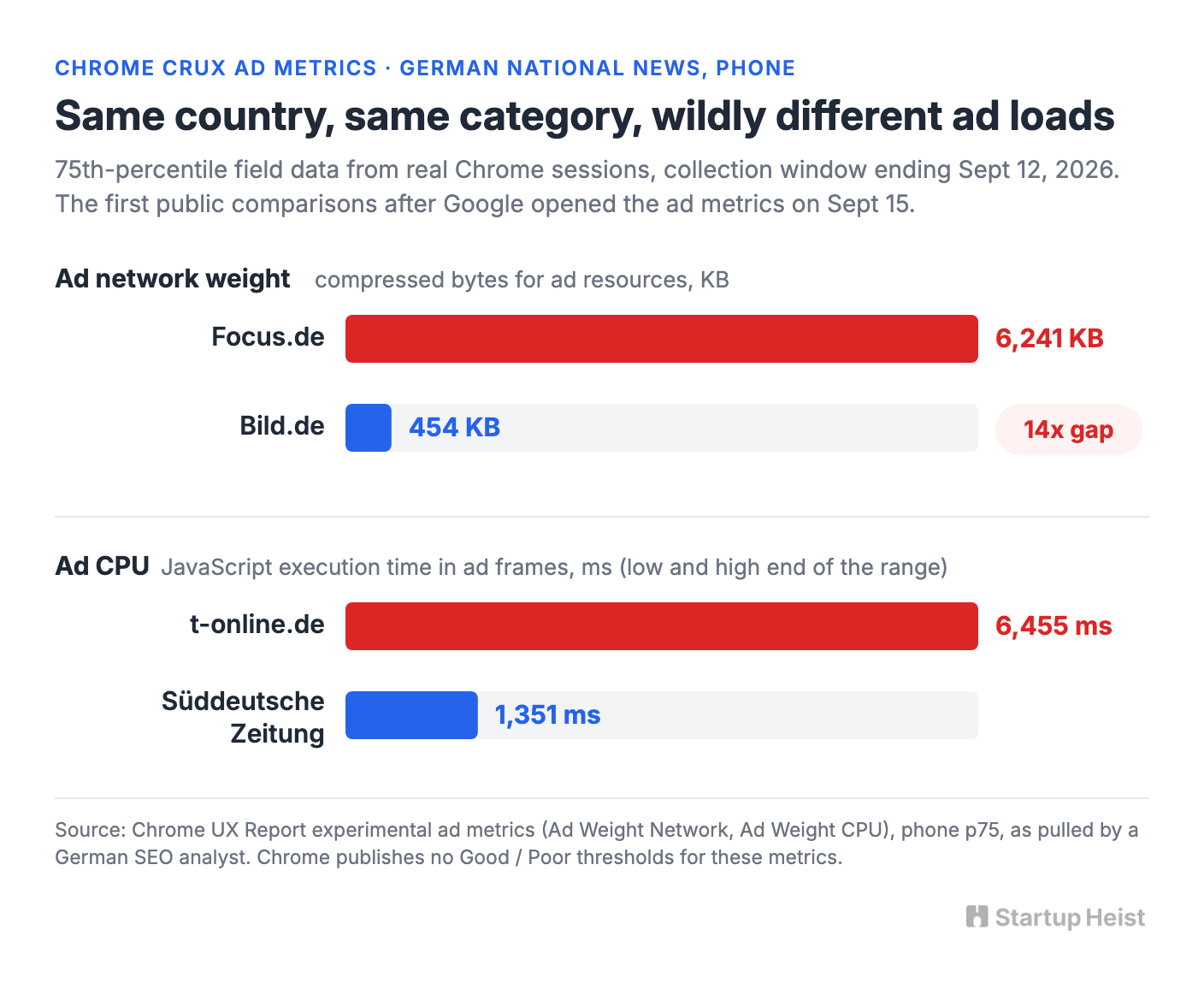
The first public comparisons show how uneven the landscape is. A German SEO analyst pulled the phone data for national news sites in the collection window ending September 12. At the 75th percentile, Focus.de loaded 6,241 KB of ad resources against 454 KB at Bild.de, a fourteen-fold gap between two news sites in the same country. Ad CPU ranged from 1,351 milliseconds at Süddeutsche Zeitung to 6,455 at t-online.de.
For the first time, an outsider can systematically ask which regional sports publisher runs ordinary ad density but unusually heavy ad CPU, which local-news group's ad weight has climbed for six straight weeks while its peers held flat, and which recipe sites look inefficient enough that an ad-ops firm should call them this week.
Google supplies the measurements and deliberately leaves the interpretation to someone else. The ad metrics carry no "Good," "Needs improvement," or "Poor" thresholds, and they sit outside Core Web Vitals entirely. Someone has to provide that judgment, and the best place to sell it is to the companies already paid to fix publisher monetization. Skip the website-performance dashboard and build them a prospecting service.
Call it AdTax Radar. Here's the opportunity:
The money: Six agency buyers at $1,000 to $2,500 a month puts you at $6K to $15K MRR, and BuiltWith already charges up to $995 a month for website prospecting signals.
Inside:
• Seven-step MVP built on the free CrUX API
• Pricing ladder from $1,500 pilot to exclusivity
• Cold email that sells before you build
• 30-day plan and the outcome-data moat
The Heist
AdTax Radar monitors thousands of trafficked, programmatically monetized publishers and flags anomalies in their real-world ad load. Its first customer is the Prebid consultant, managed monetization provider, publisher-performance agency, or fractional ad-ops operator who needs to know which publishers are worth contacting and why. The publishers themselves are the subject of the research.
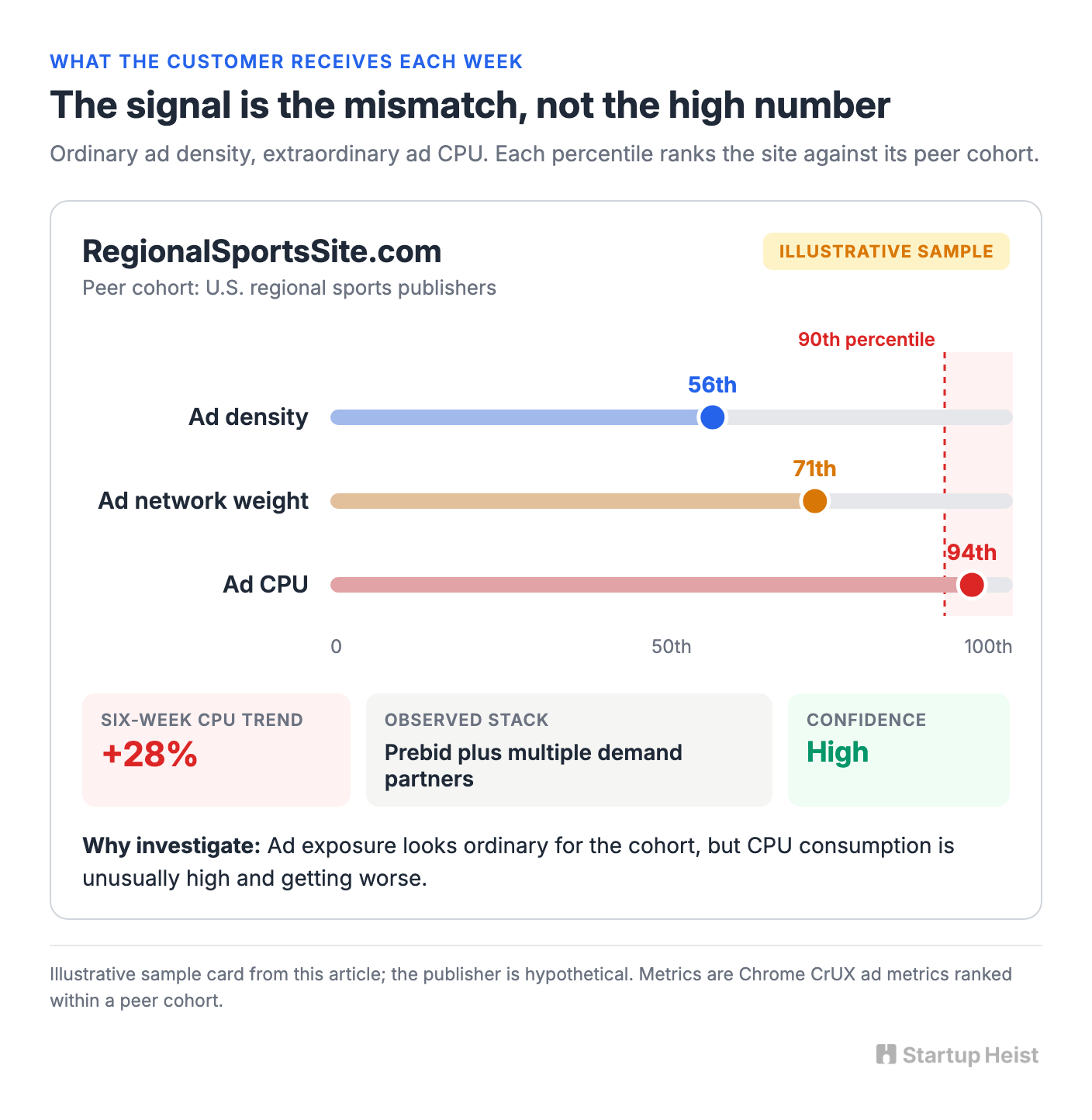
Every week, that customer receives a short list of accounts that have already been researched. A sample card:
RegionalSportsSite.com
- Peer cohort: U.S. regional sports publishers
- Ad density: 56th percentile
- Ad network weight: 71st percentile
- Ad CPU: 94th percentile
- Six-week CPU trend: +28%
- Observed stack: Prebid plus multiple demand partners
- Confidence: high
Why investigate: Ad exposure looks ordinary for the cohort, but CPU consumption is unusually high and getting worse.
Questions to ask: Was a new rich-media or video partner added? Did refresh cadence change? Which creatives or ad slots carry the heaviest frames on article templates? And since the metric can't see main-frame auction code, when did anyone last profile the Prebid wrapper itself?
An agency salesperson can act on that card in a way they can't act on another CSV of "websites that use Prebid." The strongest version of the product is white-labeled opportunity intelligence: a deterioration watchlist, human-verified accounts, one-page evidence packs, and CRM-ready leads. Underneath, it turns external operating telemetry into intent data.
Why This Exists Now
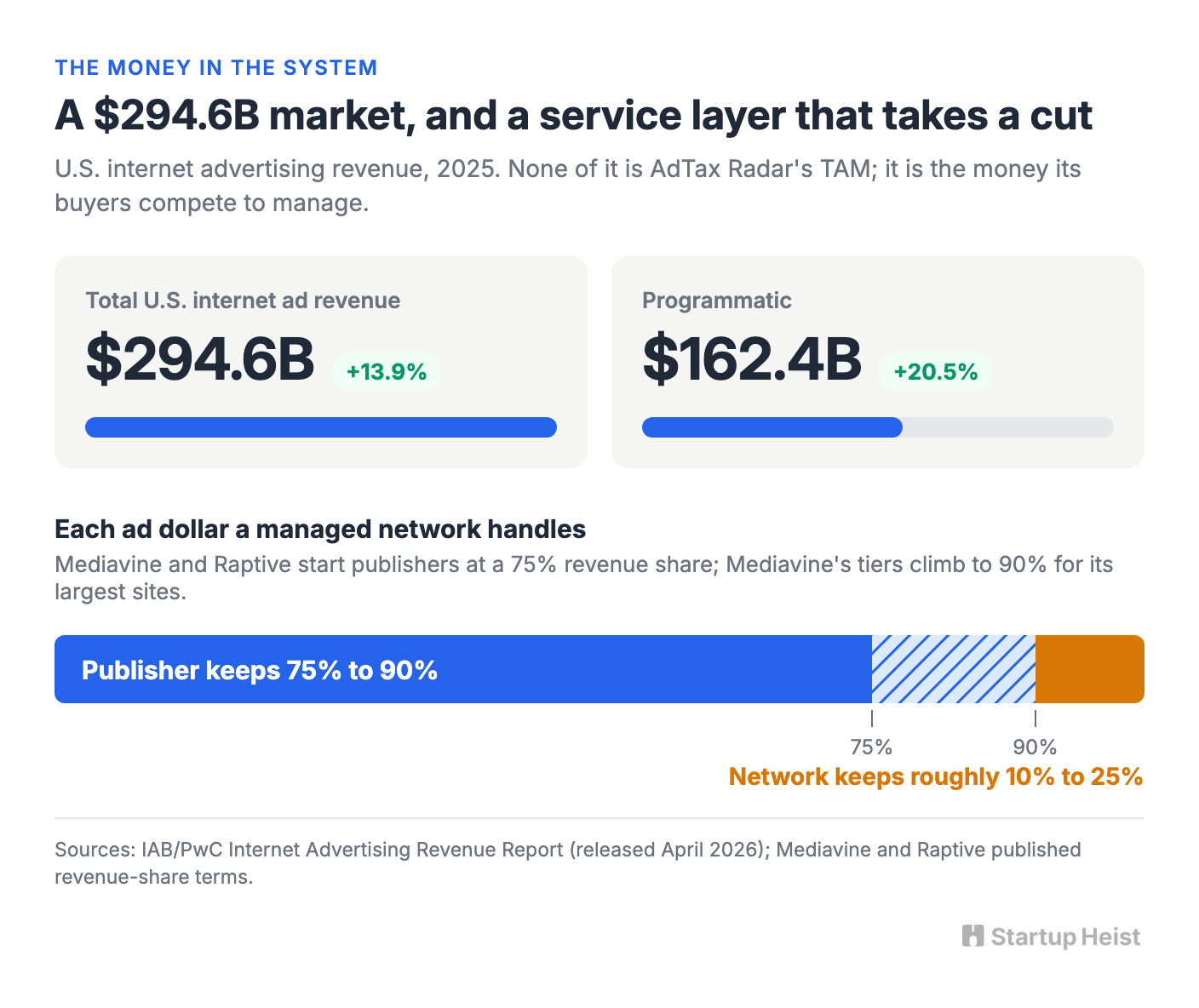
The money moving through this system is enormous, although none of it is AdTax Radar's TAM. U.S. internet advertising revenue reached $294.6 billion in 2025, up 13.9%, according to the IAB/PwC report released in April 2026. Programmatic alone hit $162.4 billion, up 20.5%. At that scale, small gains in yield, latency, viewability, header-bidding configuration, or refresh logic matter to publishers and to the vendors who serve them.
An entire service layer already exists to capture those gains. Prebid's own documentation tells publishers without engineering or ad-ops resources to hire a managed-service company, and Prebid.org lists providers from Magnite and Media.net to Playwire and Mile. Managed networks like Mediavine and Raptive start publishers at a 75% revenue share, and Mediavine's tiers climb to 90% for its largest sites, so a network keeps roughly 10% to 25% of every ad dollar it manages. These firms grow by winning publishers, often from each other, and their prospecting inputs are weak: this site uses Prebid, it has enough traffic, it runs these SSPs, it seems slow, it has a lot of ads.
The Chrome data is a sharper signal because it reports what real users experienced. Ad Count samples visible ads once per second and averages them per visit, and Ad Density measures the share of the viewport ads occupy. Ad Weight Network totals compressed bytes for ad resources, while Ad Weight CPU sums JavaScript execution time in ad frames. Chrome reports the 75th percentile, and the CrUX History API returns weekly snapshots of overlapping 28-day windows, 25 weeks by default and up to 40. As that history accumulates, it lets you separate a persistently strange publisher from one that is actively deteriorating. A rep who opens with "your site looks bad" is offering an opinion. A rep who opens with "Your ad CPU is unusually high relative to 43 similar regional publishers and has risen across recent collection periods" has a reason for the call.
The Real Product Is the Comparison
The four CrUX ad metrics were commoditized within days. RUMvision shipped a free side-by-side "Ad usage" comparison across any set of sites almost immediately, and Chrome's own CrUX Vis dashboard shows them for free. The Trade Desk's OpenSincera, launched in 2025, already scores more than 400,000 publishers on ads-to-content ratio, refresh rate, and page weight for buyers, free and with an API. Anyone selling access to the numbers is competing with free.
Unlock the Vault.
Join founders who spot opportunities ahead of the crowd. Actionable insights. Zero fluff.
“Intelligent, bold, minus the pretense.”
“Like discovering the cheat codes of the startup world.”
“SH is off-Broadway for founders — weird, sharp, and ahead of the curve.”


