


YouTube Is Building a Reaction Economy. Build the Permission Layer.
On July 24, 2023, the day LeMMiNO premiered his documentary "The Kennedy Assassination: Inside the Book Depository," xQc, one of the biggest streamers on the internet, played the whole thing for his audience and uploaded the reaction. The film runs one hour and 38 minutes, and he added almost nothing to it. Creators including SomeOrdinaryGamers and Ethan Klein of H3H3 publicly challenged him, and the backlash turned reaction videos into an argument about theft: a streamer monetizes months of someone else's work, and the person who made it finds out afterward.
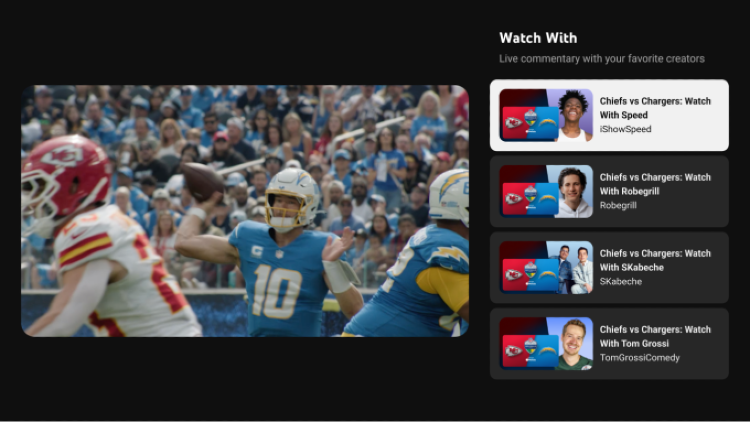
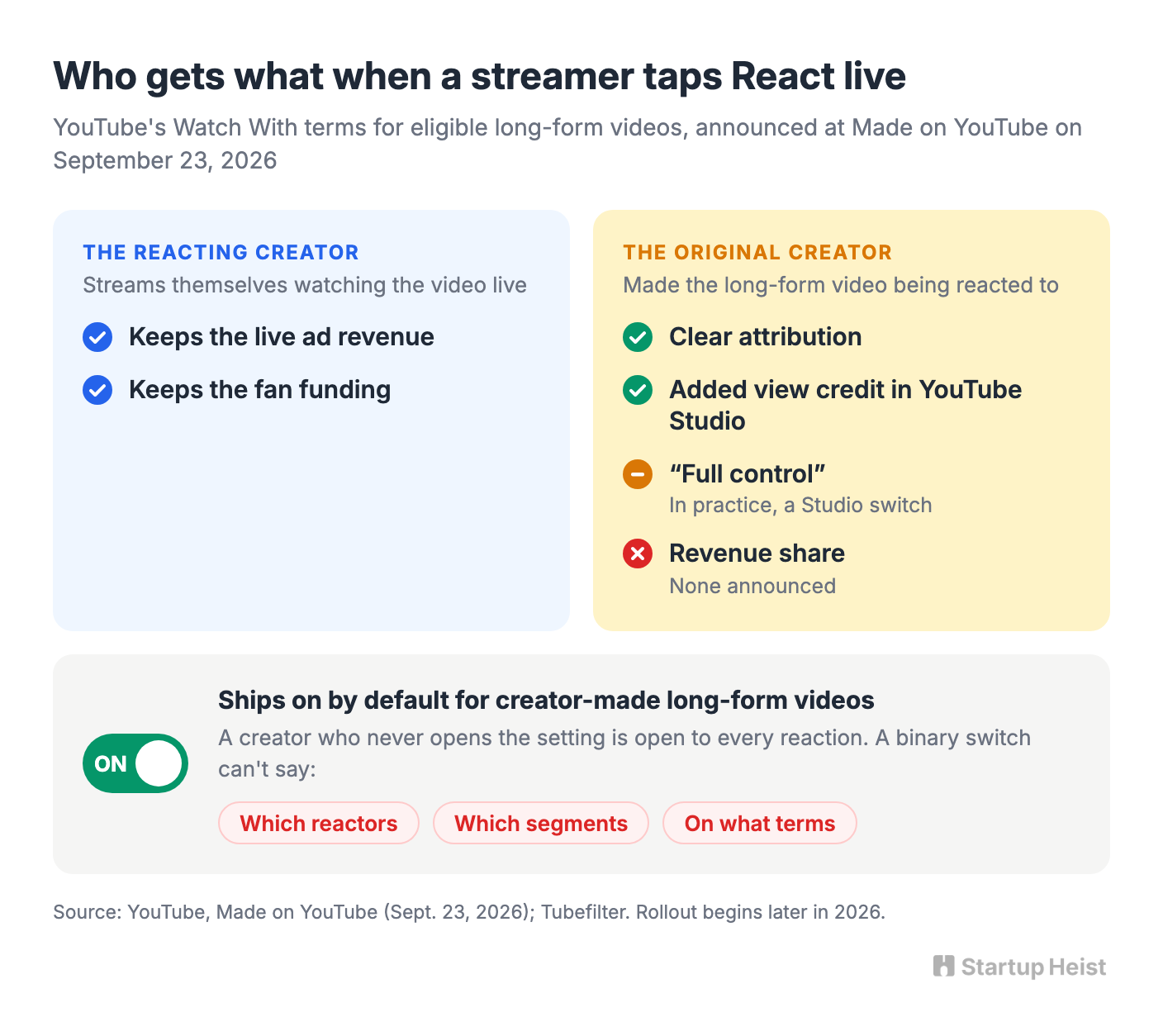
On September 23, 2026, at Made on YouTube, the company shipped its answer. Watch With, the co-streaming feature YouTube used to pair creators with NFL broadcasts in September 2025 and Coachella sets in April 2026, is expanding to eligible long-form videos. A streamer taps React live on an eligible video and broadcasts themselves watching it with their audience. The reacting creator keeps the live ad revenue and fan funding. The original creator gets clear attribution, added view credit in YouTube Studio, and what YouTube calls "full control" over which videos can be reacted to. The rollout begins later in 2026.
Look closely at the terms. YouTube hasn't announced any revenue share for the uploader, who gets a launch channel instead: somebody else's live audience, pointed at their work. That "full control" also turns out to be a Studio switch. Tubefilter reports that Watch With ships on by default for creator-made long-form videos, so a creator who never opens the setting is open to every reaction. A binary default amounts to blanket permission. It can't say which reactors, which segments or on what terms, and that gap between an on/off switch and affirmative, conditional consent is the startup.
Watch With moves reactions from "react first, sort out rights later" to "react unless the creator switches it off," and every new distribution channel eventually grows a services and software layer around it. The opening is a curated campaign desk that matches long-form creators with reactors who fit editorially, with guaranteed review, explicit terms, coordinated bookings, and proof of what happened after the stream. "SubmitHub for YouTube" undersells it. The closer model is a creator distribution desk for reaction campaigns.
Here's the opportunity:
The money: Twenty $499 Reaction Sprints a month brings in about $10,000, and fifty brings in about $25,000. SubmitHub shows creators already pay for curated access to scarce attention.
Inside:
• Full MVP scope and the Reaction Brief template
• Three-tier pricing from $149 to $1,250+
• Reactor and creator outreach scripts
• The consent-ledger moat and 90-day plan
The shift underneath the feature
YouTube says more than 600 million logged-in viewers watched live content, including archived streams, on an average day in August 2026. More than 40% of live watch time comes from viewers outside a creator's home country. Roughly 20 million new videos land on the platform every day.
Supply is effectively infinite, and live attention is finite. A history streamer with a four-hour Sunday show already has more links than she could watch in a year. What she lacks is six videos she trusts to carry tonight's conversation. The documentary maker on the other side wants rooms full of people who already care about his subject, because impressions from strangers do little for him.
Long-form creators hold the material, while streamers hold the live attention and the taste to program it. Watch With builds the pipe between them. Nobody has yet built the valve that decides what flows through it.
Why the obvious version fails
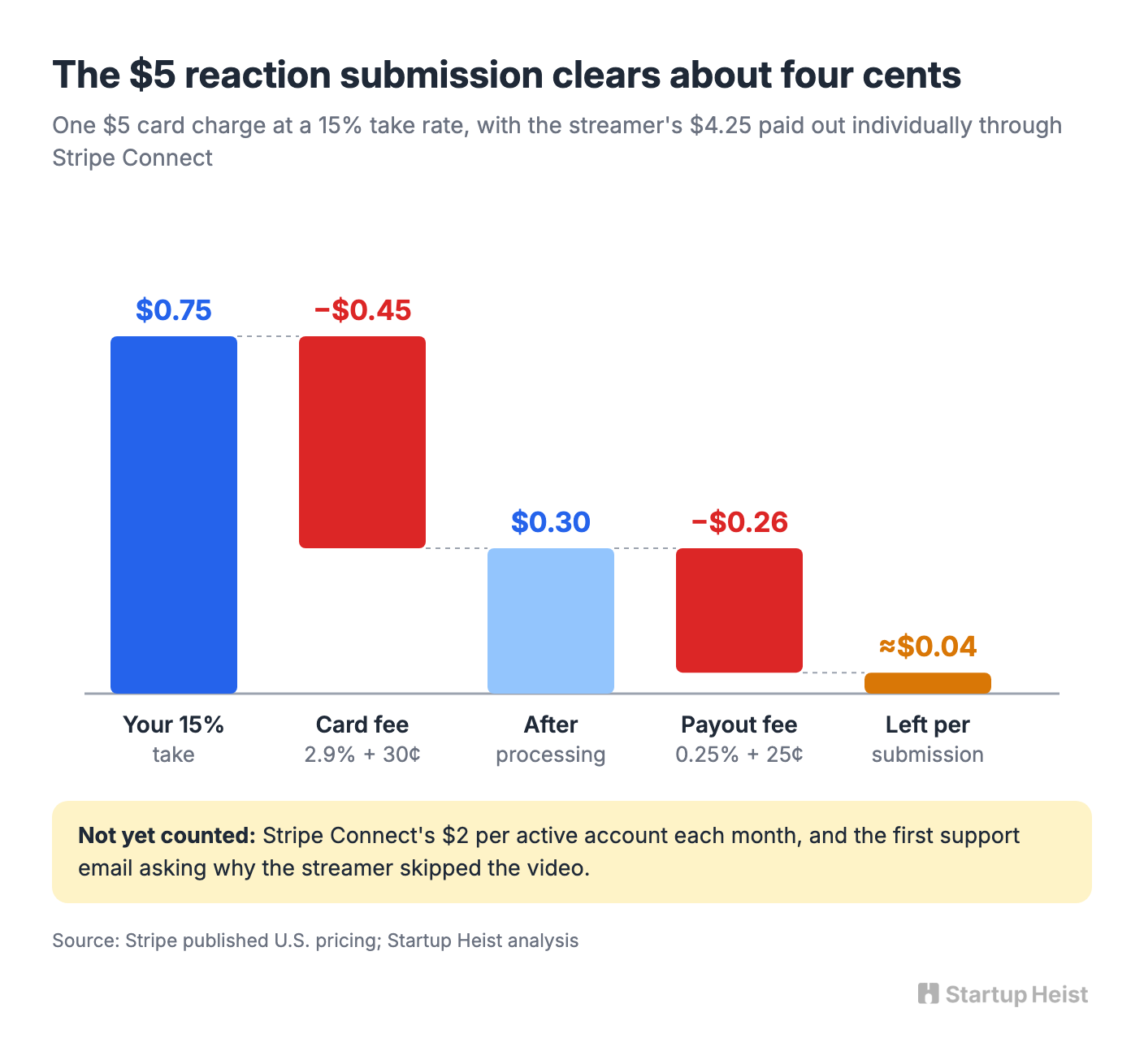
The first instinct is ReactQueue: upload a video, pay $5, a streamer watches it. Run it through Stripe's published U.S. pricing. A $5 card charge costs 2.9% plus 30 cents, about 45 cents. At a 15% take rate you keep 75 cents, so roughly 30 cents survive processing. Paying the streamer through Stripe Connect costs 0.25% plus 25 cents per payout and $2 per active account each month. Pay out each submission individually and you clear about four cents, before the first support email asking why the streamer skipped the video.
The demand side is worse. Established streamers are drowning in links. Discord servers, inboxes, comments and chat already supply more material than any human could watch, and a product that hands them one more inbox only adds to the pile. Whatever you build has to reduce the noise.
SubmitHub shows people will pay for structured access to scarce editorial attention: more than a million artists, publicists and labels have used it to reach its network of 1,700-plus quality-checked curators. A reaction is a heavier transaction than a playlist add. A reactor may spend 30 to 90 minutes live with one video, talking over it in public, in front of an audience with its own temperament, while the source video carries sponsor obligations and usage limits. Each reaction is closer to a miniature creator collaboration than a submission, so price it like one.
Sell the campaign
Tell customers plainly what their money buys: qualified consideration and campaign execution. Nothing you sell promises a positive reaction, guaranteed virality, or YouTube Partner Program watch hours.
A creator submits a video. You turn it into a reaction-ready brief, select the right reactors, handle outreach and permissions, coordinate any booked streams, and deliver a report afterward. The whole business runs on three labels. A decline is shown to the creator as a decline. Consideration means a reactor agreed to review the video. A booking means a reactor has contractually agreed to cover it on stream.
The biggest risk in a paid reaction marketplace is letting "pay for access" slide into "pay for praise." Once creators believe a fee buys favorable coverage, reactor credibility collapses and the marketplace goes with it. Make independence part of the product: the creator paid for the process, and the opinion was never for sale. Paid bookings also create a material connection under FTC endorsement rules, so the reactor discloses it on stream and checks YouTube's paid promotion box. Build that into the booking flow from day one.
Start with creators in the middle
Unlock the Vault.
Join founders who spot opportunities ahead of the crowd. Actionable insights. Zero fluff.
“Intelligent, bold, minus the pretense.”
“Like discovering the cheat codes of the startup world.”
“SH is off-Broadway for founders — weird, sharp, and ahead of the curve.”


