


The Chore Is the Cover: Build a Trash-Day Check-In Network for Aging Parents
The aging-in-place market has a wide gap between "Mom has an app" and "Mom needs a caregiver," and millions of families live inside it.
Their parent is still independent. She drives, cooks, pays her own bills and doesn't consider herself someone who needs care. She's also 78, the kids live two states away, dragging the cans to the curb has become a chore she quietly dreads, and every so often she forgets to answer her phone. The adult child doesn't need four hours of home care. They want somebody trustworthy who physically sees Mom once or twice a week and tells them everything looks normal.
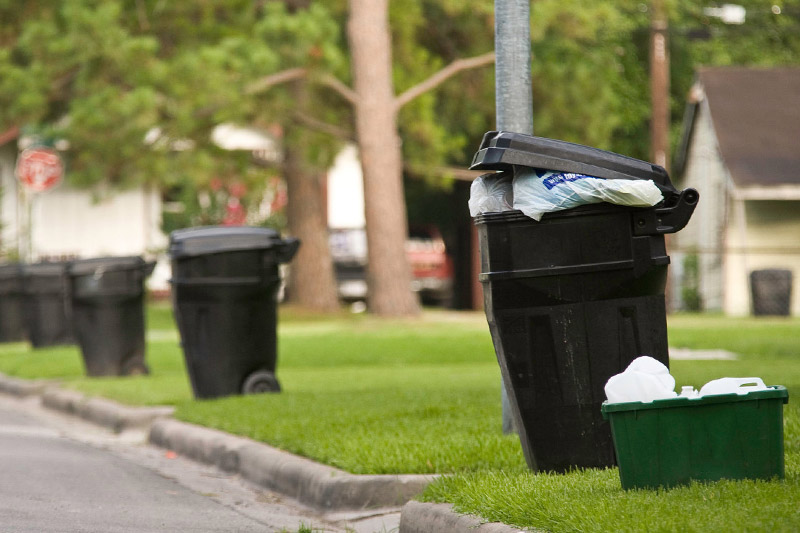
That's the opportunity behind Bin Day Hello, a hyperlocal service that handles a recurring household chore (starting with rolling trash bins out and back) and uses that routine to create a brief, consent-based human touchpoint. The resident gets help with something she'd rather not do, the family can receive a structured update, and when something breaks the routine, the operator follows a protocol agreed on in advance.
What the chore buys you is permission. A wellness check can feel infantilizing, and a camera feels invasive. A medical alert pendant makes an independent 74-year-old feel old. Someone showing up because it's trash day feels normal, and that difference is enough to build a real local business on.
Here's the opportunity:
The money: One 100-household community at $69 a month is $6,900 MRR; ten communities is $69,000. A San Diego bin valet already charges $30 a month for the chore alone.
Inside:
• Unit economics at 8, 10 and 12 stops per hour
• Pricing where the property pays for the chore
• MVP stack and three-level escalation protocol
• Eight-week launch plan and outreach scripts
The missing product between an app and a caregiver
In 2023, 16.2 million community-dwelling Americans age 65 and older lived alone, 28% of that population, according to the federal Administration for Community Living. Among women 75 and older, the share reaches 42%. AARP's 2024 Home and Community Preferences survey found that 75% of adults over 50 want to stay in their current homes as they age. The load lands on families: AARP and the National Alliance for Caregiving count 63 million family caregivers in 2025, up 45% from 2015, and seven in ten of them hold jobs.
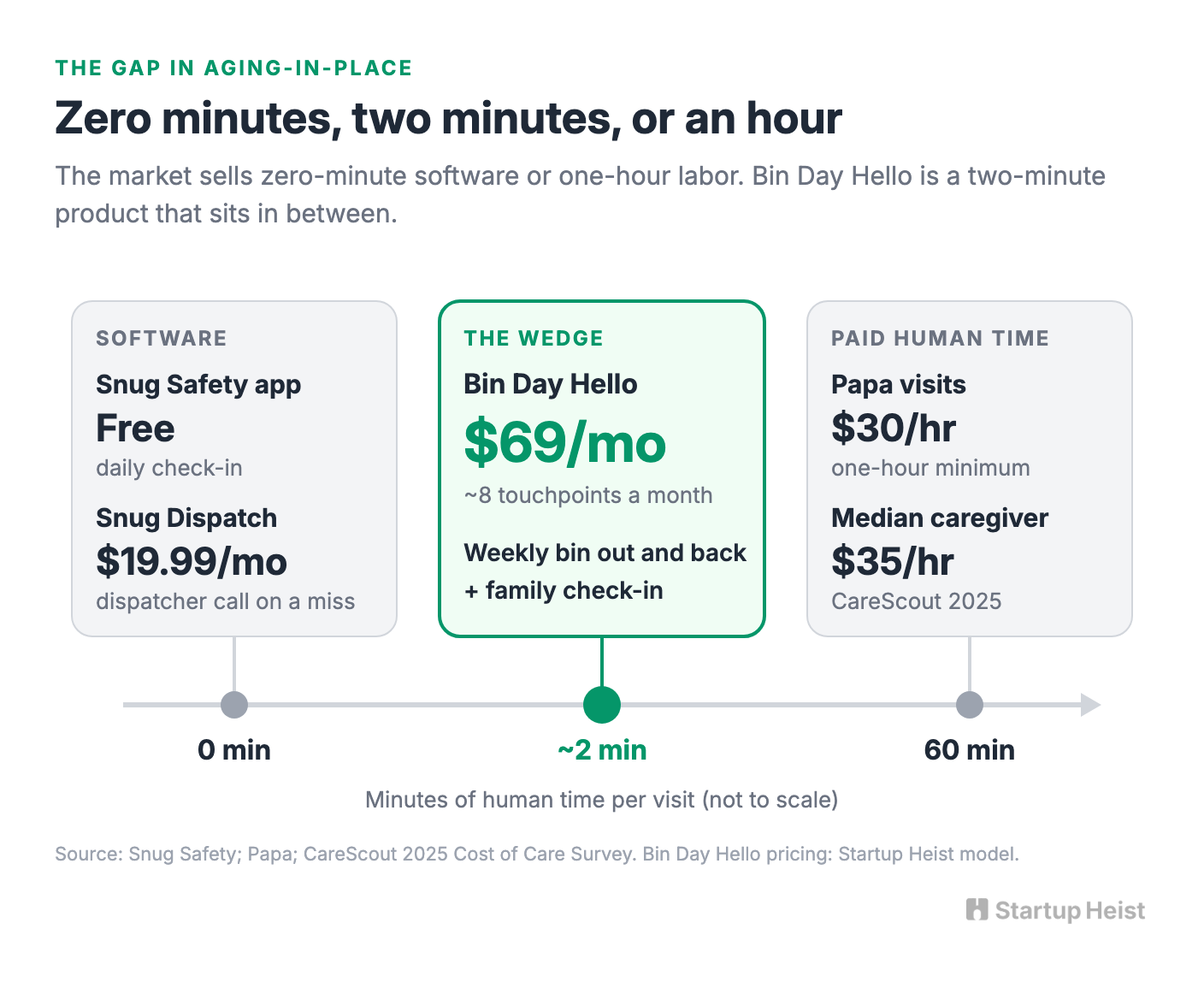
The existing options sit at opposite ends. Snug Safety handles reassurance digitally with a free daily check-in app, plus a $19.99-a-month Dispatch plan that adds a professional dispatcher call and wellness-check coordination when a check-in is missed. At the other end is paid human time. CareScout's 2025 Cost of Care survey put the national median for a non-medical caregiver at $35 an hour, and Papa, the venture-backed companion network, sells direct-to-consumer visits at $30 an hour with a one-hour minimum.
Bin Day Hello lives in between. It's a two-minute product in a market that sells zero-minute software or one-hour labor, and the whole business model sits in that gap.
The trick: sell the chore first
Selling "wellness checks" to independent older adults runs into an ugly problem, because the buyer and the user hear two different products. The daughter hears peace of mind. Her father hears that his daughter hired somebody to make sure he hasn't died.
The chore fixes the positioning. "Someone will bring your cans out Tuesday night and return them Wednesday afternoon" is concrete, useful and dignity-preserving. The resident is buying convenience and the family is buying continuity, while the operator gets a legitimate reason to appear at the same home, at roughly the same time, every week. Routine creates a baseline: the bin is usually back by noon, the resident usually waves from the kitchen window, the mail usually gets collected. None of that is a medical assessment, and the company must never pretend otherwise. What routine does is make exceptions visible.
Cities already hint at the demand. Many offer free backdoor trash collection to residents who can't get bins to the curb. Atlanta extends it to residents 70 and older who live alone and are physically unable to move their carts, and Hillsborough County, Florida, and Milwaukee run similar programs. Qualifying means meeting eligibility criteria that amount to proving you can't do it yourself, and your customer is the person who would never apply.
A narrow market, and a dense one
Sixteen million older Americans living alone doesn't mean 16 million customers. Many live in apartments where trash is handled centrally, many have family nearby, and some need far more help than a two-minute visit can responsibly provide. The real market sits at an intersection: independent older residents, a recurring exterior chore, enough density, resident consent, and a remote family or a property willing to pay.
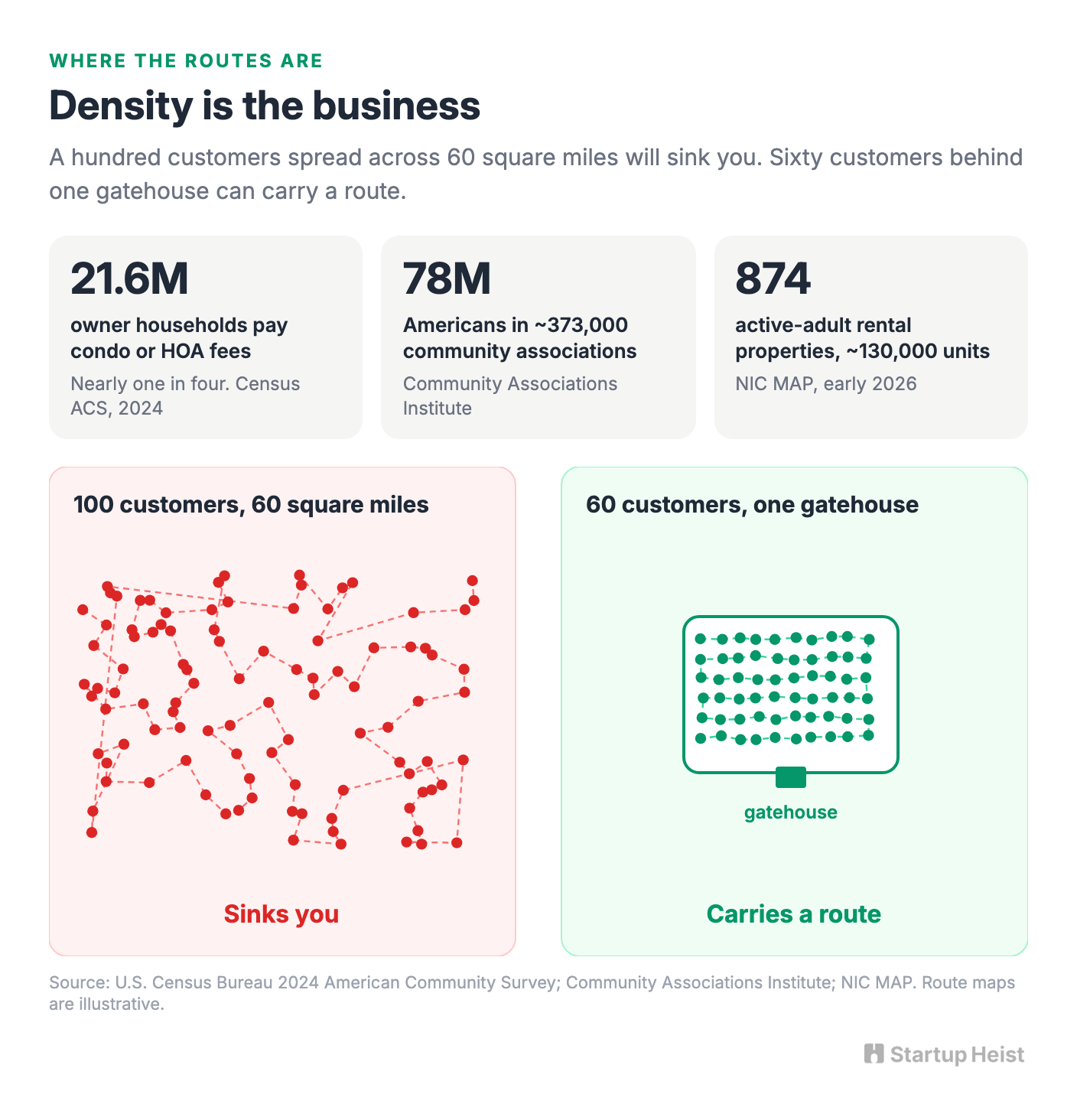
That intersection is still large. The Census Bureau's 2024 American Community Survey counted 21.6 million owner households paying condo or HOA fees, nearly one in four, with the highest shares in Arizona, Florida and Nevada. The Community Associations Institute estimates 78 million Americans live in roughly 373,000 community associations. NIC MAP tracked 874 active-adult rental properties with nearly 130,000 units as of early 2026, though these are multifamily rentals, many of them apartment-style buildings where trash may already be handled. That makes 55+ single-family HOAs and cottage communities the natural home for the bin wedge.
That matters because density is the business. A hundred customers spread across 60 square miles will sink you, while 60 customers behind one gatehouse can carry a route.
Three companies already proved the pieces
The obvious mistake is a marketplace: enter your ZIP code, we'll find someone nearby to check on Mom. That stacks fragmented customers, fragmented workers, irregular demand and expensive acquisition on top of high trust requirements. The pieces of the better model already exist in three places. Valet Living turned an unglamorous chore into a property-level amenity sold to apartment owners, and says it now performs more than 460 million service events a year across 1.8 million apartment homes in 40 states, a scale that comes from workers hitting many doors inside one property on a fixed schedule. In France, La Poste launched "Veiller sur mes parents" (Watch Over My Parents) in 2017: families pay, and the mail carrier who already walks the route stops in one to six times a week, then messages relatives afterward. The standard price runs from €39.90 a month for one weekly visit to €139.90 for six.
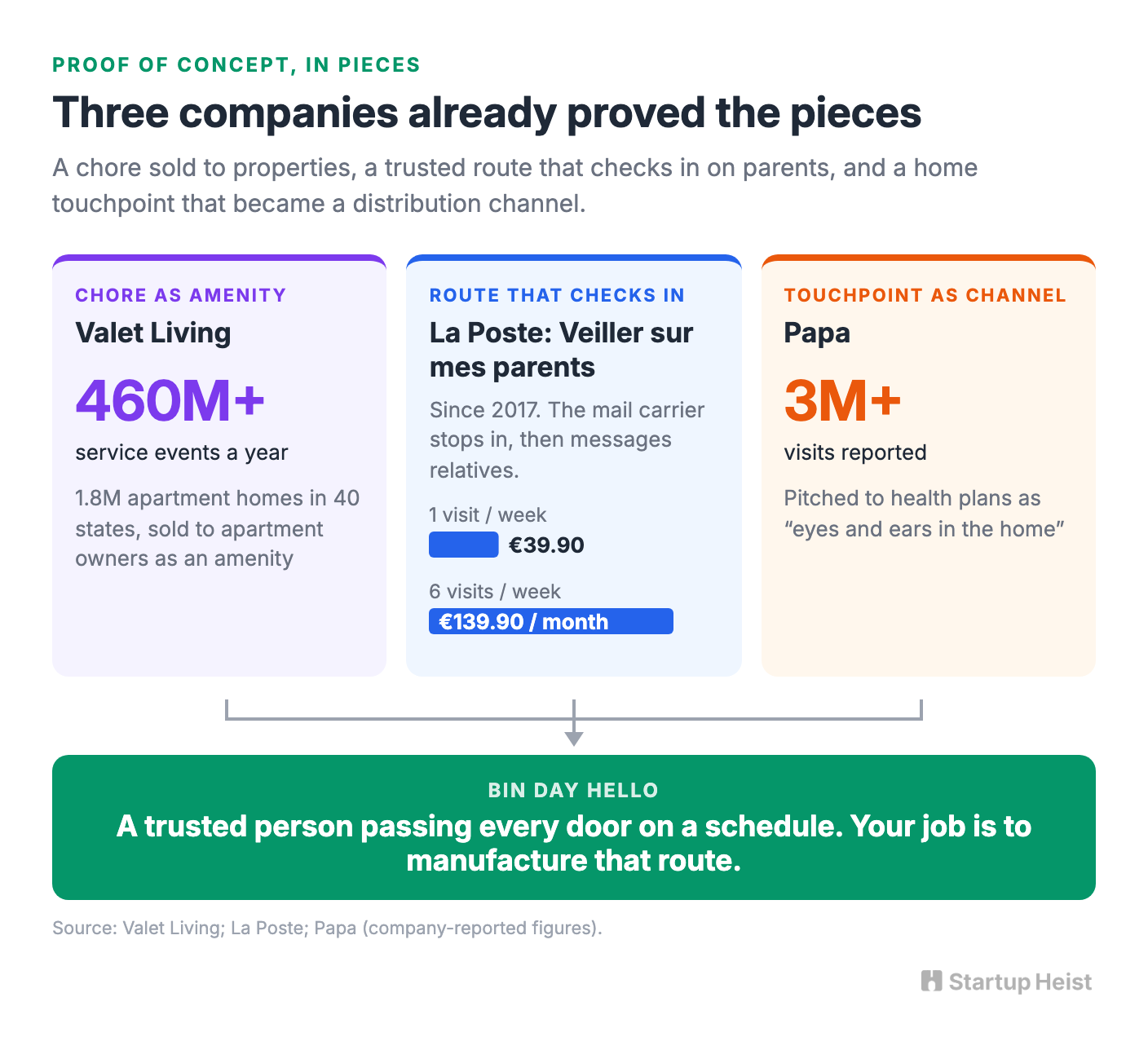
Papa shows where the model can end up. It reports more than 3 million visits and pitches its "Papa Pals" to health plans as "eyes and ears in the home" who report needs and risks after visits. A reliable human touchpoint in someone's home is itself a distribution channel. Papa's visits happen because someone booked time, whereas yours happen because Tuesday comes every week, and that predictability produces very different route economics. La Poste had what a startup lacks, a trusted person already passing every door on a schedule. Your job is to manufacture that route.
The unit economics are brutal until density rescues them
Price the service at $69 per household per month. Bins go out once a week and come back once a week, roughly eight touchpoints a month. That's $8.63 of revenue per stop.
Unlock the Vault.
Join founders who spot opportunities ahead of the crowd. Actionable insights. Zero fluff.
“Intelligent, bold, minus the pretense.”
“Like discovering the cheat codes of the startup world.”
“SH is off-Broadway for founders — weird, sharp, and ahead of the curve.”


