


The Exception Desk: The Dental AI Business Hiding Between APIs and Payer Portals
Skip the autonomous AI biller. Build the machine that does the ugly insurance work around the biller, and knows when to stop.
Some of the best software opportunities turn up wherever expensive people sit stuck between two pieces of software. Dental insurance is full of them.
A patient is booked for tomorrow at 9 a.m. Someone at the front desk has to confirm the coverage is active, then find the deductible, the annual maximum, what's been used, the coverage percentages for preventive, basic and major work, and the frequency limits on cleanings and X-rays, and type it all into the practice-management system. Some of it arrives electronically, some sits three screens deep in a payer portal, and some contradicts what the electronic response said. The login expired overnight, or the portal moved a button. Multiply that by every insured patient on the schedule, every day.
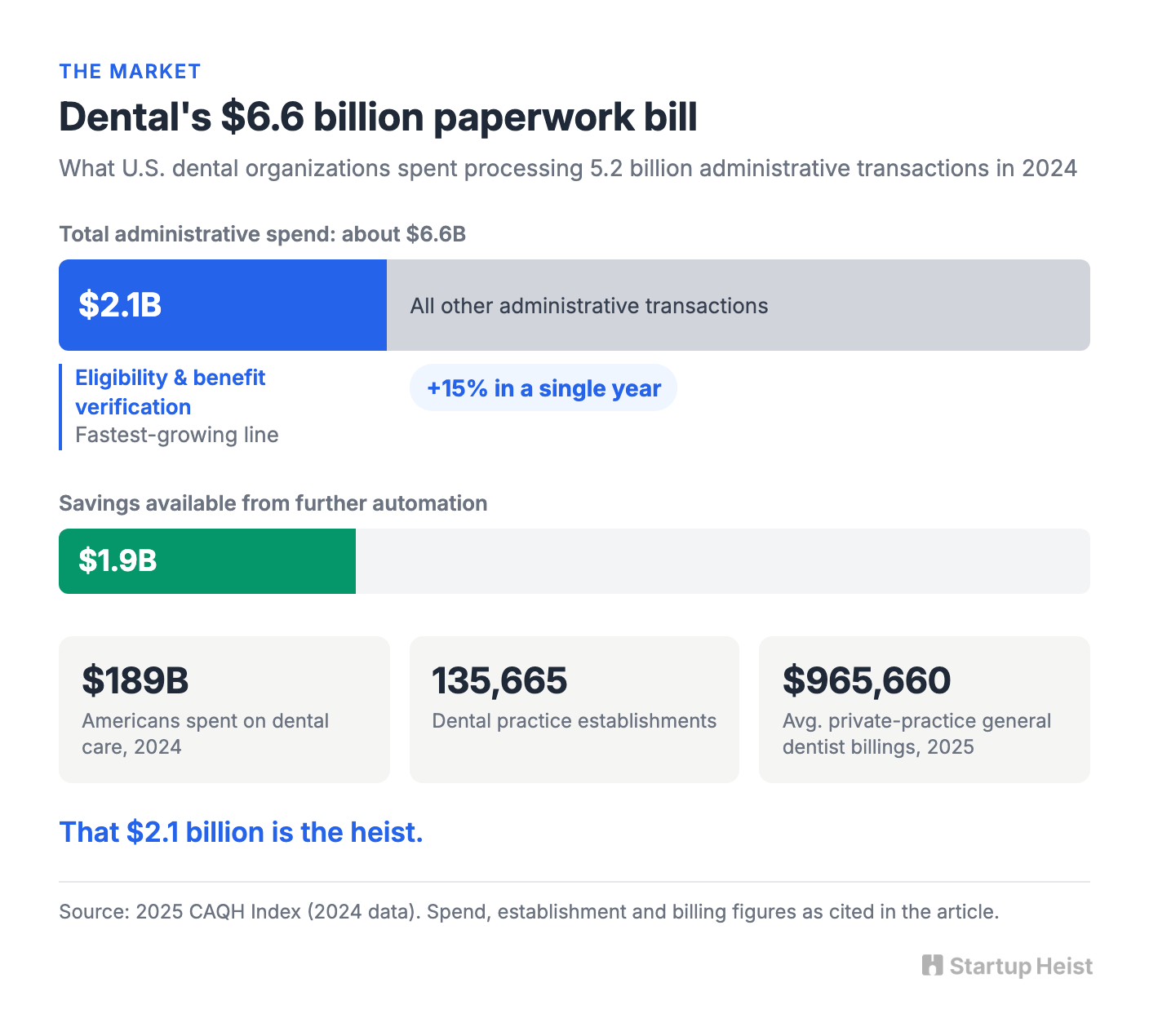
The money behind this chore is large. Americans spent $189 billion on dental care in 2024, spread across 135,665 dental practice establishments, and the average general dentist in private practice billed $965,660 in 2025. The 2025 CAQH Index, which tracks administrative costs across U.S. healthcare, found dental organizations spent about $6.6 billion processing 5.2 billion administrative transactions in 2024, with $1.9 billion in savings available from further automation. The fastest-growing line was dental eligibility and benefit verification, up 15% in a single year to $2.1 billion.
That $2.1 billion is the heist. The product that goes after it does the payer-portal grind overnight, keeps the evidence for every number, and puts anything consequential in front of a human before it touches the patient record. Everything in the design follows from that last part.
The money: 100 Open Dental locations at $399 a month is $39,900 MRR. A third of private-practice dentists already plan to use AI for insurance verification.
Inside:
• A 12-week build from shadow mode to write-back
• Pricing tiers from $199 pilots to $599 desks
• Cold email and a 12-minute demo script
• Kill criteria that catch the BPO trap
Why the Timing Works
Dental practices are caught in what the American Dental Association's Health Policy Institute calls a "fiscal squeeze." Over the past five years, prices for equipment and supplies and wages for dental staff rose 23%, while reimbursement averaged across all payers rose 19%. Through the first half of 2026, staff wages kept outpacing inflation while reimbursement kept lagging it. With labor costs running ahead of revenue, an office manager who watches ten staff hours a week disappear into insurance portals starts looking for relief.
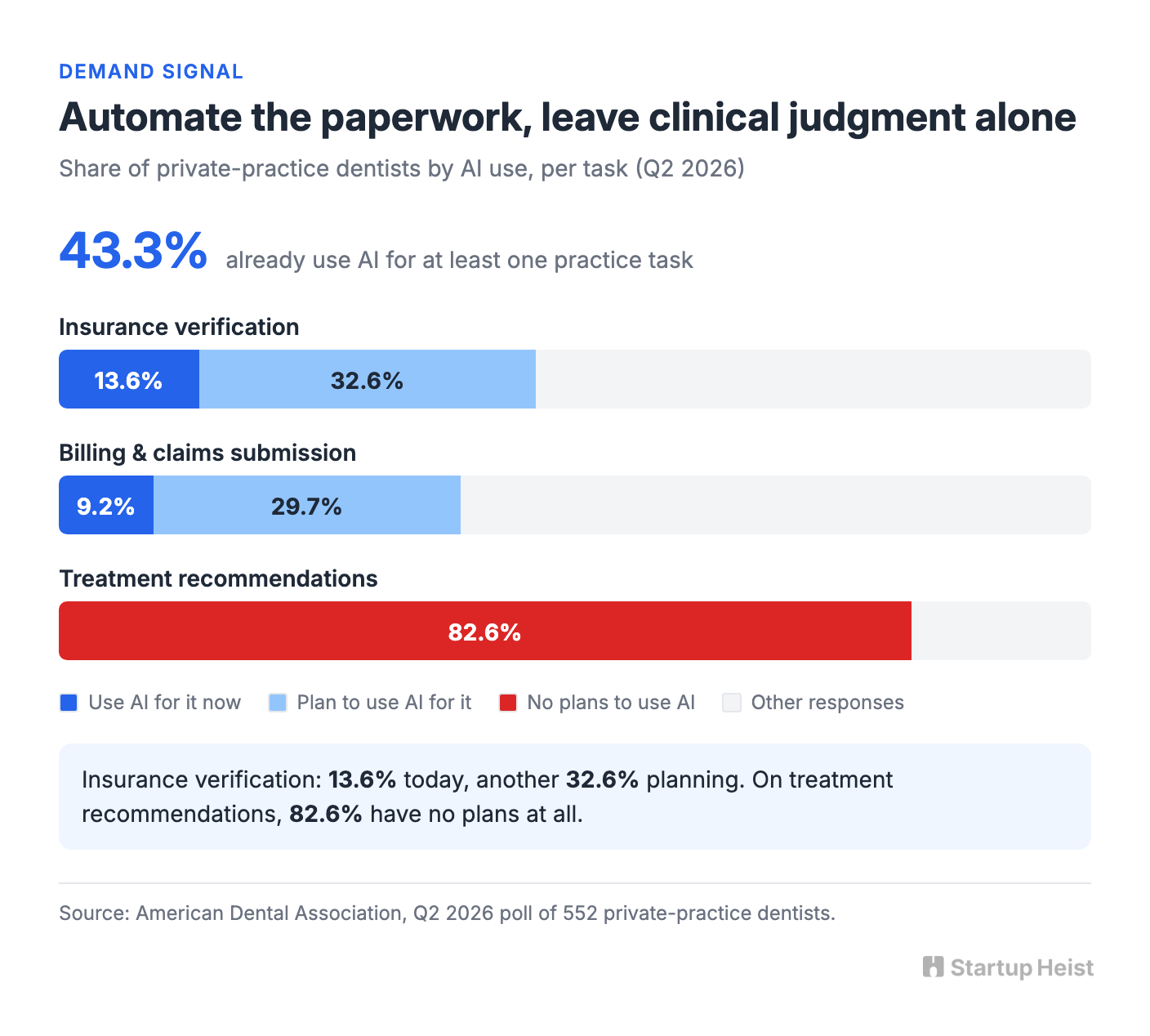
Dentists have already said where they want that relief. In the ADA's Q2 2026 poll of 552 private-practice dentists, 43.3% use AI for at least one practice task. Only 13.6% use it for insurance verification today, but another 32.6% plan to. Billing and claims submission shows the same shape: 9.2% now, 29.7% planning. On treatment recommendations, 82.6% said they have no plans to use AI at all. Put those numbers together and you have something close to a product spec: automate the paperwork and leave clinical judgment alone.
Office managers point the same way. In a 2025 survey by the National Association of Dental Plans and the American Association of Dental Office Management, which drew just under 400 responses and over 80% of them from single-location practices, respondents ranked benefit verification, treatment preauthorization and claims processing as the improvements that would matter most. About half said they frequently or almost always ran into problems with insurer customer service.
Browsers are also becoming infrastructure. Keeping browser automations alive has always been the hard part of this business: a payer moves a button, adds a modal or changes its login flow, a selector breaks, and twenty offices wake up with no verification data. That maintenance tax killed a lot of "we'll just automate the website" startups. Airtop's Agent Builder now turns browser workflows into reusable automations, and when a run fails, it diagnoses the failure, drafts a fix and tests it. The repair stays a draft until a human deploys or discards it, and Airtop never changes a live agent on its own, which is exactly the split healthcare administration needs between automated repair and human release. Paid plans start at $29 a month, with tiers at $189 and $558, and your true cost per practice will run higher once you add browser usage, retries, monitoring and support.
The Trap Is the "AI Biller"
The obvious pitch writes itself: hand the AI your payer logins and it verifies everyone, fixes denials, submits claims, posts payments and repairs itself when websites change. Resist building it. "Dental billing" is a bundle of jobs with different failure modes, including eligibility, coding, claim creation, attachments, denials, appeals, remittances, payment posting, secondary claims and aging receivables. A mistake in any one of them turns into a wrong patient estimate, a mangled claim or a reconciliation problem that surfaces weeks later.
The funded competition is real, too. Zuub raised a $9 million Series A in 2024 for insurance automation it says serves thousands of providers, and it cites practices spending roughly 40 hours a week on manual verification. Overjet, better known for imaging AI, now sells insurance verification connected to more than 1,000 payers and says it cuts the time customers spend on it by over 60%. Their traction confirms the pain. It should also talk you out of launching generic "AI insurance verification for dentists," because broad verification is turning into a feature inside platforms that already have sales teams. What's still open is a narrow, trustworthy wedge into a single software ecosystem.
The Product: Tomorrow Morning's Exception Queue
Start with practices on Open Dental and one daily job. Every evening, the software pulls tomorrow's appointments, decides which insured patients need verification, and retrieves benefits from the cleanest source available, in a fixed order: API or structured transaction first, browser second, human last. HIPAA already mandates a standard electronic eligibility transaction, the X12 270/271, yet in 2023 only 82% of dental eligibility transactions ran fully electronically, against 96% in medicine. Frequency limits, history and plan quirks often live only in the portal, which is why even Overjet blends direct payer connections with portal retrieval. Your product lives in that gap.
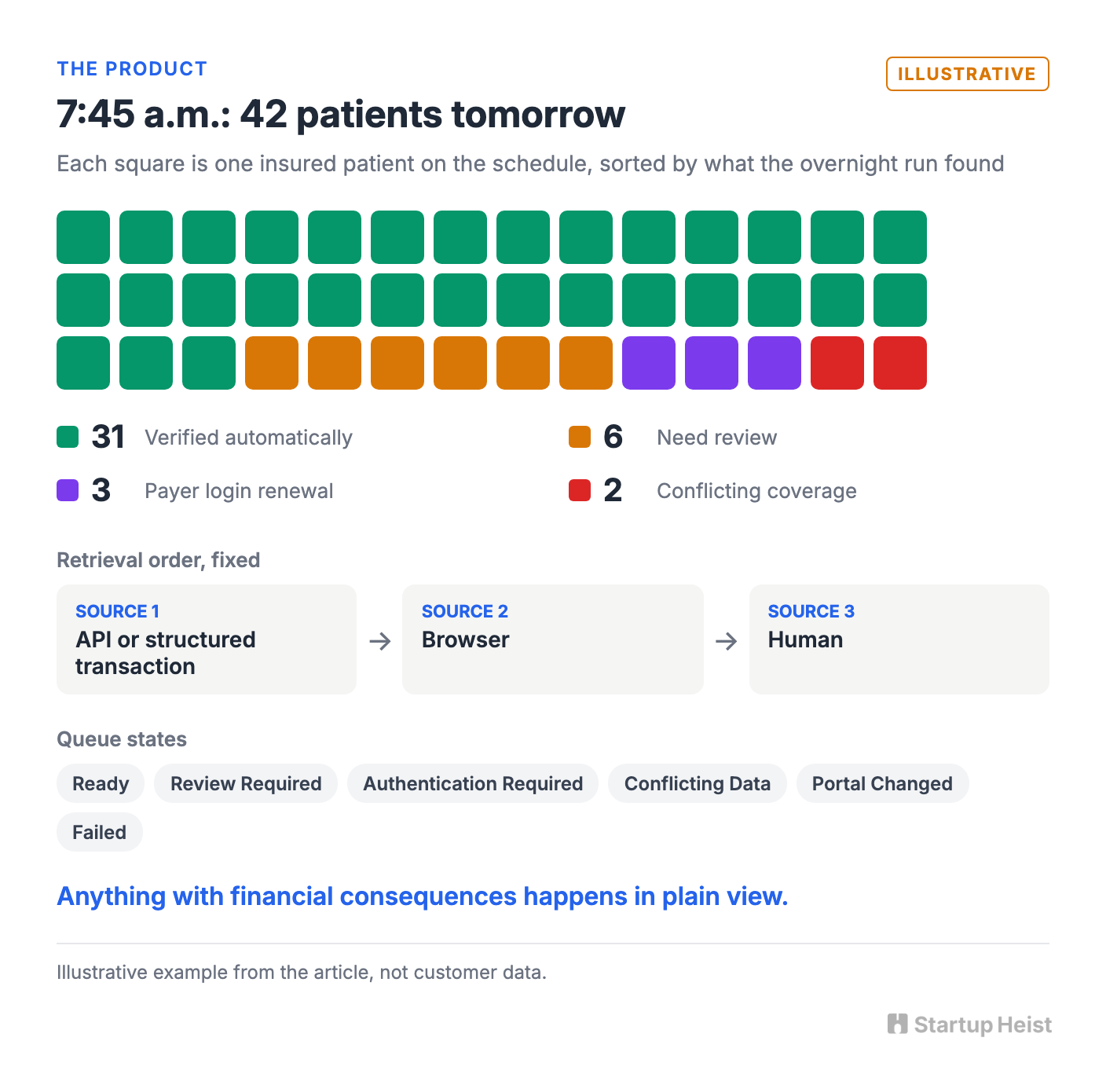
The office manager walks in at 7:45 a.m. to a screen that reads: 42 patients tomorrow, 31 verified automatically, 6 need review, 3 need a payer login renewed, 2 show conflicting coverage. Clicking any review item shows the patient, the payer, each retrieved value, where it came from and when, a screenshot or raw response, why the system flagged it, and the proposed update, with Approve, Edit and Reject buttons. Anything with financial consequences happens in plain view.
You won't find a chat box asking what your AI dental assistant should do today. The interface is a queue, with states like Ready, Review Required, Authentication Required, Conflicting Data, Portal Changed and Failed. Good operational software is designed around what the human no longer has to look at. If 40 checks come in and 33 are routine, your job is to make those 33 disappear and hand over the other seven already organized. Buyers keep paying for software built that way long after the novelty of an AI demo wears off.
Why Open Dental Is the Beachhead
You'll be tempted to support Dentrix, Eaglesoft, Curve and Denticon on day one. Don't. Open Dental gives a small team something rare in dental software: a documented, cheap API.
Unlock the Vault.
Join founders who spot opportunities ahead of the crowd. Actionable insights. Zero fluff.
“Intelligent, bold, minus the pretense.”
“Like discovering the cheat codes of the startup world.”
“SH is off-Broadway for founders — weird, sharp, and ahead of the curve.”


