


The AI Intake Desk for Web Agencies
A project inquiry lands at 7:14 p.m. on a Tuesday. The prospect runs a Shopify store that is buckling under international expansion. They want a migration, they have roughly $25,000 to spend, and they want to launch in eight weeks. The agency owner is at dinner. By 9:30, the prospect has filled out two more agency contact forms. By 10 the next morning, a competitor has already held the discovery call.
Web agencies lose leads like this every week, and the fix is a business you can build: an AI intake layer for web design and development agencies. It responds within seconds to prospects who asked to be contacted, runs a short project-fit conversation, captures the details an agency owner actually needs, separates real projects from tire-kickers, and books qualified prospects straight onto the calendar.
The voice technology underneath is cheap and getting cheaper. The value sits in knowing which questions to ask about a Shopify migration versus a Webflow redesign, which leads deserve an owner's scarce hour, and what should happen to everyone else. You can build a company on that judgment layer, while the phone call itself is plumbing anyone can buy.
Here's what that company looks like:
The money: 100 agencies at an average $399 a month is roughly $40K MRR; 250 is about $100K. One recovered $20K project covers a customer's fees for four-plus years.
Inside:
• Vertical intake flows and four-lane routing
• 10-part MVP, stack and per-call costs
• Pricing built to dodge the $99 trap
• Audit-first outreach and TCPA-safe design
The Phone Is Becoming Plumbing
Voice AI can now hold a real conversation. Overheard, a Y Combinator-backed startup, uses AI voice calls to interview a company's users with open-ended questions and follow-ups, then synthesizes the findings with every insight tied to a quote. Interviewing is harder than booking an appointment, because the agent has to interpret vague answers and decide what to ask next. An AI that can run a product-research interview can handle a fifteen-question agency intake.
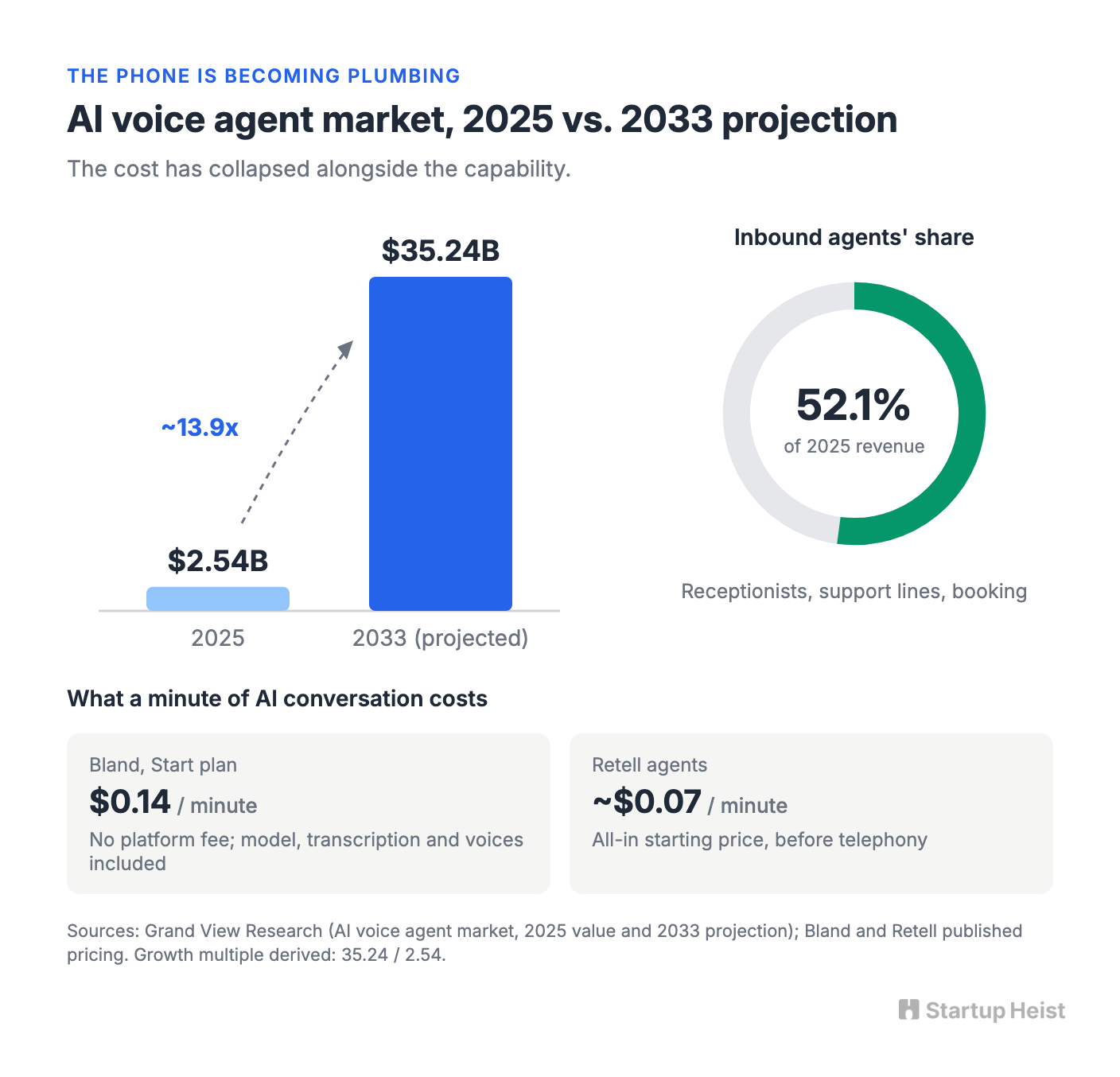
The cost has collapsed alongside the capability. Bland's Start plan charges $0.14 a minute with no platform fee, covering the language model, real-time transcription and voices. Retell's agents start around $0.07 a minute all-in, before telephony. Calendly publishes a developer guide for AI agents that check availability, propose times and create the booking directly through its Scheduling API, with no redirect to a booking page. Grand View Research values the AI voice agent market at $2.54 billion in 2025 and projects $35.24 billion by 2033, with inbound agents (receptionists, support lines, booking) already taking 52.1% of 2025 revenue.
Those numbers are a reason to stay off the infrastructure layer. Well-funded platforms are racing each other down on per-minute pricing, and anything you build at that level they will ship next quarter. The money sits one level up, where the conversation meets a specific industry's buying process.
Generic Receptionists Can't Screen an Agency Lead
When a prospect contacts a good web agency, the owner needs far more than a name and a callback number. Before committing 30 to 60 minutes to a discovery call, they want to know:
- What the prospect is building (a redesign, migration, ecommerce store, SaaS app, branding or a retainer), and which platform they're leaving
- Which integrations have to survive the move, and what's driving the launch date
- Whether the budget is $3,000, $30,000, $300,000 or unset
- Who signs off, and whether they want an agency at all or are collecting three quotes because a boss asked
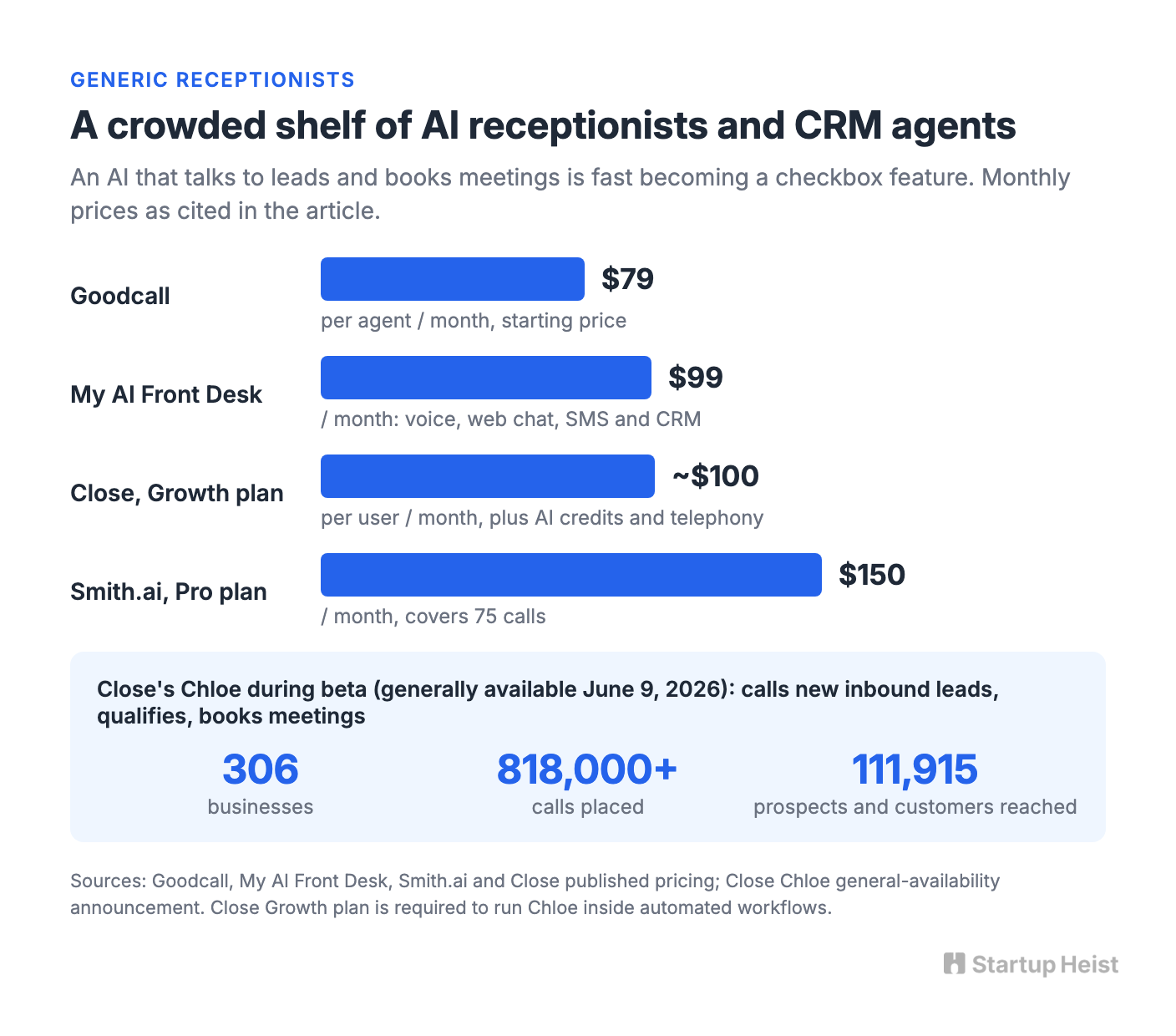
Generic AI receptionists handle the first line of that list poorly and the rest not at all, and the category is already crowded. Smith.ai sells an AI receptionist that answers, summarizes, qualifies, routes and books for $150 a month on its Pro plan, which covers 75 calls. Goodcall starts at $79 per agent per month. My AI Front Desk bundles voice, web chat, SMS and a CRM for $99 a month.
CRMs are absorbing what's left. On June 9, 2026, Close made Chloe generally available: an AI agent that calls new inbound leads within minutes, runs qualification conversations, books meetings and logs everything to the CRM. During beta, 306 businesses used Chloe to place more than 818,000 calls, reaching 111,915 prospects and customers. Running Chloe inside automated workflows requires Close's Growth plan, at roughly $100 per user per month, and every call also draws on AI credits and telephony usage. An AI that talks to leads and books meetings is fast becoming a checkbox feature, yet few products target the harder problem: knowing how a Shopify agency decides which migration leads are worth the owner's evening.
Sell Recovered Projects
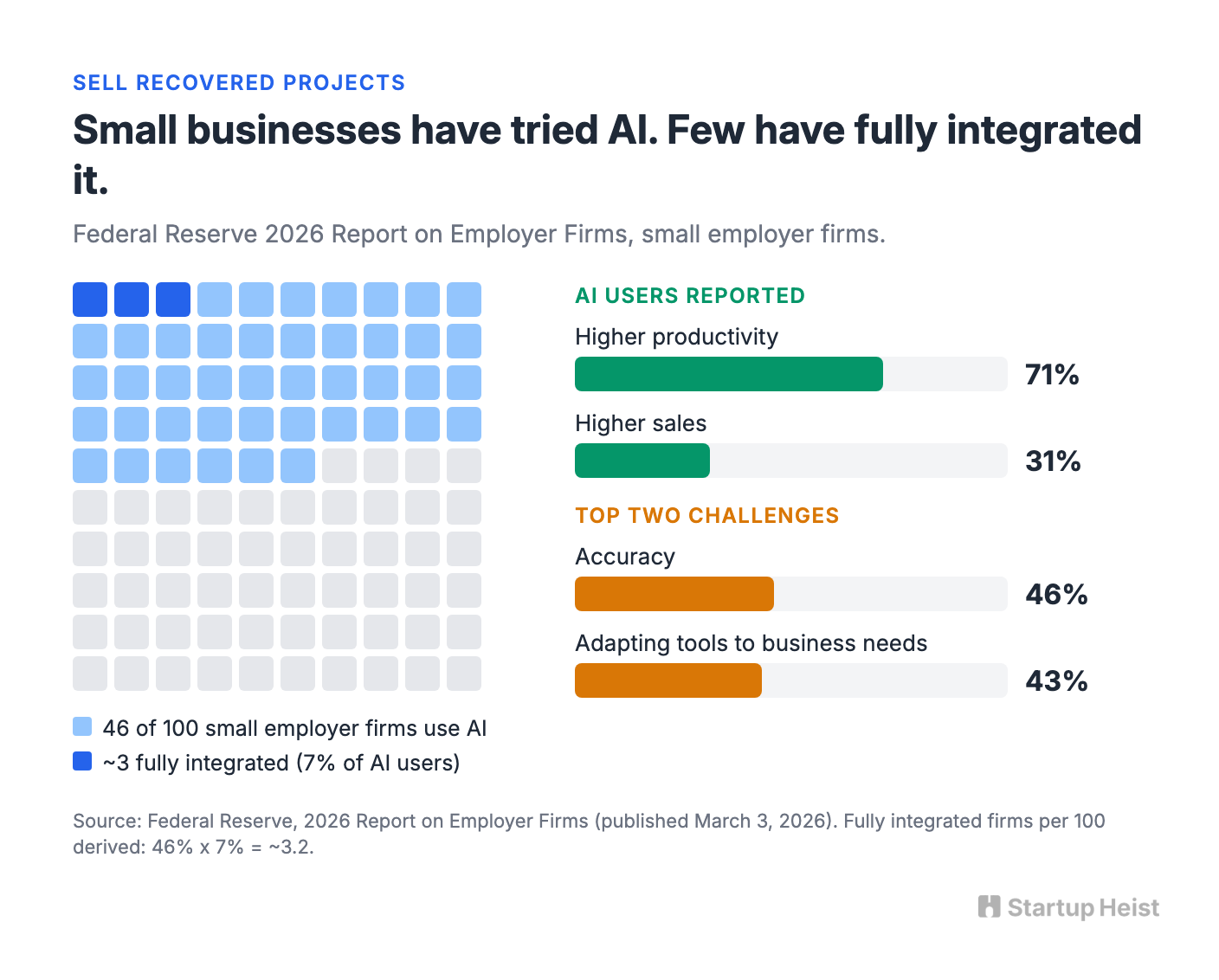
The Federal Reserve's 2026 Report on Employer Firms, published March 3, 2026, found that 46% of small employer firms already use AI, yet just 7% of those users had fully integrated it into their business. Among users, 71% reported higher productivity and 31% reported higher sales. Their top two challenges were accuracy (46%) and adapting tools to their business needs (43%). Small businesses have tried AI. What they lack is someone to fit it to their workflow and make it dependable, and that is what a vertical implementation business sells.
Frame the pitch around revenue the agency already pays for. "Replace your SDR" falls flat with boutique agencies, because most never had one; the principal handles every inquiry personally. The agency spends real money generating inquiries through its portfolio, SEO and ads. Your system makes sure a real project never sits in the inbox overnight, and that obvious bad fits stay off the calendar.
Speed to lead matters, though the famous numbers deserve care. A 2011 Harvard Business Review study of online sales leads found that firms contacting a lead within an hour were nearly seven times as likely to qualify it as firms that waited longer, and many of the multipliers circulating in sales decks descend from research of that vintage. Skip promises like "21x more conversions." Measure each customer's own baseline instead: median response time, inquiry volume, discovery calls booked, show rate, qualified-opportunity rate and projects closed. Compare the same numbers 30 days after install, and the before-and-after becomes your best sales asset. Expect the biggest gains at the agencies with the most inbound demand, since they lose the most of it after 6 p.m.
Design the Front Door
Unlock the Vault.
Join founders who spot opportunities ahead of the crowd. Actionable insights. Zero fluff.
“Intelligent, bold, minus the pretense.”
“Like discovering the cheat codes of the startup world.”
“SH is off-Broadway for founders — weird, sharp, and ahead of the curve.”


