


The Tiny Creature That Makes Jira Bearable
The obvious startup idea is to make Jira look like Stardew Valley, and you should skip it. Repainting enterprise software makes a fun demo and a fragile business.
The better opportunity is smaller and easier to defend: a privacy-first focus companion, built as a Chrome extension, that lives beside the web apps people hate opening.
A project manager opens Jira to clear a backlog, and a small creature wakes up in the corner of the screen. She tells it what she wants to finish, starts a 25-minute session, and gets to work while the creature tends a garden. When the session ends, a new plant appears. Tomorrow the garden is still there, a little bigger.
The creature never reads the Jira ticket, touches customer data, or sends her employer's information to a server. It barely cares that Jira is underneath it. Its only job is to make starting tedious browser work feel less unpleasant.
Everything else about the company follows from that design choice. Deep visual reskins of Salesforce or Jira break every time the host app ships an update, command weak pricing, and ask for permissions no IT team will approve. The stronger wedge is private ritualization of boring work: a focus product that shows up exactly where the resistance begins.
Built that way, this is a credible micro-SaaS that could reach $5,000–$20,000 MRR with a very small team, with a second act in sanctioned workplace deployment once the creature has earned it. Here's the opportunity:
The money: 1,000 subscribers at $59/year is about $4,900 MRR; 2,500 gets you past $12,000. Finch, at an estimated $2M a month on iOS, shows people pay to keep a creature happy.
Inside:
• Six-feature MVP with a zero-data architecture
• Week-two kill test to catch novelty churn
• Free-timer pricing with a $59/yr Plus tier
• 90-day build plan and beta outreach script
The Problem Starts Before the Work Does
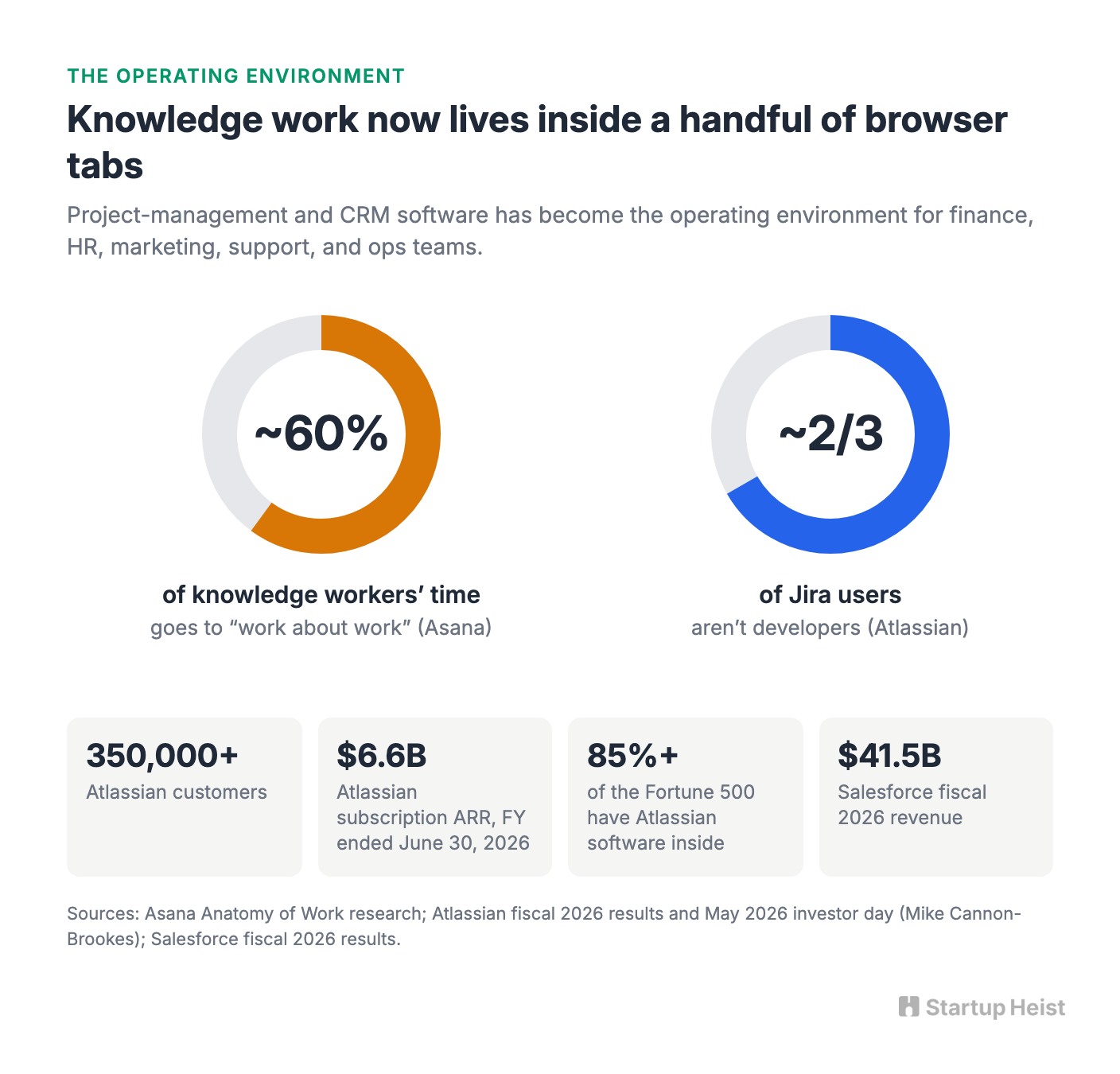
Knowledge work now lives inside a handful of browser tabs. Atlassian reported more than 350,000 customers and $6.6 billion in subscription ARR at the close of its fiscal year ended June 30, 2026, with its software inside more than 85% of the Fortune 500. At its May 2026 investor day, CEO Mike Cannon-Brookes said roughly two-thirds of Jira users aren't developers. Salesforce booked $41.5 billion in fiscal 2026 revenue. Project-management and CRM software has become the operating environment for finance, HR, marketing, support, and ops teams.
Calling these tools ugly misses the point, since making Jira beige instead of gray changes nothing. The real problem happens a few seconds before work begins, when you're staring at twelve tickets that need cleanup, eight CRM records that need updating, and a stack of expenses waiting to be categorized. The work isn't hard enough to be interesting, but it demands enough attention that you can't do it on autopilot. So you check Slack, then email, then an article, and eventually the tab you were avoiding.
Asana's Anatomy of Work research has found knowledge workers spend roughly 60% of their time on "work about work," the coordination and admin that surrounds the skilled job. Much of that work sits in tools like these. What you're looking at is a task-initiation problem wrapped in a software experience problem, and task initiation is a problem people already pay to solve.
The Gap Between a Pet and a Timer
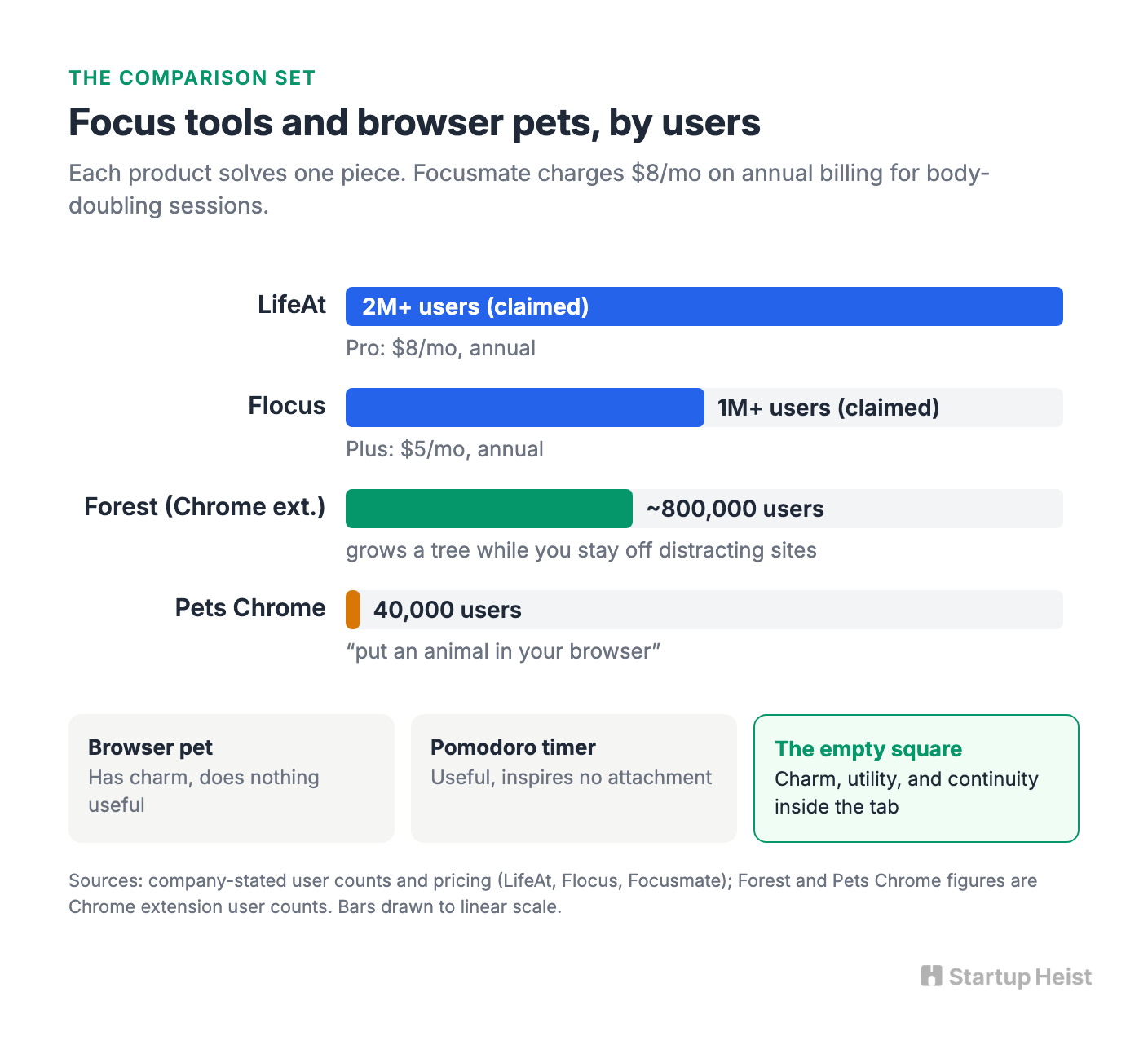
The right comparison set is focus apps, virtual coworking, ambient workspaces, and digital pets, and the pattern across them is hard to miss. Focusmate charges $8 a month on annual billing ($12 monthly) for unlimited body-doubling sessions. LifeAt claims more than 2 million users and sells Pro at $8 a month annually. Flocus claims more than 1 million users and sells Plus at $5 a month on annual billing, down from a $9 list price. Forest's Chrome extension, which grows a tree while you stay off distracting sites, has around 800,000 users. Pets Chrome, whose entire proposition is "put an animal in your browser," has 40,000.
A character can also carry a productivity product on its own. Hank Green's Focus Friend, a phone app where a small bean knits socks while you stay off your phone and drops its stitches when you don't, hit No. 1 on the U.S. App Store in August 2025 and was named Google Play's app of the year. Finch, the self-care pet app, pulls an estimated $2 million a month on the App Store alone, according to Sensor Tower. People will pay, repeatedly, to keep a small creature happy.
Each of these products solves one piece. A browser pet has charm but does nothing useful, while a Pomodoro timer is useful and inspires no attachment at all. Coworking adds accountability but needs another destination and another person. Focus Friend lives on your phone, and Forest punishes you for leaving your work. Nobody we found has fused charm, utility, and continuity inside the tab where avoidance is already happening. That empty square is the product: a tiny creature that appears whenever you open the admin work you keep postponing.
Context Without Content
The temptation is to overbuild this immediately: detect the Jira ticket, read its title, track its movement, award XP for closing it, sync progress to a server, add AI coaching, then integrate Salesforce, Asana, and Monday. Do all that and your charming companion ends up asking for permission to "read and change all your data" on applications full of customer records, internal discussions, and pipeline numbers, at which point the product is finished before it launches.
Chrome's own developer guidance pushes the other way. It recommends requesting the minimum permissions and supports optional host permissions that users grant at runtime, one site at a time, and Google notes that users trust extensions with fewer permission warnings. Turn that constraint into the product philosophy: the extension should know where you are, never what you're working on.
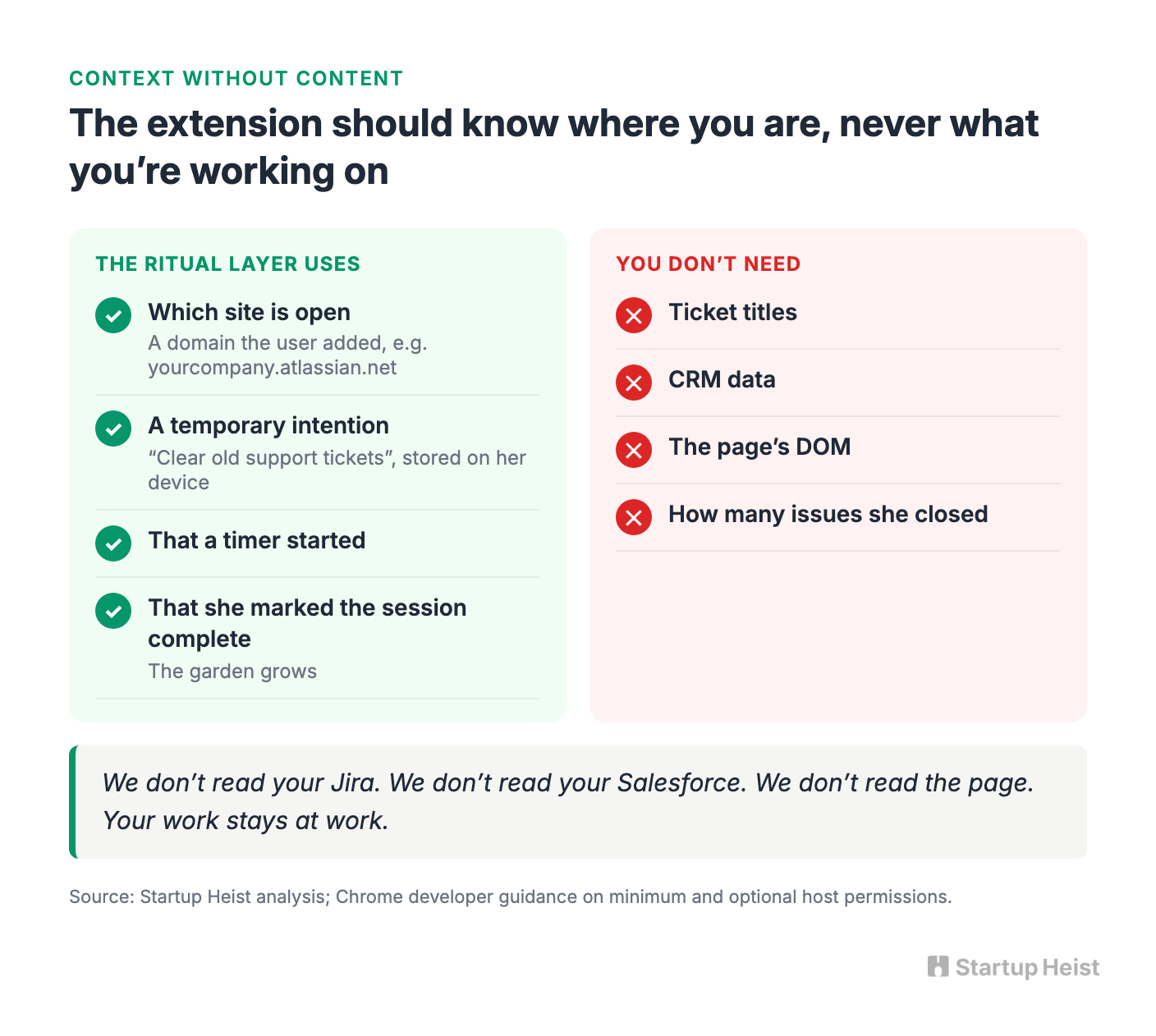
The user adds `yourcompany.atlassian.net` as a focus location, and whenever that domain is open, the companion can appear. She types a temporary intention, Clear old support tickets, which stays on her device. A timer starts, she works, she marks the session complete, and the garden grows. You don't need ticket titles, CRM data, the page's DOM, or a count of how many issues she closed. You're building a ritual layer, and a ritual layer needs almost no data.
The zero-data architecture writes your marketing for you. We don't read your Jira. We don't read your Salesforce. We don't read the page. Your work stays at work. Copy like that does double duty as compliance language and as the brand itself.
Why Now
Unlock the Vault.
Join founders who spot opportunities ahead of the crowd. Actionable insights. Zero fluff.
“Intelligent, bold, minus the pretense.”
“Like discovering the cheat codes of the startup world.”
“SH is off-Broadway for founders — weird, sharp, and ahead of the curve.”


