


The Shopify App That Makes Money Before the Return Label Prints
A customer buys a $100 sweater from a Shopify brand. Two weeks later she decides she doesn't want it. For her, the next step is one click: Return.
For the merchant, that click starts a small financial disaster. The sale disappears. A return label costs $8 to $12. Someone has to receive and inspect the sweater, which may then need steaming, repackaging, relabeling, discounting, or liquidation. Support touches the ticket. Payment processing fees may not all come back. And if the sweater is seasonal, worn, or simply arrives three weeks later, its resale value has already slipped.
Suppose the merchant could step in before any of that happens:
"Keep the sweater and we'll refund you $25 right now. Or continue with your normal return."
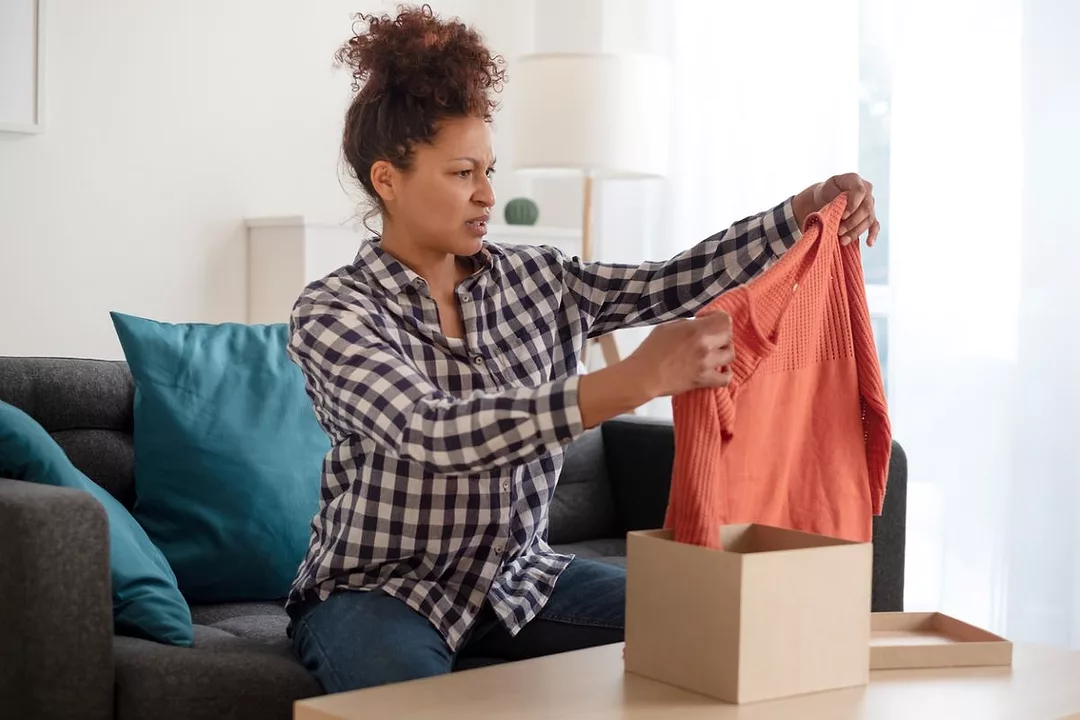
Some customers take the $25, and for those orders the merchant never prints a label, handles a package, restocks anything, or ships a replacement.
The obvious startup here is an AI bot that negotiates returns. Skip it. The better idea is more boring: a Shopify profit engine that decides when paying a customer to keep an unwanted product is cheaper than taking it back. It makes one controlled offer, based on SKU economics and merchant-set guardrails, before the label is created. There's no chatbot arguing with shoppers, no reverse-logistics platform, and no attempt to replace Loop, AfterShip, ReturnGO, or Shopify itself. The app answers one question: is this item worth taking back?
Here's the shape of the opportunity:
The money: 100 apparel merchants on the $79 Growth tier is $7,900 MRR; 250 is $19,750. Roughly a third of retailers already offer returnless refunds, per Asendia.
Inside:
• The cost ceiling, worked on a $100 sweater
• Holdout design that catches the coupon machine
• A five-merchant pilot and its five pass tests
• Three SaaS tiers priced against measured savings
One Ecommerce Dollar in Five Flows Backward
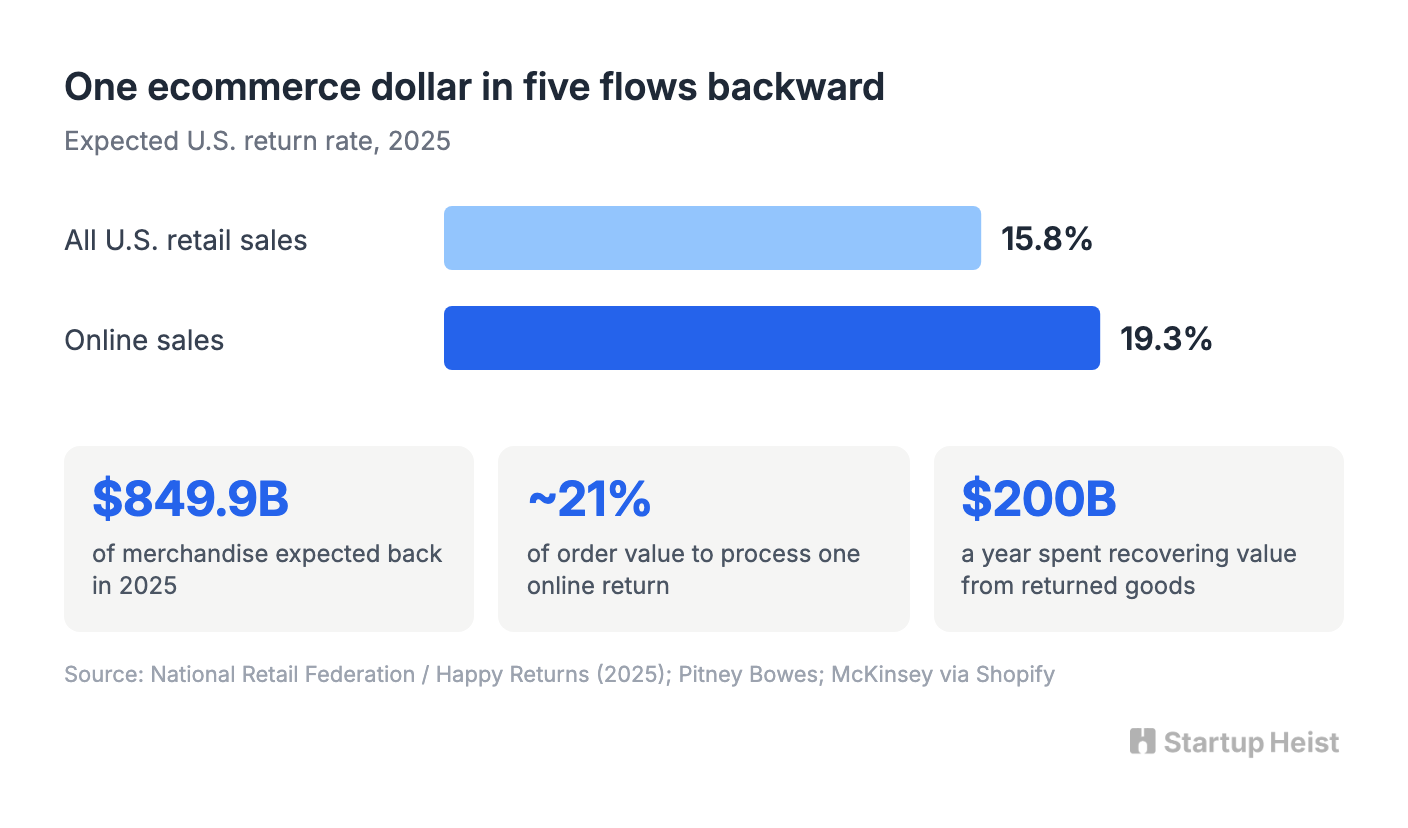
Returns look manageable until you put every cost on one P&L. The National Retail Federation and Happy Returns estimated that U.S. retailers would take back $849.9 billion of merchandise in 2025, a 15.8% return rate on annual sales. Online was worse: 19.3% of online sales were expected to come back. Roughly one ecommerce dollar in five reverses direction. The refund is only the visible part. Shopify cites McKinsey's estimate that retailers spend about $200 billion a year trying to recover value from returned goods, and a Pitney Bowes survey puts the cost of processing a single online return at around 21% of the order's value.
Apparel is the interesting category because its returns are rarely binary product failures. The dress was fine, but the color read differently on screen. The jacket fits, but not well enough to keep at full price. Those are economically different from "you sent me the wrong size." The wrong-size shopper needs an exchange. The mildly disappointed shopper with a $70 accessory might happily keep it for $15 back.
Yet nearly every returns system begins with the policy question: is this customer allowed to return the item? The question that actually moves margin is whether the merchant should even want it back, and almost nobody in the Shopify ecosystem is answering that one at the SKU level.
The Trap: Another Returns Platform
Returns software is crowded, and the crowd is closing in from both ends. Shopify now handles return rules, self-serve return requests, refunds, store credit, exchanges, return shipping, inventory updates, and return-reason analytics natively. Shopify Flow fires workflows as a return moves through requested, approved, declined, cancelled, reopened, and closed. Shopify's own guide to returns software tells merchants they only need a dedicated platform for advanced incentivized exchanges, multi-warehouse routing, large carrier networks, or multi-platform operations.

Above that floor sit the platforms. Loop starts at $155 a month for Essential and $340 for Advanced, and its feature matrix already lists Keep Item alongside Shop Now, instant exchanges, and bonus credit. AfterShip Returns starts around $16 a month and ships a Green Returns option that refunds the customer without collecting the package; across the 4,000-plus retailers AfterShip analyzed, products priced under $50 account for 57.6% of those returnless refunds. Newer entrants keep arriving: Keepers, from 8th Origin LLC, launched on the Shopify App Store on July 13, 2026 at $29 a month with keep-the-item refunds, instant exchanges, and automated labels. And per a 2025 Asendia report, roughly a third of retailers already offer returnless refunds, with another 28% planning to.
So there's no credible pitch that says "nobody lets shoppers keep the product." They do. What they all share is that the keep-it option is a policy toggle: a price threshold, a category rule, a manual override. Redo comes closest to something smarter, with returnless-refund rules scoped by SKU, collection, price, and return reason, but it's still a threshold the merchant sets by hand, with no computed cost ceiling and no holdout to prove the offers changed anything. Shopify's returnless-refund guide advises against using the tactic for apparel at all, a category where return rates top 30%. That advice is correct for a blanket rule, because a blanket rule on a category like that bleeds money. It's wrong for a per-SKU, per-reason decision with a measured ceiling, and the gap between those two is the whole opportunity. Existing systems are built around the return workflow. This one is built around the return economics.
The Product: One Offer, Before the Label
Call it MarginBack, KeepMargin, Retain, whatever. The positioning matters more than the name: know when paying a customer to keep an item beats taking it back.
The app installs into Shopify and sits immediately before the physical-return step. A customer selects an item and a return reason. The engine evaluates the request. For most returns, nothing happens and the shopper continues through the merchant's normal flow. For the eligible minority, a single card appears:
Keep this item and receive $22 back immediately.
You can also continue with your standard return.
One offer, with no negotiation theater, no dark patterns, and the Return button exactly where it always was.
That matters more than it sounds. NRF found that 82% of shoppers consider free returns important when buying online, 76% are more likely to choose a return option with an instant refund or exchange, and 71% say they're less likely to shop with a retailer again after a poor returns experience. The partial refund has to feel like a convenience the brand extended rather than a hostage negotiation.
The Secret Sauce Is the Ceiling
Unlock the Vault.
Join founders who spot opportunities ahead of the crowd. Actionable insights. Zero fluff.
“Intelligent, bold, minus the pretense.”
“Like discovering the cheat codes of the startup world.”
“SH is off-Broadway for founders — weird, sharp, and ahead of the curve.”


