


Steal the Paper Trail
Somewhere in your town, a 186-page planning-board packet explains exactly what will happen to the vacant shopping center. The school district has uploaded an agenda with a major facilities decision on it. A restaurant has filed for a liquor license, a developer has requested a zoning variance, and a council vote has quietly moved a project from "proposed" to "approved."
All of it is public, and almost nobody reads it.
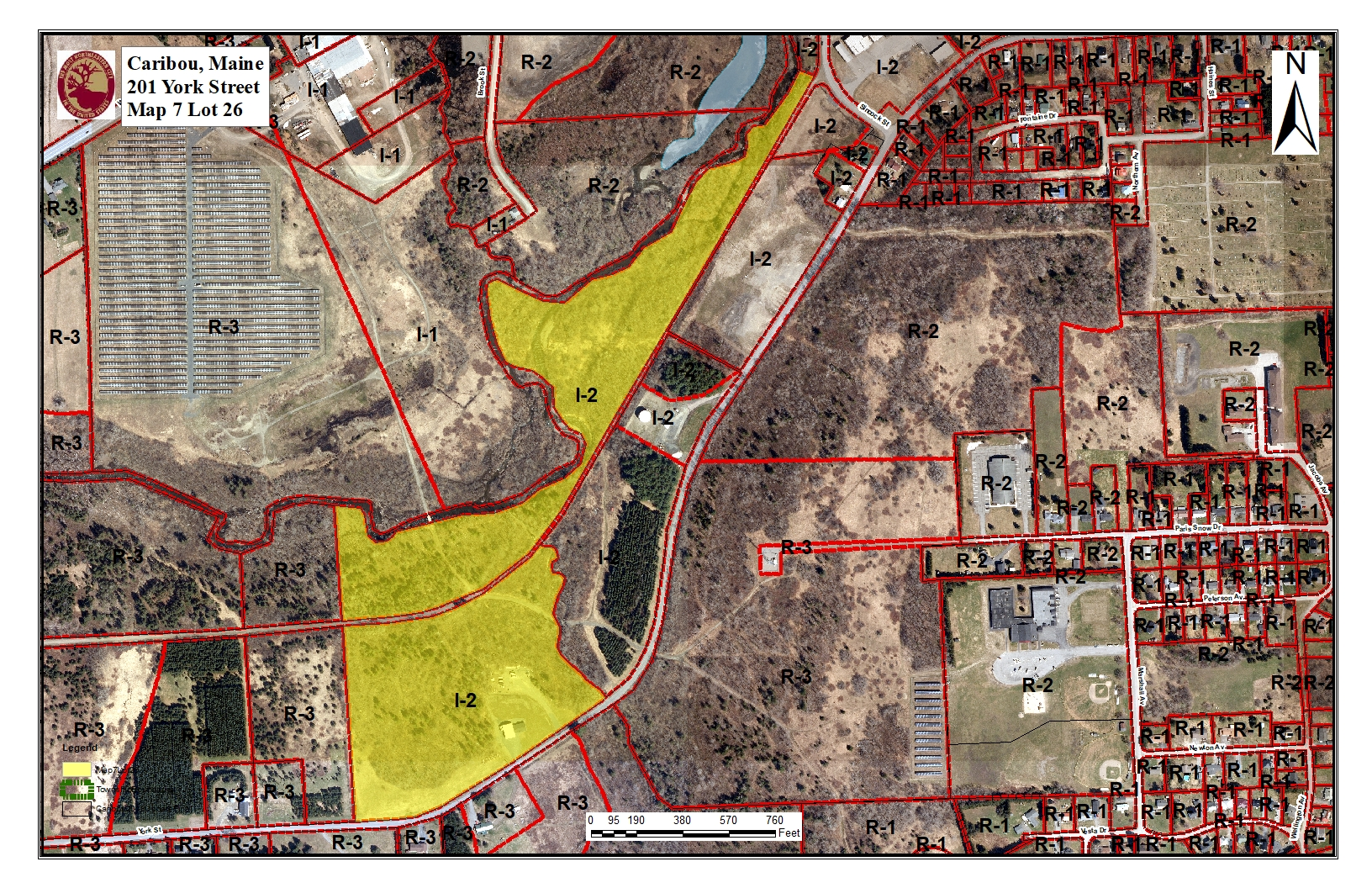
Three days later, someone posts in the town Facebook group: "Does anyone know what they're building next to the CVS?" Twenty-six comments follow. Three people say apartments, someone heard Trader Joe's, one person blames the mayor, and another swears construction starts next week. The actual answer has been sitting on page 74 of the planning packet since Tuesday.
You can close that gap with a source-cited neighborhood briefing: a free, human-edited hyperlocal newsletter that monitors public records and tells residents what was proposed, approved, delayed, permitted or scheduled, with the source document, the next step and the reason anyone should care. Run modestly, it's a $5K to $15K-a-month local media business. Run ambitiously, it becomes a local-change database that professionals pay to query.
Here's the opportunity at a glance:
The money: Four sponsors, 25 pro alert seats, ten listings and a few team accounts reach about $5.4K MRR from one town of 5,000 subscribers.
Inside:
• The five-part briefing item format
• An eight-step build from scrape to claim ledger
• Price sheet and the math to $5K MRR
• A founding-sponsor pitch email to copy
The Translator Disappeared
The collapse of local journalism is old news. For this play, the sharper loss is the reporter whose job was to sit through the boring meetings and read the packet.
Medill's 2025 State of Local News report counts close to 3,500 newspapers that have stopped printing since 2005, along with more than 270,000 newspaper jobs. It found 212 U.S. counties that are full news deserts and another 1,525 with only one local source, leaving almost 50 million Americans with limited or no access to local news. The same report tracked more than 300 local news startups over five years, just under 80% of them digital. The market is being rebuilt, and most of the rebuilding is happening online.
Demand never left. In Pew's December 2025 survey, 80% of U.S. adults said local news outlets are at least somewhat important to their community's well-being, and 72% said they often or sometimes get local news from friends, family and neighbors. Your real competitor is "Did you hear?" The neighborhood information network already exists, but it's fragmented, lossy and usually several retellings removed from the original record. The position worth taking is the citation layer underneath that conversation: the link a resident pastes when the rumor about the old diner becoming a six-story apartment building starts circulating.
AI Makes Provenance the Product
It's tempting to make AI the hero of the pitch. Treat it as your labor arbitrage instead, and put trust on the label.
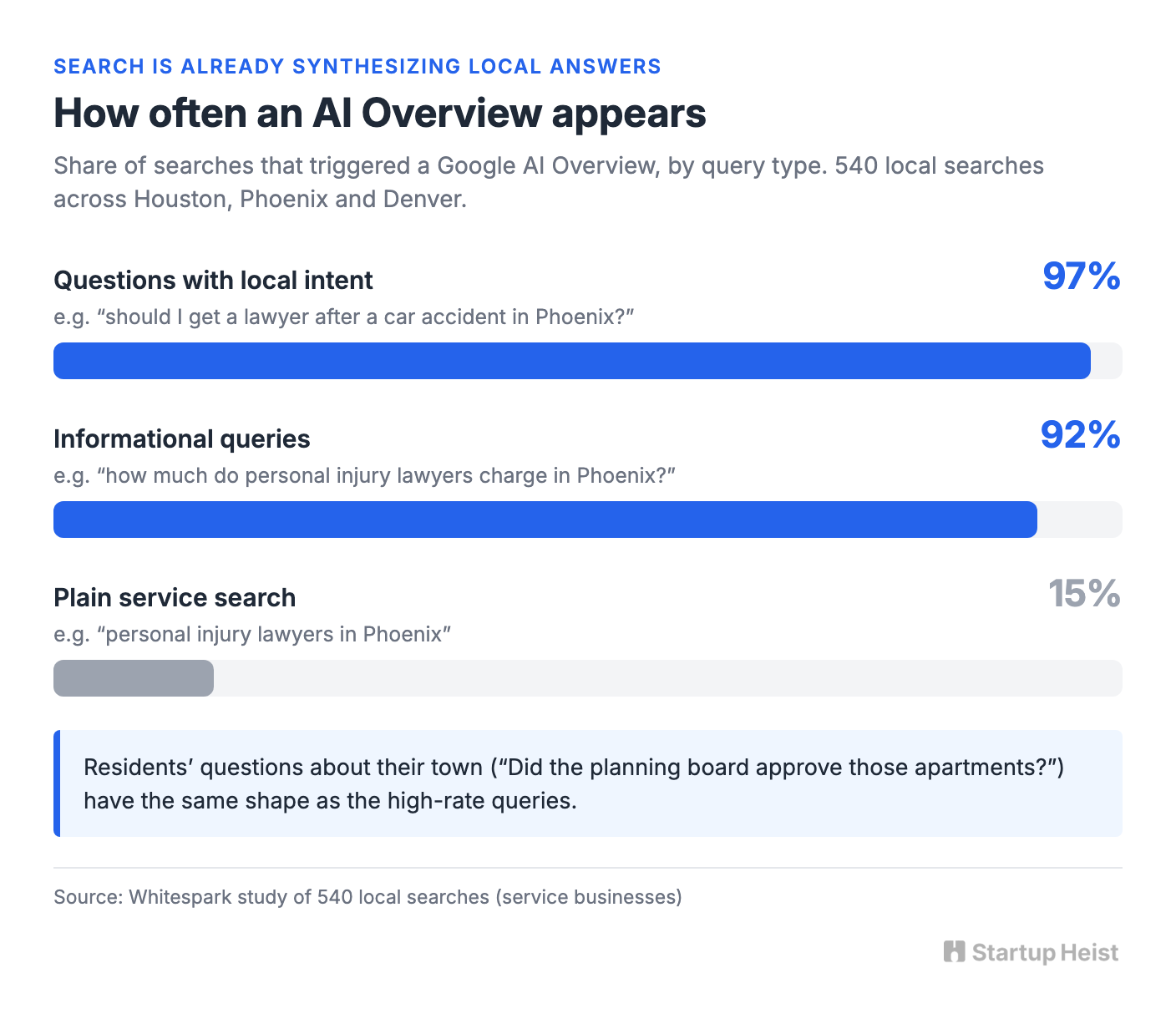
Search is already synthesizing local answers. Google began rolling out AI Mode to everyone in the U.S. on May 20, 2025, and expanded ads inside AI Overviews the same year. A Whitespark study of 540 local searches across Houston, Phoenix and Denver found AI Overviews on 92% of informational queries, such as "how much do personal injury lawyers charge in Phoenix?", and on 97% of questions with local intent, such as "should I get a lawyer after a car accident in Phoenix?" A plain "personal injury lawyers in Phoenix" search triggered one only 15% of the time. The study covered service businesses, but the questions residents ask about their town ("Did the planning board approve those apartments?" "Why is Main Street closing for six weeks?") have the same shape, which puts them where a synthesized answer is most likely and a small error does real damage.
Readers have noticed, and they're wary. The Medill Survey 2026, published September 15, 2026, polled 1,223 Chicago-area adults and found that grammar and spell-checking was the only newsroom AI use at least half were comfortable with. Fewer than a third were comfortable with AI summarizing news, and just 15% were comfortable with AI deciding what to cover.
The early experiments show why. By May 2025, Civic Sunlight was emailing LLM-written council-meeting newsletters for about twenty towns in Maine and nearby states, and its founder put their accuracy at 90% to 95%. One Concord, N.H., edition told readers the council had "approved funding" for Memorial Field and the Penacook Library Activity Center. The council had only discussed the field, and the center was funded years earlier. The error was a false state change, the exact thing this business sells. Prism News went further, running more than 200 AI-generated local news sites billed as "zero humans, zero legacy, and infinite AI scale" until it suspended them in August 2026, after journalists documented fake bylines and content lifted from local reporters.
So run models aggressively on the back end and show your work on the front end. Brand yourself an "AI newspaper" and you undercut the thing readers value most. The model finds the document, extracts the address, notices the status flipped from pending to approved and drafts three sentences. A human opens the source, verifies the claim and presses publish.
Professionals Already Pay for This Data
The strongest evidence for this business sits on the professional side, where companies already sell municipal paper trails to people with money on the line. Hamlet, founded in 2022, monitors more than 3,000 city councils, planning commissions and other governing bodies for real estate developers and data center operators. GatherGov claims coverage of 9,300+ jurisdictions and 94% of the U.S. population, tracks projects from application through entitlement, and lists Prologis and Compass among its customers. Its pitch is blunt: a rezoning filed today won't show up in permit data for years. Shovels sells more than 178 million permits across 2,770+ jurisdictions, along with zoning and land-use decisions, and Gryd (formerly BuildZoom Data) markets nearly 400 million permits for underwriting, lending and construction intelligence.
These companies sell national breadth to enterprise buyers, and none of them owns a town. None has 5,000 residents opening an email about what's changing on their street, and none can tell you that "the Harrison site" and "218 Lancaster Avenue" are the same fight residents have been having for two years. The resident layer is thinly served, mostly by Facebook groups and unreviewed AI summaries, and a solo operator can claim it one municipality at a time. Axios has shown what that audience is worth at scale: in December 2020 it paid a reported $5 million for Charlotte Agenda, a staffed local newsletter with 55,000 subscribers and $2.2 million in prior-year revenue.
The Product: A Change Log for a Place
Unlock the Vault.
Join founders who spot opportunities ahead of the crowd. Actionable insights. Zero fluff.
“Intelligent, bold, minus the pretense.”
“Like discovering the cheat codes of the startup world.”
“SH is off-Broadway for founders — weird, sharp, and ahead of the curve.”


