


The Tiny Coworker That Cleans Up After You
The opportunity: a $29 local-first Mac companion that turns one annoying digital-maintenance chore into a ritual people actually want to perform.
Productivity software usually competes on efficiency. This product competes on something harder to buy: the urge to start.
The tools for the work itself already exist. macOS can run folder actions, a dozen utilities sort Downloads folders, and todo apps have streaks. Habitica has spent more than a decade turning tasks into an RPG, and Finch built a hit consumer app around caring for a virtual bird by caring for yourself.

The opening sits between those categories: a tiny creature that lives on your Mac and helps you finish the irritating last 10% of digital housekeeping, whether that means sorting ten downloads, filing five screenshots or packing up one client delivery.
Call it a tiny coworker for the chores you keep postponing, and start it on exactly one chore.
The money: Sell 250 licenses a month at $29 and you bring in about $7,250 a month before fees. Finch's pet-plus-habit loop earns an estimated $2 million monthly.
Inside:
• Nine-part MVP for a ten-file cleanup ritual
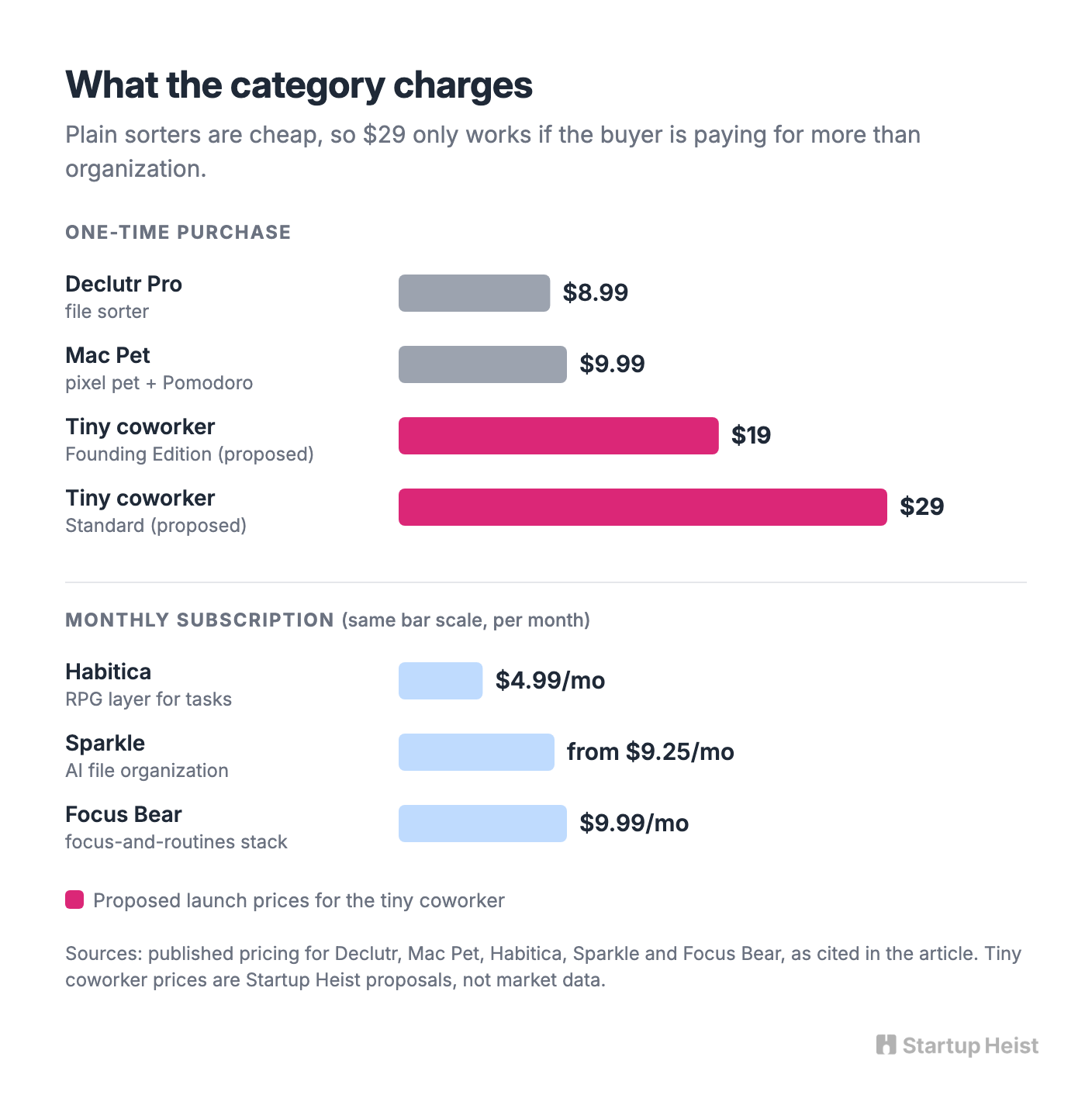
• $19 founding edition, then $29, no subscription
• Beta outreach script and 30-day retention gates
• Five moats plus a creator Delivery ritual
The Signal
In late September 2026, a Mac desktop pet called Mochi launched on Product Hunt. Mochi is a small pink blob that floats around your screen, reacts to the apps you use, naps, and notices when you're working late. If you let it, a feature called Desk Patrol flies to loose Desktop files and carries them into folders like Screenshots, Documents and Media. It never deletes or overwrites anything, every move can be undone from the menu bar, and it runs locally with no account. A paid tier lets you grow a strawberry tree, build a nest, hatch an egg and raise a small family.
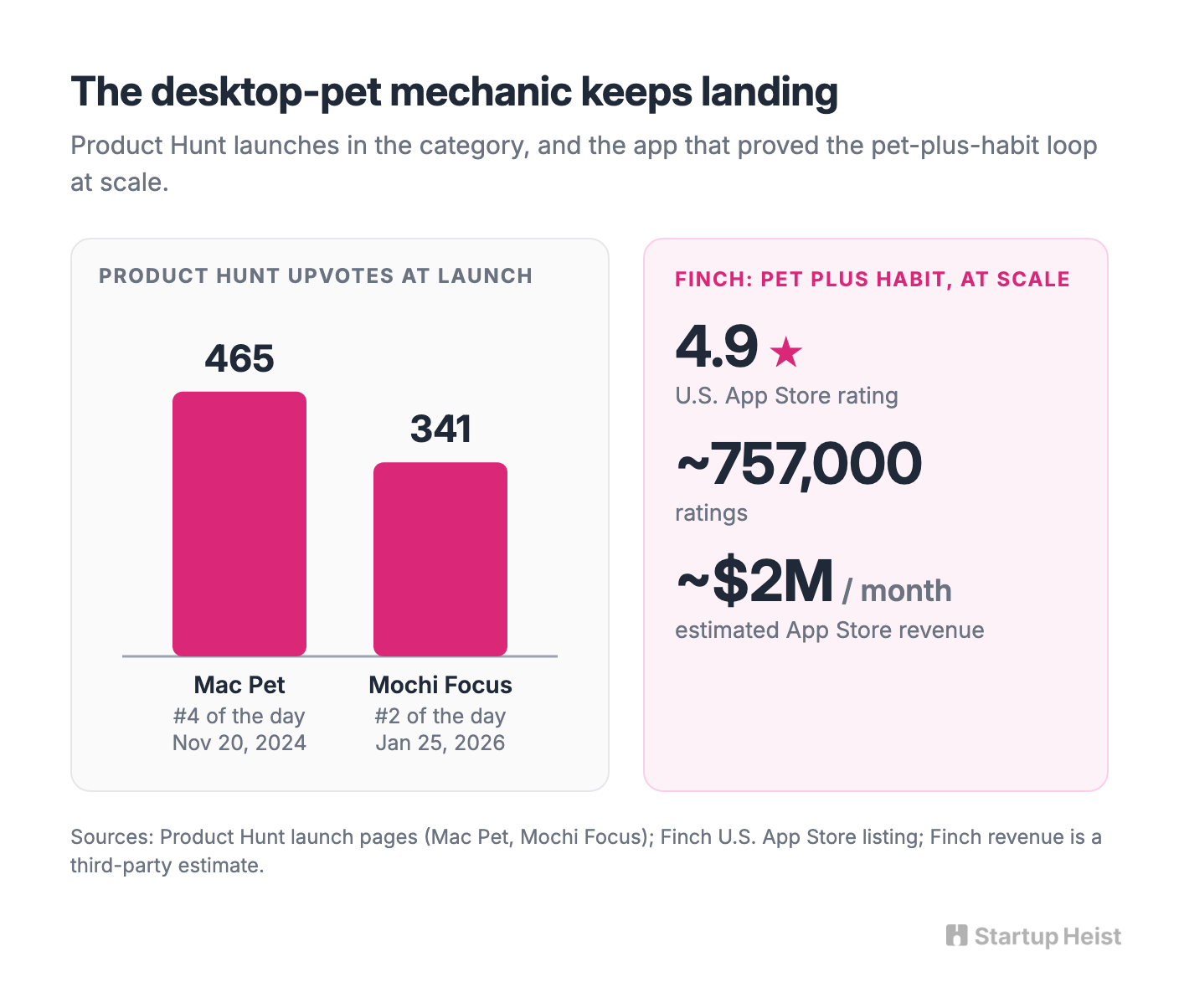
Mochi didn't crack its launch day's top ten, which matters less than the pattern around it. The category keeps landing. Mac Pet, a pixel pet that lives in the menu bar or MacBook notch with a built-in Pomodoro timer, finished #4 on Product Hunt on November 20, 2024 with 465 upvotes and sells for $9.99 one-time. Mochi Focus, a Chrome focus timer whose mascot evolves as you log focused minutes, finished #2 on January 25, 2026 with 341 upvotes. Desktop pets explain themselves in a five-second screen recording: the viewer watches a creature walk over to a mess and deal with it.
Copying Mochi would be the wrong heist. The prize is the mechanic underneath: attach an emotionally salient character to a mundane, measurable computer behavior. Finch proved the mechanic works at scale. Its U.S. App Store listing shows 4.9 stars across roughly 757,000 ratings, and third-party estimates put its App Store revenue near $2 million a month. Habitica charges $4.99 a month for its RPG layer, and Focus Bear charges $9.99 a month for a broad focus-and-routines stack. Every one of them asks you to maintain an abstract system: create the task, open the app, check it off. Your computer already knows your Downloads folder holds 147 files, so the pet never needs you to report anything.
Don't Build a Better File Organizer
Pitch this as "a smarter way to organize your Downloads folder" and you've already lost. Declutr sorts Desktop and Downloads into categories, runs custom rules on name, extension, age and size, and watches folders in real time. The core app is free and Pro is a single $8.99 unlock. The Mac App Store has a shelf of similar sorters, and power users have built their own Hazel rules and Automator scripts for years. Automated file organization is a commodity.
That commoditization is the opening. What you're selling is initiation, the push to deal with the files no rule can handle. A folder rule already moves every `.dmg` into Installers. The ambiguous pile is a different matter: `IMG_4821.png`, `invoice-final-3.pdf`, `export-v7-FINAL.mov`, `presentation2.key`. Each one needs a small human decision, and none of those decisions is hard, but together they settle into digital clutter. Mac users also split sharply on whether software should move or delete things for them, and plenty want preview-and-approve because they don't trust automation to know what matters.
The product insight follows from that: don't automate the ritual away; make it pleasant enough that people do it. An app that silently cleans everything reduces the pet to decoration, and a pet that does nothing useful is just a toy. The sweet spot is assisted maintenance, where the app lowers the friction of deciding, the human keeps control, and the pet makes finishing feel good.
Why the Pet Changes the Math
The research on gamification is honest about its limits, and those limits point straight at the design. A January 2024 meta-analysis in Educational Technology Research and Development pooled 35 gamified interventions covering roughly 2,500 participants. The effect on intrinsic motivation was real but small. The effect on perceived autonomy was more than twice as large, relatedness improved significantly as well, and competence barely moved. It's education research, so it won't prove your app retains users. It does show where the leverage lives: game mechanics work when people feel agency and connection, and they fade when software simply hands out points.
So the pet has to be a companion and never a compliance officer. It doesn't starve, die, send angry notifications or announce "You broke your 41-day streak." If a user disappears for three weeks, the pet says something like good to see you and starts again. Finch's real advantage lies in connecting progress to care without turning a missed day into a moral failure, and that philosophy transfers to any creature you draw.
It also makes the session the unit of progress. Reward showing up and finishing an intentional session, and leave the raw count of files moved out of it. Rewarding volume creates the Jira problem, where people optimize the metric instead of the behavior, and it makes someone with twelve files feel less productive than someone with 800. The user sets what "enough" means: five files for a tiny session, ten for a normal one, twenty for a deep tidy, or five minutes on a timer. You're rewarding consistency, and compulsive cleanliness never enters the scoreboard.
Trust Is the Feature
Unlock the Vault.
Join founders who spot opportunities ahead of the crowd. Actionable insights. Zero fluff.
“Intelligent, bold, minus the pretense.”
“Like discovering the cheat codes of the startup world.”
“SH is off-Broadway for founders — weird, sharp, and ahead of the curve.”


