


The $2 Toy You Destroy Once, Then Buy Again
A fidget toy has a structural problem: when it works, the customer keeps the one they have. Korea's newest sensory craze solved that by making destruction the product.
The wakppu ball is a palm-sized sphere of soft clay dipped in candle wax. The wax hardens into a thin brittle shell. You press it, the shell fractures with a crackle, the soft interior spills out, and the object is finished. The name fuses the Korean pronunciation of "wax" with ppushigi, "smashing." One crack, one reveal, then nothing to keep.
Commercial versions sell for about 3,000 won ($2) at Daiso, Artbox and Hottracks. Members of Enhypen and Cravity were filmed cracking them on livestreams in April and June 2026, and the Korea JoongAng Daily reported in July that cracking videos routinely draw hundreds of thousands of views, with many passing a million. KakaoStyle's Zigzag platform logged a 500% rise in wakppu sales between June 14 and July 12, 2026.
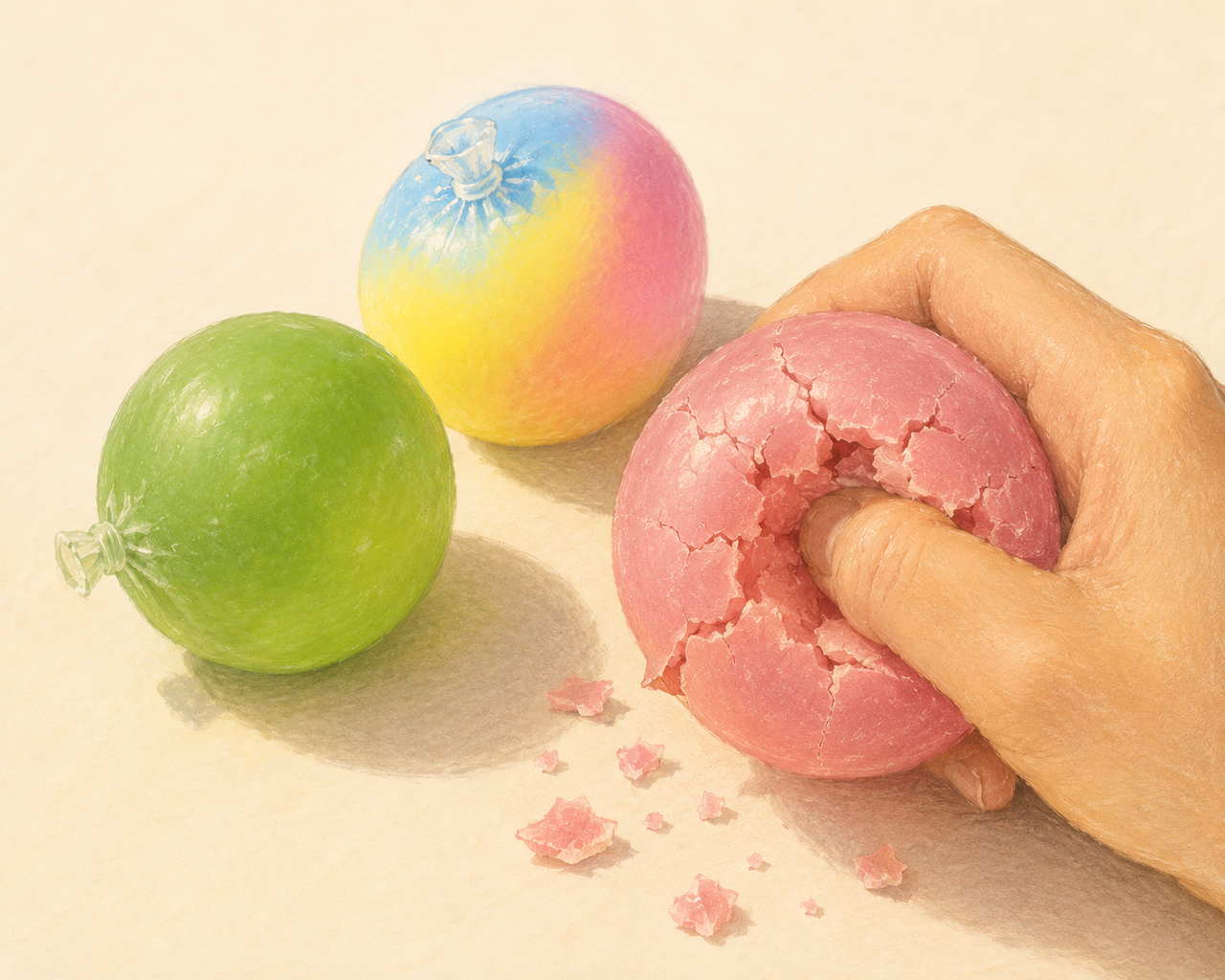
Importing a container of $2 balls isn't the opportunity. Wax cracking squishies already sit on Etsy and TikTok Shop under a half-dozen names, at prices from a few dollars to about $18 for singles and around $23 for three-packs. You'd be late.
The better heist is narrower. It's a speed business, the clock is already running, and nobody here is building a toy company, a chemistry kit or a venture-backed platform. Here's the opportunity:
The money: Three-packs at $24 clear about $5 each; 1,000 packs a month is $24,000 in revenue and $5,000 in contribution. NeeDoh moved six months of stock in six weeks.
Inside:
• One-SKU MVP and the 14+ label that must hold
• Three-pack unit economics at an 8% TikTok fee
• Creator seeding plan with the outreach email
• 12-week drop timeline and kill criteria
The Signal: Korea Validated the Behavior, Not the Product
On August 13, 2026, Korean market researcher Embrain Trend Monitor published a survey of 1,000 people ages 13 to 59 about "tactile consumption": buying or making objects primarily for the pleasure of touching, pressing, squeezing or hearing them. Just over half, 51.9%, had done it. Among teenagers the figure was 69%; among people in their twenties, 65%. Of those with experience, 63.4% had used wax-ball products. Asked what drove the purchase, 71.7% named how the object felt in the hand, ahead of price (50.7%), safety (43.4%), sound (36.1%) and design (30.7%). Asked why they bought at all, 54.6% cited the pleasure of touch or sound, and 43.4% cited stress relief.
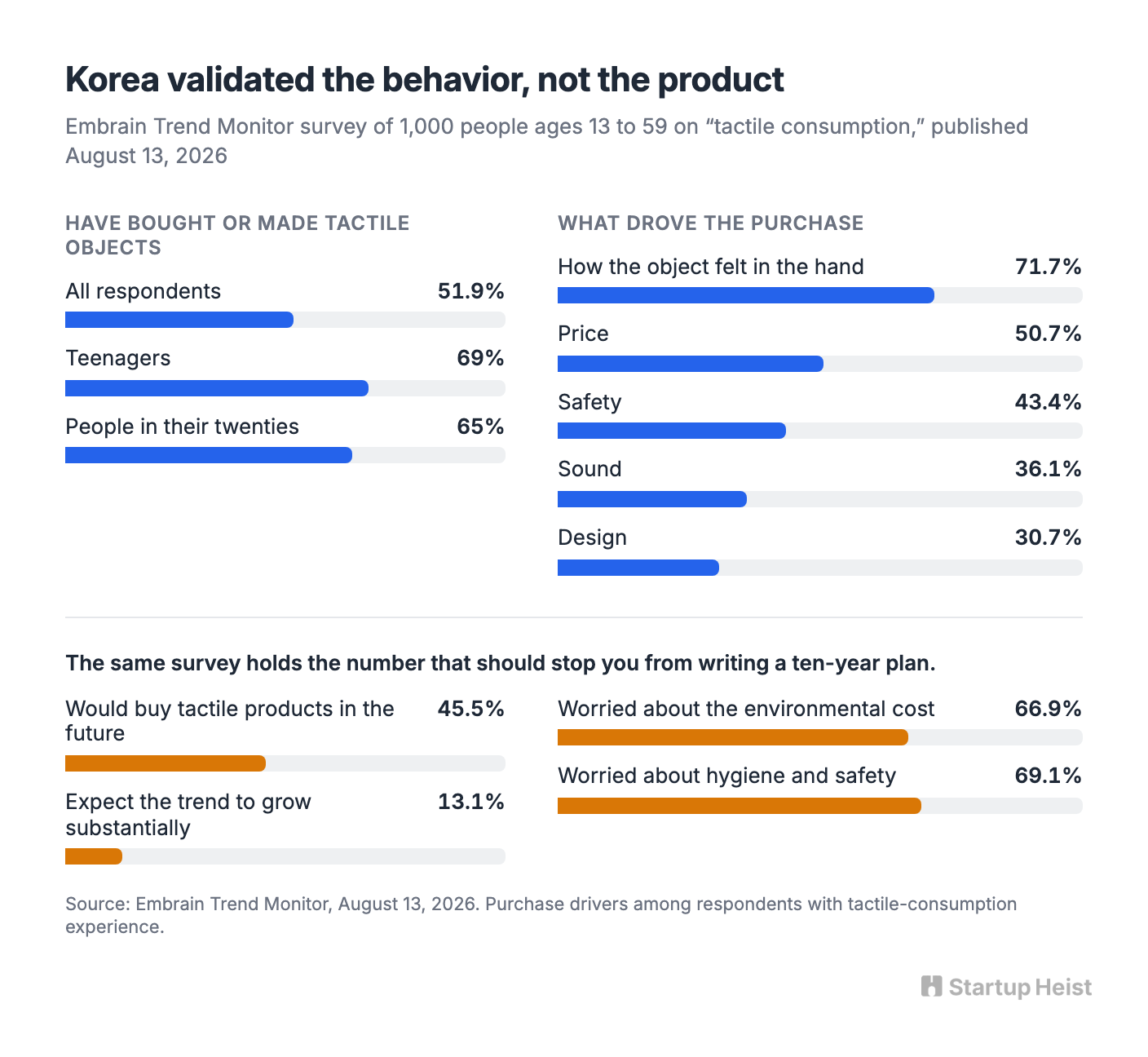
Those numbers double as a product spec. The wakppu ball is a tiny piece of physical media, and what the customer buys is a sequence: anticipation, pressure, crack, reveal, squish, film, share. Cheap physical goods usually have terrible built-in distribution; nobody films their mug. This one ships with its own ad, because the crack is the ad and the customer shoots it.
The same survey holds the number that should stop you from writing a ten-year plan. Among respondents, 45.5% said they'd buy tactile products in the future, but only 13.1% expected the trend to grow substantially, 66.9% worried about the environmental cost, and 69.1% worried about hygiene and safety. People may like the behavior longer than they like this particular toy, and that gap should shape every decision that follows.
The Wrong Play: Building the American Wakppu Company
There's effectively zero product moat. Any factory can copy the sphere, any Etsy seller can copy the colorway, and a TikTok Shop merchant can undercut you within the week. The sensory-toy incumbents aren't asleep either.
NeeDoh, a squishy line Schylling launched in 2017 at $4.49, went viral on TikTok in January 2026. The Boston Globe reported on June 5, 2026 that the company sold six months of inventory in six weeks, and toy stores began promoting shipments as "drops" that drew lines of hundreds. On January 14, 2026, Goliath acquired Crazy Aaron's, maker of Thinking Putty, to expand its sensory-play footprint globally. These companies already own production knowledge, retailer relationships, compliance infrastructure and brand recognition. If wakppu becomes a permanent $100 million category in the United States, they don't need your permission to enter it.
Treat it instead as a fast consumer-product operation with an option on something larger. That framing decides how much you spend, how much inventory you order, how fast you launch, and what you're trying to learn in the first 90 days.
The Real Wedge: Trust the Marketplace Sellers Can't Offer
Search "wax cracking squishy" on TikTok Shop and you find a market a small branded operator should like: lots of supply, very little authority. Listings run under inconsistent names (wax cracking squishy, crunchy stress ball, crispy squishy, wax crackle paw, crack ball) and the specifications are a mess. Materials are listed as TPR, PU foam, paper clay or "soft filling." Several are shaped like food. Stress-relief and anxiety claims are common. One listing sells a wax-shell paw for about $9.50 and recommends chilling it before cracking.
That fragmentation is the wedge, and the pitch writes itself: we know exactly what this is made from, we know which batch yours came from, we designed the package around the actual ritual, we tested whether it survives a delivery truck in August, and we aren't a mystery seller hiding behind a marketplace storefront.
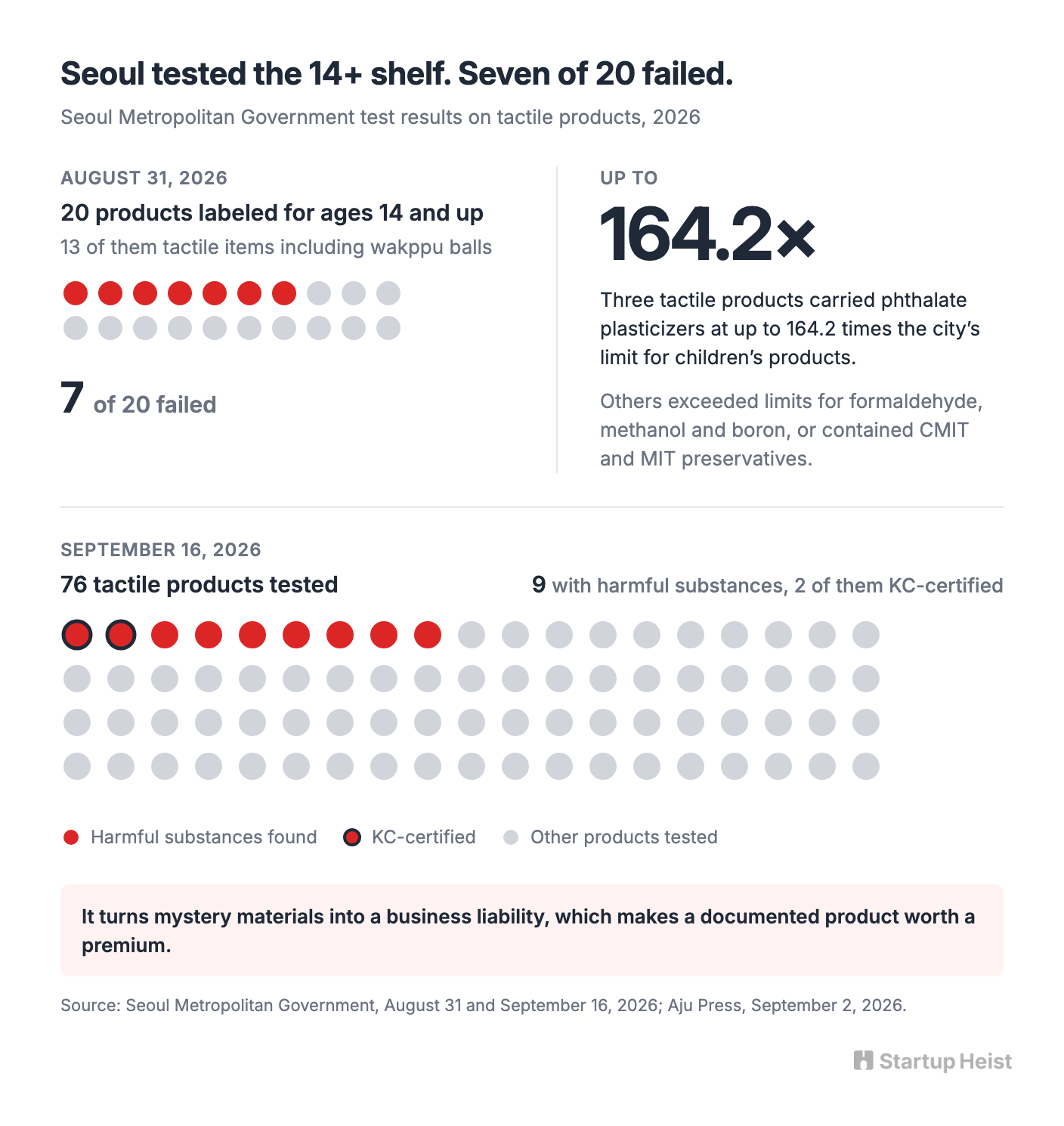
The pitch got sharply more valuable on August 31, 2026, when the Seoul Metropolitan Government announced test results on 20 products labeled for ages 14 and up, 13 of them tactile items including wakppu balls. Seven failed. Three tactile products carried phthalate plasticizers at up to 164.2 times the city's limit for children's products. Others exceeded limits for formaldehyde, methanol and boron, or contained CMIT and MIT preservatives. Seoul tested against children's standards because, in the city's words, children of all ages buy these products regardless of the label. Aju Press reported on September 2 that 14+ labeling exempts products from Korea's mandatory KC certification for children's goods, and that the line between the age on the box and the market around it had blurred. On September 16, a separate round tested 76 tactile products and found harmful substances in nine, two of them KC-certified.
None of this makes wax-cracking toys inherently dangerous. It turns mystery materials into a business liability, which makes a documented product worth a premium.
Leave "eco" out of it. The positioning word is known: material transparency, lot codes, supplier documentation, independent testing appropriate to the construction, clear age positioning, clear disposal instructions, and no "non-toxic" badge unless you can back what you mean by it. It sounds dull next to TikTok virality. Dull operations are what turn a commodity into a brand, and the commodity sellers are structurally incapable of doing them.
The MVP: One Sphere
Start with one product architecture, a single sphere, and skip the character line, the food replicas, the glitter hearts and the candle-melting kit.
Unlock the Vault.
Join founders who spot opportunities ahead of the crowd. Actionable insights. Zero fluff.
“Intelligent, bold, minus the pretense.”
“Like discovering the cheat codes of the startup world.”
“SH is off-Broadway for founders — weird, sharp, and ahead of the curve.”


