


The Quiet Pop-Up: Sell 15 Minutes of Calm to Places That Need Foot Traffic
Young Koreans haven't suddenly found religion. What's changed is that retailers figured out how to wrap shopping inside a ritual, and the ritual is what sells.
On September 9, 2026, a weekday afternoon, the Buddhism pop-up at Lotte Mall's Gimpo Airport branch in western Seoul was crowded with shoppers in their 20s and 30s. They were buying prayer bead bracelets, Buddha phone grips with heart-shaped eyes, and towels printed "Wipe Away Your Greed," writing wishes on a wall for a monk to carry to a temple, and pulling free "instant blessing" lottery tickets. Two months earlier, a Buddhism-themed event at Lotte Department Store in Busan logged 3,000 purchases in a single week, with shoppers in their 20s and 30s making up roughly 80% of buyers. At Hyundai Seoul's "Temple Week" in June, the same age group was 70% of purchasers. I'Park Mall's first Buddhism pop-up drew about 1,000 visitors a day, and it has since run a second.
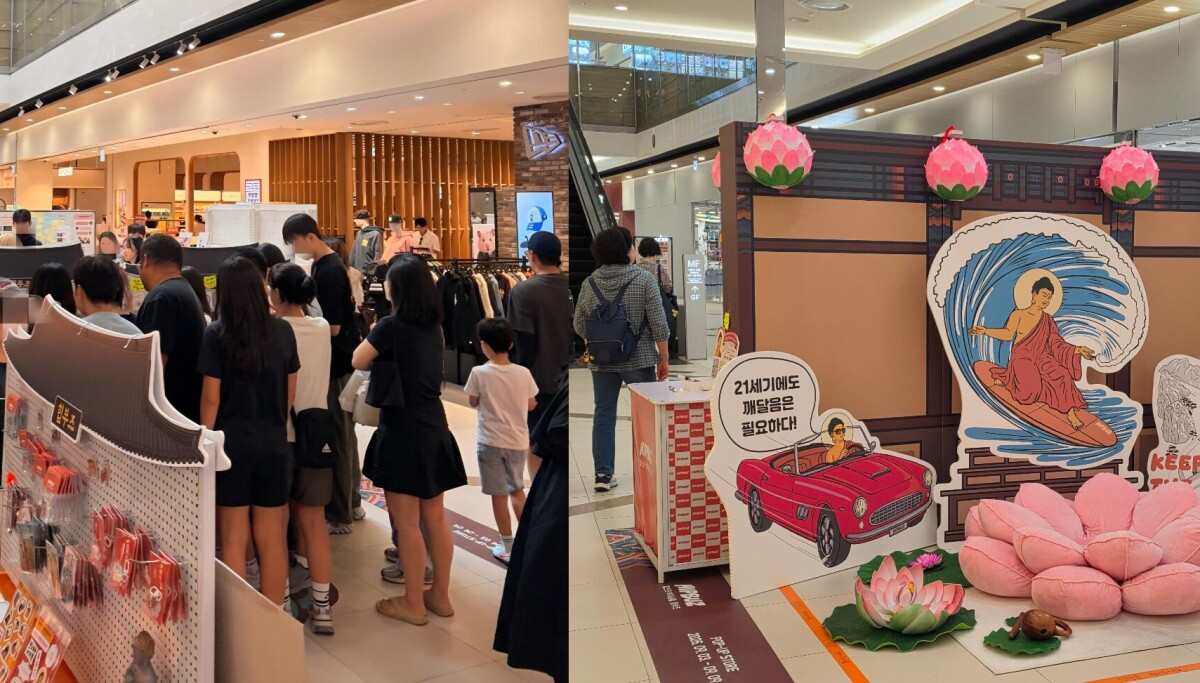
Copy the Buddha phone grips into an American mall and you'll build something between tacky and offensive. Copy the behavior underneath them and there's a business hiding in plain sight.
Build a touring "quiet pop-up": a compact 10-to-15-minute reset experience that appears inside hotels, coworking spaces, markets, apartment buildings, and conferences, with shopping centers as the eventual destination. Someone walks in, drops their phone into a tray, and sits while a local meditation teacher leads a three-to-five-minute guided sit. Afterward they make an intention card or a simple bracelet, maybe buy a journal, scan a QR code for the local partner, and get on with their day. There's no retreat, no $70 subscription, no ice bath, and nobody is trying to convert anyone. It's fifteen unusually quiet minutes in the middle of a loud place.
And the person in the chair doesn't have to be the one paying. The venue is the customer. That's the heist.
The short version:
The money: Eight half-day activations a month at roughly $1,400 contribution each is about $11,000 a month; PREIT reports retailtainment tenants lift property visits 25%.
Inside:
• Venue pricing ladder from $1,000 to $8,000
• The 15-minute ritual script, minute by minute
• Venue ROI report that sells the next hotel
• 90-day plan and the venue outreach email
The product is the interruption
If you think you're entering the meditation business, this opportunity looks terrible. Headspace charges $12.99 a month and Calm $14.99, both $69.99 a year, for unlimited guided sessions, and thousands of instructors post free sessions online. You won't win with a slightly better three-minute breathing exercise. The bracelet business looks worse, since Etsy and Amazon already sell every conceivable combination of beads, "zen" gifts, journals, and self-care accessories.
What you're actually selling is the interruption. For ten minutes a hotel lobby stops feeling like a hotel lobby, and a coworking lounge becomes a place where people deliberately put down their phones. The venue gets programming, the teacher gets exposure and paying students, and the participant gets a low-commitment experience with a souvenir. You collect the activation fee, the merchandise margin, and the audience. This is experiential retail, and the timing is what makes it interesting.
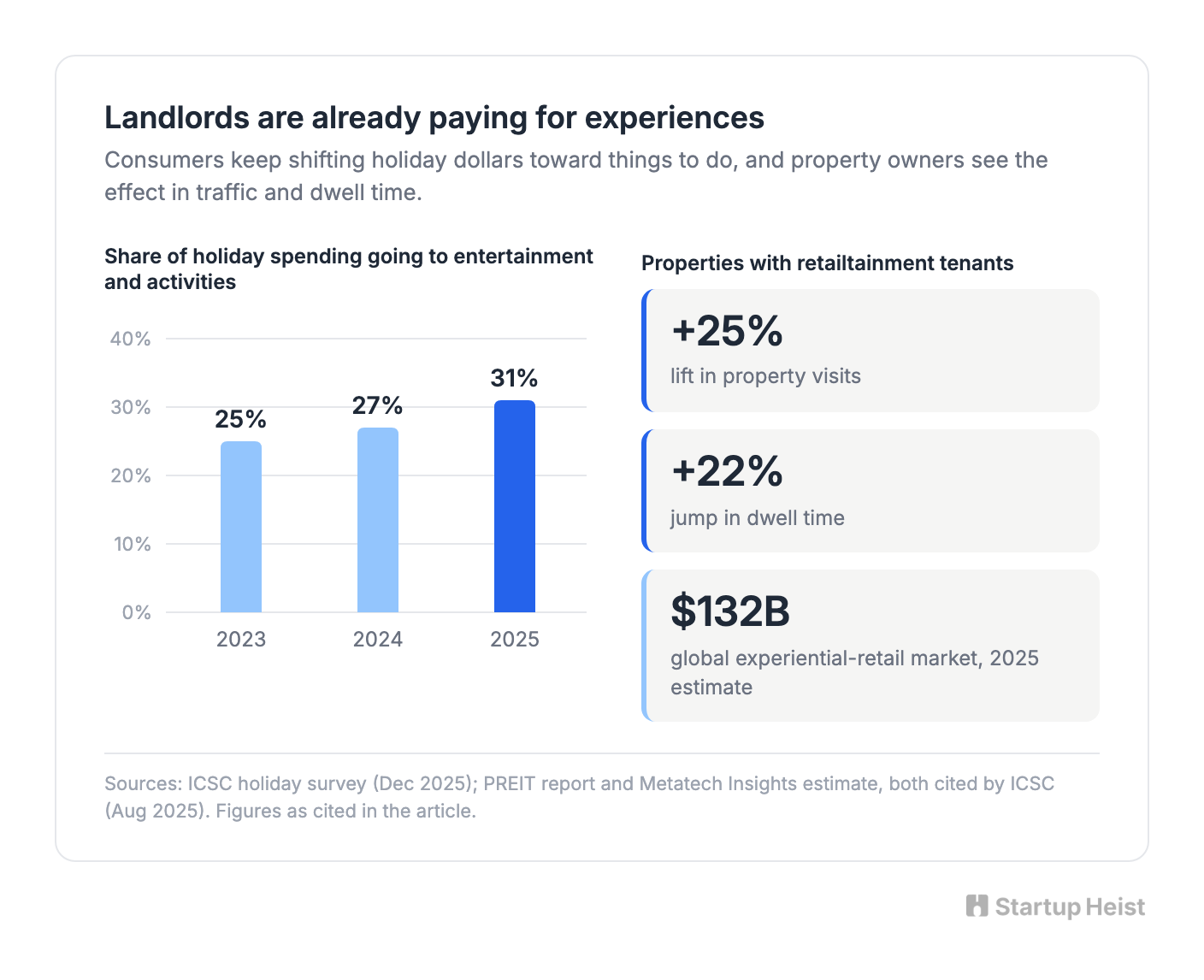
Landlords are paying for exactly this. ICSC's August 2025 coverage of "retailtainment" cites Metatech Insights' estimate of a $132 billion global experiential-retail market in 2025, and, more usefully, PREIT's report that properties with retailtainment tenants saw a 25% lift in visits and a 22% jump in dwell time. Consumers are moving the same direction. ICSC's December 2025 holiday survey found the share of spending going to entertainment and activities climbing from 25% in 2023 to 27% in 2024 to 31% in 2025, and 89% of Gen Z and 86% of millennials planned to visit a retail property in the final two weeks before Christmas. The quiet pop-up is retailtainment with the volume turned down, which sounds contradictory until you look at who's showing up to what.
The quiet crowd already exists
The larger trend is people wanting to go out without wanting to drink, dance, network, perform, or commit three hours. Eventbrite's Social Study, published January 14, 2026 from a July 2025 survey of 4,051 Americans and Britons aged 18 to 35, calls it "soft socializing": 58% said socializing mattered but preferred it not be the main focus, and 45% wanted control over how and when they interacted. Puzzle competitions in the U.S. grew attendance 151%, forest bathing events grew 25%, and 79% of respondents planned to attend more events in 2026.
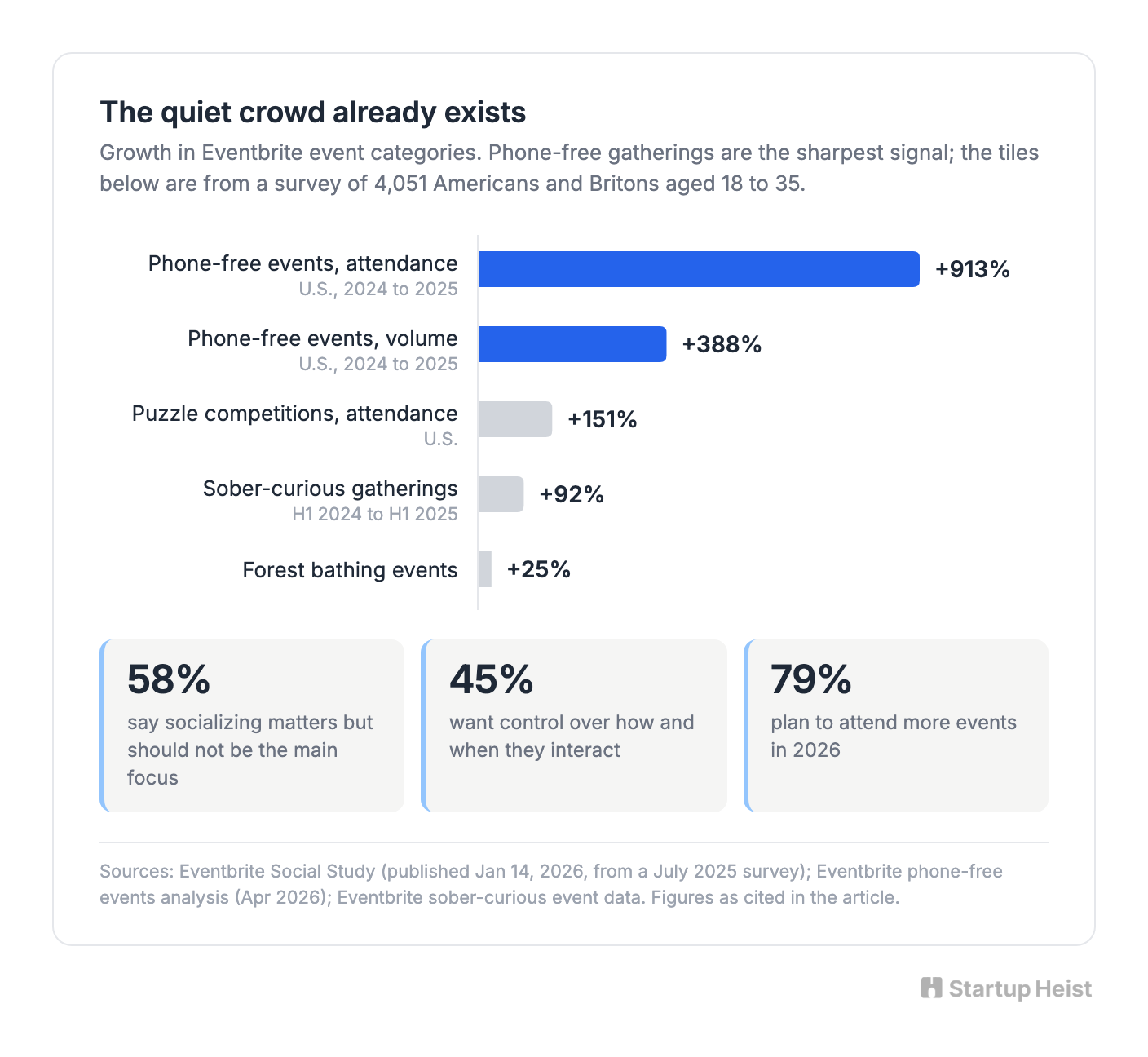
The phone-free version is the sharpest signal. Eventbrite's April 2026 analysis of events tagged "phone-free" found U.S. event volume up 388% and attendance up 913% from 2024 to 2025, with average event size more than doubling; the first quarter of 2026 alone reached over a third of the prior year's global volume. Alcohol is leaving the picture at the same time. Eventbrite counted a 92% rise in sober-curious gatherings from the first half of 2024 to the first half of 2025, and cited NC Solutions data showing 61% of Gen Z want to drink less to protect sleep, fitness, and mental health.
Wellness spending keeps growing underneath all of this. The Global Wellness Institute put the U.S. wellness economy at $2.1 trillion in 2024 in its April 2, 2026 report, with U.S. mental wellness compounding at 14.2% a year from 2019 to 2024 and global meditation and mindfulness spending growing 18.9% a year over the same period to $7.1 billion. Don't turn those figures into a TAM slide; a ten-foot booth doesn't have a $2.1 trillion addressable market. The useful conclusion is that you no longer have to teach Americans to pay for wellness. What remains underbuilt is the physical, casual, fifteen-minute version of it, and someone is going to package it.
Who actually pays
The first instinct will be to charge participants $15 or $20. Resist it. Consumer tickets can work at a wellness festival, but charging every passerby adds friction exactly where the concept is supposed to be frictionless. The better model is B2B2C. A boutique hotel pays for Saturday-morning guest programming. A luxury apartment building pays for a resident amenity; operators already run 12 to 16 resident events per property per year and are actively hunting for vendors who aren't another taco night. Coworking companies pay for member programming, conferences pay for a decompression lounge, and a retail center pays, or at least gives you favorable space early on, to create activity. A meditation center supplies the facilitator and gets paid plus a pipeline of new students. Participants enter free or nearly free, and merchandise becomes incremental instead of existential.
Buyers already pay recurring fees for this kind of programming. Exubrancy, founded in New York in 2013 and acquired by the landlord Tishman Speyer in 2017, dispatches meditation and wellness instructors to more than 600 companies as on-site programming. It stays inside offices and sends nobody home with anything, which leaves hotel lobbies, apartment lounges, and retail corridors open.
An early pricing ladder:
Unlock the Vault.
Join founders who spot opportunities ahead of the crowd. Actionable insights. Zero fluff.
“Intelligent, bold, minus the pretense.”
“Like discovering the cheat codes of the startup world.”
“SH is off-Broadway for founders — weird, sharp, and ahead of the curve.”


