


The Red Team Before You Hit Publish
Founders spend weeks building a product, days writing the announcement, and hours arguing over the headline. Then, five minutes before posting, they paste the whole thing into ChatGPT and type: "What could go wrong with this?" That last-minute anxiety is a market.
The obvious product is an AI audience simulator. Paste in your post and watch a hundred synthetic Redditors, Hacker News pedants, LinkedIn thought leaders, and skeptical journalists react to it. It demos beautifully. It's also easy to copy and hard to defend, because the moment you claim those hundred voices represent a real audience, you have to prove it.
The better business is plainer and more useful: a pre-publication red team for the internet. Paste a founder statement, a Show HN post, a Reddit submission, a Product Hunt launch, or a piece of risky marketing copy. Instead of guessing how "the internet" will feel, the software hunts for the specific ways the post can fail: the claim people will challenge, the sentence a journalist could quote out of context, the line that reads as astroturfing on Reddit, the question the founder forgot to answer. Then it rewrites the weak sections, shows the diff, and keeps a record of what was reviewed.
This is a bootstrapped SaaS with a credible path to $20,000+ in monthly recurring revenue from a few hundred accounts. If the workflow captures what actually happens after posts go live, it has a second act as a proprietary dataset. The whole play depends on knowing where the simulation should stop pretending.
Here's the opportunity in brief:
The money: 250 solo founders at $29, 75 teams at $99, and 20 agencies at $349 = $21,655 MRR from 345 accounts. Artificial Societies raised $5.35M on audience simulation, then moved upmarket.
Inside:
• Eight critic passes and the issue board spec
• Six-screen MVP with per-run unit economics
• Concierge $99 offer and cold outreach script
• The agency approval-artifact wedge
The Toy Everyone Will Build First
In November 2025, a developer posted "Show HN: I built an interactive HN Simulator." You submit a text post or a URL and instantly get a full thread of AI-generated Hacker News comments. The builder layered commenter archetypes, moods, and comment "shapes" on top of each other, with a bit of extra abrasiveness added for comedy. It earned 538 points and more than 200 real comments. Everyone understood it in two seconds, which is why it spread.
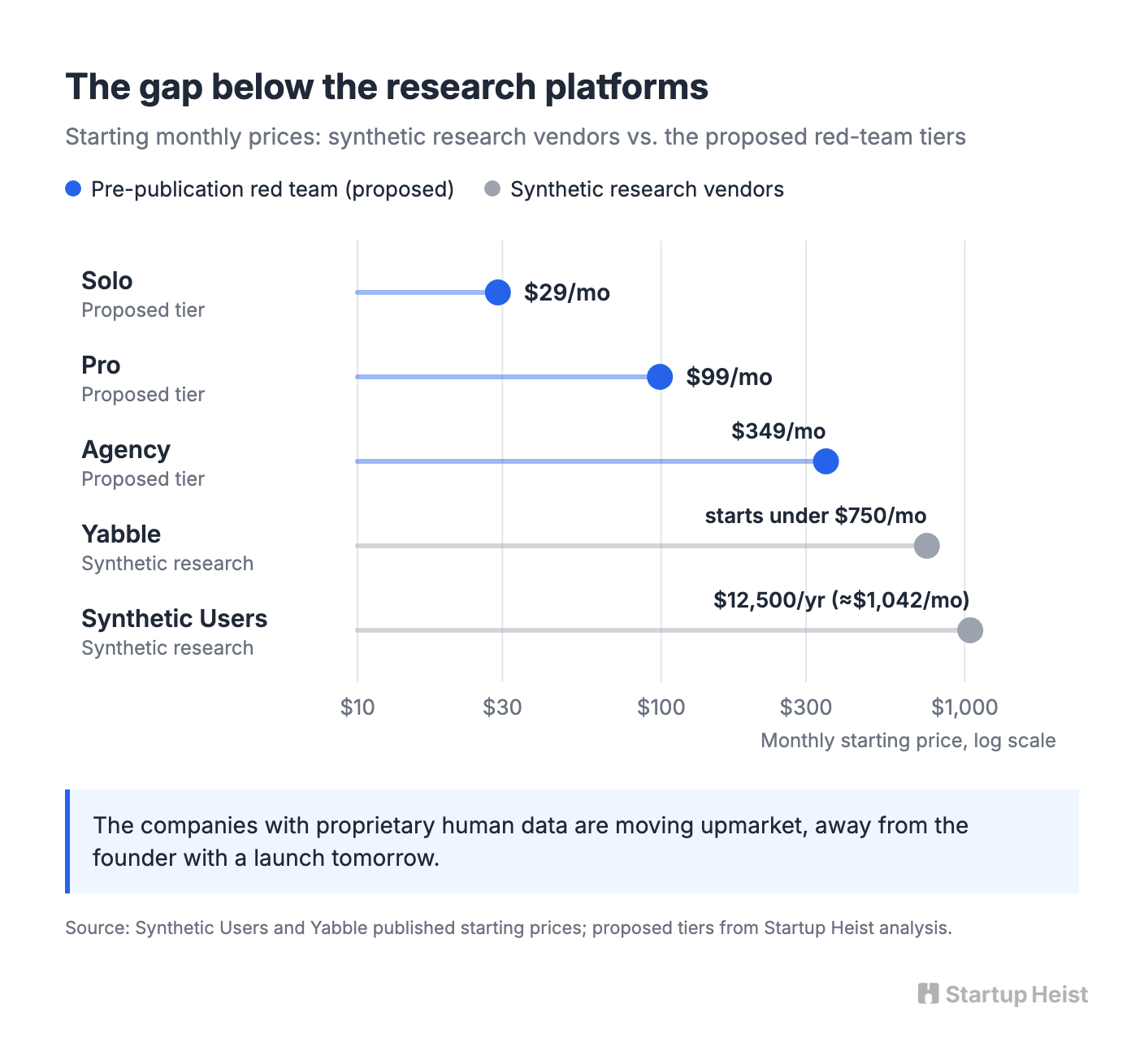
Artificial Societies shows where the idea goes once it raises money. The London-founded startup came out of Y Combinator's Winter 2025 batch and raised $5.35 million in pre-seed and seed funding, with Point72 Ventures leading the seed. Its first product, Reach, let people simulate their own LinkedIn network and test posts before publishing. The company now sells enterprise simulations for crisis communications, investor relations, and reputation work, and says it has delivered more than 18 million simulated responses to Fortune 100 clients. The synthetic research incumbents are further along still. Qualtrics fine-tunes its Edge Audiences model on millions of human respondents answering hundreds of thousands of questions. GWI grounds its synthetic audiences in more than two million interviews a year across 53 markets, refreshed weekly. Synthetic Users starts at $12,500 a year, and Yabble starts under $750 a month.
On its own, "AI people react to your post" is a feature. Turning it into a research company takes proprietary human data, published methodology, and enterprise sales, and the companies that have those are moving upmarket, away from the founder with a launch tomorrow. She needs someone to find the weak sentence before strangers do, and no dominant product owns that job yet.
Dissent Is Easier to Sell Than Prediction
Two claims sound similar and carry very different burdens:
"We predict how Reddit will react."
"We identify credible reasons your Reddit post may get criticized, ignored, or removed before you publish it."
The first requires evidence that your synthetic population behaves like Reddit. The second requires a good system for finding problems, which you can deliver honestly on day one. It's the same bargain a security scanner makes when it searches for vulnerabilities without forecasting next Tuesday's attacker, or a lawyer makes when she flags the risky clauses in a contract without predicting every future dispute.
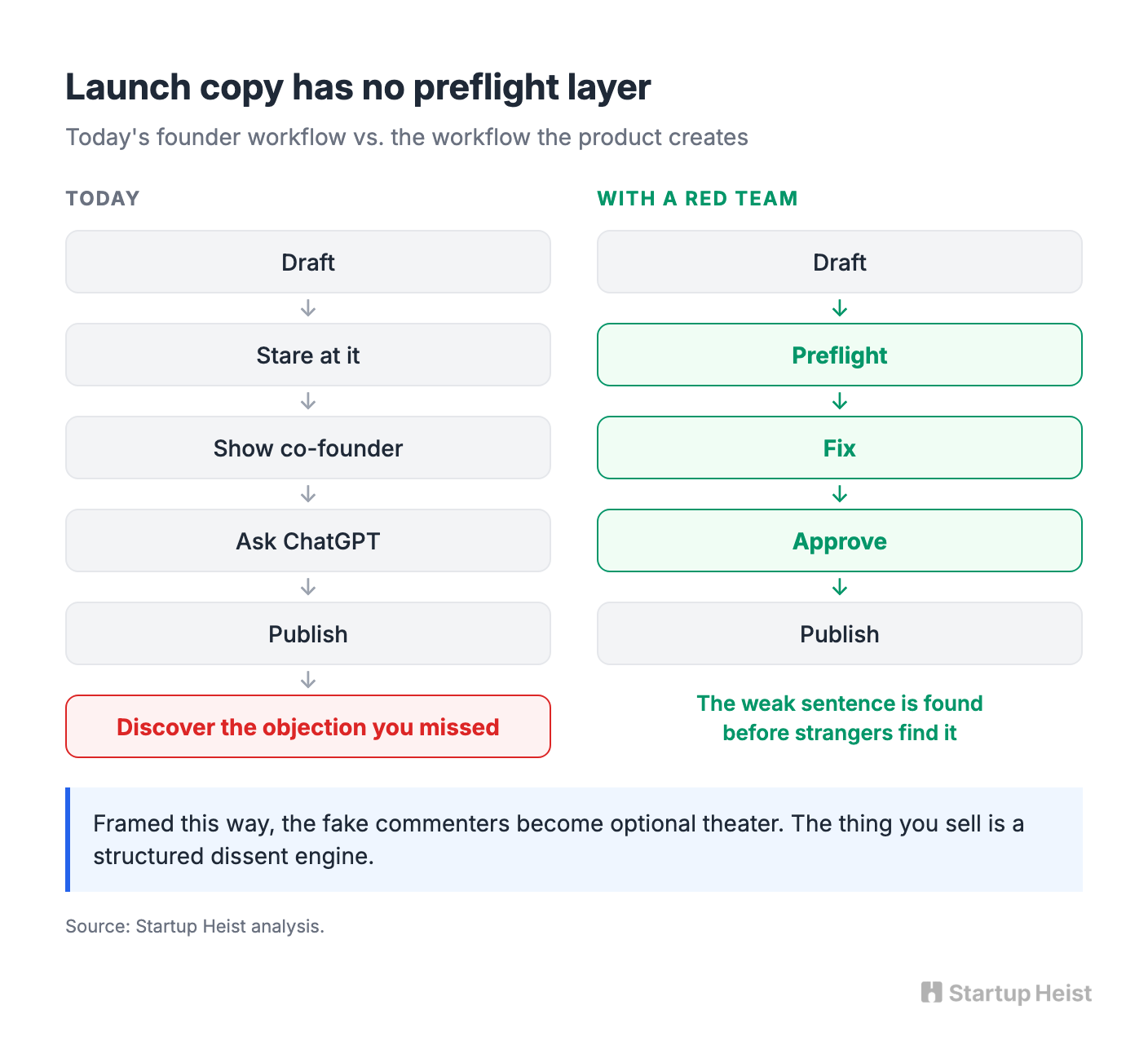
Launch copy has no equivalent preflight layer. Today's founder workflow runs: draft → stare at it → show co-founder → ask ChatGPT → publish → discover the objection you missed. The product inserts a single step: draft → preflight → fix → approve → publish. Framed that way, the fake commenters become optional theater, and the thing you sell is a structured dissent engine.
Why the Window Is Open Now
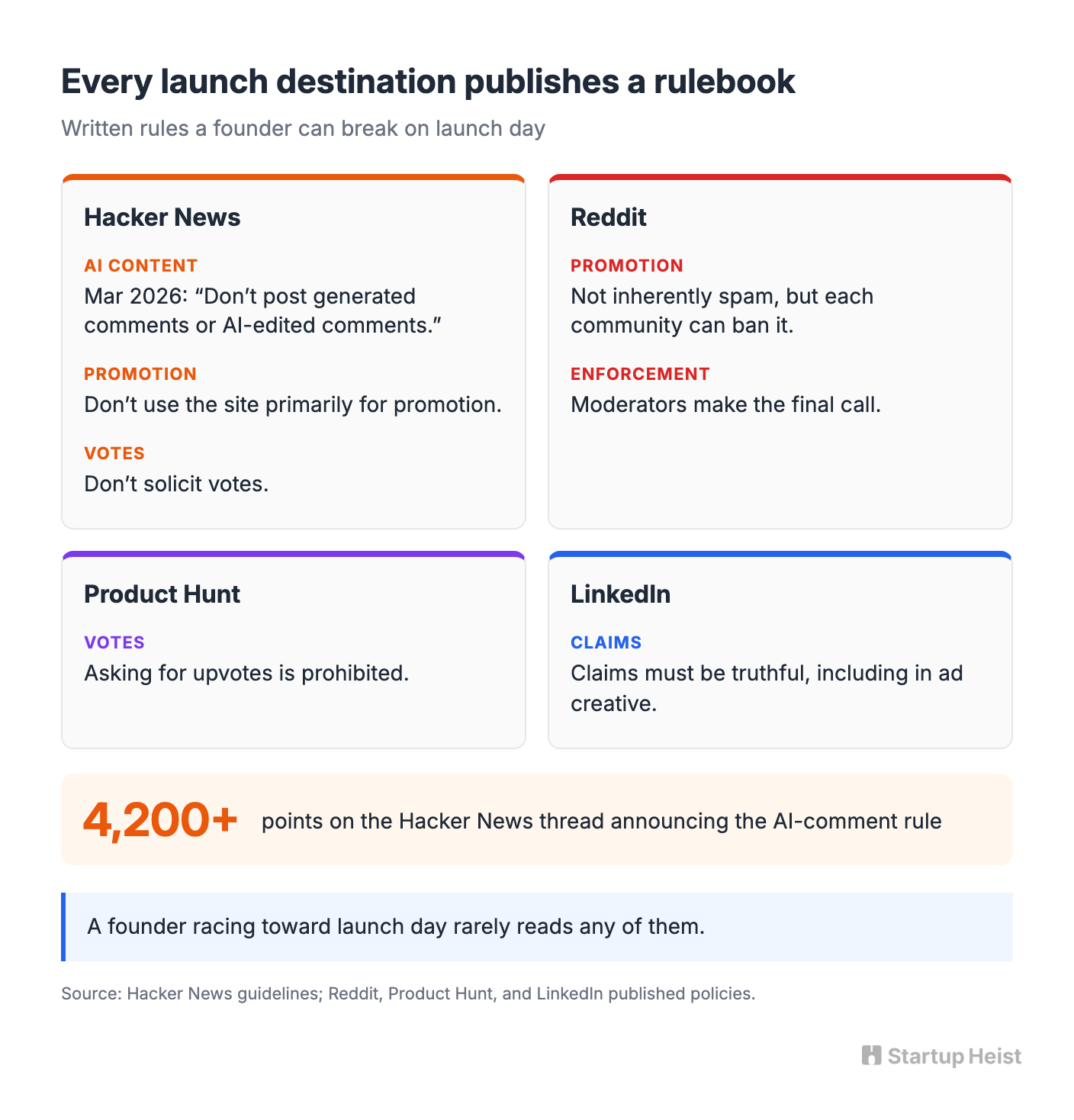
The communities founders launch into are getting stricter, and they are writing it down. In March 2026, Hacker News promoted its unwritten norm against AI comments into the official guidelines: "Don't post generated comments or AI-edited comments. HN is for conversation between humans." The announcement thread drew over 4,200 points. HN already told members not to use the site primarily for promotion and not to solicit votes. Reddit says promotion isn't inherently spam but lets each community ban it, and moderators make the final call. Product Hunt prohibits asking for upvotes. LinkedIn's policies require truthful claims, including in ad creative. Every one of these platforms publishes a rulebook, and a founder racing toward launch day rarely reads any of them.
The stakes behind public messaging keep rising. U.S. internet advertising revenue hit $294.6 billion in 2025, up 13.9%, according to the IAB/PwC report, and Statista projects worldwide social media ad spend at $338.75 billion for 2026. None of that flows to a $29 tool, but it shows how much money rides on words posted in public. Synthetic research has also gone mainstream: in Qualtrics' 2025 research trends survey of over 3,000 researchers, 71% expected synthetic responses to make up more than half of data collection within three years. The category is easy to explain to buyers and hard to win on realism, since the realism race belongs to companies with millions of human interviews.
The gap sits between a general chatbot and a $12,500-a-year research platform. A founder posting a launch announcement needs one reviewer who says: "Paragraph two makes an unsupported performance claim. HN will ask for the benchmark. Your title sounds promotional. You never mention pricing. And if someone calls this an API wrapper, your copy gives you no answer."
The Product: Eight Critics and One Issue Board
Start with four destinations where people deliberately launch things and community norms bite: Hacker News, Reddit, Product Hunt, and LinkedIn. Each gets its own rulebook built from the platform's published policies plus observed conventions. That alone beats a generic "act as five skeptical commenters" prompt, because the software can say something concrete:
Unlock the Vault.
Join founders who spot opportunities ahead of the crowd. Actionable insights. Zero fluff.
“Intelligent, bold, minus the pretense.”
“Like discovering the cheat codes of the startup world.”
“SH is off-Broadway for founders — weird, sharp, and ahead of the curve.”


