


The Blind Box Belongs in Your Coffee Cup
Nearly every coffee subscription box in America sells the same promise, which is less uncertainty. Trade asks what you like and matches you with a bag. Misto does the same across more than 60 roasters, and Bean Box curates from 64 independent roasters and more than 600 coffees. The whole category is engineered to make specialty coffee predictable.
You can play it the other way and make the uncertainty the product.
Four lettered pouches arrive. You brew Coffee A, guess the origin, rate the acidity, pick the tasting notes and commit to your answer. Then you scan the code and learn it was a natural-process Ethiopian with notes of strawberry, bergamot and cacao nib. On to Coffee B.
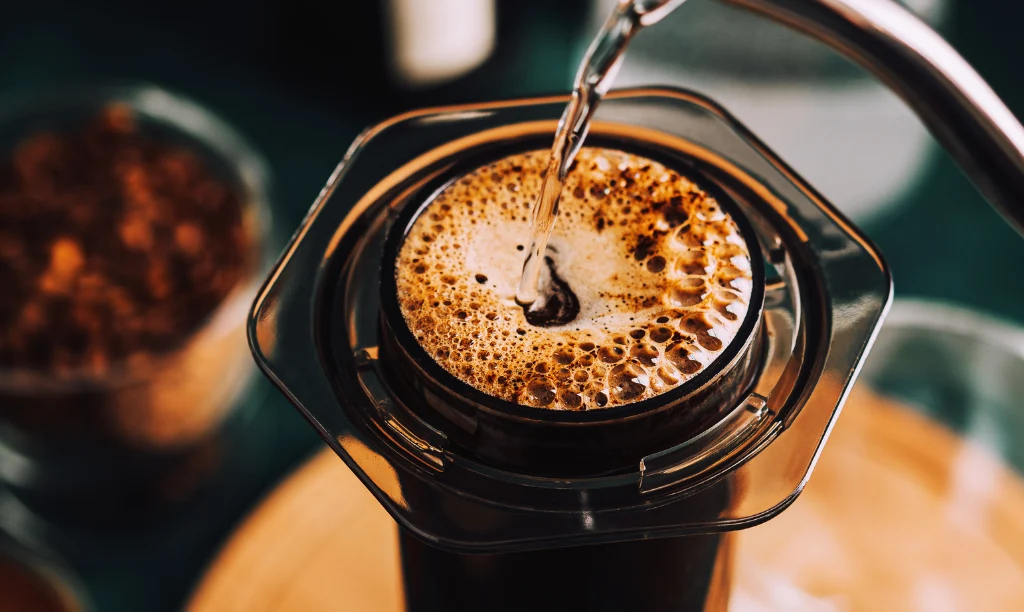
Every box contains a clearly disclosed amount of genuinely good coffee, worth what the buyer paid. Only the identity of each coffee stays hidden until it's tasted, so the buyer gets full value and the surprise rides on top as entertainment. That design choice keeps the concept clear of gacha mechanics and their regulatory problems, and it turns the box into a collectible tasting club that sits between a specialty-coffee subscription, a blind box and a game.
Here's the opportunity:
The money: 1,000 members at $34 a month is $34,000 MRR, plus commissions on full-bag reorders. Pop Mart turned sealed-box reveals into RMB 37.12 billion of 2025 revenue.
Inside:
• Series 001 build: four coffees, one game
• $36 unit economics and the 16-oz postage line
• Roaster pitch email and tasting-data hook
• Eight-week launch and the Series 002 gate
Collectibles already proved the transaction can be the product
Pop Mart didn't invent vinyl figures. It built a system of IP, numbered series, drops, scarcity and sealed-box reveals around them, and the system is what sells. In 2025 the company reported RMB 37.12 billion in revenue, up 184.7%, and THE MONSTERS, the character family that includes Labubu, generated RMB 14.16 billion on its own, up 365.7%. Japan's KURAND ran a version of the same play in drinks. Its online store carries more than 500 craft sakes, plum wines, shochu and liqueurs, all original products sold only through KURAND, and its "Sake Gacha" ships a random selection from that catalog. Since the gacha launched in 2019, KURAND has opened pop-ups in Tokyo and at Narita Airport.
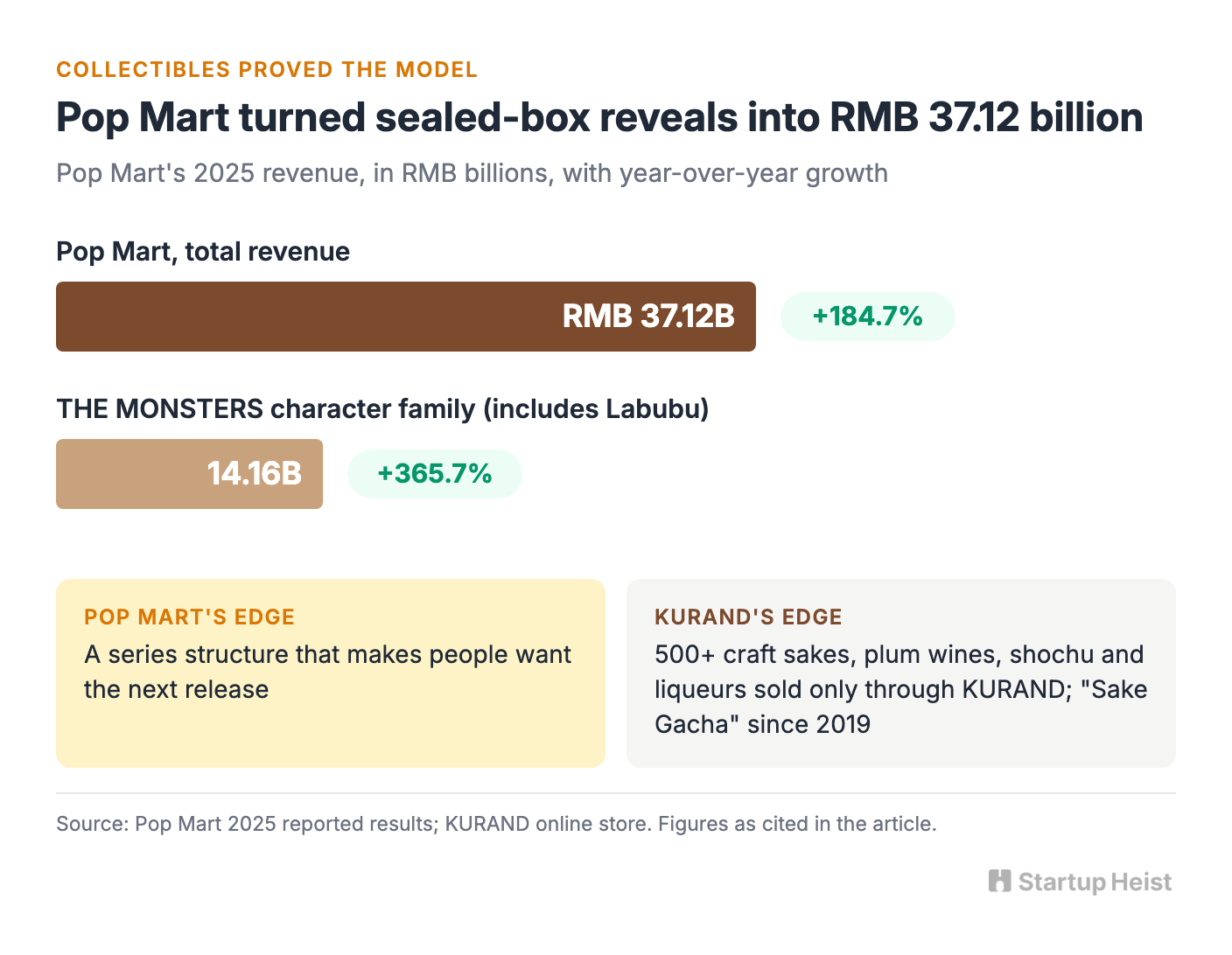
The lesson worth stealing is narrower than "put everything in a blind box," because randomness is cheap. KURAND's durable edge is a catalog nobody else can sell, and Pop Mart's is a series structure that makes people want the next release. The reveal gets a customer's attention, and the discovery machine behind it earns the second purchase.
Why coffee is the right first category
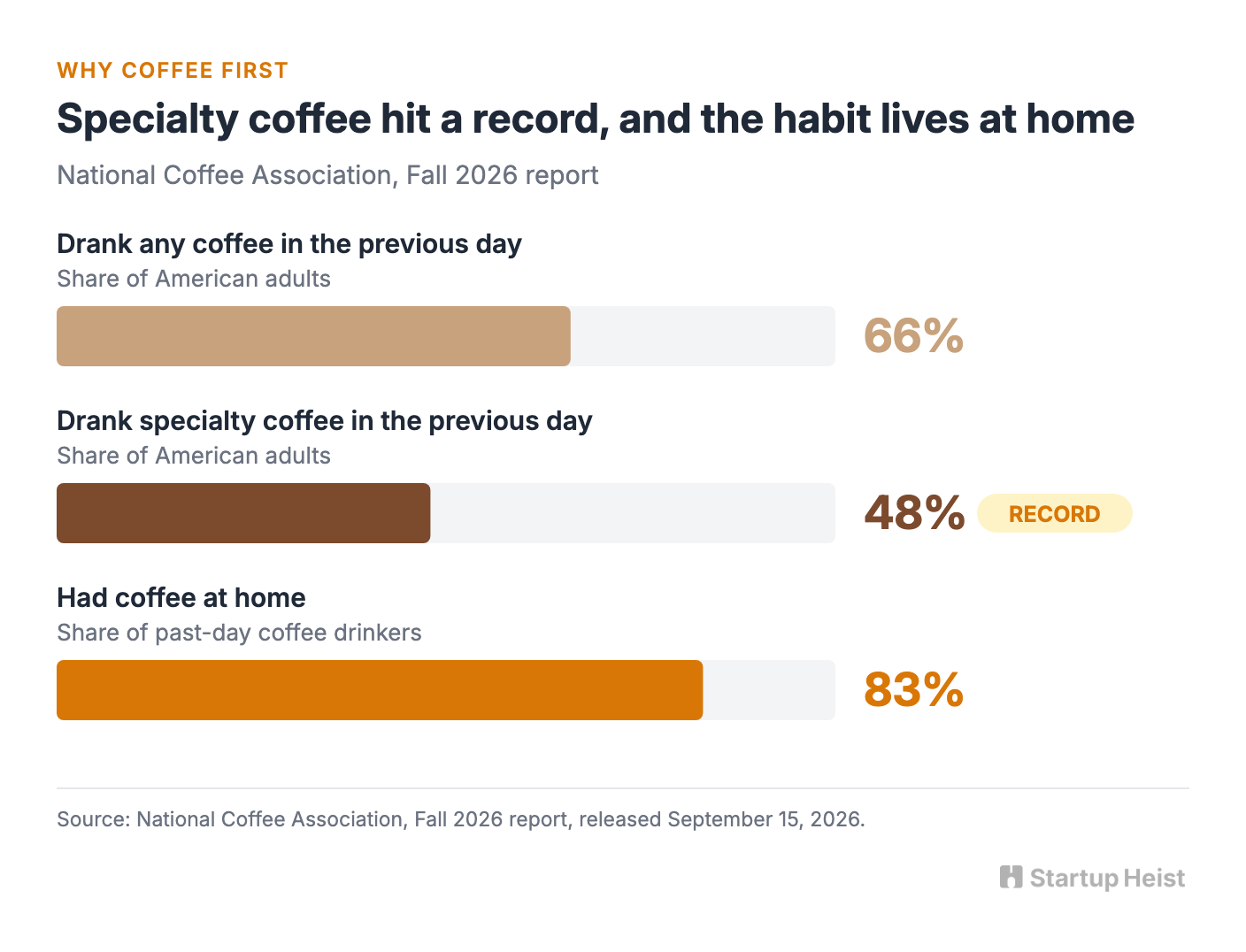
The National Coffee Association's Fall 2026 report, released on September 15, 2026, found that 48% of American adults drank specialty coffee in the previous day, a record. Overall past-day coffee drinking held at 66%, and 83% of past-day drinkers had coffee at home. The habit is enormous, trending premium and already centered on the kitchen counter, where people brew with their own hands.
Coffee also carries unusual discovery density. Two bags can differ by country, farm, elevation, variety, processing method and roast, and those differences show up in the cup clearly enough that a curious amateur can learn to taste them. Beans are light, shelf-stable for weeks and unbreakable, which matters more than it sounds once postage enters the spreadsheet.
The behavior already exists in scattered pieces. Summit Coffee sells a $28.99 mystery box of four 4-ounce bags with a QR code that reveals what you received. Brooklyn's Angels' Cup has shipped blind-labeled tasting flights with a companion app for years, and Driftaway Coffee sells a coffee tasting kit. Olympia Coffee sold a holiday "Secret Sips" blind-tasting capsule, Singapore's Bacha Coffee sold blind-box coffee gift sets for Valentine's Day 2026, and 24-day coffee advent calendars show up every holiday season. All of them sell surprise as a gift or as education for enthusiasts. Nobody yet combines numbered limited drops, collectible design, creator-native distribution and full-bag reorders routed back to the roasters, and that layer, sold as entertainment to everyone else, is the open lane.
Stage the reveal. Never hide the product.
"Mystery coffee subscription" is a Shopify feature, and anyone with beans and mailers can copy it in two weeks. Cheap mystery subscriptions and sub-$30 sampler boxes already exist. If the entire pitch is "we won't tell you which beans you get," the novelty dies by the third box, and customers start to suspect "mystery" means inventory the seller couldn't move.
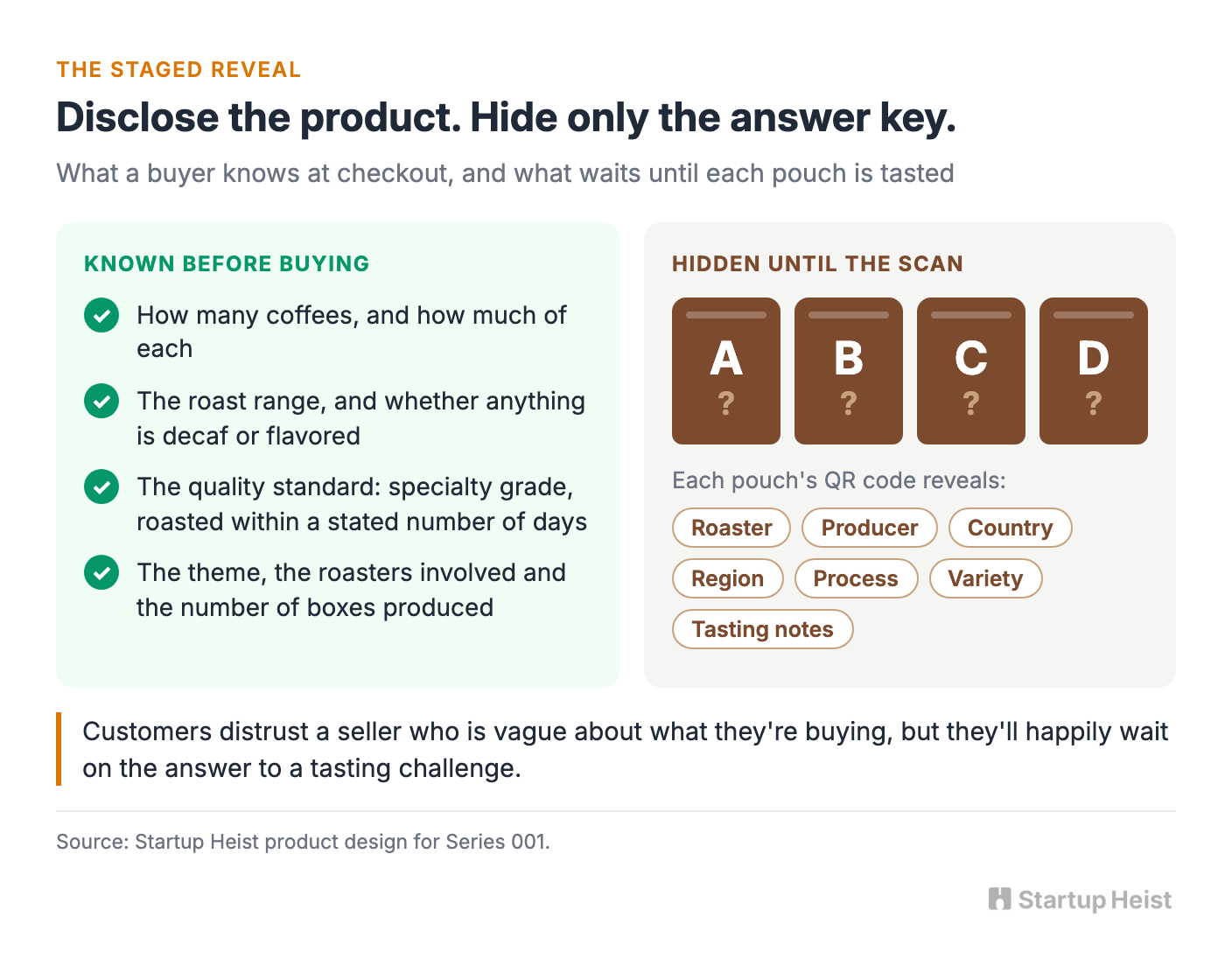
The fix is a precise decision about what stays secret. Before buying, the customer should know:
- how many coffees are included and how much of each;
- the roast range, and whether anything is decaf or flavored;
- the quality standard (specialty grade, roasted within a stated number of days);
- the theme, the roasters involved and the number of boxes produced.
What stays hidden is the answer key. Customers distrust a seller who is vague about what they're buying, but they'll happily wait on the answer to a tasting challenge, and that anticipation is what you're selling.
Series 001: the product to launch
Unlock the Vault.
Join founders who spot opportunities ahead of the crowd. Actionable insights. Zero fluff.
“Intelligent, bold, minus the pretense.”
“Like discovering the cheat codes of the startup world.”
“SH is off-Broadway for founders — weird, sharp, and ahead of the curve.”


