


The Corporate Dinner Back Door
On September 22, 2026, Ande came out of stealth with more than $52 million in seed and Series A funding. Lightspeed, Redpoint, Duration and Sierra led the round, and Bain Capital Ventures participated. Ande's thesis is that corporate entertainment is becoming a real procurement category.
The customer list backs it up. Cloudflare, Salesforce, Navan, Netskope, Monday.com and McGraw Hill already run corporate entertainment through Ande. The company says more than 60 enterprises push over $400 million in annual spend through its network of 93,000 venues and providers across more than 90 cities. Employees find a venue, and the software routes approvals, executes contracts, processes payment and reconciles the expense. Ande pegs the enterprise entertainment market at $325 billion a year.
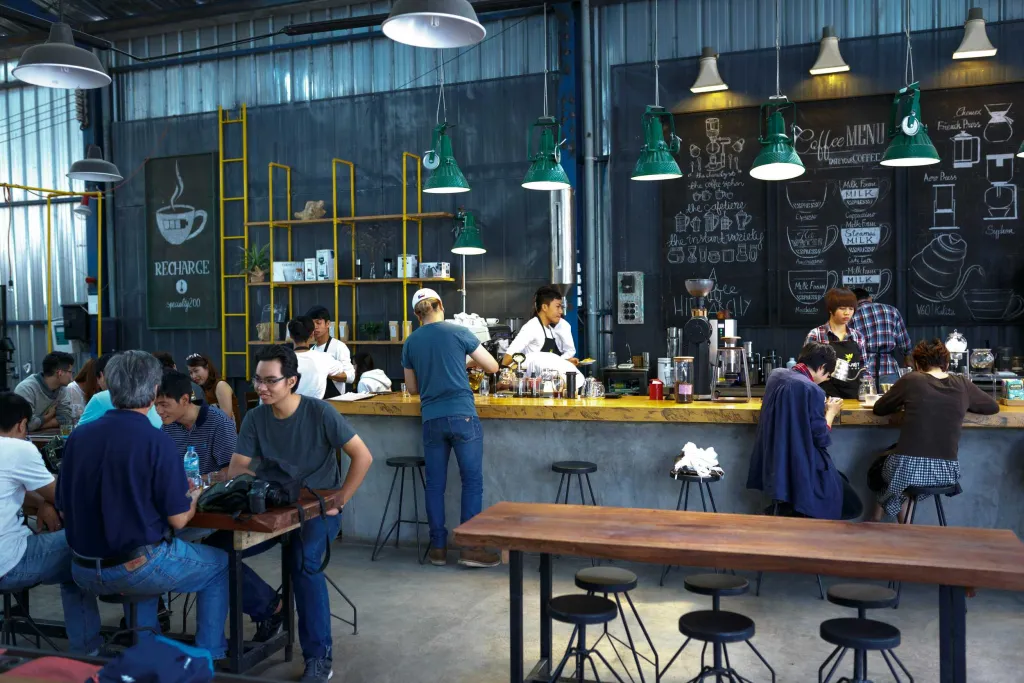
All that venture money is aimed at making corporate dinners easier to buy. The other side of the transaction holds a second business, because independent restaurants were rarely built to sell like B2B vendors. One may have a beautiful private room, a $5,000 food-and-beverage minimum and a chef who can impress a CEO, while the sales infrastructure around that room amounts to a PDF menu, an email inbox and whichever manager picks up the phone.
The opportunity is to turn those restaurants into professional corporate sellers: vendor packets a procurement team can process, standardized group-dining packages, instant proposals and deposits, and a human-assisted pipeline of nearby companies that actually book dinners. Call it Corporate Desk.
The money: Forty restaurants at $129 a month is $5,160 MRR plus $30,000 in setup fees. Upgrading some to the $349 Pipeline plan pushes a few dozen venues toward $10,000 MRR.
Inside:
• MVP scope and a self-serve proposal builder
• Pricing tiers with setup fees and ROI math
• A corporate-account graph for prospecting
• The first-20 sales motion and outreach script
Avoid two traps from day one. Don't build another restaurant event-management system, and don't build a miniature Ande. The business lives in the gap between having a private room and having a working corporate revenue channel.
Corporate dining is turning into procurement
For decades, corporate dining was decentralized. An executive assistant needed a table for 14, a salesperson wanted dinner after a conference, or a law firm needed a private room for recruits, so someone searched Google, called three restaurants, put down a corporate card and filed an expense report.
The old routine looks increasingly strange inside companies that have centralized every other meaningful category of spend. Ande sells consolidation of corporate entertainment spend: one vendor relationship, purchase orders, centralized legal, policy controls and unified invoicing. Ande reports that Navan's teams ran more than 150 events a year and moved them under a single approval framework, and that three teams at Cloudflare ran more than 300 events in just over a year while cutting hundreds of purchase orders to fewer than ten. Navan itself launched a unified Events platform in June 2026, a second sign that corporate event purchasing is centralizing.
Purchasing rewards a different set of capabilities than hospitality does. The corporate buyer wants capacity, minimum spend, menu options, dietary accommodations, room photos, cancellation and payment terms, insurance details, accessibility information and a contact who responds immediately. If procurement gets involved, add tax forms and contracts. A great restaurant isn't automatically a good vendor, and the one that can answer all of that in five minutes beats the one that says, "I'll ask the events manager when she comes in tomorrow."
Restaurants need checks
The urgency on the restaurant side is financial. The National Restaurant Association projects U.S. restaurant and foodservice sales of $1.55 trillion in 2026, up 4.8%, but most of that growth is menu pricing; real growth is closer to 1%. A third of operators told the association they were not profitable in the first half of 2026. In July 2026, 47% reported higher same-store sales while 49% reported lower traffic, the 17th net traffic decline in 18 months.
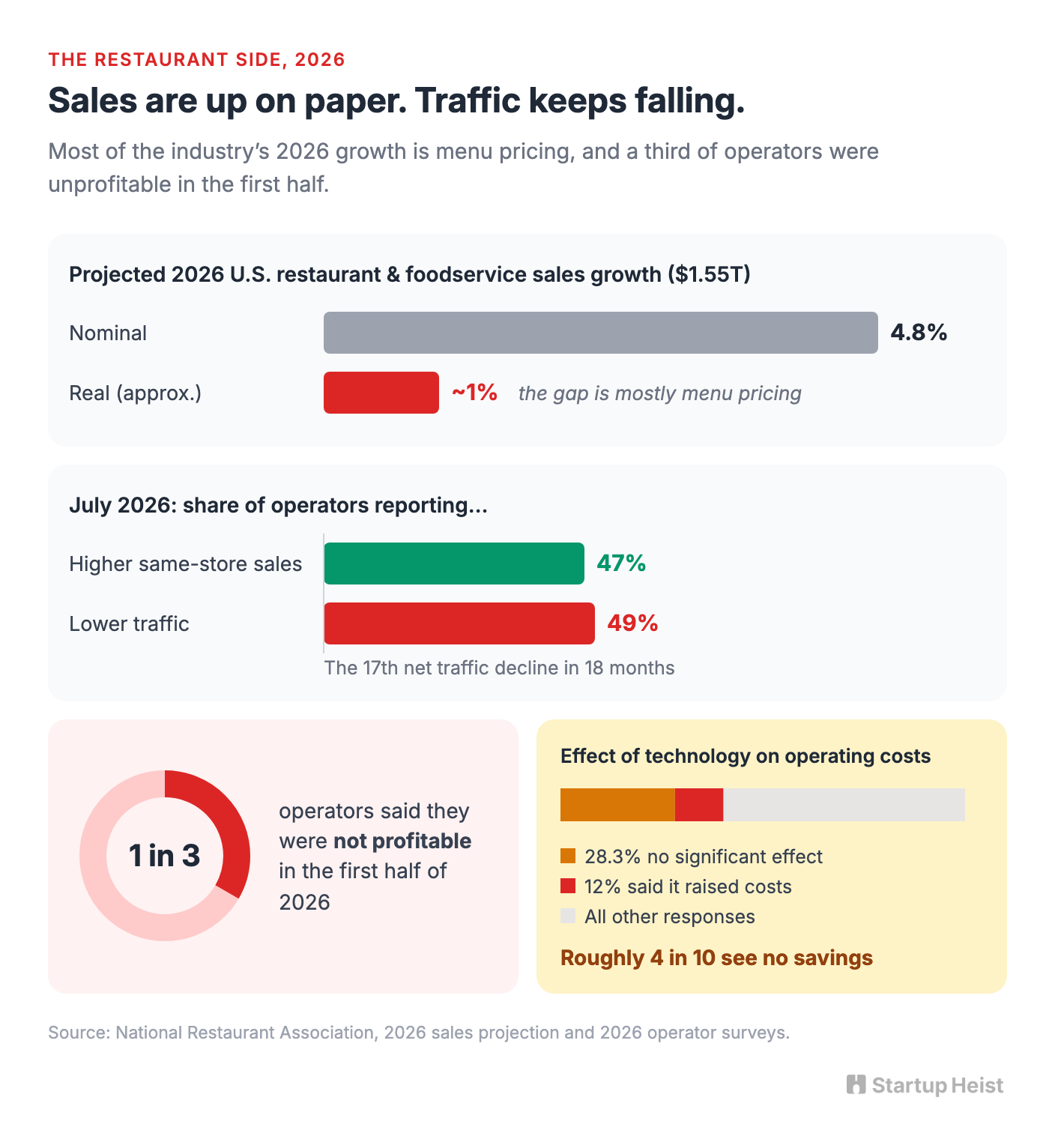
Operators are also tired of software that doesn't pay for itself. In a 2026 association survey, 28.3% said technology had no significant effect on operating costs and another 12% said it raised them, so roughly four in ten see no savings.
The pitch to an owner is simple: sell incremental corporate revenue and keep the software in the background. One extra $2,500 private-dining event each month is $30,000 a year in high-margin revenue from a room that would otherwise sit dark on a Tuesday.
Ande already covers more ground than it appears
Ande isn't only working the enterprise buyer side. It markets a venue product built on four verbs: capture, convert, collect and grow. An AI agent qualifies inquiries, corporate payments settle in a single channel, and venues get a view of their corporate book of business with cross-selling between properties. Its company-reported case studies are strong. Altamarea Group runs 88.9% of its corporate events on Ande. Saison Hospitality handled 1,152 leads in 117 days through the virtual concierge and cross-sold 38 inquiries to sister properties. Waterbar and EPIC Steak in San Francisco went from no payment coverage to running every corporate event through Ande's payment channel.
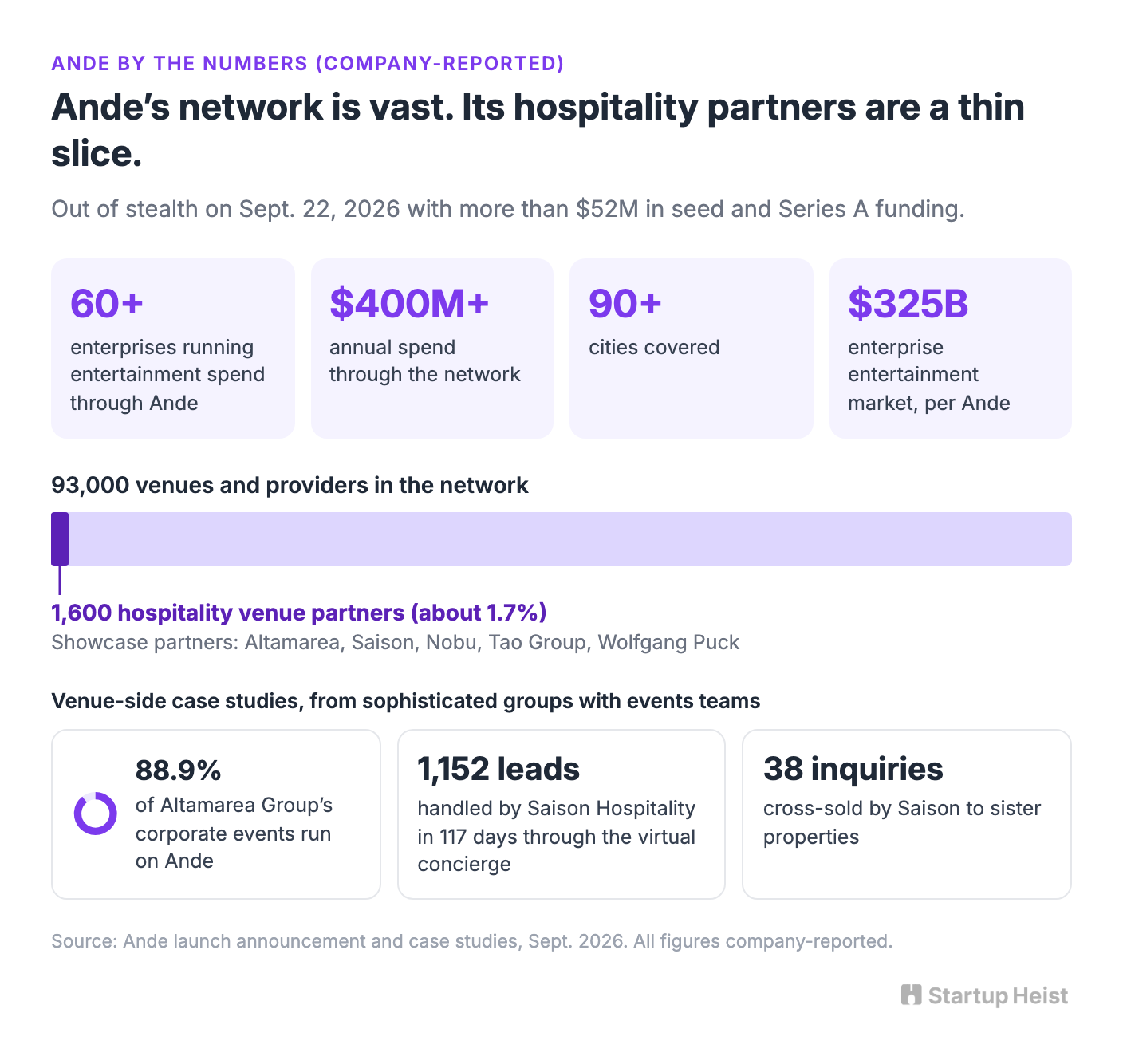
Those partners share a profile. Ande counts 1,600 hospitality venue partners within its 93,000-provider network, and its showcase names (Altamarea, Saison, Nobu, Tao Group, Wolfgang Puck) are sophisticated groups with events teams, inbound volume and brand pull. Underneath them sits a much longer tail of independents without enough inbound private-event demand to justify an AI concierge, and their problem starts earlier in the funnel.
The heist is a timing gap. Ande and networks like it are professionalizing corporate hospitality faster than thousands of independent restaurants can professionalize themselves. Those restaurants need to create the corporate business before anyone can route it.
The incumbents tell you what not to build
Private-event software is crowded. Tripleseat says more than 20,000 venues use its platform for inquiry capture, proposals, contracts, BEOs, e-signature, payments, calendars and reporting. Perfect Venue goes after smaller operators: its Professional plan runs $199 per location per month on annual billing and includes AI email replies, a guest portal, express booking, food-and-beverage minimums and e-sign. A founder charging $149 a month for "Tripleseat but simpler" walks into a knife fight.
Unlock the Vault.
Join founders who spot opportunities ahead of the crowd. Actionable insights. Zero fluff.
“Intelligent, bold, minus the pretense.”
“Like discovering the cheat codes of the startup world.”
“SH is off-Broadway for founders — weird, sharp, and ahead of the curve.”


