


The Roofing Quote Layer
A homeowner notices missing shingles after a storm. They Google roofers, open three local websites, and find the same call to action on every one: request a free inspection.
The contractor sees nothing wrong with that. The homeowner sees a form, an unknown salesperson calling at an unknown time, and no clue whether the project costs $8,000 or $28,000. Somewhere between those two numbers sits a decision they can't make. So they close the tab and keep shopping, or worse, they fill out all three forms and the job goes to whoever calls back first.

The first roofer that shows a credible price range, explains what moves the number, and offers an inspection slot on the spot wins a meaningful share of that traffic. Software for this already exists. Roofr, Roofle, and ResponsiBid all sell some version of instant online quoting, so nobody needs to invent satellite roof estimation. The opportunity is building the lightest, most neutral, multi-brand quoting layer for roofing companies that already have websites, CRMs, and operating systems they refuse to replace.
Here's what that looks like as a business:
The money: 100 independents at $149 a month plus ten portfolio groups at $2,500 clears $39K MRR; one incremental roof job covers a contractor's annual bill.
Inside:
• Six-step homeowner flow, built in 6-8 weeks
• Three-tier pricing: $149 to $2,500-plus
• Hail-country GTM: 100-contractor outreach plan
• Confidence-graded estimates that protect trust
The product is a white-label instant quote widget. A homeowner enters an address, confirms a few project details, gets an instant ballpark range, and books an inspection. Behind the scenes, the software pulls rooftop geometry, applies the contractor's local pricing rules, routes the lead to the right branch, and pushes everything into whatever CRM the company already runs.
For an independent roofer, that's a better website funnel. A private-equity-backed roofing group gets something more valuable out of it: a standardized customer-acquisition layer that rolls out across ten, twenty, or fifty acquired brands without forcing anyone onto the same website or operating software. That's the heist.
A $92 billion industry that can't quote a price
Three things make roofing an unusually good vertical for a focused conversion product.
It's enormous and fragmented. IBISWorld puts U.S. roofing contractors at roughly $92.5 billion in 2026 revenue spread across about 109,000 businesses. KPMG's 2026 roofing report sizes the residential and commercial contracting market between $50 billion and $100 billion and estimates the two largest operators together control only 4% to 6% of it. The same report describes 2025 roofing M&A volume as an all-time high; one deal tracker counted 134 platform acquisitions that year, more than double 2021's pace, with private equity and strategic buyers still active into 2026. Fragmentation this deep means thousands of potential customers and no dominant gatekeeper.
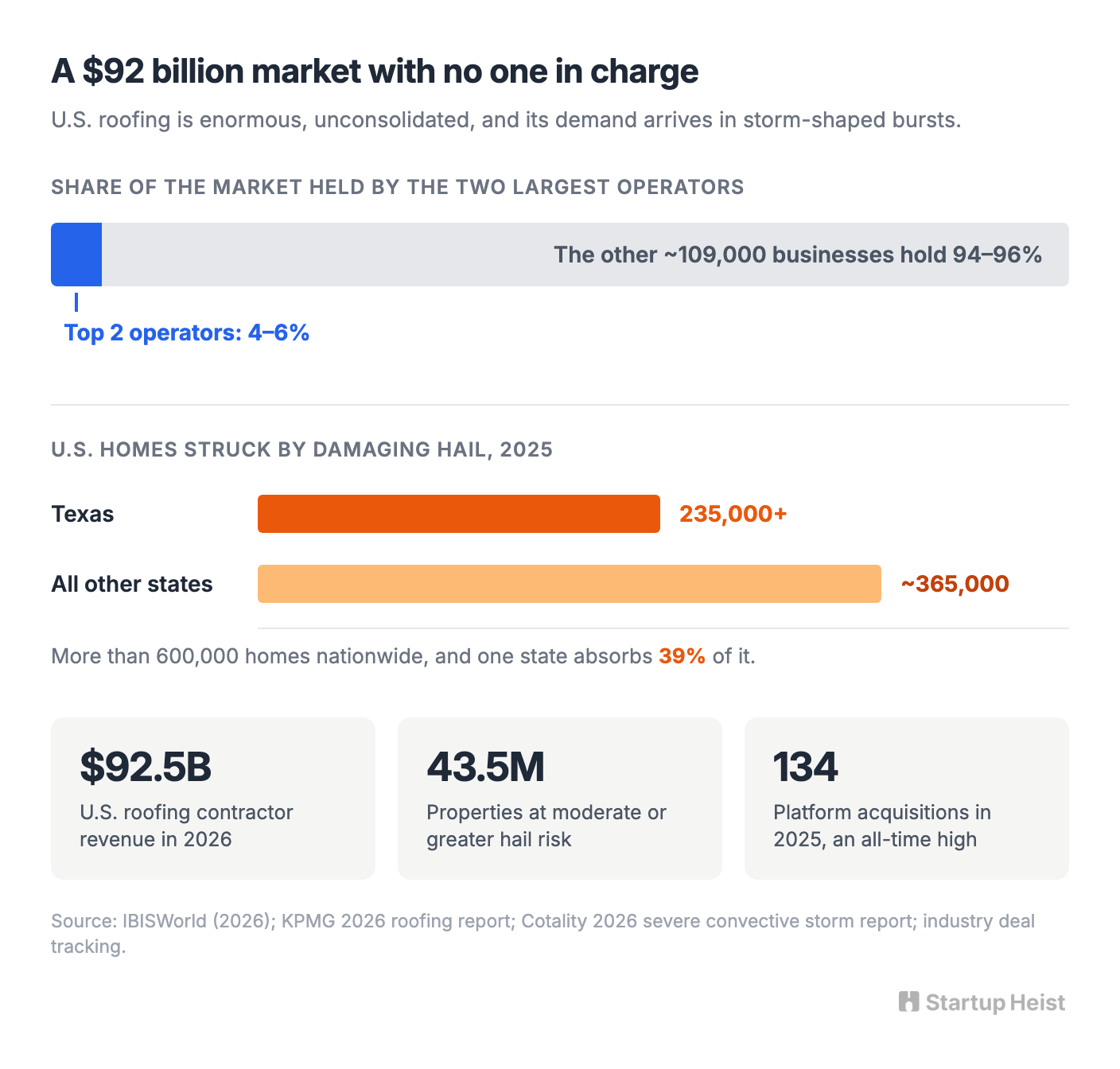
Demand arrives in violent bursts. Cotality's 2026 severe convective storm report counts 43.5 million U.S. properties facing moderate or greater hail risk. In 2025, damaging hail struck more than 600,000 homes, including over 235,000 in Texas alone. When a storm crosses Dallas or Oklahoma City, thousands of homeowners start shopping within the same seventy-two hours. Contractors can't staff a call center for a surge that shows up six times a year. An automated quote-and-booking funnel absorbs the spike while competitors let calls roll to voicemail.
And the ticket size makes the math trivial. A residential replacement runs five figures. One incremental job pays for a few hundred dollars of monthly software many times over, which means the product sells on booked inspections and won jobs rather than vague productivity promises.
Private equity changes the buyer
The pitch to an independent roofer is simple: turn more of the traffic you already pay for into qualified appointments. The PE-backed buyer has a different problem, and a more expensive one.
A roofing platform acquires respected local companies precisely because homeowners trust the local names. The parent wants to keep those brands while standardizing finance, marketing, and reporting behind them. The result is a digital mess. One branch runs WordPress and AccuLynx. Another runs Webflow and JobNimbus. A third has a ten-year-old website wired to a generic contact form. Pricing, service areas, and follow-up discipline vary by location, and replacing everything at once is expensive and politically brutal, because the acquired operators fight to keep the workflows that built their businesses.
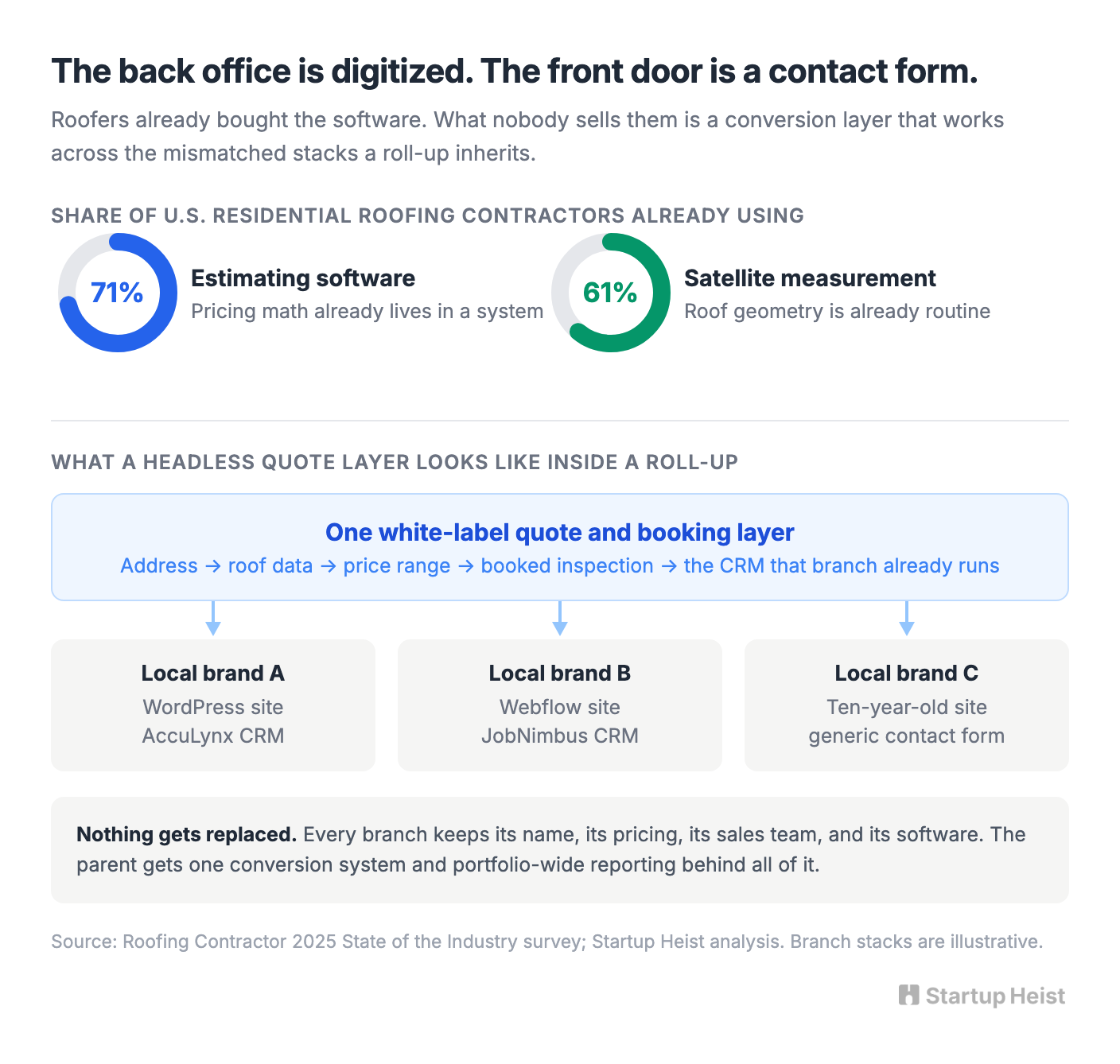
A headless quoting layer skips that fight entirely. The parent deploys one conversion system across every website while each branch keeps its name and colors, its material packages, its local pricing, its sales team, its CRM, and its inspection calendar. The holding company gets centralized conversion reporting while the local operator keeps running the roofing business. None of it competes with contractor-management software; the widget is the front door to the stack each contractor already owns.
The timing works because the industry is already digitized where it counts. Roofing Contractor's 2025 State of the Industry report found 71% of residential contractors using estimating software and 61% using satellite or aerial measurement. These companies don't need another operating system. They need the systems they already bought to convert more demand, and nobody is selling them that as a standalone product.
The incumbents are building the wrong thing
There's no first-mover story here, and that's good news. Roofr sells an Instant Estimator add-on at $149 per month, or $125 on annual billing, and surrounds it with CRM, measurements, proposals, and payments. ResponsiBid runs $179 to $229 per month and has expanded from quoting into scheduling, invoicing, and jobs. Roofle's Roof Quote PRO is already a white-labeled instant-quote widget with native integrations into JobNimbus and AccuLynx. Three funded companies validating the category means "instant roofing quote" is a proven purchase, and it also means the phrase is worthless as positioning.
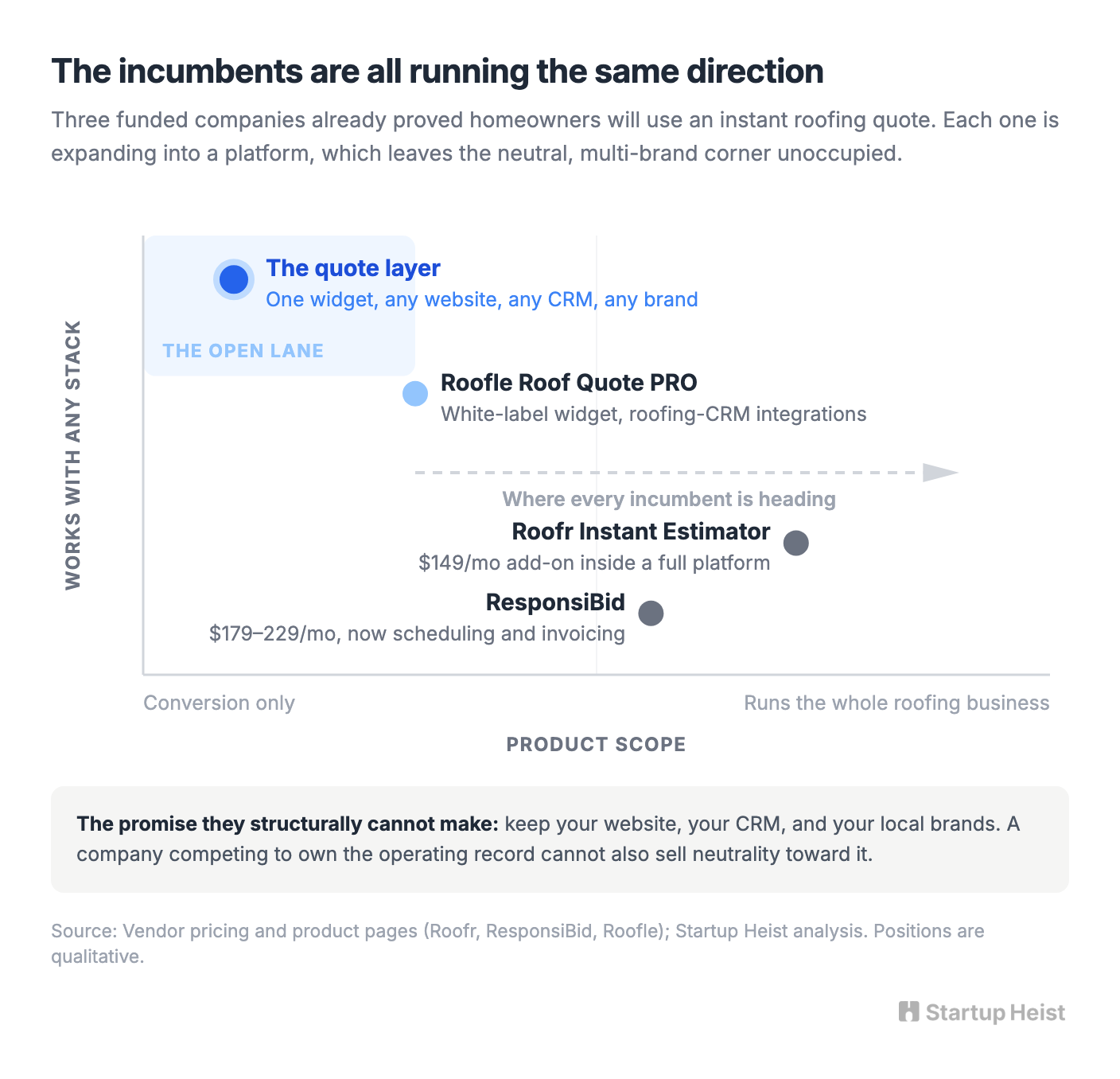
The opening is in what these products are becoming. Every one of them is expanding toward platform status, pulling customers deeper into their own ecosystems and competing to own the operating record. A new entrant should run the opposite direction: skip the CRM, the crew management, the material orders, and the insurance documents, and build the best conversion layer regardless of what sits behind it. The payoff is a promise the platform players structurally can't match: keep your website, your CRM, and your local brands, and add instant ballparks, inspection booking, and portfolio-wide conversion reporting in an afternoon.
That's a narrower product than the incumbents sell, and a far easier one for a multi-location buyer to say yes to.
What the product actually does
The homeowner experiences a six-step flow, and each step has one job.
Unlock the Vault.
Join founders who spot opportunities ahead of the crowd. Actionable insights. Zero fluff.
“Intelligent, bold, minus the pretense.”
“Like discovering the cheat codes of the startup world.”
“SH is off-Broadway for founders — weird, sharp, and ahead of the curve.”


