


The Restaurant Table That Remembers
The one object on the table that isn't asking you for something
Sit down at a good restaurant tonight and count the technology pointed at you. A QR code for the menu, a tablet swiveled around for the tip, a loyalty prompt at checkout. A review request by text an hour later, a newsletter box printed on the receipt. Every one of them exists to extract something: an order, an email, a rating, a return visit.
There is one object on that table that wants nothing.
It's small, made of ceramic or brass or thick acrylic, and it sits near the candle where it reads as part of the room rather than part of the point-of-sale stack. Three words are cut into the face:
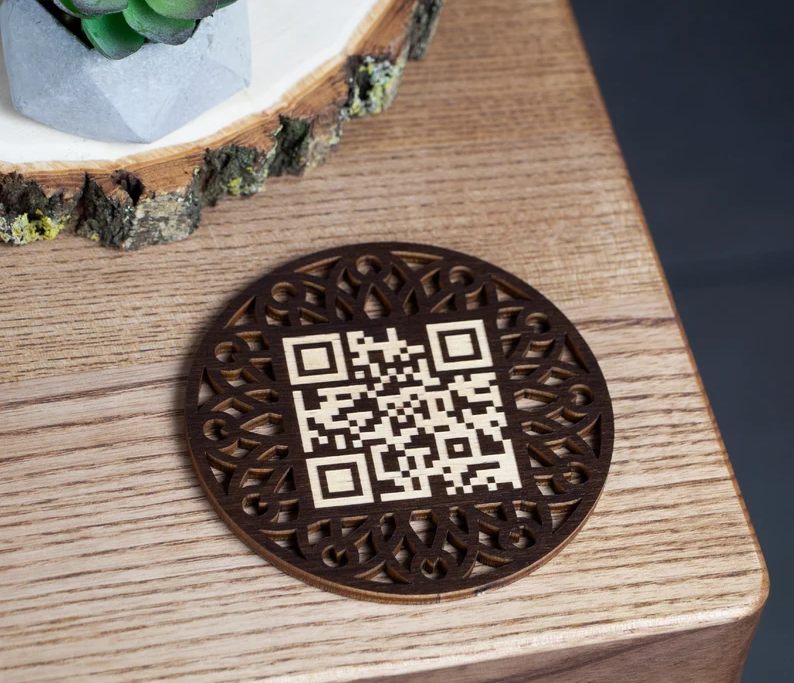
This table remembers.
You tap it with your phone. No app, no account, no form. Up comes a short stack of things left by people who sat in your chair.
March 14, 2026. "We came here after she said yes."
June 2, 2026. A crude drawing of the house martini.
August 21, 2026. "Dad's 70th. He ordered the same thing he ordered here in 1998."
Then one line at the bottom: Leave something for the next person.
That's the product. Everything behind it is plumbing. Stripped of the romance, here's the business:
The money: 100 venues at $129 a month is $12,900 MRR. A thousand venues is about $1.55 million a year, run by one or two people.
Inside:
• $495 activation offer that opens the door
• Full MVP scope: two web apps, one queue
• Moderation design that protects the venue
• Ten-restaurant GTM with the cold email
The chip that makes it work is incidental. The word that sells it is memory.
Restaurants digitized everything except the part guests remember
Restaurant technology has gotten very good at answering one question: what do we know about this guest?
SevenRooms, now owned by DoorDash, runs guest profiles across more than 13,000 venues worldwide and assembles over a hundred data points per diner from preferences, visit history, and real-time point-of-sale spend. Resy moved deeper into service itself in August 2026, first by folding Tock's restaurants, wineries, and experiences onto its platform on August 11 to push the combined network past 25,000 venues, then two days later by pushing guestbook notes, preferences, visit history, and special occasions directly onto Toast handhelds mid-service. OpenTable sells the same intelligence at $149, $299, and $499 a month, before per-cover fees that run $0.25 to $1.50 and quietly turn a busy 2,500-cover restaurant's bill into $1,800 to $2,650 a month.
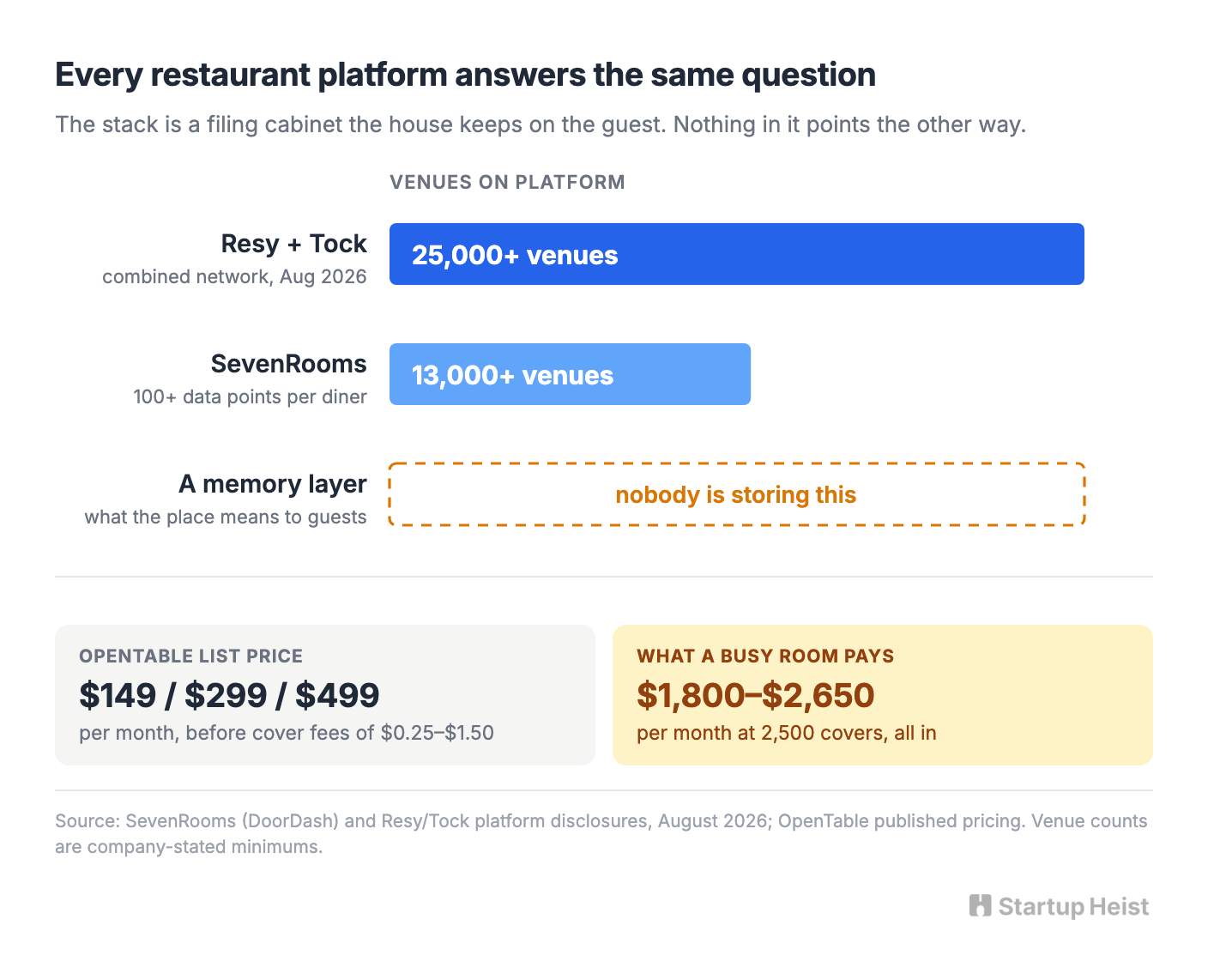
Every one of those systems is a filing cabinet the house keeps on the guest. Nothing in the stack points the other way, and nothing answers the second question: what does this place mean to the people who have been here? A proposal at table nine leaves no trace once the check clears. A twentieth anniversary shows up as a reservation record and a spend total. The restaurant hosts the most emotionally loaded hour of somebody's year and keeps a receipt.
There's no point building another restaurant CRM. That land is taken. The opening is the layer that sits on top of whatever the restaurant already runs and holds the part nobody is storing.
Why emotion becomes a line item
The National Restaurant Association projects $1.55 trillion in U.S. restaurant and foodservice sales for 2026 on 1.3% real growth, with 42% of operators reporting they were not profitable in 2025. Popmenu's January 2026 survey of 328 operators and 1,000 consumers found nearly seven in ten diners planning to cut back on dining out this year.
That's not an industry in the mood for cute software.
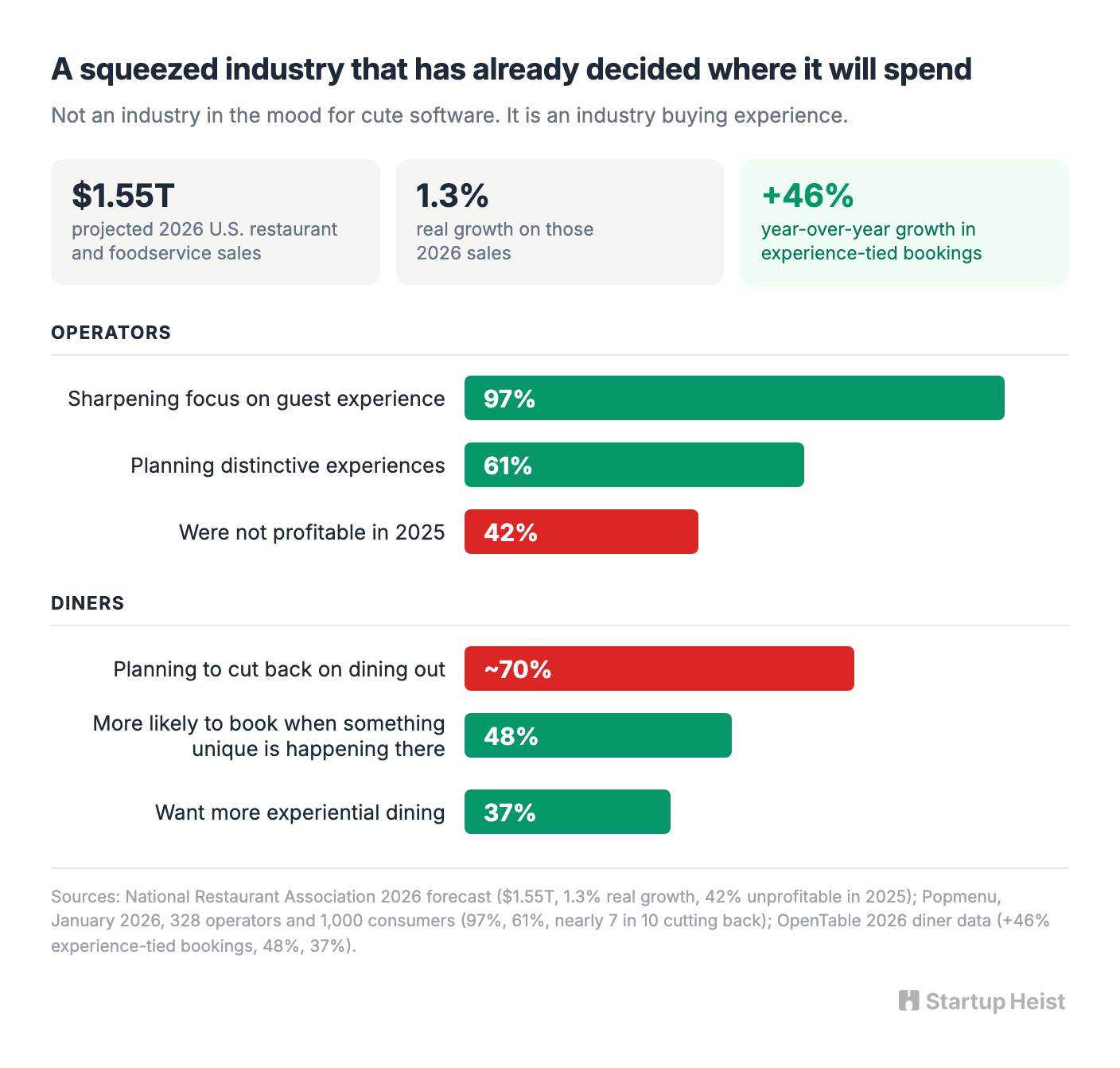
It is, however, an industry that has already decided where it will spend. In that same Popmenu study, 97% of operators said they were sharpening focus on guest experience and 61% planned to run distinctive experiences: theme nights, interactive dinners, nostalgia pop-ups, unusual ambience. OpenTable's 2026 diner data shows bookings tied to experiences up 46% year over year, 37% of Americans wanting more experiential dining, and 48% saying they're more likely to book a restaurant when something unique is happening there. Thirty-six percent now prefer a neighborhood gem to the newest opening.
The distribution math is friendlier than it looks. Toast's blind survey of 1,466 U.S. adults, run October 9 to 15, 2025, found word of mouth is still the top way people find a restaurant at 38%, with walking or driving past it second at 30%. Toast and Resy's 2026 regulars research supplies the other half: as much as 50% of order volume can come from 7% of guests, who book ahead for 83% of their visits against 48% for everyone else.
Nobody needs a million people to touch this thing. A few hundred guests per restaurant is enough, and those few hundred are already the ones paying the rent.
The behavior is proven. It's just trapped inside weddings.
A healthy, competitive market of digital guestbook products exists right now, and every one of them serves weddings. Wedibox, Guestlense, Gather Shot, Rompolo, and Quickpix all do a version of the same thing: put a QR code on a table card, and guests upload photos, write notes, and record voice messages from their own phones into one shared gallery the couple keeps.
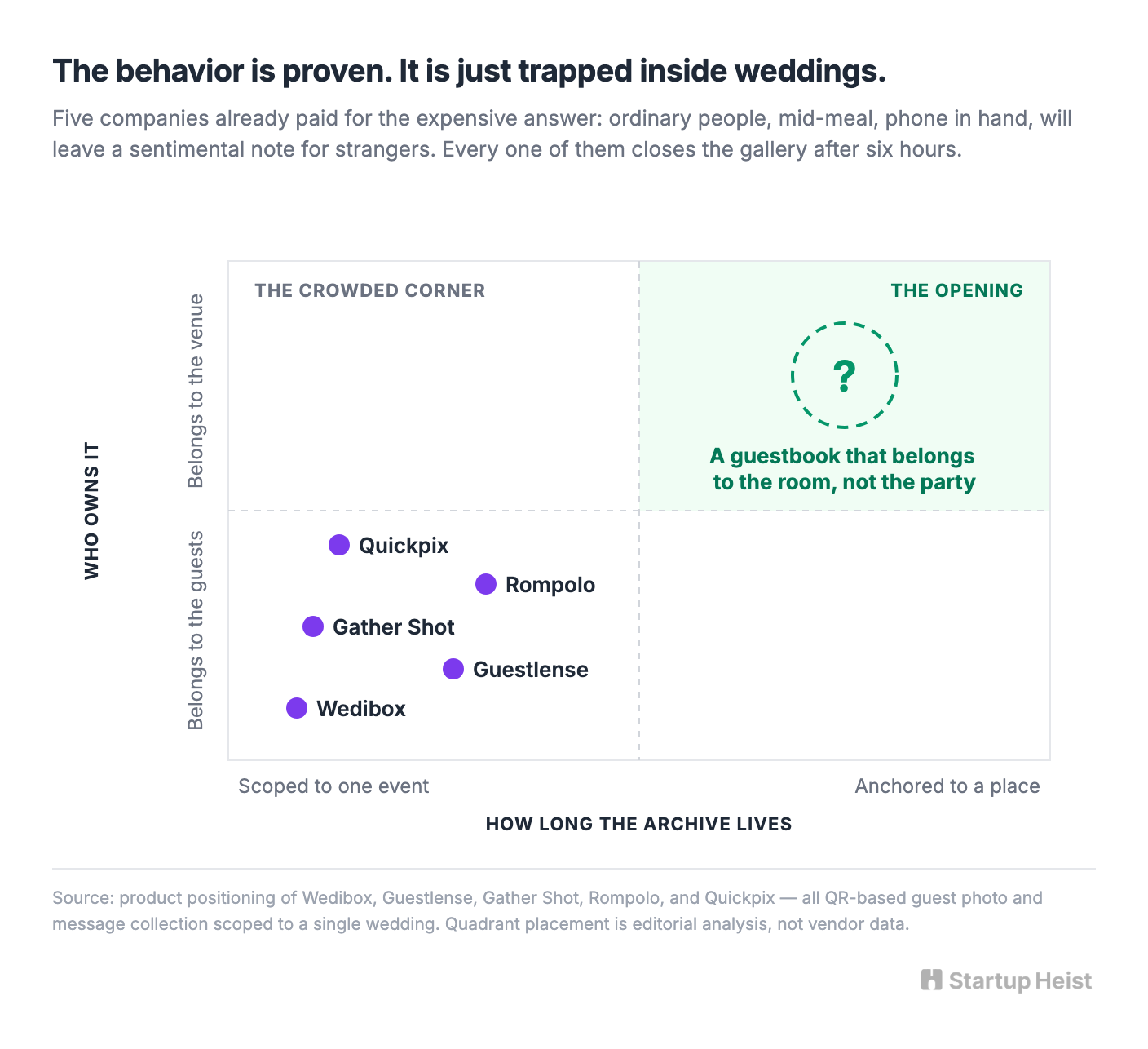
Those companies have already paid for the expensive answer. Ordinary people, mid-meal, at a table, holding a drink, will pull out a phone and leave a sentimental message for strangers and for the future. What none of them do is persist. A wedding guestbook lives for six hours and belongs to two people. The gallery closes, the QR code dies, and the venue that hosted the whole thing gets nothing. Nobody has taken the proven behavior and anchored it to a place instead of an event.
The tap-to-open hardware is equally settled. Vendors like Tapsy already put NFC tap targets on tables and counters that open browser flows with no app install, mostly for feedback and review capture. The chip is a commodity. Plain tags run under a quarter each in bulk, and custom shapes start around 500 units. The technology buys you nothing defensible, which is fine, because the guest behavior is the asset and nobody has claimed it yet.
Sell the activation before the subscription
Unlock the Vault.
Join founders who spot opportunities ahead of the crowd. Actionable insights. Zero fluff.
“Intelligent, bold, minus the pretense.”
“Like discovering the cheat codes of the startup world.”
“SH is off-Broadway for founders — weird, sharp, and ahead of the curve.”


