


The Group Checkout Heist
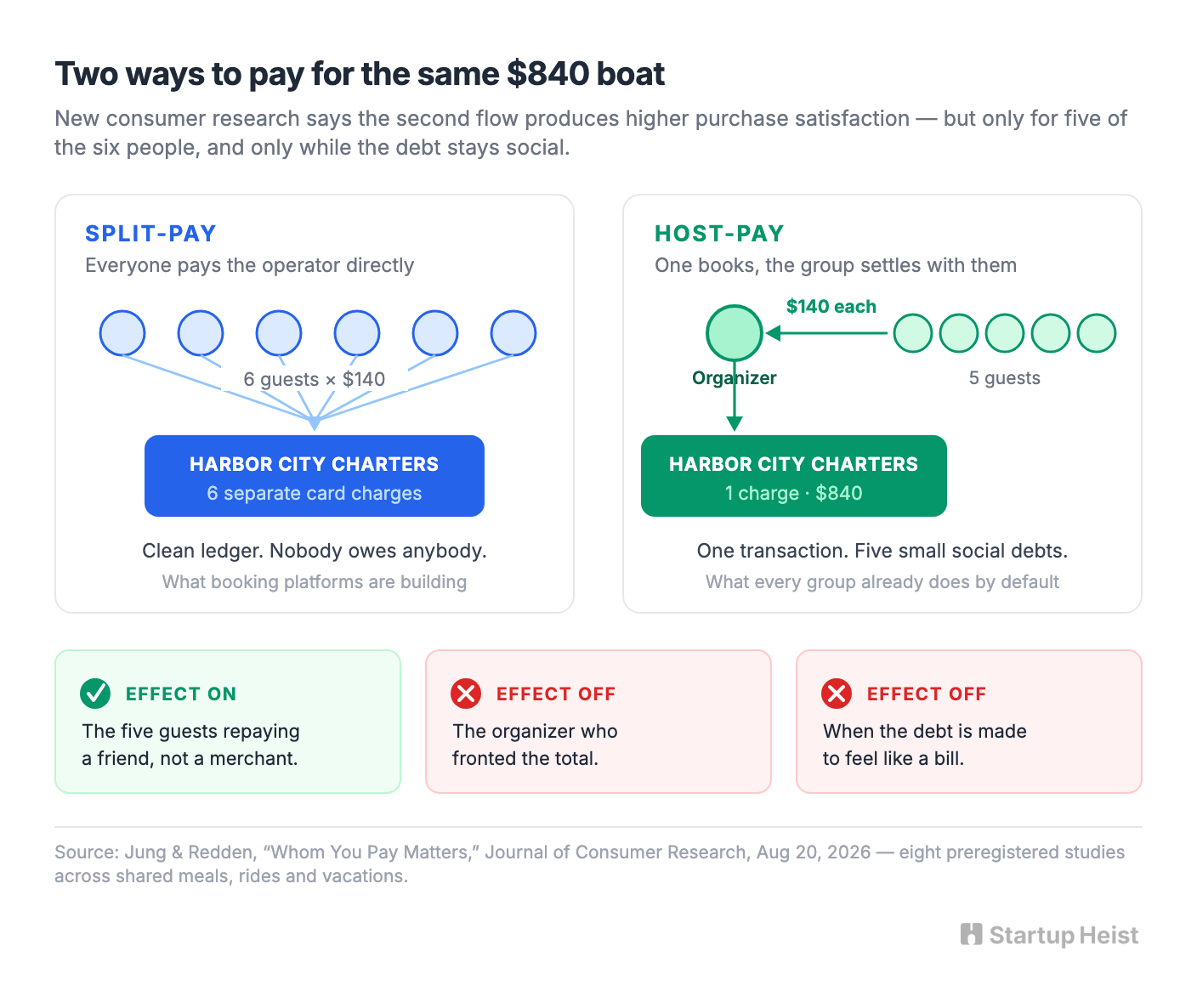
Six friends book an $840 private boat tour. One of them puts it on a card, then spends the next week nudging five people in a group chat.
Booking software companies look at that scene and see a defect. The fix writes itself: let all six pay $140 directly to the operator, and nobody ends up owing anybody anything.
New consumer research suggests that fix may quietly make the purchase worse.
On August 20, 2026, Han Young Jung and Joseph Redden published Whom You Pay Matters: How the Payment Path of Shared Expenses Affects Purchase Satisfaction in the Journal of Consumer Research. Across eight preregistered studies covering shared meals, rides, and vacations, people reported higher purchase satisfaction when one consumer paid the vendor and the others repaid that person, compared with everyone paying the vendor directly. The mechanism the authors identify is relief: settling a small debt to a friend delivers a moment of resolution that paying a merchant never produces.

The effect has a switch on it. It disappeared when the financial obligation was made salient, and it disappeared for the person who fronted the total. The satisfaction lift belongs to the five people paying a friend back, and it holds only while that debt stays social rather than financial. Make it feel like a bill and the lift evaporates.
So there's a replicated psychological asymmetry sitting inside a workflow that every booking platform in the tours-and-activities category is currently trying to engineer away. Nobody has tested the two payment architectures against each other on live bookings, which means the answer you'd be selling doesn't exist anywhere yet.
Here's the opportunity:
The money: 1,000 operator locations at $125 a month is $1.5M ARR. Ten pilot operators at $79 buys the first real data.
Inside:
• The MVP scope, and what to refuse to build
• Three-tier pricing from $79 to $599
• Cold email that gets escape rooms on a call
• Kill criteria set before you write code
The industry is optimizing the obvious variable
Group commerce runs on one person. Someone finds the escape room, the charter, the cooking class, sells the idea to the group, negotiates the date, counts heads, and books.
Then money gets involved, and the booking platforms treat what follows as a collections problem. Xola has shipped exactly this. Its Split Payment feature works on customer-facing checkout and in the back office, lets the organizer reserve and invite others to contribute, and supports custom amounts or paying off the outstanding balance. Xola positions it as removing the burden of one person fronting the full cost.
Xola's own support documentation shows how stubborn the problem is. When split pay is used, the organizer's card still shows a pending charge for the full purchase value, cleared only once another guest pays anything at all. The checkout warns them about it. Even in the product built to stop one person from fronting the total, the organizer watches the total land on their card anyway. The market leader ships a warning label with the solution.
That's the shape of the whole category: the intent is right, and the execution carries friction nobody has measured against the alternative. The alternative is the flow every group already runs by default, where one person pays and everyone settles up after. Booking software treats it as a bug. The research suggests it may be a feature.
The word doing the work is may. A consumer psychology paper is not evidence that putting a $1,500 charter on one person's Visa increases bookings. Real commerce has credit limits, cancellations, weather, deposits, flaky friends, and organizers who flatly refuse to front the money. That's why the product sells the test rather than the finding.
The product: an experimentation layer for group checkout
Take an operator called Harbor City Charters. A six-person sunset booking runs $900.
Your software doesn't replace Harbor City's booking system. It adds one decision point at checkout: everyone pays their share, or one person books now and the group settles afterward. If the booking runs through the host flow, Harbor City receives one ordinary $900 transaction through the processor it already uses. Your company never touches the money, and that distinction is load-bearing.
After the booking clears, the organizer lands on a Harbor City-branded page. You are hosting Saturday's Sunset Charter. Six guests, $150 each. They confirm five names and contact details, and each guest gets an individual link. The guest page is deliberately quiet. Saturday is booked. Your share is $150. Alex covered the reservation, send your share directly to Alex when you're ready. Underneath sit whatever repayment rails Alex chose to share: a Cash App payment link, a Venmo handle, PayPal, a QR code, or plain instructions.
Those rails already work. Cash App launched shareable payment request links on February 10, 2026, built to be dropped into a text or a DM and open a pre-filled payment on the other end. Block shipped it after finding that 53% of Gen Z customers send a warm-up text before they dare send an actual payment request. Venmo Groups has auto-calculated shared balances across groups of up to 30 since 2023.
None of that needs rebuilding. What you add is merchant context, and that context is the entire asset. The operator's system knows which booking created the group, who organized it, what each share should be, whether settlement completed, which architecture the booking used, whether it was cancelled or refunded, and whether the group came back.
Venmo and Splitwise know who owes whom, and they have no idea what happened to the merchant afterward. Your system does, and that's the whole business.
Why tours and activities are the right laboratory
The wedge goes into a single under-digitized category, which is the only reason a solo builder gets traction against companies with real engineering teams.
U.S. domestic leisure travel spending is forecast to reach roughly $909 billion in 2026, up 0.9% on the year, per the U.S. Travel Association. Underneath that sits the number that matters. Arival and Phocuswright put the global tours, activities and attractions market at $253 billion in 2024, growing to a projected $342 billion by 2029, with experiences bookings up 17% in 2024 against 6% for travel overall. The category is also barely digitized: only 33% of experiences were booked online in 2025 against 64% of travel bookings overall, and more than 70% of operators are small or micro-businesses.
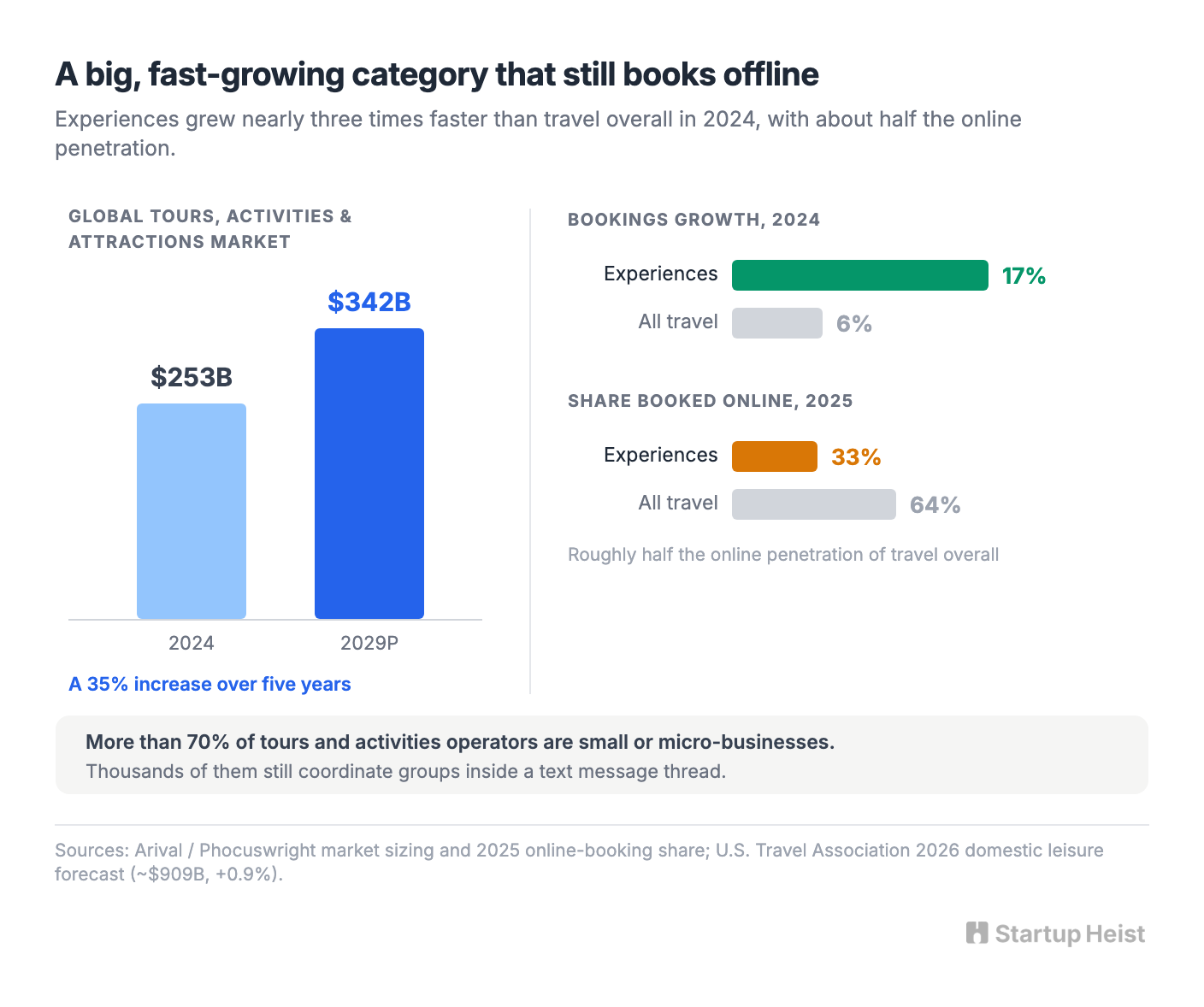
You get a large, fast-growing category where thousands of businesses still run a mess of booking widgets, phone reservations, deposits, payment links, and group coordination in text messages.
These operators already pay for software, which matters more than it sounds. Bókun charges $49, $149, or $499 a month depending on tier, plus a booking fee of 1.5%, 1.25%, or 1%. Rezdy runs $49, $99, and $249 a month plus a flat 3% on online bookings, with API access and webhooks reserved for higher plans. SquadTrip, built for group trips, is $29 a month plus 6%. A $99 add-on is unremarkable inside that stack, and completely unjustifiable unless it moves a number the operator cares about. Nobody needs a better-looking repayment page.
Pick operators where a host already exists
Unlock the Vault.
Join founders who spot opportunities ahead of the crowd. Actionable insights. Zero fluff.
“Intelligent, bold, minus the pretense.”
“Like discovering the cheat codes of the startup world.”
“SH is off-Broadway for founders — weird, sharp, and ahead of the curve.”


