


The Municipal Bid Desk: The AI Business Hiding Inside Every 70-Page RFP
A 70-page RFP lands in the inbox of a 12-person IT services company. The contract is worth $180,000 a year. The company has the technicians and the insurance, and it already serves three customers that look almost exactly like this one.
Then the owner opens the bid package.
A mandatory pricing workbook. A non-collusion affidavit. Five references in a specified format. Insurance minimums buried on page 43. An addendum acknowledgment form. A cybersecurity questionnaire. A three-page implementation narrative. A supplier portal registration that takes two days to clear. And a 2 p.m. deadline nine days out.
He closes the PDF.
That closed PDF is the business. Thousands of capable small companies do exactly this every week, and the reason has almost nothing to do with whether they can perform the work.
The opportunity is a vertical municipal bid desk: software plus expert review that turns a state or local government solicitation into a go/no-go decision, a cited compliance plan, a missing-evidence checklist, and a submission-ready first draft assembled only from facts the bidder has actually verified about itself.
It's a better business than the $250 ChatGPT wrapper version of the same idea, but only if you resist automating too much, too early.
Here's the shape of it:
The money: Twenty $750 bid engagements a month is $15,000 MRR. Fifty is $37,500. One founder, two trained reviewers, no funding.
Inside:
• Four jobs the first version must nail
• Pricing ladder from $99 to $1,500 a bid
• The evidence vault that becomes the moat
• Eight-week build and the outreach email
There is a trillion-dollar market behind a terrible front door
Public procurement runs at roughly 10% of U.S. GDP. State, local and education buyers alone purchase close to $1.5 trillion in goods and services every year, a figure the industry assembles from layered Census, NASBO, NCES and NACo data because no single agency counts it cleanly.
The more useful number is the denominator. The 2022 Census of Governments counted 90,837 local governments in the United States: 3,031 counties, 35,705 municipalities and townships, 12,546 independent school districts, and 39,555 special-purpose districts covering water, fire, transit, libraries, ports and parks. Every one of them buys things, and almost none of them buy the same way.
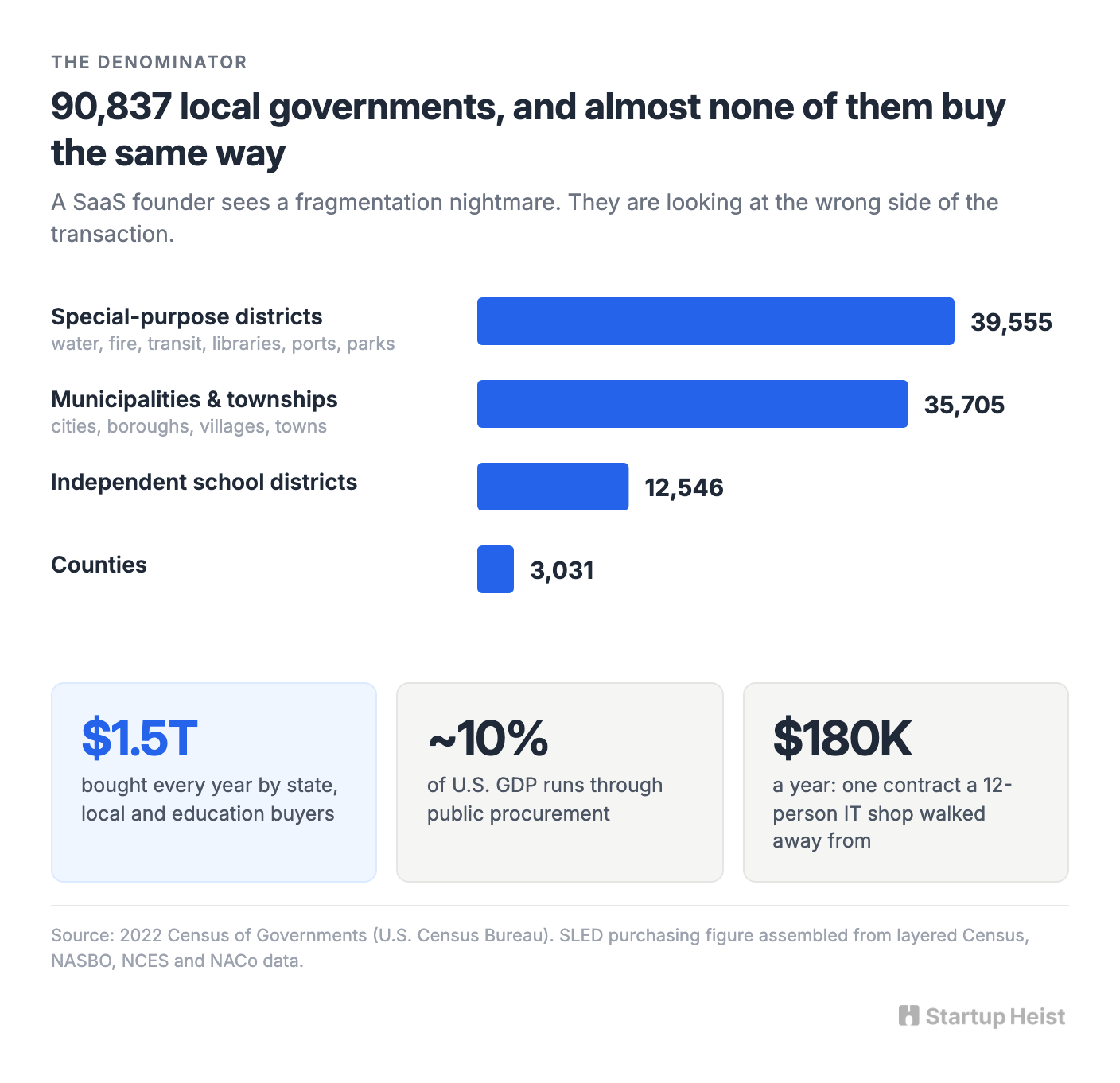
A normal SaaS founder looks at 90,000 fragmented government buyers and concludes that selling to them is a nightmare. He's right, and he's looking at the wrong side of the transaction.
Sell to the vendors instead. Cities need IT support. School districts need network contractors. Counties buy cybersecurity assessments. Water authorities buy software. The companies that already do this work commercially are sitting right there, fully qualified, being asked to play an unfamiliar game to win a customer they could serve tomorrow.
The bottleneck is compliance, not prose
A generic language model can already write a persuasive implementation narrative. What actually stops a small bidder on a government RFP is a different set of questions. Are we eligible? What exactly must we submit, in what format, through which portal? Which requirements are mandatory versus scored? What changed in Addendum 2? Is our cyber-liability limit high enough? Does the narrative have a page limit, and does the pricing go in the workbook or the portal?
Writing is maybe 30% of the job. The rest is decompression, qualification, evidence gathering, version control and project management under a hard deadline.
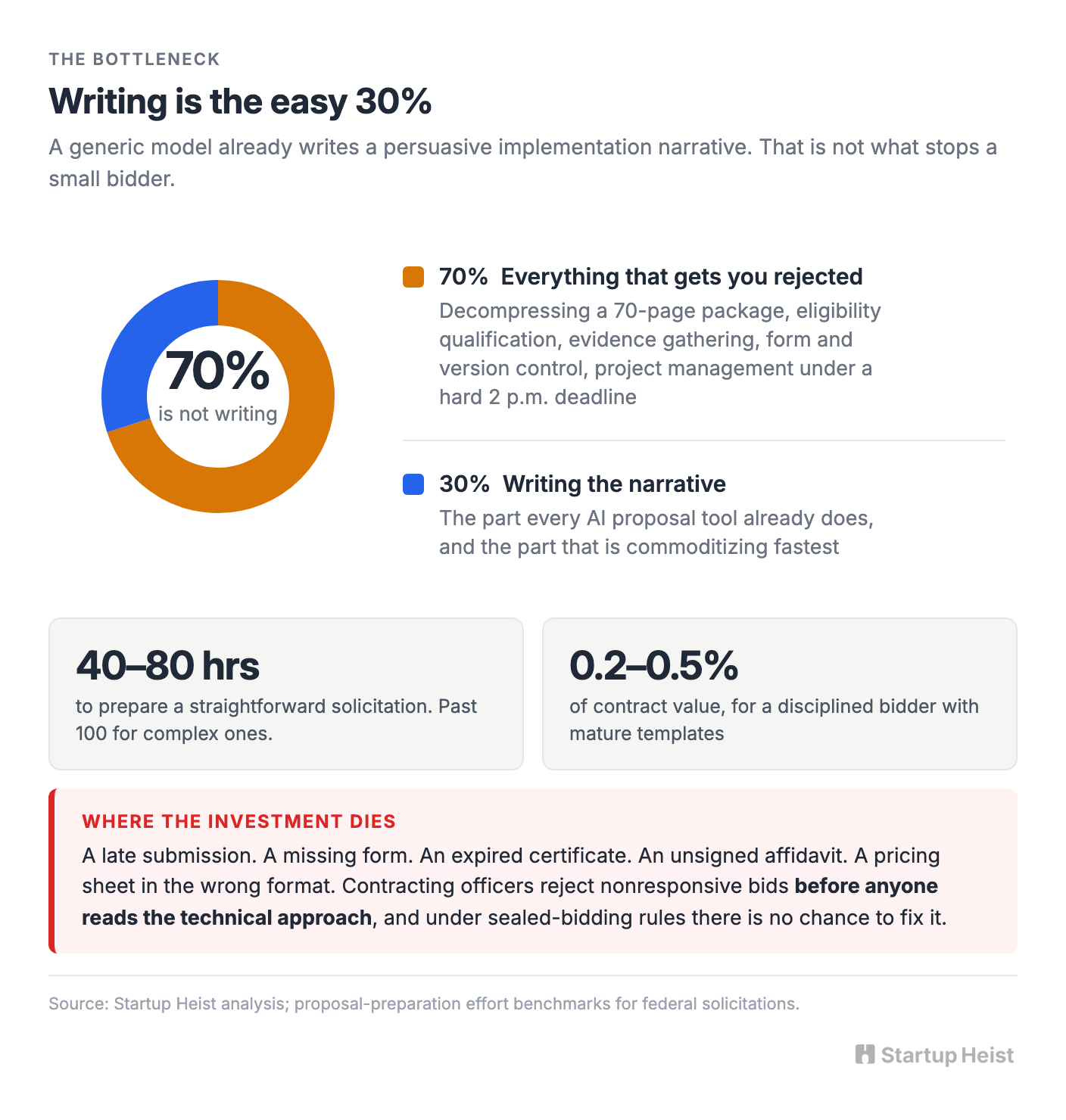
The cost of getting that wrong is total. Proposal preparation for a straightforward federal solicitation runs 40 to 80 hours, and past 100 for complex ones. For a disciplined bidder with mature templates that's roughly 0.2% to 0.5% of contract value. Most of that investment is destroyed by administrative failure rather than weak content. A late submission, a missing form, an expired certificate, an unsigned affidavit, a pricing sheet in the wrong format: contracting officers reject nonresponsive bids before anyone reads the technical approach, and under sealed-bidding rules there's no chance to fix it.
So the product isn't "upload RFP, AI writes proposal." It's "upload RFP, system builds a defensible plan for submitting this specific bid." Less magical, and considerably harder to replace.
Everyone else is pointed at discovery or pointed upmarket
The GovCon software market is real and getting funded. GovDash announced a $30 million Series B on January 15, 2026, led by Mucker Capital and British Columbia Investment Management, with Northzone and Y Combinator following. The company reported 16x revenue growth and roughly 200 customers, said its customers won more than $5 billion in contracts during 2025, and cleared FedRAMP Moderate Equivalency. That's a full capture-to-contract-management stack for organizations that already have a capture process.
Below that, the market has crowded into finding opportunities. Govly's free tier searches SAM.gov plus more than 6,000 state, local and education (SLED) sources. BidSparq tracks 14,000-plus sources at $249 a month and scores every opportunity 0 to 100. Sweetspot aggregates over 1,000 state and local portals. CLEATUS scans federal and SLED feeds daily and delivers compliance scores with bid/no-bid guidance.
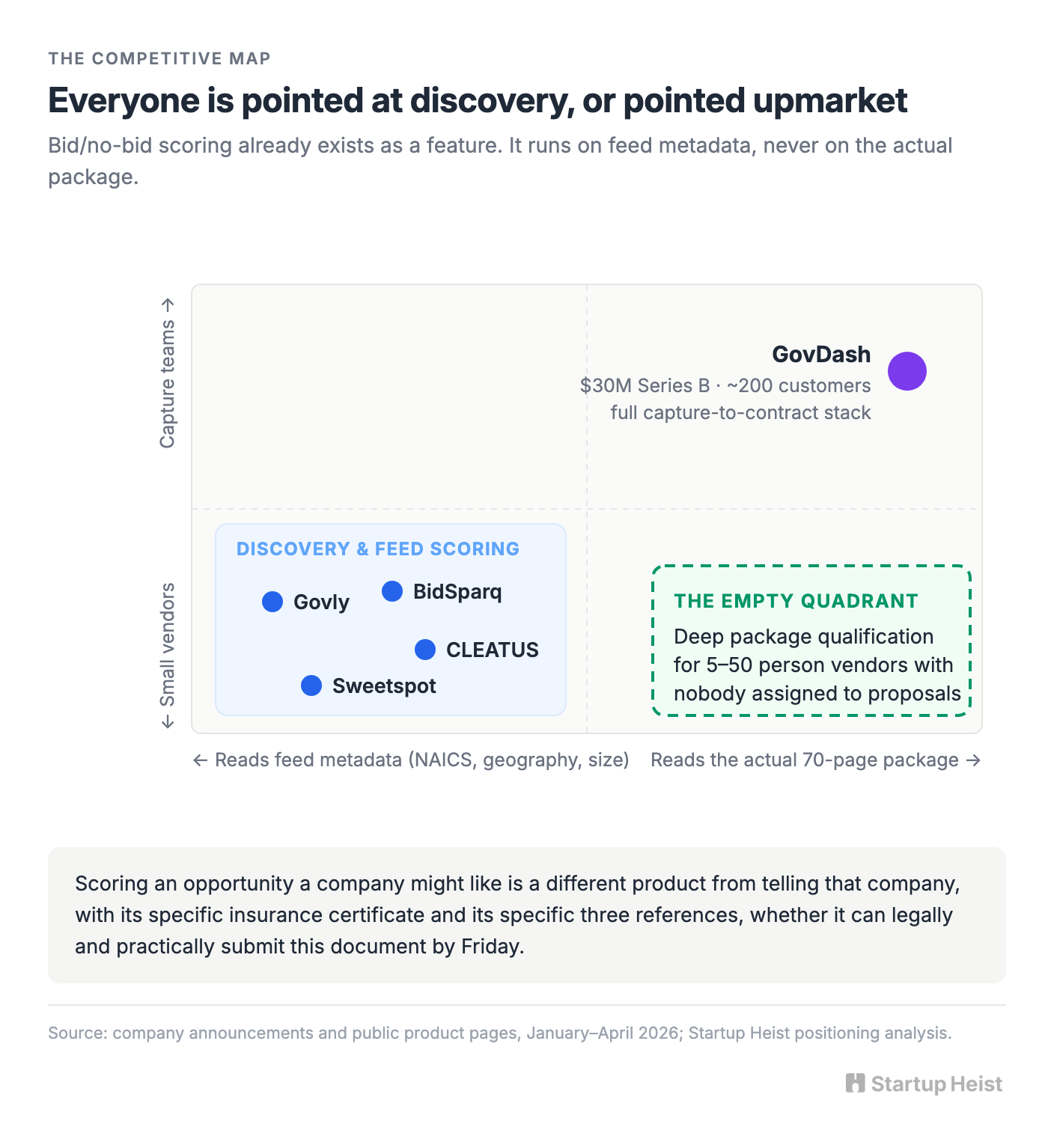
That list contains a warning and a gap. Bid/no-bid scoring already exists as a feature. But all of it operates on feed metadata (NAICS codes, set-asides, geography, contract size), never on the actual 70-page package with its page-43 insurance minimum and its addendum. Scoring an opportunity you might like is a different product from telling a specific company, with its specific insurance certificate and its specific three references, whether it can legally and practically submit this document by Friday.
Don't spend six months scraping every procurement portal in America. Let the customer bring you the opportunity. The wedge opens the moment someone says: we might bid this, tell me what I'm getting into.
The demand is already federally subsidized
The strongest evidence that the problem is real is that the government pays people to solve it manually. APEX Accelerators, the Department of Defense program formerly known as PTACs and rebranded in 2023, operate 95 centers with more than 300 local offices and over 600 procurement professionals. They help companies determine whether they're procurement-ready, register in government systems, research opportunities and prepare bids. The service is free to the business. An entire federally funded assistance network exists because "just respond to the RFP" isn't something a capable small company can do unassisted.
The buyers want this fixed too. Euna Solutions, citing its 2025 State of Public Procurement report, found that 62% of public agencies receive only two to five bid responses per project on average. In April 2026 it launched an AI tool to strengthen solicitations before publication, attacking thin competition from the buyer's side of the desk.
Thin bidder pools and a federally funded network of counselors doing manual decompression describe the same market failure from opposite ends. Nobody is standing in the middle with software.
Four jobs for version one
Unlock the Vault.
Join founders who spot opportunities ahead of the crowd. Actionable insights. Zero fluff.
“Intelligent, bold, minus the pretense.”
“Like discovering the cheat codes of the startup world.”
“SH is off-Broadway for founders — weird, sharp, and ahead of the curve.”


