


The 47-Day-Old SUV Is a Marketing Event
Walk a mid-sized independent used-car lot and you're looking at a database that happens to be made of steel. Eighty vehicles, each carrying a VIN, a year, make, model, trim, mileage, price, a photo set, a location, and its own vehicle detail page. The inventory turns constantly, every unit eventually has to leave, and most of those cars have no video.
A survey of 250 U.S. auto-retail CMOs and digital-marketing leads, fielded April 27 to May 6, 2026 and published September 3, found that only 38% of live vehicle listings carried a video asset. Phyron, an automated-video vendor, commissioned that research, so treat the figure as directional rather than neutral. The mechanism holds up either way: dealers carry far more inventory than their marketing staff can turn into fresh creative, and the inventory changes faster than the creative does.

The obvious startup writes itself: an AI video generator for car dealerships. Connect to the dealer's feed, turn every vehicle into a video, charge $800 a month. Don't build that one. It already exists, it's funded, and it's cheaper than you'll be.
The version worth building is narrower and less glamorous: a service-assisted micro-SaaS that watches an independent dealer's inventory, identifies the vehicles that most need help moving, turns those into localized short-form creative with compliant copy and tracking, and hands the dealer something deployable every Monday.
Here's the opportunity:
The money: Fifty dealers at $599 a month is $30K MRR, and rendering costs pennies per video. One founder and a contractor can run it.
Inside:
• The trigger rules that replace a content calendar
• FTC-proof copy guardrails for price claims
• The feed-audit wedge that opens cold outreach
• Three pricing tiers anchored against CARVID
The thing you're actually selling keeps a dealer's oldest and most expensive inventory from quietly rotting at the back of the lot. AI video is just how it gets done.
Every aged unit has a meter running
Video coverage is a symptom of something far more expensive: carry cost.
Once you fold in floorplan interest, insurance, reconditioning capital, depreciation, and the opportunity cost of the parking space, dealers generally put the cost of holding a used unit at roughly $30 to $40 per day. Past 60 days, the same estimates climb toward $40 to $75 as depreciation accelerates and the vehicle starts competing against fresher, better-priced comparables. Front-end gross on a used car tends to collapse somewhere between day 30 and day 45, and after that, price cuts stop being strategy and start being triage.
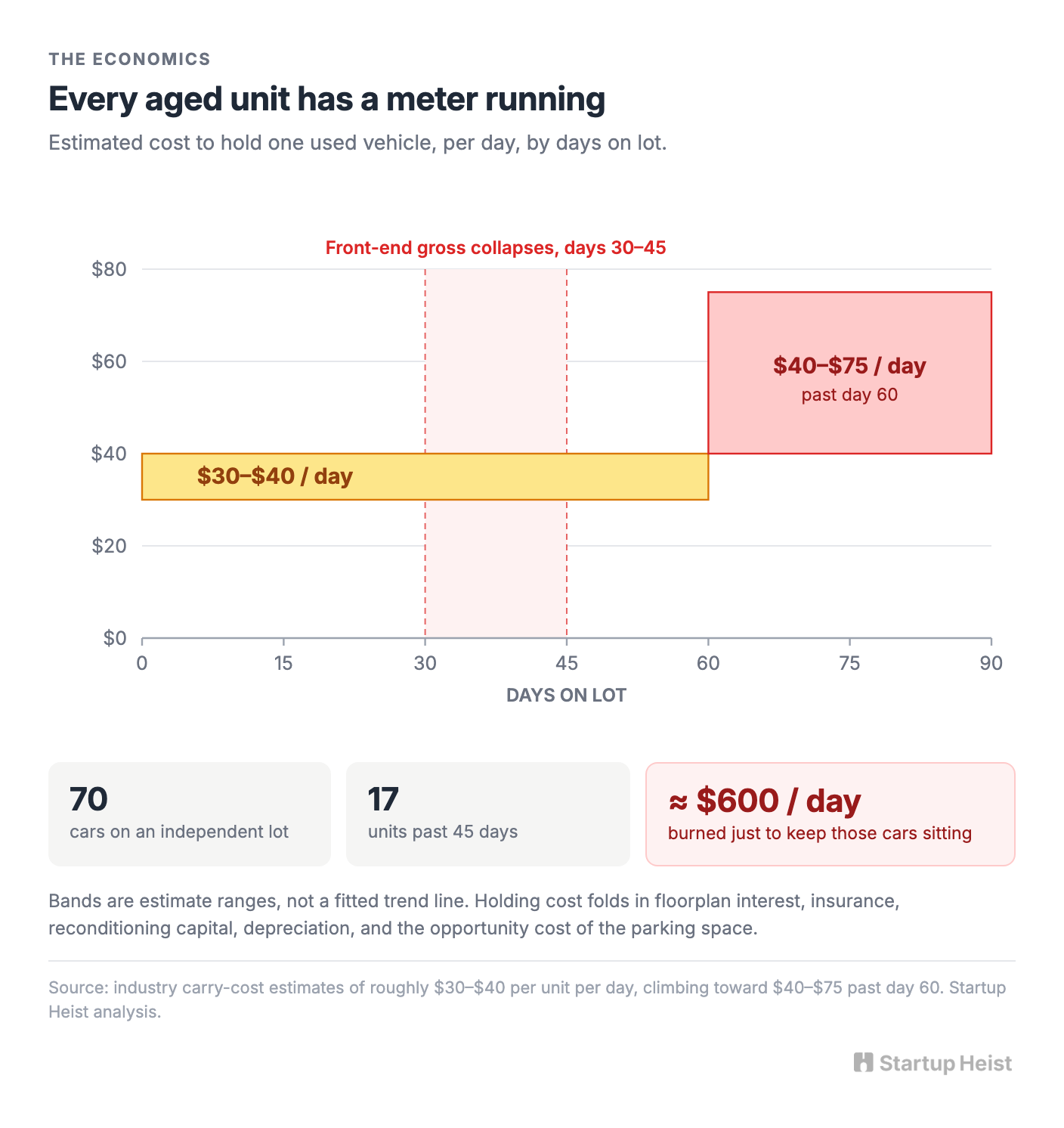
Do the arithmetic on a real lot. A 70-car independent store with 17 units past 45 days is burning roughly $600 a day just to keep those cars sitting there. That changes who you're competing with. A $49 social-posting app fights for a slice of the marketing budget; you're going up against a line item the dealer already pays every morning whether anyone markets those cars or not. Aging inventory is the only marketing problem in this business with a meter attached to it.
The obvious version is already built
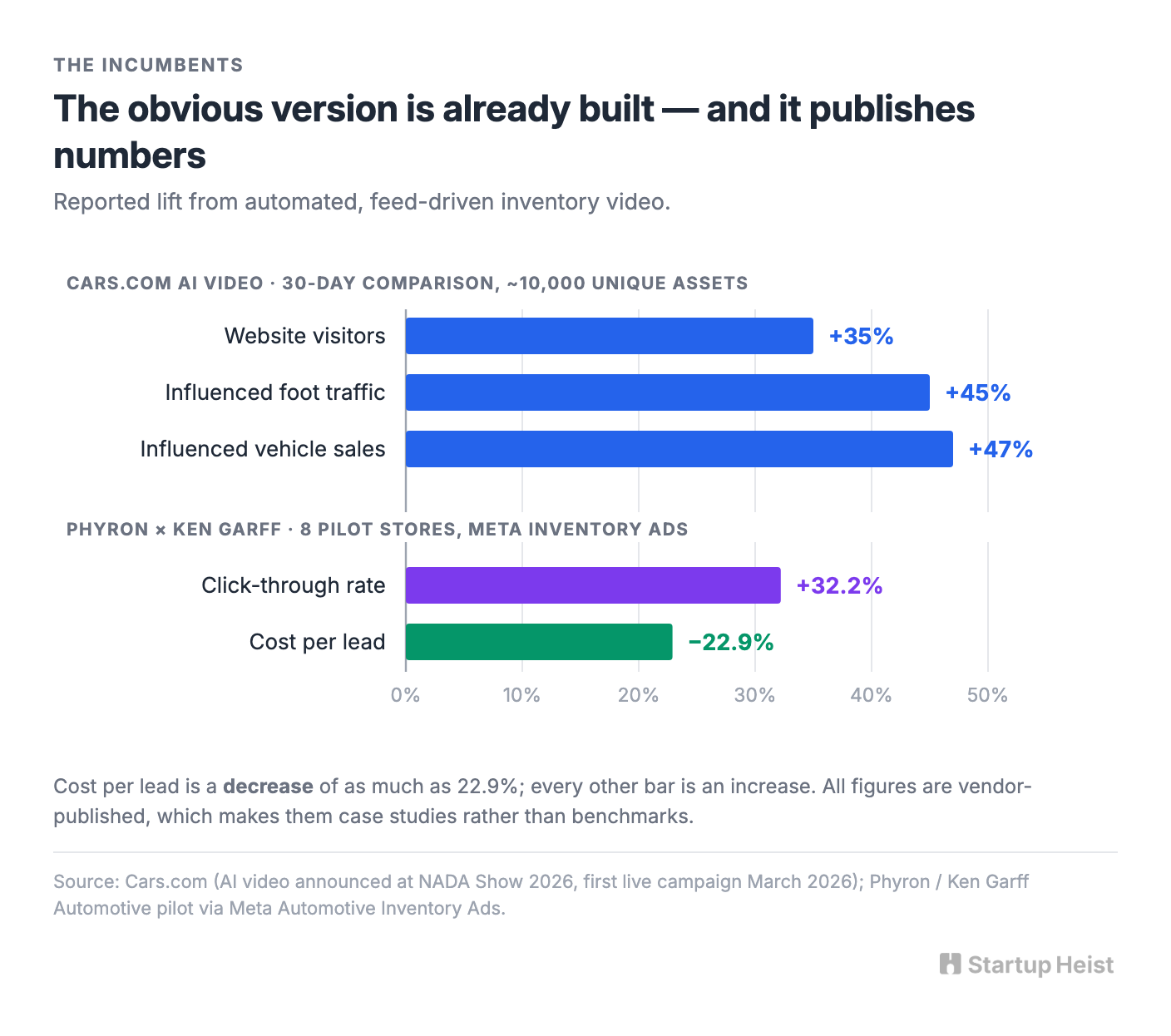
The incumbents haven't missed this. Cars.com announced an AI video product at NADA Show 2026 and ran its first live campaign that March. The system reads a dealer's feed, assembles VIN-specific video from photos and structured data, renders for TikTok, Instagram, and Facebook, targets shoppers using its own in-market audience signals, and pulls the ads when a vehicle sells. In a 30-day comparison it served close to 10,000 unique assets and reported a 35% lift in website visitors, 45% in influenced foot traffic, and 47% in influenced vehicle sales. Phyron runs the same play at broader scale: Ken Garff Automotive pushed Phyron-generated video through Meta Automotive Inventory Ads across eight pilot stores and reported click-through up 32.2% with cost per lead down as much as 22.9%. Both sets of numbers are vendor-published, which makes them case studies rather than benchmarks.
Then there's CARVID at the small end. Its dealer plans run $249 a month for one user, $499 for five, and $799 for ten, promotional rates as of this writing against list pricing of $349 to $849, with a managed-ads add-on for Google, Meta, and TikTok inventory campaigns starting at $299. It connects to a DMS, generates video, and auto-posts across nine platforms.
That pricing kills a comfortable assumption. Founders picture the low end of this market as $50 toys that make them look premium by comparison. The actual threat is a competent mid-priced competitor. CARVID already sells what most founders would build, already charges what you were planning to charge, and already sells paid-media management on top. If your pitch is "we turn VINs into MP4s," you launch late and undifferentiated on the same day. The commoditization cuts the other way too. Cheap, competent infrastructure is what makes the better business possible.
The question nobody is answering
The big systems are built to answer one question well: how do we get video onto every VIN?
An independent dealer with 70 cars and no marketing department asks something different. Which five cars should I push this week, what should we say about them, and can you have the ads ready without my staff touching anything?
Vehicle A landed six days ago, priced sharply, already pulling traffic to its detail page, so leave it alone. Vehicle B has been sitting 47 days. Vehicle C just took a $1,500 price cut. Vehicle D is a three-row SUV heading into the last weekend before school starts. Vehicle E is a sub-$20,000 commuter matching the strongest buyer segment within twenty miles.
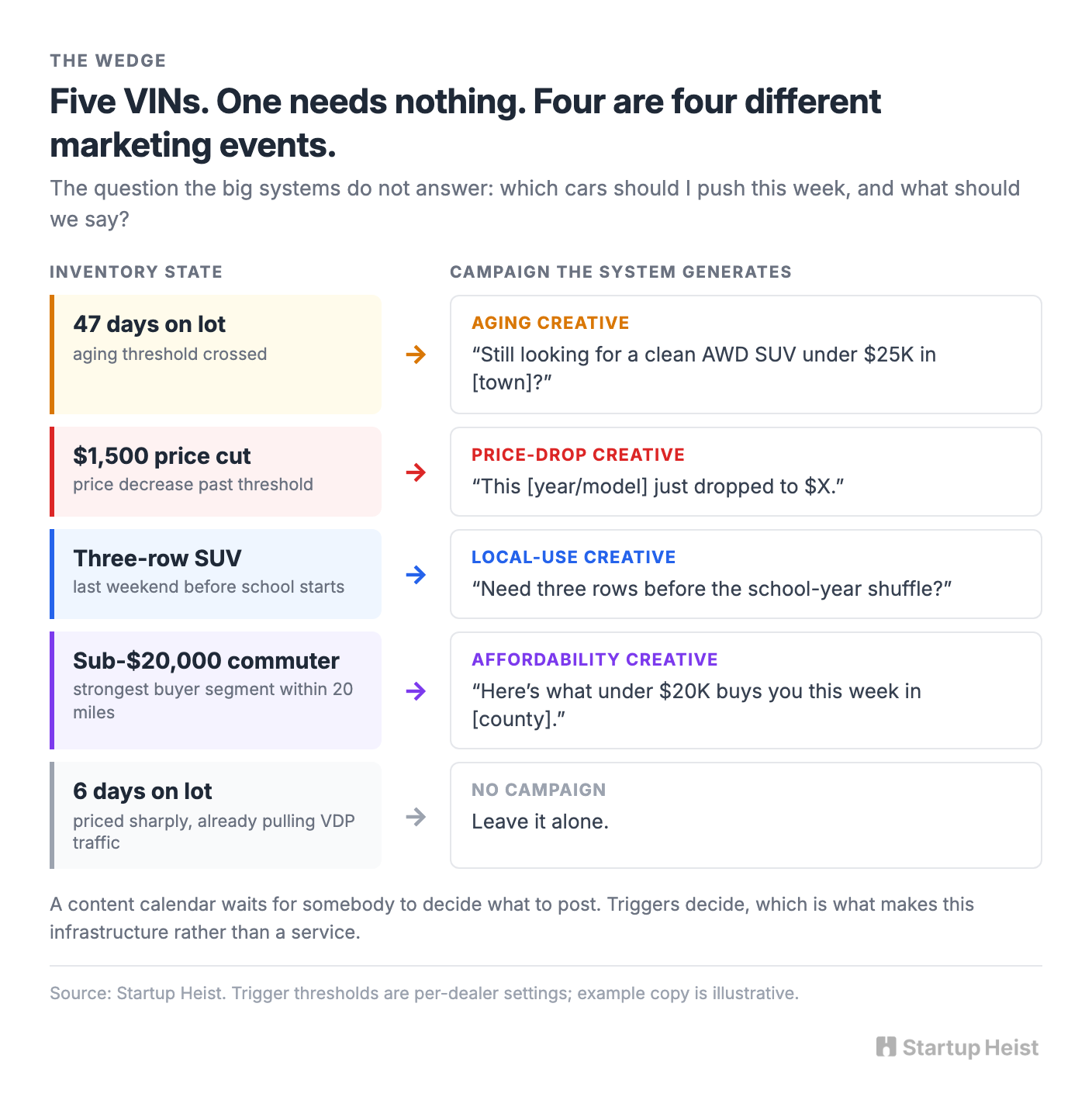
Five VINs. One needs nothing. The other four are four different marketing events, each with its own trigger, angle, and urgency, and a system that recognizes the difference generates the campaign that fits:
- 47 days on lot produces aging creative: "Still looking for a clean AWD SUV under $25K in [town]?"
- A price decrease produces price-drop creative: "This [year/model] just dropped to $X."
- A seasonal match produces local-use creative: "Need three rows before the school-year shuffle?"
- A value-segment match produces affordability creative: "Here's what under $20K buys you this week in [county]."
That's inventory state converted into marketing action, and nobody in this category is charging for it, which is why the seat is still open.
Why 2026 is the year this becomes buildable
Social advertising has gone catalog-native, and that changes what a small company has to build.
TikTok opened Automotive Ads to the industry in July 2025. Inventory Ads promote individual VINs for dealers and marketplaces; Model Ads handle trims and offers for OEMs. Dealers feed a vehicle catalog on a schedule, and TikTok generates multi-link carousels routing each card to the exact VDP, plus video units with live product cards pulling current price and mileage. Meta's Automotive Inventory Ads run the same logic on a CSV, TSV, or XML feed refreshed at least daily.
The platforms handle targeting, matching, and catalog plumbing. What they'll never know is which F-150 has been sitting 61 days, which three vehicles the GM wants gone before month end, which local references sound native instead of machine-assembled, which claims this dealer's attorney approved, or whether "price drop" outperforms "work truck under $30K" at this store.
The unit of automotive advertising is shifting from "we need three dealership posts this week" to "we have 83 live products that change daily and creative has to attach itself to the right ones." That gap sits between the inventory system and the ad network, and it's unoccupied.
The product: an aging-inventory creative engine
Never promise "10 TikToks a week." That's social-media management, and it prices like social-media management. The promise is this:
Unlock the Vault.
Join founders who spot opportunities ahead of the crowd. Actionable insights. Zero fluff.
“Intelligent, bold, minus the pretense.”
“Like discovering the cheat codes of the startup world.”
“SH is off-Broadway for founders — weird, sharp, and ahead of the curve.”


