


The Rental Scam That Uses a Real House
On August 20, 2026, the Jefferson County Sheriff's Office in Arkansas opened an investigation into a TikTok account advertising a house on East 41st Avenue in Pine Bluff. Three bedrooms, two baths, $900 a month. Text a number for details.
The house was real. So was the address, and so were the photos.
The account had no right to rent it. The owner told investigators it never authorized the listing, and TikTok removed the account after its own review. Sheriff Lafayette Woods Jr. compressed the whole lesson into one line: a property may be real, but that doesn't mean the person advertising it is legitimate. That's a product specification.
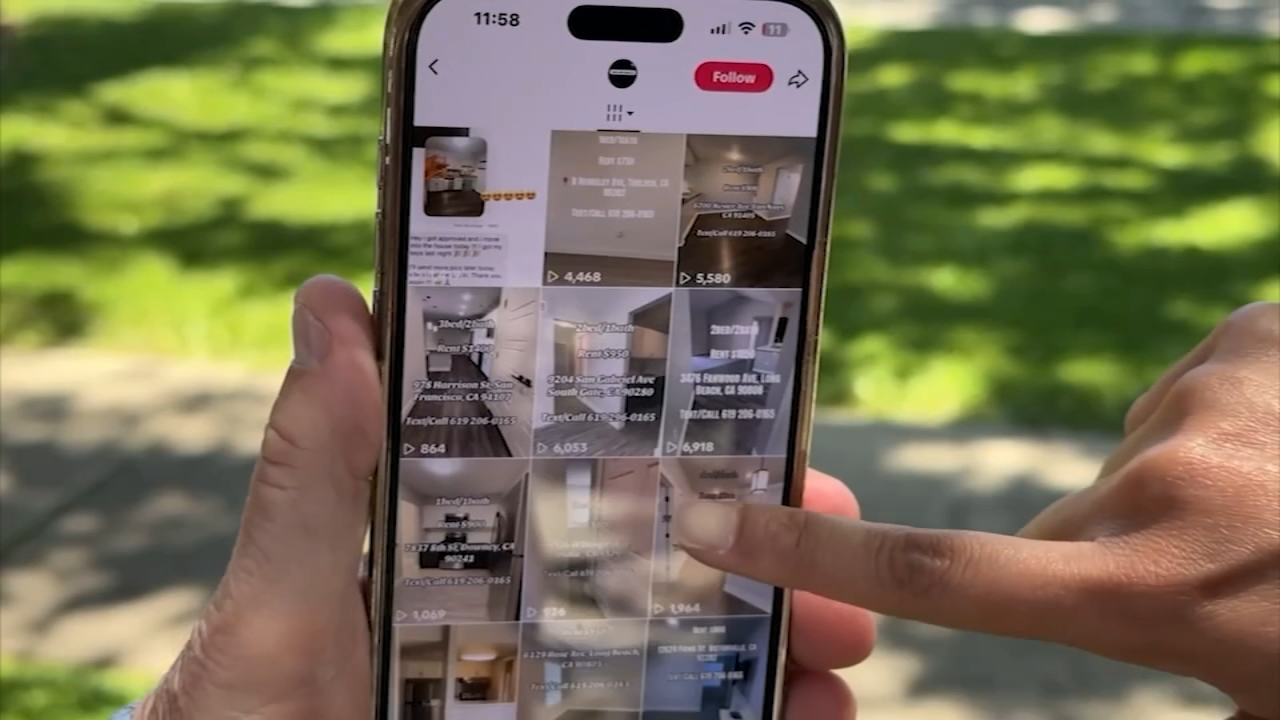
The old rental scam was fiction. Someone posted a home that didn't exist, collected a deposit, and vanished. The current version is more durable because it borrows something real. A scammer lifts the photos and description from a legitimate listing, undercuts the price, swaps in their own phone number, and waits for an application fee. Every fact a nervous renter can check holds up. The address exists. The house looks exactly like the pictures. A drive-by confirms it. What no renter can check is whether the person collecting the money has any right to be.
The business sits in that gap: a pre-payment verification layer for rental listings found outside trusted marketplaces. A renter enters an address, the advertised rent, the contact number, and whatever evidence they have, whether that's screenshots, pasted text, or a listing URL. Back comes a short report showing what can and cannot be independently reconciled. Then you sell that workflow to universities, tenant-support organizations, and relocation programs that already have a reason to protect the people using it.
It isn't a fraud detector, and it isn't another apartment marketplace.
Here's the opportunity:
The money: Fifty institutions at $399 a month is roughly $20,000 MRR. Renters aged 18 to 29 file 46% of all rental scam reports.
Inside:
• Eight checks the evidence report returns
• Four evidence layers built on public data
• Pricing from pilot to $1,500 a month
• A 60-day plan that skips the crawler
Where the losses are, and where they're heading
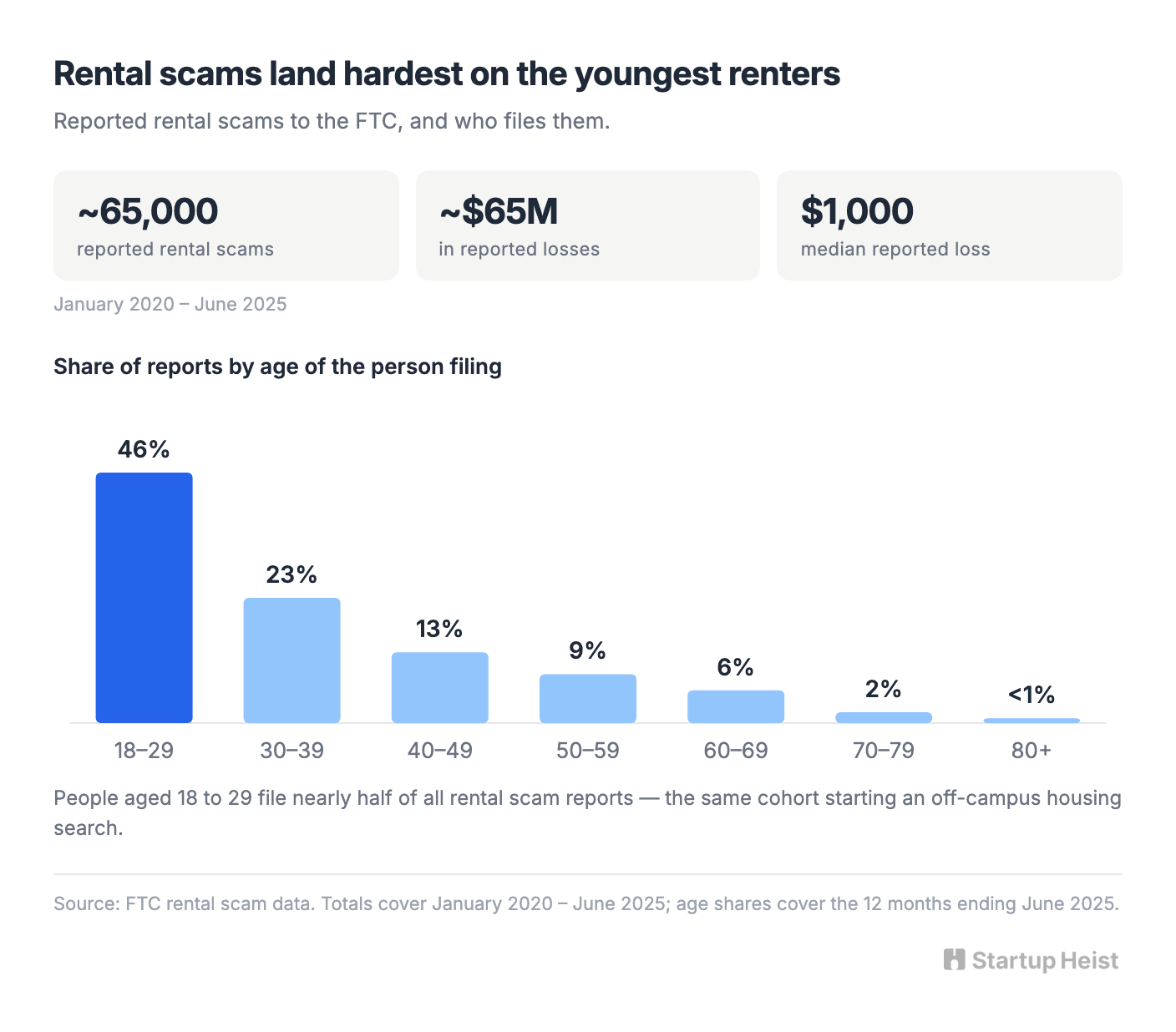
The FTC counted nearly 65,000 reported rental scams between January 2020 and June 2025, worth roughly $65 million in reported losses, with a median loss of $1,000. The FBI's Internet Crime Complaint Center, counting complaints a different way, logged close to $200 million in rental fraud losses in 2024 alone. The FTC is blunt that reports capture a fraction of the real thing, and the most-cited attempt to size the rest, an Apartment List renter survey, put the number of Americans who have lost money to rental fraud at 5.2 million.
Two details inside that data matter more than the totals.
Age is one. People between 18 and 29 are three times more likely than other adults to report losing money to a rental scam, and in the twelve months ending June 2025 they filed 46% of all rental scam reports. The FTC names college housing groups as a place these renters get hit, which is exactly where the off-campus housing search begins.
Platform is the other. Among reports that identified where the scam started, about half traced to Facebook and another 16% to Craigslist. TikTok barely registers.
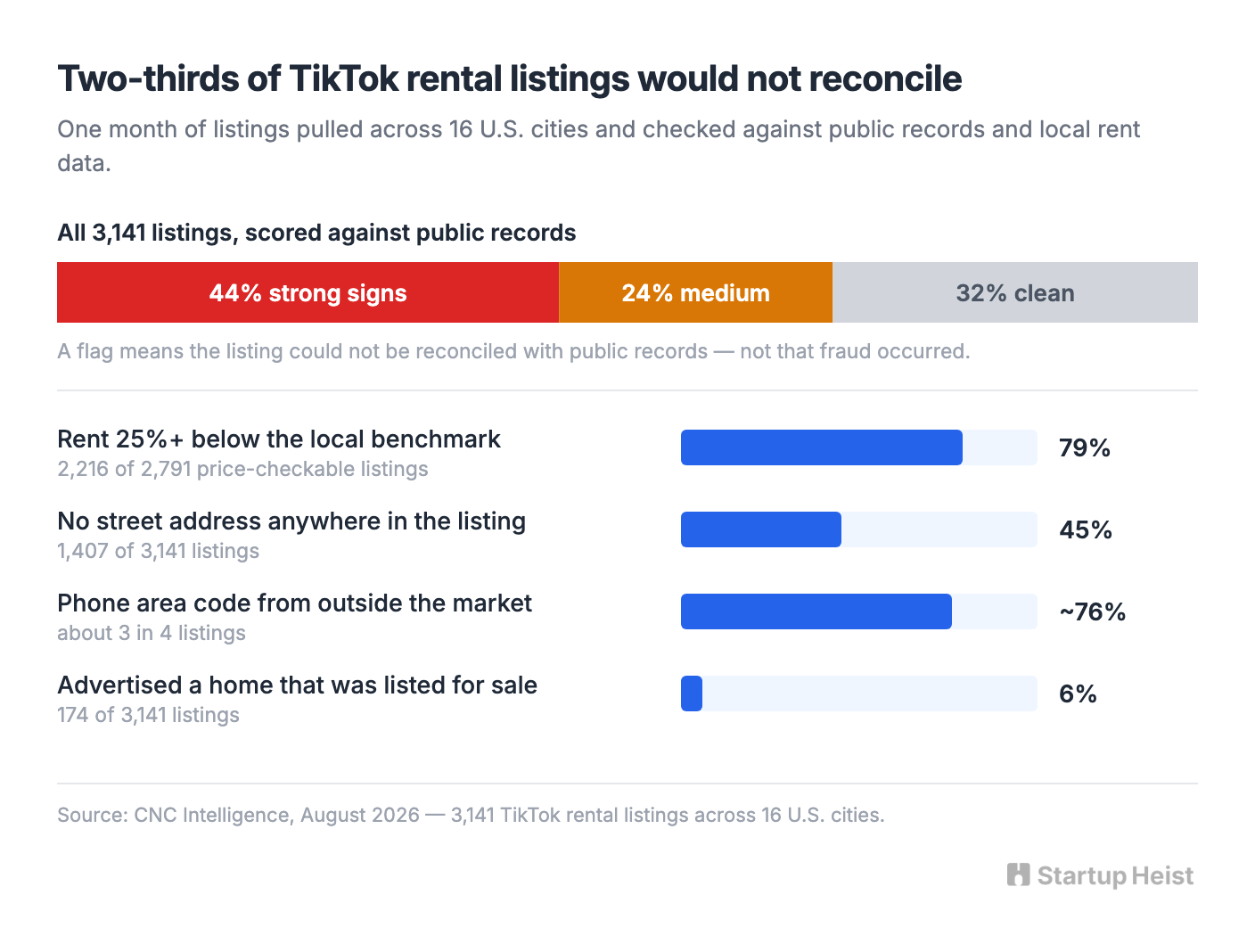
TikTok still matters, because it shows the direction of travel. In August 2026, the investigative firm CNC Intelligence pulled 3,141 TikTok rental listings across 16 U.S. cities and ran them against public records and local rent data. Sixty-eight percent carried warning signs, 44% strong and 24% medium. Of the 2,791 listings where a price check was possible, 2,216 were at least 25% below the local benchmark, and half of those were below 50%. Another 174 advertised homes that public records showed were listed for sale, not rent. Three-quarters used a phone area code from outside the city they advertised in. Half the accounts were less than six months old.
Handle that 68% carefully. CNC says explicitly that a flag means its checks could not reconcile the listing against public records, not that fraud occurred. That distinction is also the product. You never tell a renter this listing is 82% likely to be fraudulent. You tell them you found three things that don't reconcile, and here they are.
Social platforms broke the provenance chain
A traditional rental marketplace wraps a listing in context you barely notice. Address, listing history, the identity of the landlord or management company, comparable units, a structured application flow. That packaging is the product.
Now turn the same apartment into a twenty-second video. Nice kitchen, hardwood floors, $1,250, DM for details. Almost all of the context is gone. CNC found that 1,407 of the listings it reviewed, just under half, gave no street address at all.
The search itself has gone fully mobile. Zillow's 2025 renter research found 81% of recent renters searched on a mobile website and 73% used an app, and the typical renter touched five different sites during the hunt. Discovery got fast, fragmented, and thumb-sized while verification stayed exactly where it was.
Which leaves the renter doing forensic work. The FTC's own advice is to search the address, find the real owner or management company, hunt for the same property listed elsewhere at a different price, compare the rent against local market rates, call a manager at a number you found yourself, and send no money until all of that resolves. Good advice, and also a thirty-minute scavenger hunt that lands on a 23-year-old who needs an apartment by Friday.
The fraud market protects everyone except the renter
Money is already moving on rental fraud, all of it on the other side of the transaction.
Property Shield sells fraud monitoring to MLSs, REALTOR associations, and multifamily operators, scanning listing sites and social platforms for unauthorized copies of legitimate inventory. It reported removing more than 318,000 fraudulent listings in 2024, monitors close to 400,000 properties, and says it has pulled down more than a million fake rental listings over the past two years. Rently resells that monitoring to property operators, an integration announced in October 2024 that sweeps more than a dozen social platforms hourly. Downstream sits the mature applicant-screening industry, which exists so landlords can verify that renters are legitimate.
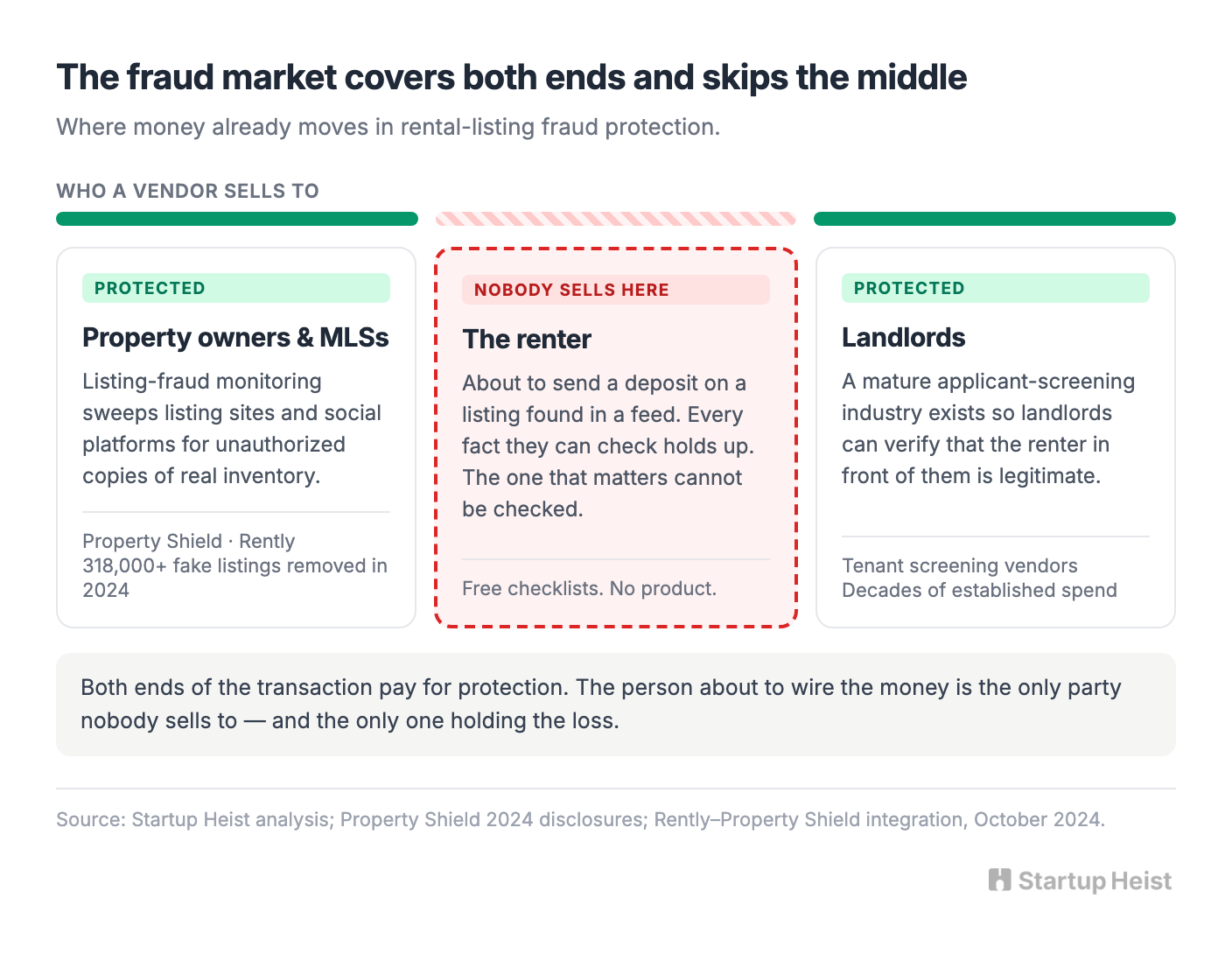
Both ends are covered. Owners pay to protect their listings, landlords pay to vet applicants, and nobody sells anything to the person about to wire the money.
The renter side isn't empty, and it pays to know exactly what's there. FlagMyListing runs a free scam-detection engine where a renter pastes listing details and gets an instant risk assessment. Nonprofit tenant tools like JustFix's Who Owns What trace a building's true ownership and violation history, which answers a different question than whether the person in your DMs is authorized to rent it to you. International-student marketplaces including AmberStudent, HousingAnywhere, and StudentsLanding advertise verified listings, but they're closed marketplaces that vet only the inventory booked through them, so they do nothing for a student who already found a place on TikTok or in a Facebook group. Regulators are circling the same problem from the supply side: Maryland's proposed HB 1456 would require online platforms publishing rental listings to verify that the poster is authorized to advertise the property.
Free consumer tools prove the demand and, more usefully, prove the pricing problem. A stressed renter who needs this once every three years is a terrible person to charge. So the hard question is who pays.
What you actually build
Position it as a check, not a search. The interface should feel closer to running a VIN on a used car than to shopping for an apartment.
Unlock the Vault.
Join founders who spot opportunities ahead of the crowd. Actionable insights. Zero fluff.
“Intelligent, bold, minus the pretense.”
“Like discovering the cheat codes of the startup world.”
“SH is off-Broadway for founders — weird, sharp, and ahead of the curve.”


