


The Postcard That Already Did the Work
Outbound to small businesses usually starts with a promise. We can redesign your website. We can improve your Google presence. We can get you more leads. Then comes the call, the audit, the proposal, the follow-up, the second follow-up, and a prospect who stops replying.
There's a sharper version of the same motion: do part of the work before you ask for the meeting.
Find a roofing contractor whose mobile site buries the estimate button under three screens of hero image. Build a private, conversion-focused version of that page. Print a screenshot of it on a postcard. Add a QR code that opens the working preview, plus one specific observation: your mobile visitors have no obvious way to request an estimate.

The pitch stops being theoretical the moment the contractor is holding the demo.
The heist works right now because one half of the equation collapsed in price while the other half got more expensive. Producing a credible, custom, conversion-tuned web page went from a week of billable design work to about twenty minutes of prompting. Physical attention never got cheaper. A postcard still lands on a desk, gets picked up, and gets read by the one person who signs checks. You're arbitraging cheap production against expensive attention.
The wedge is narrow on purpose: a productized preview-site-plus-QR-postcard outbound engine, aimed at one high-value local-service vertical.
The money: $1,500 to activate, $299 a month to maintain. Forty roofing customers on the care plan is $11,960 in monthly recurring revenue.
Inside:
• The 0-100 score that picks who gets a card
• Postcard copy plus the legal guardrails
• Unit economics on 100 cards, both ways
• Three-tier pricing built for contractors
What you sell after the door opens can't be AI websites, because those are already a commodity. You sell measurable lead capture: conversion repair, Google Business Profile cleanup, call and form attribution, and ongoing optimization. A solo founder can test the whole thing for a few hundred dollars, charge four figures before doing meaningful implementation work, automate most of the production, and grow it into a vertical marketing platform if the data compounds.
Why this market pays
Start with fragmentation. Census business-size data counts roughly 24,500 employer roofing establishments in the United States, and 81% of roofing firms employ nine people or fewer. Two-thirds employ fewer than five. The plumbing, heating, and air-conditioning category is four times that size, north of 100,000 establishments with a similar shape.
You want that profile: tens of thousands of home-services companies large enough to buy customer acquisition and small enough that the owner personally opens the mail.
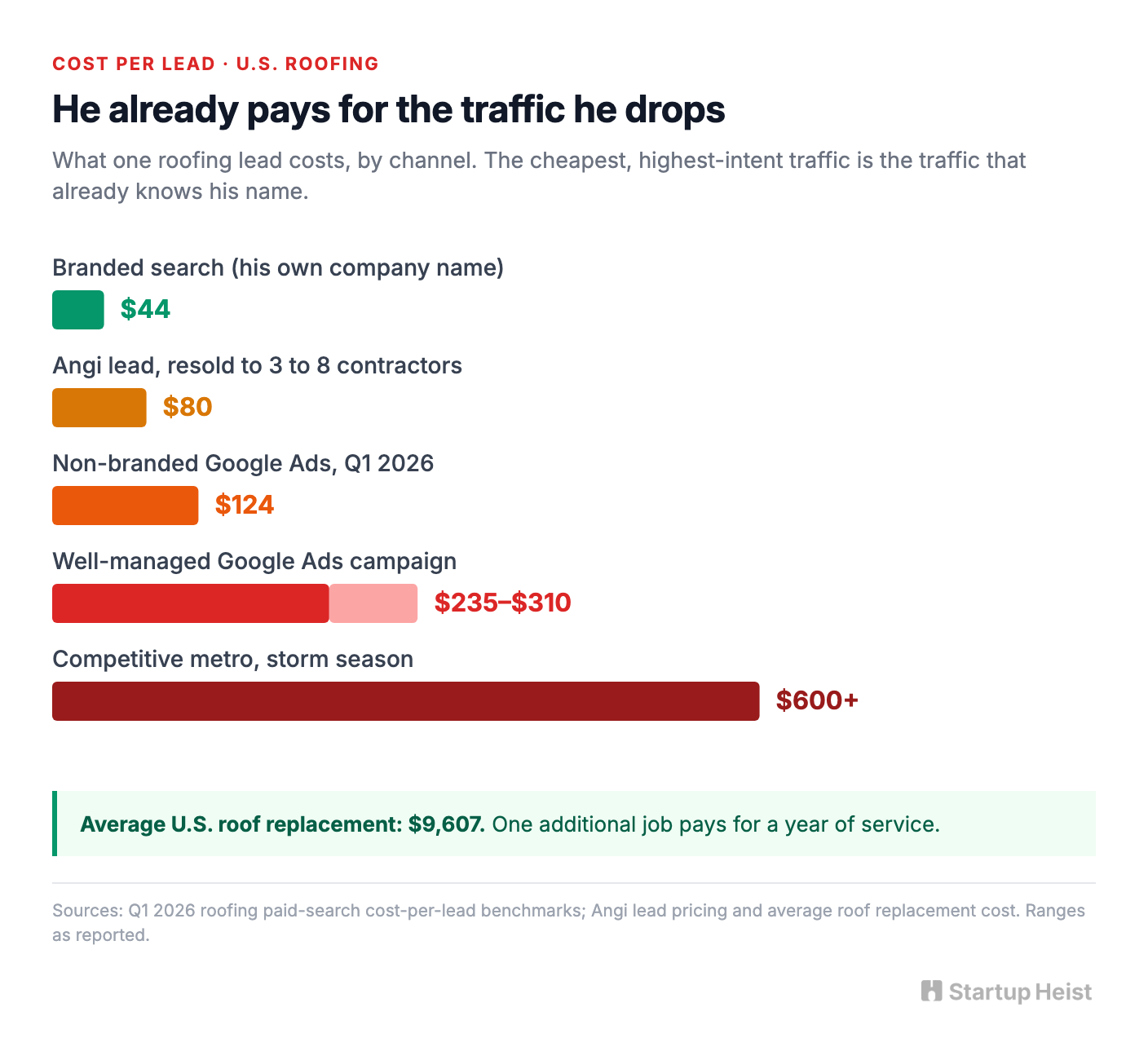
Now look at what a customer is worth to them. Angi puts the average U.S. roof replacement at $9,607, ranging from about $5,900 up past $46,000. One additional job pays for a year of your service.
Then look at what they already spend to get one. Non-branded Google Ads leads for roofing ran about $124 in the first quarter of 2026; well-managed campaigns land in the $235 to $310 range, and in storm season the median pushes past $300 with competitive metros clearing $600. Branded searches, the people typing the company's own name into Google, cost the same advertisers $44. The cheapest, highest-intent traffic a contractor owns is the traffic that already knows who he is. On Angi, a roofing lead costs $80 and gets resold to three to eight contractors at once, sometimes more, so he's paying full price for a sliver of a job and a race to the phone.
Hold those numbers together. A roofer pays $235 or more for a maybe-lead while a visitor who already found the website on purpose bounces because the estimate button sits below the fold. What you're offering him is the recovery of leads he already paid for and dropped.
The reframe is the whole sale, and it lets you escape the worst trap in SMB software: pitching a $39/month tool to an owner who doesn't want another tool. Sell an outcome. If this turns one more existing visitor into an estimate request, it pays for itself.
The website is the demo, not the product
Wix will generate a business-ready site from a text prompt and let you start for free. Whatever scarcity used to exist in "I can build you a website quickly" is gone. Don't sell that. Sell the leaks around it.
A contractor already has demand arriving from Google, referrals, yard signs, truck wraps, reviews, Facebook, Angi, and paid search. The question is what happens after somebody looks them up. BrightLocal's July 2026 consumer research found 84% of consumers had searched online for a local business in the previous three months, with Google the dominant starting point and 73% of those searches beginning on mobile.
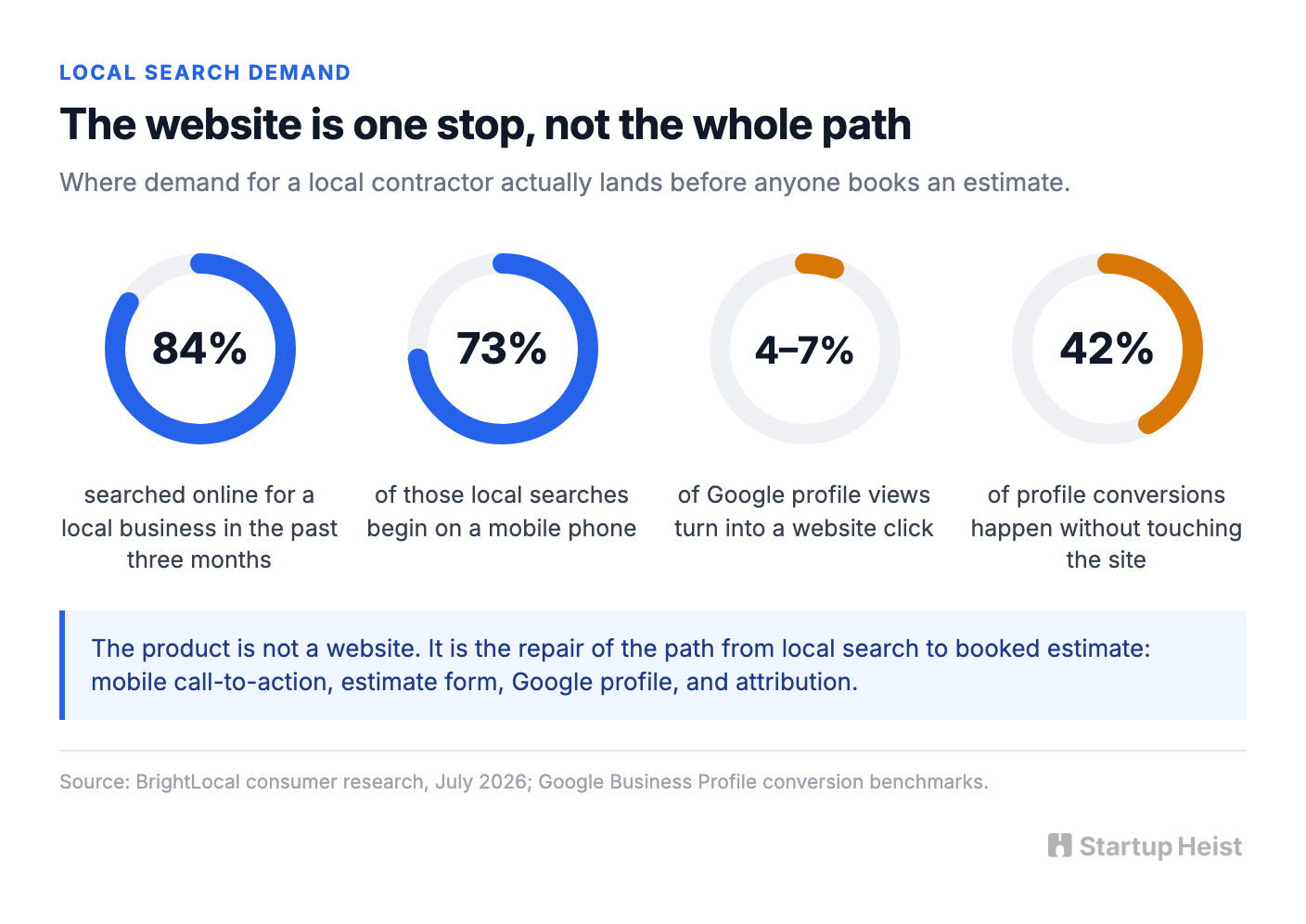
The website is only one stop on that path. The Google Business Profile is another, where roughly 4 to 7% of views convert into website clicks and about 42% of all profile conversions happen without the visitor ever touching the site. So are the mobile call-to-action, the estimate form, the review count, the response time, and whether anyone in the building can tell which marketing source produced the inquiry.
Frame the product as repairing the path from local search to booked estimate. A bundle like that is much harder to replace with "my nephew can use Wix."
Pick the vertical, then pick the prospect
Four verticals are obvious candidates, and they behave differently.
| Vertical | Why it works | The catch |
|---|---|---|
| Roofing | High job values, visual work, easy-to-spot weak sites, tight geographic targeting | Seasonal, storm-driven, crowded |
| HVAC | High replacement value, recurring maintenance, urgent demand | Strong incumbents, sophisticated marketers |
| Plumbing | Enormous business count, urgent searches, owners live on the phone | Many jobs are low-ticket |
| Restoration | Very high-value leads, emergency intent | Insurance complexity, trust barriers, harder ops |
Pick independent residential roofers in one metro for the first test.
Roofers with no website at all sound like the obvious target and are the wrong signal. No web presence usually means no interest in digital marketing, a book that runs entirely on referrals, or no crew capacity to absorb more work.
The prospect you want has visible evidence of demand and is visibly wasting some of it. Eighty-five Google reviews behind a 2017 website. A homepage that looks fine on desktop with no persistent estimate button on mobile. Twelve service suburbs and no service-area pages. A quote form with fifteen fields, and nobody in the office who can say whether last month's calls came from Google or Facebook.
Those businesses already believe in marketing, so you can skip the argument that the internet matters and go straight to showing them where the money leaks out.
The qualification engine is the real product
The obvious automation is a straight line: business database, AI, website, postcard, QR code. Operationally useful, and it protects nothing. Any competent builder can rebuild that stack in a weekend.
The interesting product sits in front of it.
Unlock the Vault.
Join founders who spot opportunities ahead of the crowd. Actionable insights. Zero fluff.
“Intelligent, bold, minus the pretense.”
“Like discovering the cheat codes of the startup world.”
“SH is off-Broadway for founders — weird, sharp, and ahead of the curve.”


