


The Ruler Brands Use to Buy YouTube Creators Just Changed Length
On August 24, 2026, YouTube changed the definition of the most commercially important number in the creator economy.
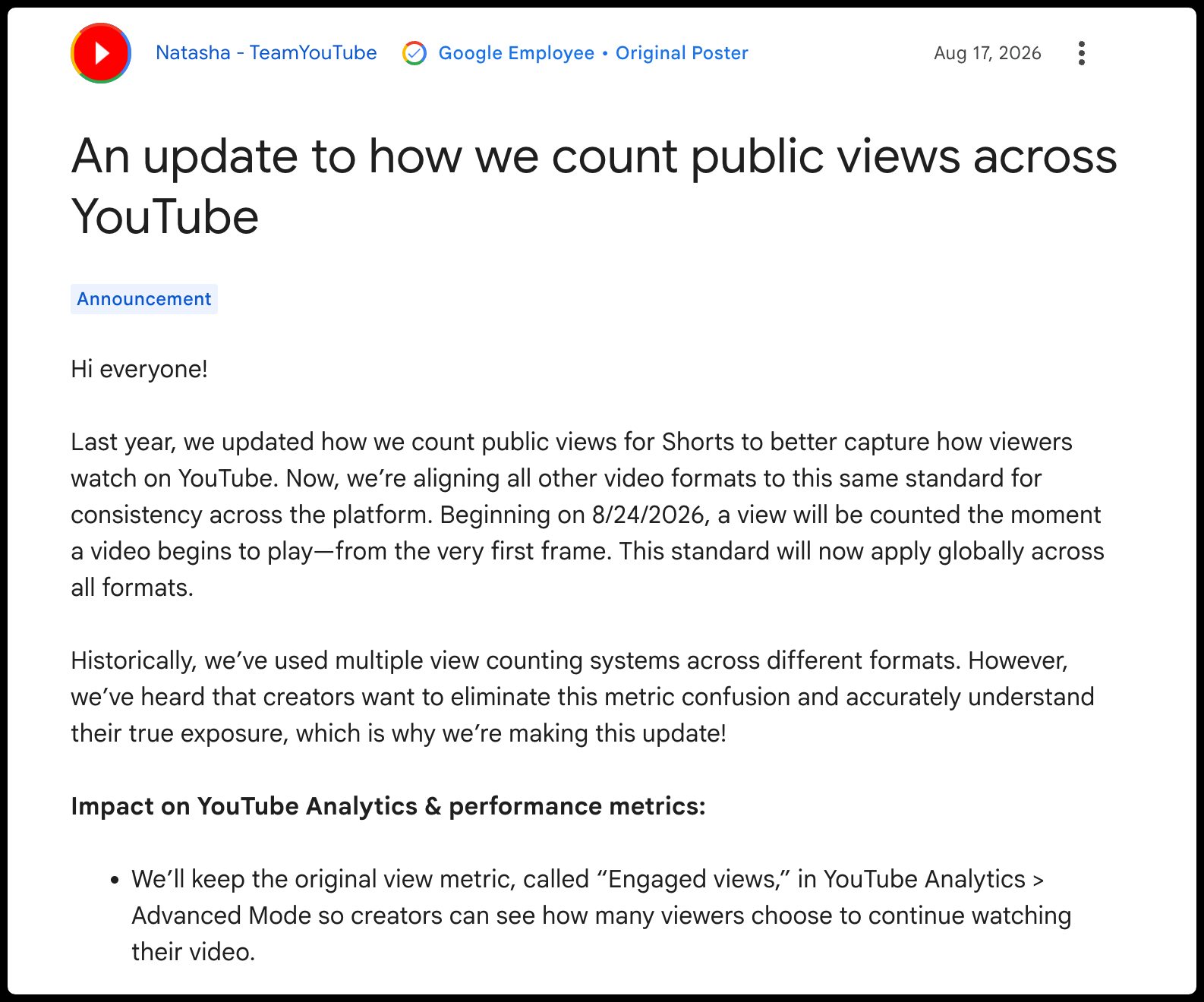
A public view now registers the moment a video starts playing. First frame, no minimum watch time, no threshold to cross. The change applies globally and across every format: Shorts, long-form, podcasts, live.
YouTube didn't delete the old measurement. It kept the previous, stricter definition, renamed it Engaged views, and left it inside Analytics. Monetization still runs on engaged views and engaged watch hours, so nobody's AdSense check moved.
Viewers will never notice. Anyone buying YouTube sponsorships now has a contract problem.
The commercial tell sits in YouTube's own explanation. The company's stated hope was that "metric parity across all formats gives creators a clearer picture of their overall exposure and makes it easier to confidently express their true scale and value to brand partners and sponsors." The platform changed the number brands use to price creator deals, then told creators the change would help them negotiate.
That handed the sell side a bigger number to quote and left the buy side asking something it never had to ask before: which views?
That's the heist, and it isn't another influencer marketing dashboard. The opening is the measurement-basis layer that sits between the creator, the agency, and the brand: authorized data in, a defensible rate card and campaign reconciliation out, plus the contract language that names exactly which metric governs the deal.
Call it ViewBasis. Here's the opportunity:
The money: Twenty agencies at a $600 average is $12K MRR. A hundred at $800 is a real software company. Services open at $199 per channel.
Inside:
• Three artifacts to sell, priced and specced
• The $199 report that tests demand first
• Six screens, and what to leave out
• Five moats that beat a data monopoly
The break in the ruler
The mechanic takes one sentence to explain. The downstream effects take a lot longer.
Before August 24, a public view meant YouTube's older, stricter standard, long understood as something close to a meaningful chunk of watch time. After August 24, a public view means playback started. The old standard still exists as `engagedViews`, a documented metric that YouTube made available in all Analytics and Reporting API reports alongside `views`.
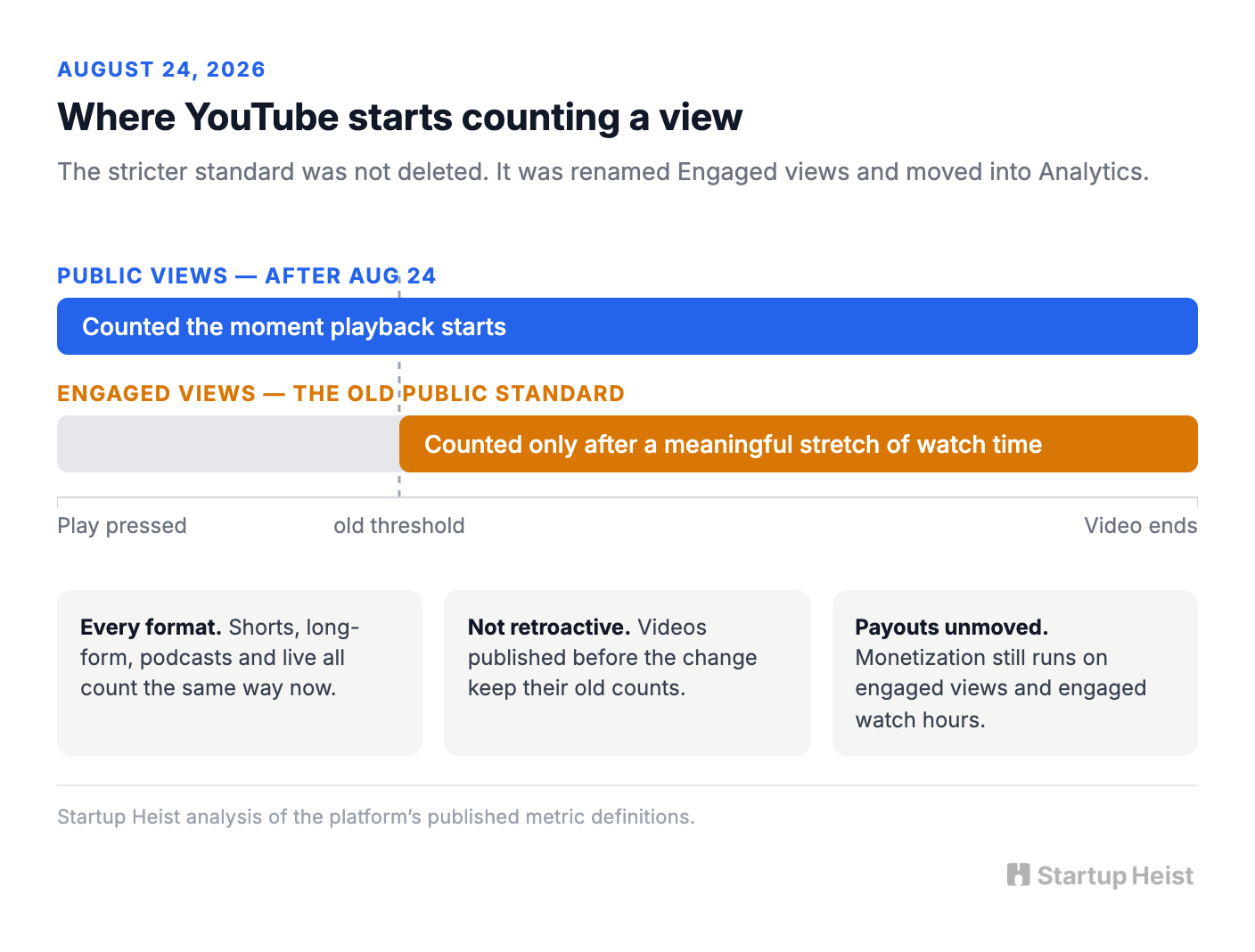
So there are now two defensible answers to "how many views did this video get." One number counts who showed up. The other counts who stayed. Both come straight from YouTube, both are real, and they can differ by a lot.
The change also isn't retroactive. Videos published before August 24 keep the counts they earned under the old definition, so a brand benchmarking a September campaign against a creator's spring performance is comparing two different units and calling it a trend line.
And YouTube's own economics stayed on the stricter metric. The platform pays creators on engaged views while publishing the looser number on the watch page. When the house keeps two sets of books and shows you the more flattering one, that tells you which set carries weight.
Nobody knows the conversion rate, and that's the opportunity
Agentio, a creator advertising platform with authenticated data from connected creator channels, ran the math twice, and the two answers didn't match.
On August 21, three days before the change went live, Agentio modeled the expected lift across 35,800 creator videos published in June and July 2026, assuming a 30-second engagement threshold. The estimate: long-form public counts would run roughly 30% above engaged views. The lift skewed toward smaller channels, at 32.4% for micro creators, 28.1% for mid, and 26.6% for macro. By vertical, the combined technology and fitness category led at 36.5% while gaming trailed at 27.0%. Device type moved the number too, from 37.2% for desktop-heavy audiences down to 28.9% for channels watched mostly on TV.
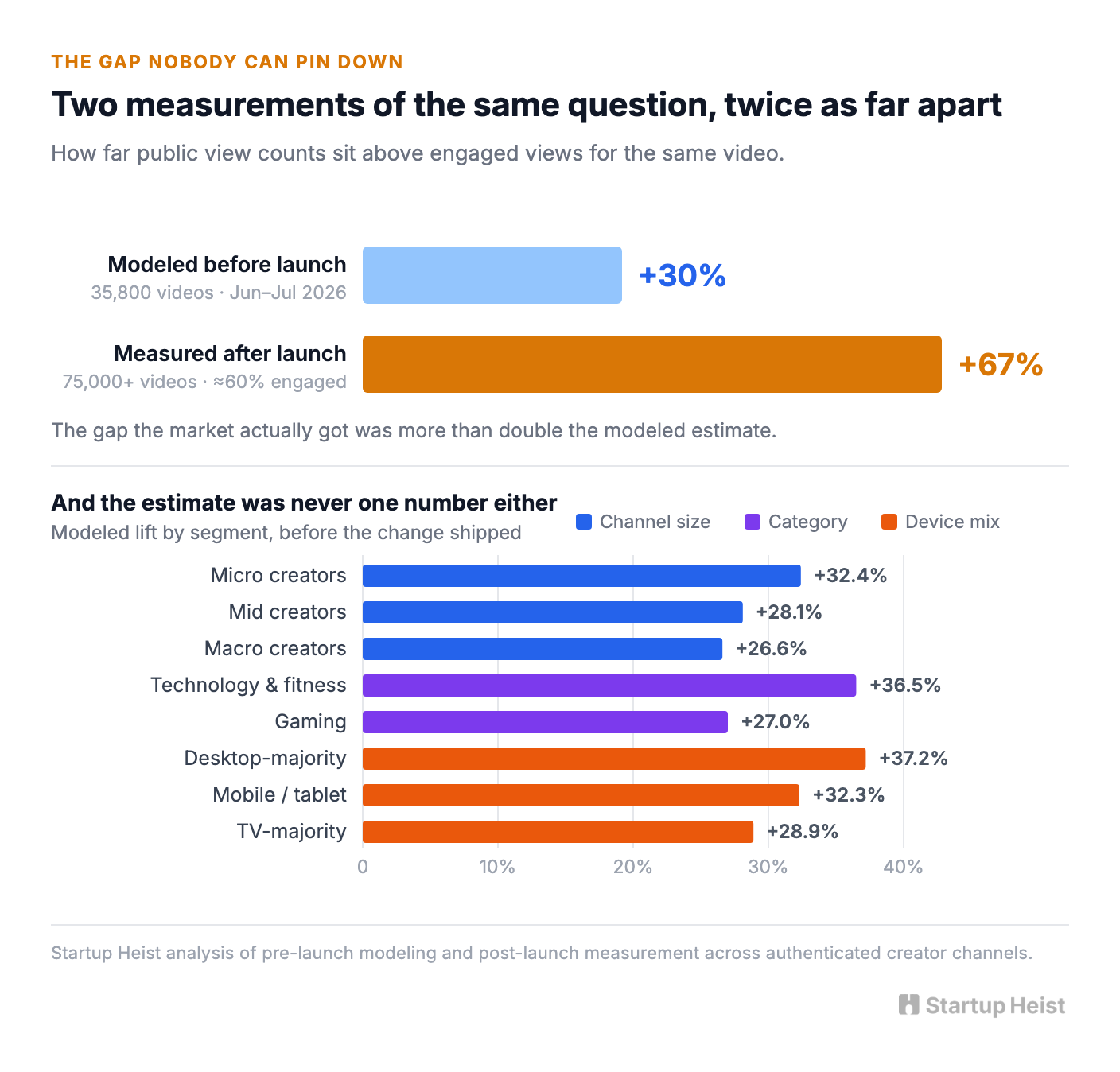
Then the change shipped, and Agentio measured what actually happened across more than 75,000 videos. Roughly 60% of the new public views were engaged views. A 60% engaged rate means public counts sitting about 67% above engaged counts, more than double the modeled estimate.
Two credible measurements from the same company on the same question, landing twice as far apart as the first one predicted. The spread itself is the useful result.
If the best-instrumented player in creator advertising couldn't pin the ratio in advance, a brand manager reconciling a campaign in a spreadsheet has no business assuming one. The variance runs by channel, by format, by traffic source, by how much of the audience arrives through autoplay. Every creator has their own number, and none of them know it.
The market has two rulers now, and most contracts are still written as if there's one.
Why anyone pays for this
Creator advertising got big enough that even boring measurement plumbing can support a real business.
IAB put U.S. creator ad spend at $37 billion in 2025, up 26% year over year and growing roughly four times faster than the media industry overall, with a 2026 projection of $43.9 billion. Forty-eight percent of ad buyers already call creators a "must buy," ranking the channel behind only social and paid search. The same research keeps flagging the same gaps: measurement, consistent reporting, and standards.
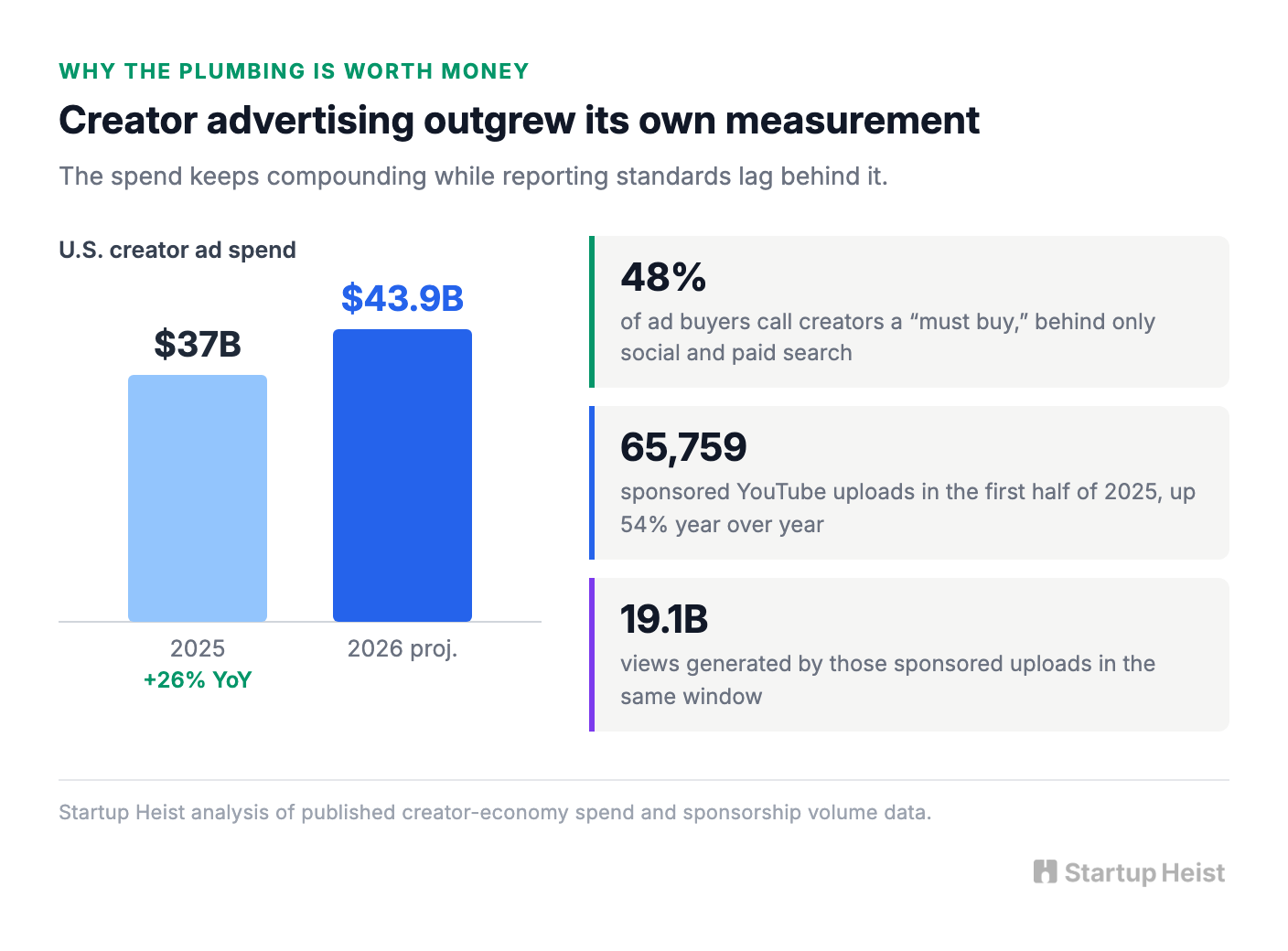
YouTube brand deals specifically are compounding. Gospel Stats, the data arm run by the team behind Tubefilter and the Streamy Awards, tracked 65,759 sponsored YouTube uploads in the first half of 2025, a 54% jump year over year, generating 19.1 billion views. Ground News alone ran 1,863 sponsored integrations in that window, up 202%.
None of that spend has to flow through you. The people administering it are the customers.
A twelve-person creator management agency running forty YouTubers refreshes rate cards every quarter, answers brands asking for average views, calculates effective CPM, monitors guarantees, chases creators for screenshots, builds client reports, and negotiates make-goods when a video underdelivers. Every one of those tasks now has a new footnote attached to it, and the footnote changes the answer.
What that agency needs is somebody to make its numbers defensible. It already has more creator discovery databases than it uses.
What YouTube already fixed, and what it didn't
The platform solved one piece of this already, and it's worth understanding before you build anything.
YouTube's Brand Partner Access lets a creator grant a specific brand access to a specific sponsored video's performance data. Once granted, the brand sees watch time, view duration, engagement rate, and audience demographics directly in Google Ads. The screenshots, the exported CSVs, and the trust exercise all go away.
It works, and it removes the most obvious version of the pain.
It also stops well short of the actual job. Brand Partner Access is per-video, brand-facing, and locked inside Google Ads. It won't reset a creator's rate card or reconcile a campaign against contract terms, and it can't tell you whether a 500,000-view guarantee was satisfied because it has no idea what the contract said. Talent managers and boutique influencer marketing agencies who never open a Google Ads account get nothing from it. Neither does anyone who needs an artifact both parties can sign off on when they disagree about money.
YouTube built the pipe and left the governance layer above it unbuilt.
What ViewBasis actually sells
Unlock the Vault.
Join founders who spot opportunities ahead of the crowd. Actionable insights. Zero fluff.
“Intelligent, bold, minus the pretense.”
“Like discovering the cheat codes of the startup world.”
“SH is off-Broadway for founders — weird, sharp, and ahead of the curve.”


