


The Exclusivity Clause Hiding Inside Live Commerce's $20 Billion Year
On August 7, 2026, Whatnot closed a $545 million Series G at a $20 billion valuation, roughly double the $11.5 billion it carried ten months earlier. Seven weeks before that, its sellers crossed one billion cumulative orders, and CEO Grant LaFontaine noted that the majority of them happened in the previous six months. The platform now moves more than twenty items per second. U.S. livestream ecommerce sales grew nearly 50% in 2025 to $14.64 billion.
The obvious startup idea in those numbers is live shopping for merchants who want to sell from their own Shopify stores. That idea is taken. StreamBid runs Shopify auctions with real-time bidding, anti-snipe rules and winner checkout for $79 a month flat. LiveMeUp sells streaming hours in tiers from $89 to $399. Auction Today has 303 reviews at 4.9 stars and charges $15 a month for unlimited auctions. SoldLive turns Facebook, Instagram and TikTok live comments into Shopify orders for $35 to $300. The generic version of this product already exists, it works, and it's cheap.

That leaves a narrower opening: one category where sellers already go live several times a week, where inventory is one-of-one, where buyers form relationships with individual hosts, and where the work surrounding the sale is ugly enough that generic livestream software will never absorb it. Specialty plants clear every bar. Rare tropicals, hoyas, orchids, tissue cultures, collector-grade aroids. The livestream gets you in the door. What you're actually selling is the operating system for a plant business.
Here's the shape of it:
The money: 500 merchants on a $199 plan is $99,500 MRR, in a category where a $30,000-a-month shop already hands over $2,400 in marketplace commission.
Inside:
• Twelve-week MVP scope and what not to build
• Three-tier pricing and the math that closes
• The 100-seller outreach list and the email
• The data moat that takes two years to build
The Vertical Already Has Its Own Marketplace
Plant sellers don't only sell on Whatnot. Many of them live on Palmstreet, a live-shopping marketplace founded in 2020 that started with rare plants and has since raised $25 million from a16z, Craft Ventures and Headline. Palmstreet charges a 6.9% selling fee across its live, purge, invoice and shop formats, plus 2.9% and $0.30 in Stripe processing. Whatnot's standard rate outside its discounted categories is 8% plus the same processing. A specialty plant seller with an audience is paying one of these tolls, often both.
Now look at what Palmstreet does with its best sellers. Its Foundation Program is open to merchants who clear $25,000 in GMV over a trailing three months, and it pays them monthly cashback of 0.25% to 1.0% of selling fees plus early feature access and marketing support. The condition: the member agrees not to live sell on competing live-selling platforms. Instagram, Facebook and TikTok are explicitly carved out. Leave and you wait three months to reapply, and you come back at Tier 1 with every point of accumulated status gone.
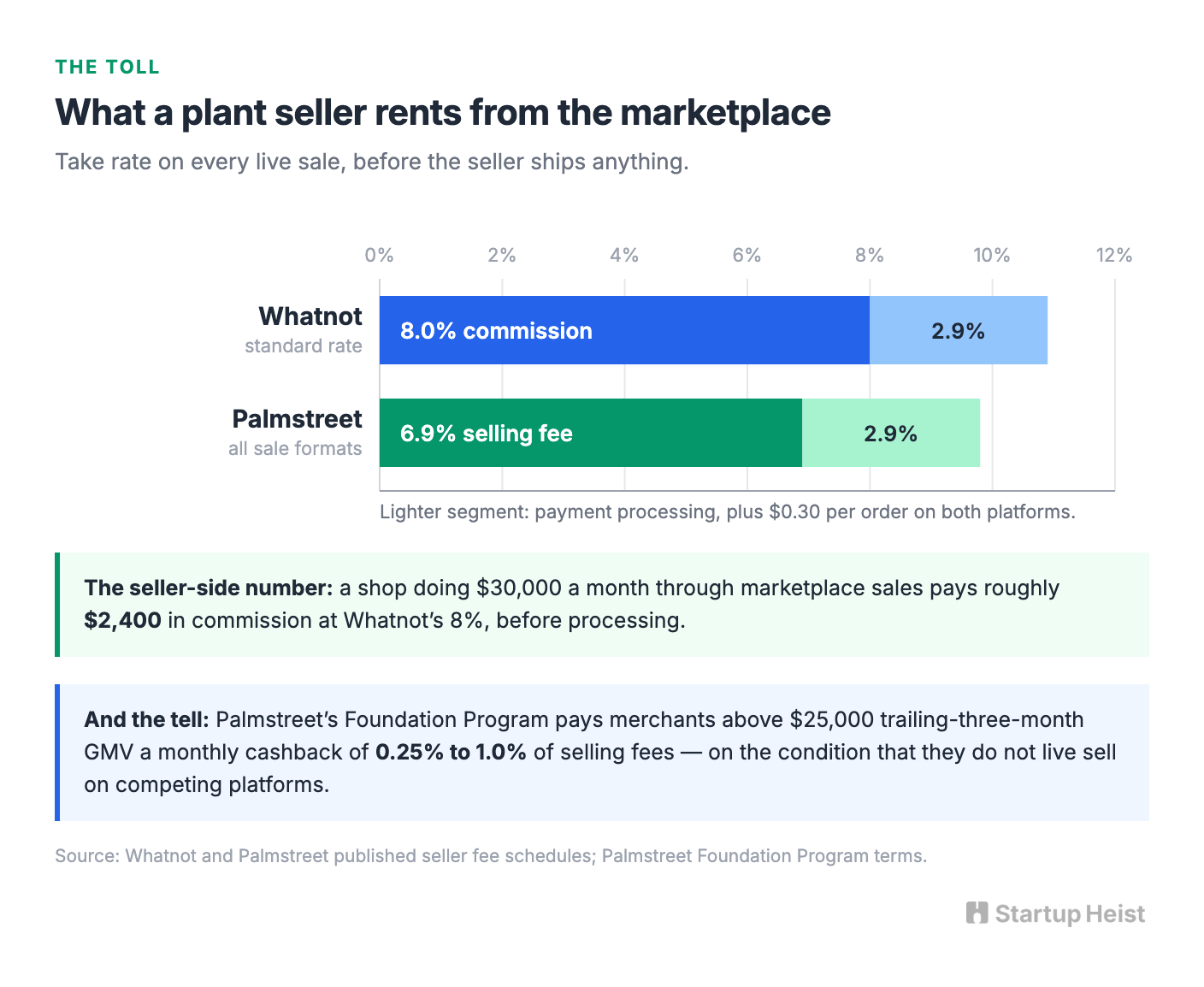
That clause is worth more than any market-size chart. A venture-backed marketplace is paying its top plant sellers, in cash, not to go live anywhere else. Marketplaces write exclusivity terms when they can feel a customer relationship becoming portable. Palmstreet is telling you where the pressure is, and what it costs to hold the line: about one percent of fees.
Plants earn that pressure. Sellers already run recurring Friday-night drops, restock shows and tissue-culture sales, often several broadcasts a week, and nobody has to convince them live selling works. The category is real money without being a bubble: USDA figures put U.S. sales of foliage plants for indoor and patio use at $931.6 million in 2024, up nearly 35% over five years. A plant shop doing $30,000 a month through marketplace sales pays roughly $2,400 in commission at Whatnot's 8%, before processing. A $199-per-month owned-channel tool doesn't have to replace that marketplace. It has to move about $2,500 of monthly GMV off an 8% commission, or about $2,900 off Palmstreet's 6.9%, to pay for itself.
That makes the pitch something no marketplace can counter: use Whatnot and Palmstreet to find customers, use your own store to keep them. The merchant keeps renting discovery and stops renting the relationship.
The Product: A Live Nursery Operating System
Call it Greenroom for now; the name matters less than the position. It's a Shopify app for specialty plant sellers that happens to make live auctions trivially easy to run.
A merchant installs it and creates a show: Friday Rare Hoya Drop, 8 PM ET. They walk the greenhouse with a phone, scan a plant, take three photos, and tap through a form built for living inventory rather than SKUs: species and cultivar, rooted cutting, four-inch pot, minor cosmetic leaf damage, $18 start, continental U.S. only, minimum shipping temperature 40°F. Next plant. Twenty minutes later, eighty lots are queued.
At showtime the merchant streams from that same phone. The storefront renders video, the current lot, a countdown, chat and bidding. The seller taps NEXT and the next specimen goes live. When the clock runs out the winner gets checkout, inventory decrements, and the following plant pins itself. Afterward, Greenroom cuts each auction segment into a shoppable replay, keeps unsold plants purchasable, and sends first-look alerts to collectors based on the genera they have bought before.
Then it handles the question generic livestream tools don't know to ask: should this plant ship tomorrow at all?
The Problems Horizontal Software Cannot See
Plants are living inventory, and a $150 Anthurium isn't a t-shirt. Condition, transit time, destination climate, acclimation status and state regulation all bear on whether an order should leave the building. Whatnot's own plants policy requires sellers to disclose species, to disclose survival risks and care guidance before the point of sale on tissue cultures, and recommends 30 to 90 days of acclimation on imported tropicals. Shipping across state lines pulls in USDA APHIS rules and a patchwork of state agriculture departments.
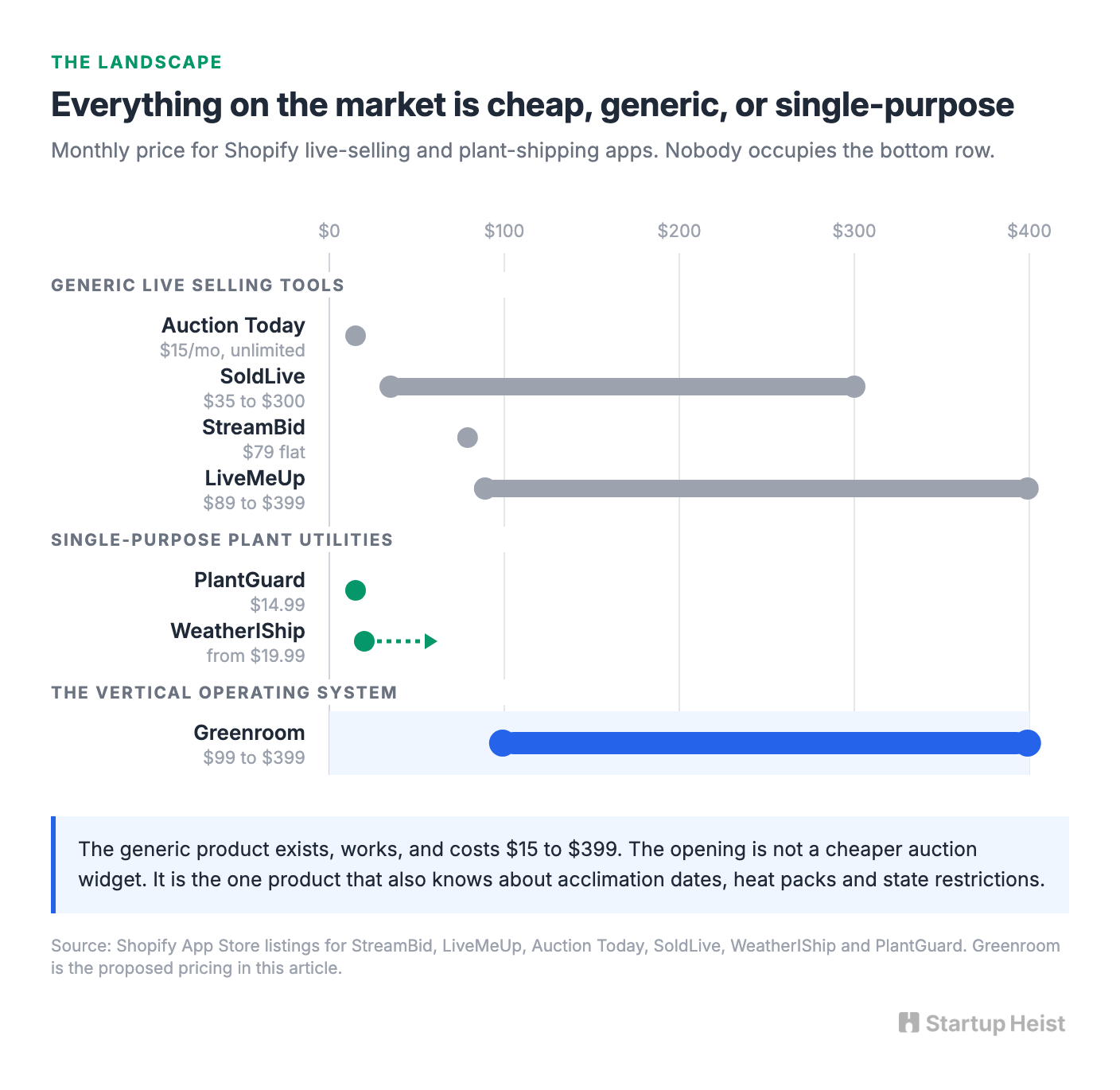
Two tiny Shopify apps prove merchants already pay for pieces of this. WeatherIShip checks destination weather during each order's transit window and tags orders for insulation, heat packs or hold, from $19.99 a month. One reviewer, a live plant seller, spelled out the before state: manually checking the weather at every single order's destination address so nothing cooked or froze. PlantGuard launched on May 21, 2026 at $14.99 a month with 143-plus species and 5,600-plus state restrictions drawn from APHIS and state agencies, and blocks non-compliant shipments at checkout.
Neither app has meaningful review volume yet, which is exactly the point. Merchants are assembling an operating system out of Shopify, two marketplaces, Instagram, a weather app, spreadsheets, shipping software, email, SMS, a restriction checker, and a great deal of knowledge stored only in the owner's head. Fragmentation that specific is a business waiting to be built, and whoever consolidates it takes the account.
Don't Sell Livestreaming
Unlock the Vault.
Join founders who spot opportunities ahead of the crowd. Actionable insights. Zero fluff.
“Intelligent, bold, minus the pretense.”
“Like discovering the cheat codes of the startup world.”
“SH is off-Broadway for founders — weird, sharp, and ahead of the curve.”


