


Press 1 If You're a Robot: Build the Front Desk for AI Callers
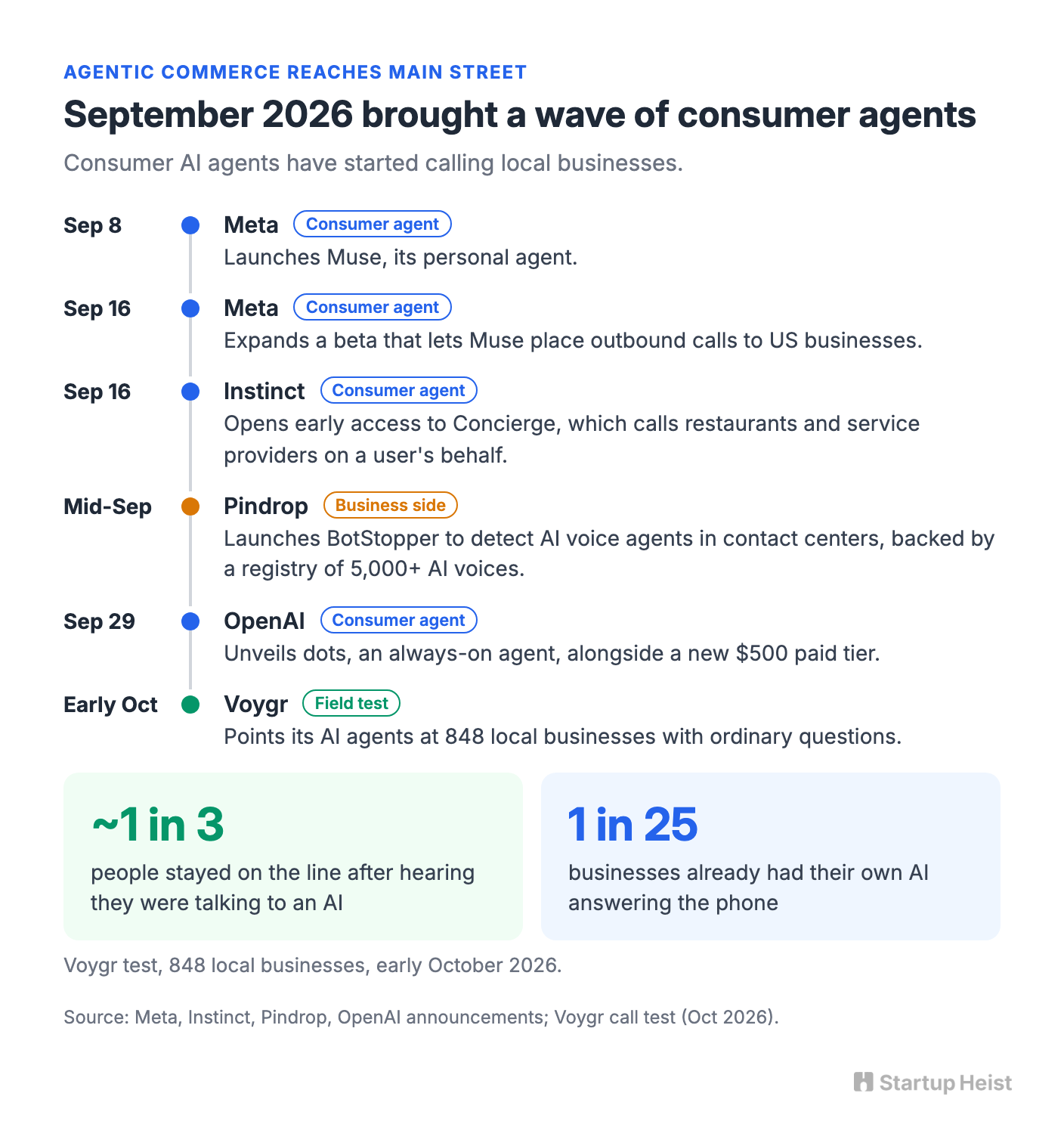
In early October 2026, a Y Combinator startup called Voygr pointed its AI agents at 848 local businesses and had them ask ordinary questions. Is the dentist taking new patients? What does the cheapest haircut cost?
About one in three people stayed on the line after hearing they were talking to an AI. One in 25 businesses already had its own AI answering the phone. Staff at veterinary and dental offices were the most willing to keep talking, while dry cleaners and bars hung up fastest.
The Lazy Bear restaurant group in San Francisco has seen the other side. Its COO told the San Francisco Standard that, as far as she knows, no AI agent has successfully made a reservation at Lazy Bear, True Laurel, or Jou Jou, and that agents often get stuck at the payment step. Lazy Bear doesn't take phone reservations at all; tickets sell through Tock.
Consumer AI agents have started calling local businesses, and a meaningful share of the people who answer will talk to them. What's missing is the machinery to finish the transaction. AI receptionists built for human callers are everywhere. A front desk that can serve a human, serve that human's AI, and close the booking either way is still hard to find.
Veterinary clinics are the place to start, for a reason that has nothing to do with robots: they already lose about a third of their booking attempts. Sell the fix for today's missed calls, and build the rails for tomorrow's AI customers on the same install. Here's the opportunity.
The money: 500 clinics at a blended $229 a month is about $115K MRR. A JAVMA study found a third of vet booking attempts never produced an appointment.
Inside:
• Five-part MVP with a machine booking API
• Three integration levels for closed PIMS
• Pricing tiers with per-minute margin math
• 10-week build, pilot scorecard, outreach email
The Phone Is Ringing From Both Ends
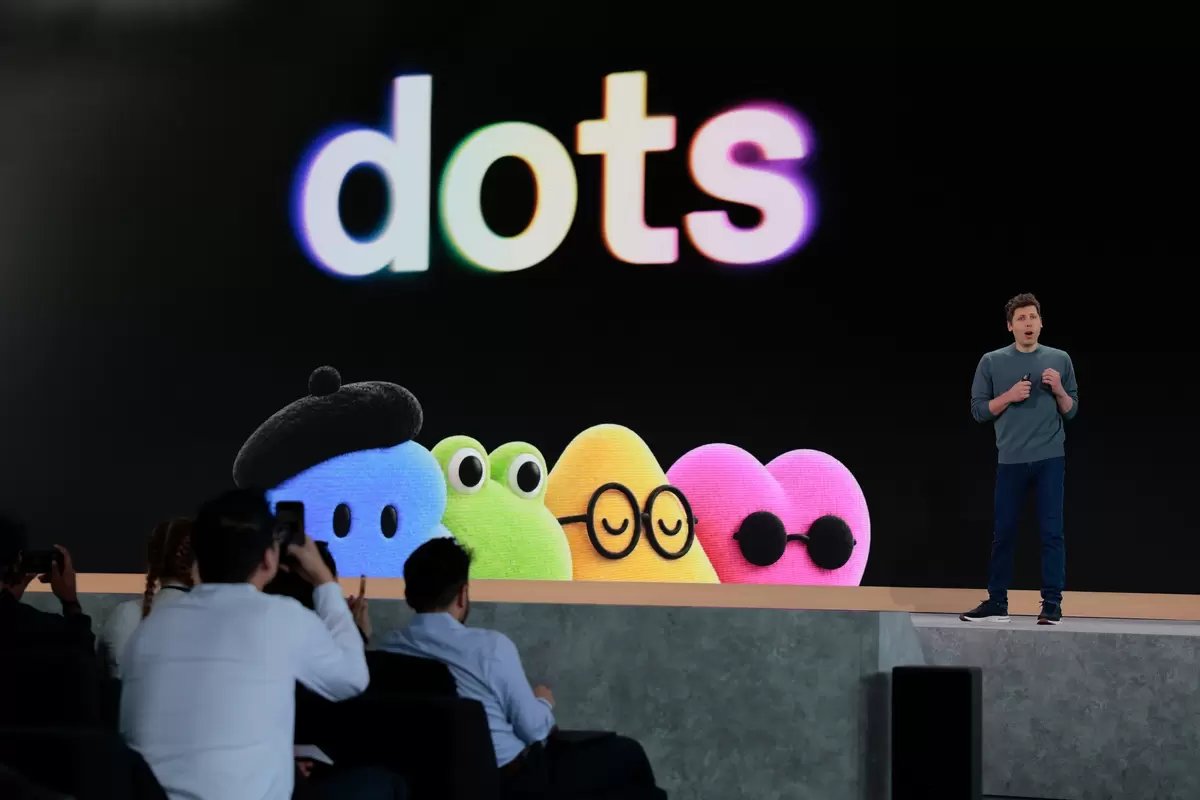
Google has placed automated booking calls to businesses through its Business Profile system for some time, but September 2026 brought a wave of consumer agents. Meta launched Muse, its personal agent, on September 8, and on September 16 expanded a beta that lets Muse place outbound calls to US businesses. The same day, Instinct opened early access to Concierge, which calls restaurants and service providers on a user's behalf. On September 29, OpenAI unveiled dots, an always-on agent, alongside a new $500 paid tier.
Call volume is still small. At The New Wheel, an e-bike shop with three Bay Area locations, an employee answers one or two AI calls a week. Completion is the harder problem. 404 Media reported that Meta added a layer of trained human contractors who can take over Muse calls, which Meta told employees was to ensure calls could be completed. The company that built the agent has put people behind it to get calls over the line.
The friction sits on the business side too. A phone system can't tell an authorized assistant from spam, the receptionist has no idea whether a bot can commit to a deposit, and the booking form asks for details the agent doesn't have. Any one of those snags can end the call. As agentic commerce reaches Main Street, local businesses face a new competitive question: can a customer's software actually do business with you?
A product built only for AI callers, at a few calls a week, wouldn't justify a subscription. It needs a bigger problem to ride on, and vet clinics have one.
The Vet Front Desk Is Leaking Appointments
Between February and April 2025, researchers posing as dog owners contacted 5,053 general veterinary practices across six states to book a routine wellness visit. The results, published in the Journal of the American Veterinary Medical Association, were blunt. Only 67% of attempts produced an appointment. Most failures were operational: 15.1% of attempts never reached a staff member, and another 8.2% ran into hold times longer than five minutes. Just 3.9% failed because the clinic lacked capacity.
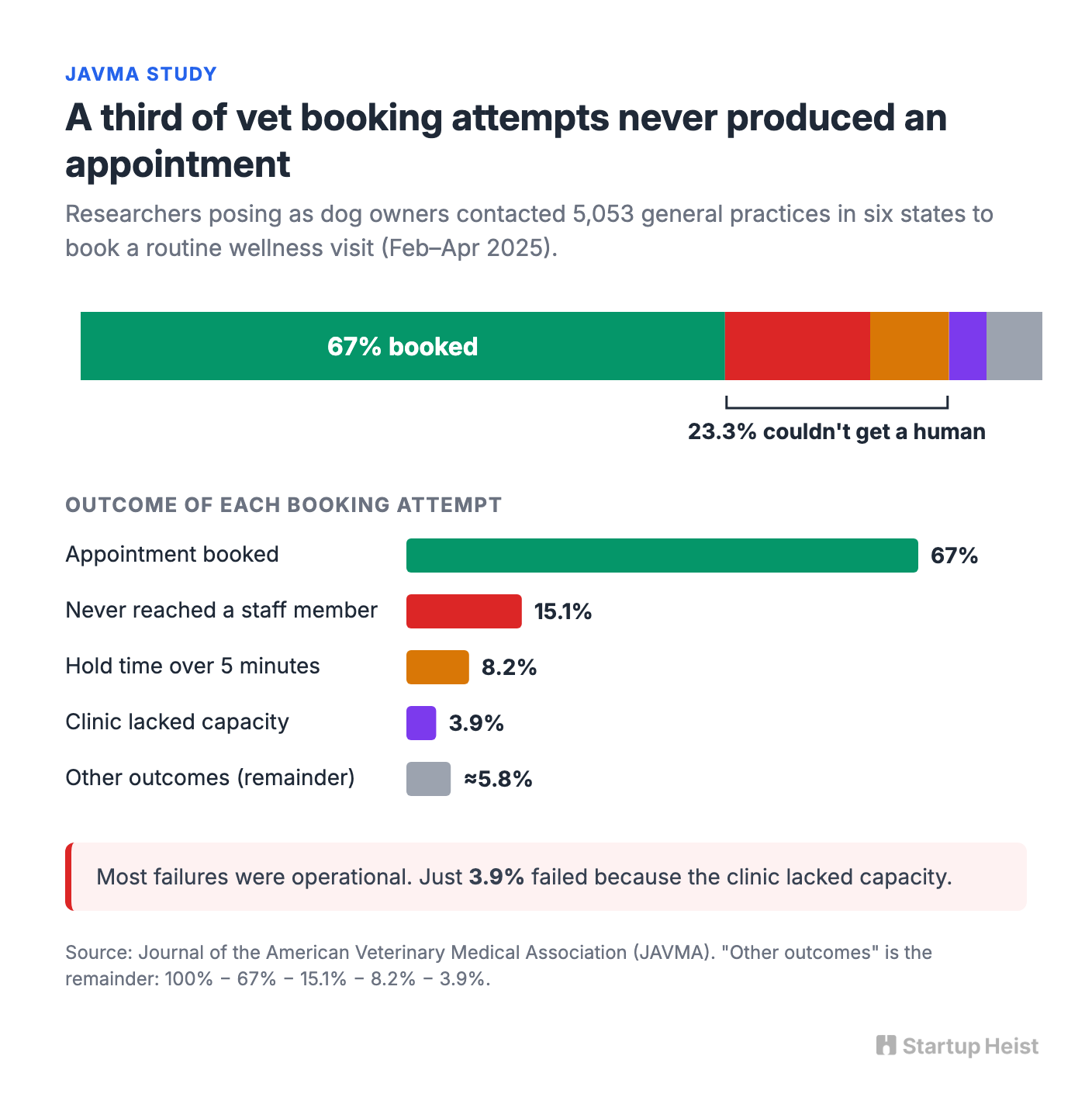
Nearly a quarter of people trying to give a clinic money couldn't get a human to take it. The front desk is checking in a dog, taking a payment, and calming a distressed owner while the phone rings, and the phone usually loses.
The leak continues after closing. Otto, a veterinary communications platform, reported that 37% of online bookings at its clinics in 2025 came in after hours. Pet owners want to book when the clinic is closed, and a business-hours front desk can't take that booking.
Veterinary AI receptionists for that problem are a well-understood market. The second problem is newer: even clinics that answer every call may fumble when the caller is an AI assistant. A product that solves the first problem earns the installed base to solve the second.
Why Vet Clinics, and Which Ones
The US Census counted 34,296 veterinary-service establishments in 2023, and the AVMA puts average practice gross revenue at about $1.5 million in 2024. A practice that size can justify a few hundred dollars a month for software that recovers appointments.
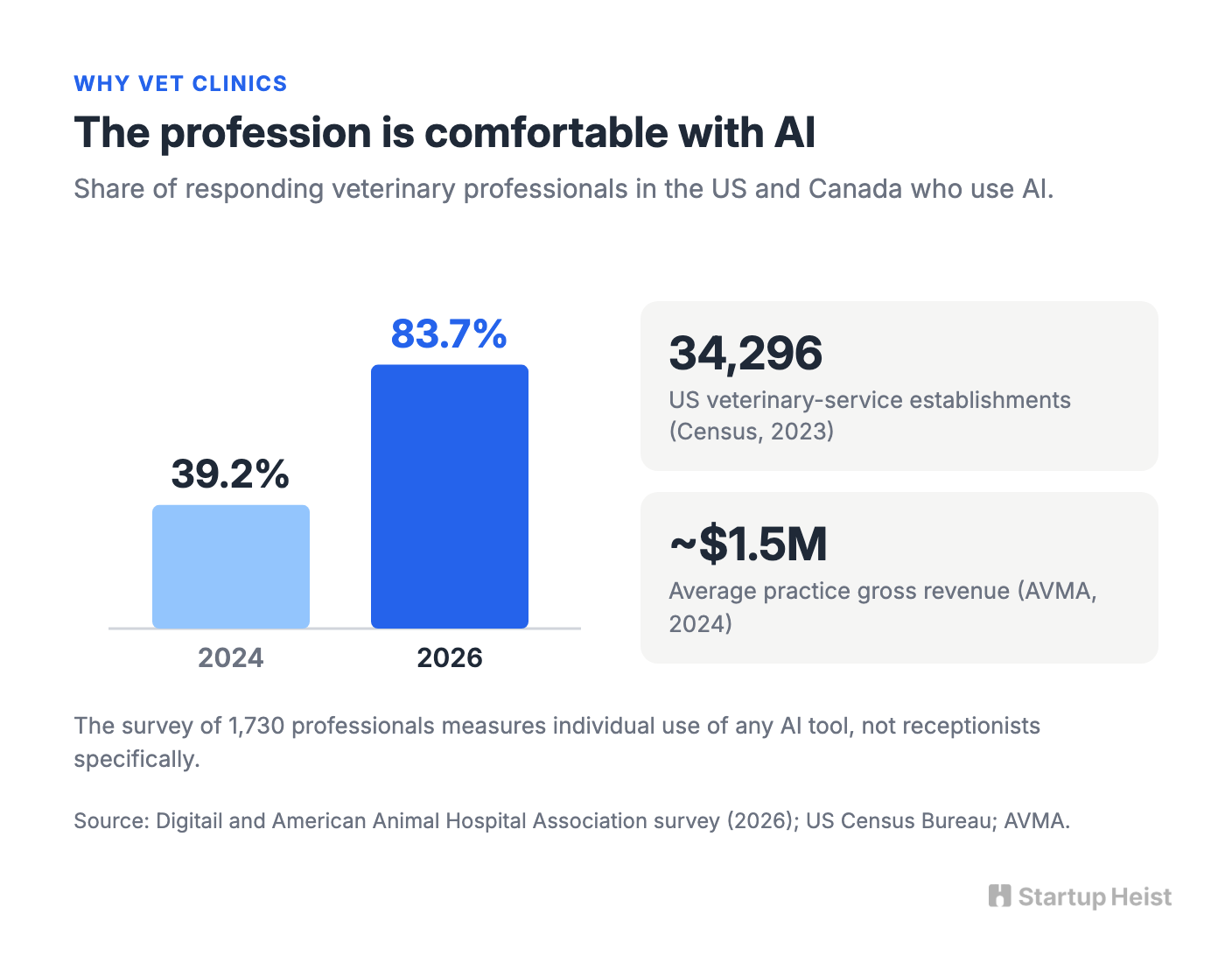
The profession is comfortable with AI, too. A 2026 survey by Digitail and the American Animal Hospital Association found 83.7% of 1,730 responding veterinary professionals in the US and Canada now use AI, up from 39.2% in 2024. The survey measures individual use of any AI tool and says nothing about receptionists specifically, but your pitch won't have to start with a lecture. Voygr's calls add that vet staff are among the most willing to talk to an AI caller.
Lifetime value favors you, since a new-puppy appointment opens the door to vaccinations, wellness exams, dental work, and years of visits. Be choosy, though. A clinic booked solid gains nothing from more requests, and emergency hospitals can't treat calls as routine commerce. Your best early customers are independent general practices with measurable missed calls, some open routine capacity, and clear rules for which visits can be booked without a clinician's judgment.
The Field Is Crowded, and the Handoff Is Still Open
You're walking into a market with real competitors. VetRec sells an AI receptionist at $299 a month for up to 500 interactions and $499 for up to 1,000, with extra calls at $0.65 each. PupPilot bundles a phone system, AI answering, and scheduling. Otto launched Agentic Confirmations in January 2026 to handle confirmations, reschedules, and client questions automatically or flag them for staff. On the enterprise side, Pindrop launched BotStopper in mid-September 2026 to detect AI voice agents in contact centers in real time, backed by a registry of more than 5,000 AI voices. Answering and bot detection are filling up quickly.
Unlock the Vault.
Join founders who spot opportunities ahead of the crowd. Actionable insights. Zero fluff.
“Intelligent, bold, minus the pretense.”
“Like discovering the cheat codes of the startup world.”
“SH is off-Broadway for founders — weird, sharp, and ahead of the curve.”


