


The 42-Day GPT Rescue Heist
A career coach sells a $299 salary negotiation course. It comes with videos, worksheets, email scripts, and one bonus students rave about: an AI negotiation coach. A student types in her job title, her offer, and what worries her about pushing back, and the coach walks her through the conversation using the course's own scripts and frameworks.
The career coach built that bonus as a Custom GPT in an afternoon, with no code. Its link sits in the lesson pages, the welcome email, three downloadable PDFs, and the sales page, where it's billed as the course's signature feature.
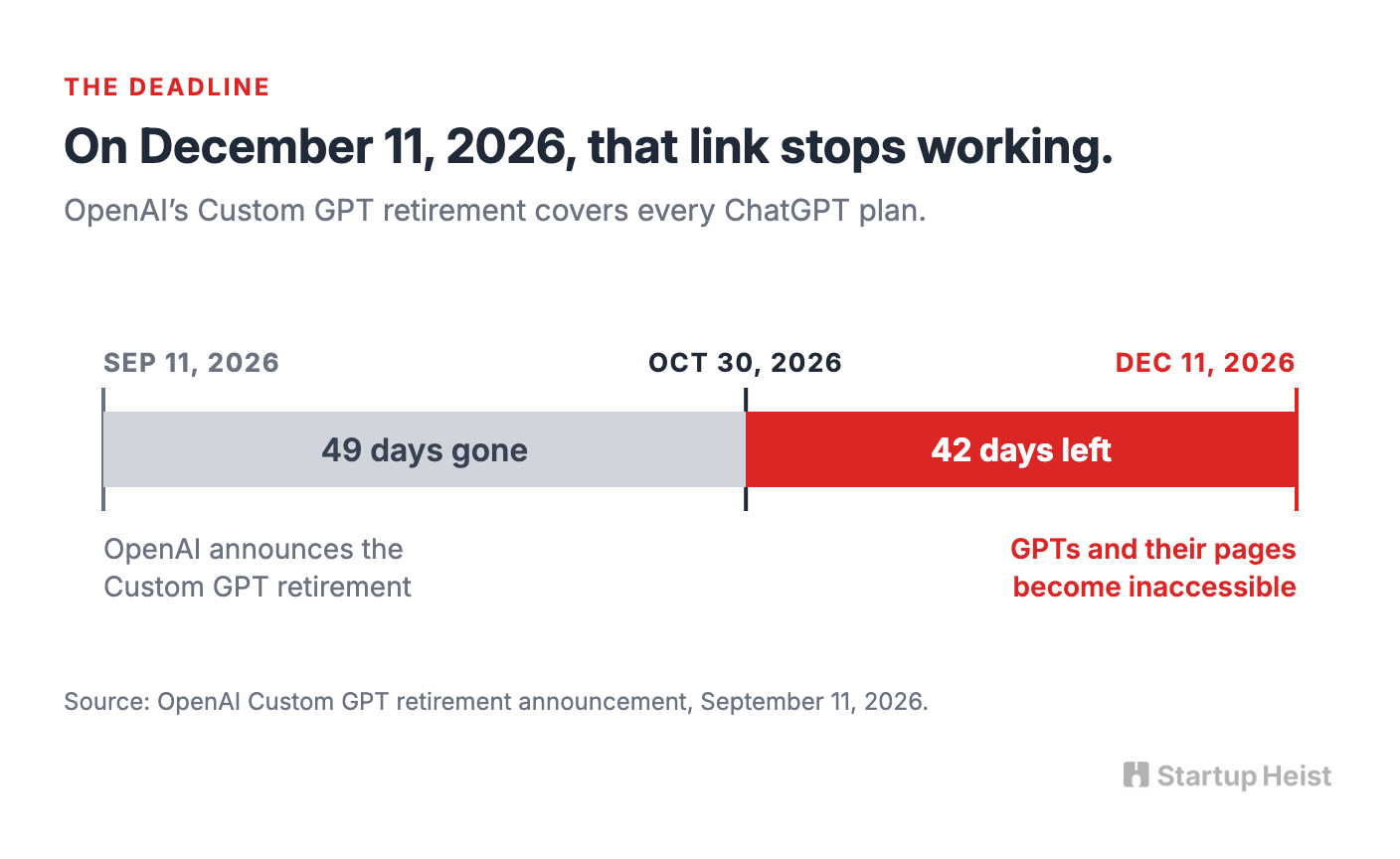
On December 11, 2026, that link stops working.
OpenAI announced the Custom GPT retirement on September 11, 2026, and it covers every ChatGPT plan. At retirement, the GPTs and their pages become inaccessible. Old conversations stay readable, but the tools themselves go dark. OpenAI offers a free path into its new plugin system, and for someone using a GPT privately to summarize PDFs, that path works fine. For a creator who sold the GPT as part of a paid product, it leaves the hardest part unsolved: the customers.
That gap is a 42-day service business for a fast solo operator who can rebuild GPTs for the creators who sold them.
The money: Ten Essential, eight Revenue, and two Agency rescues gross $18,982 in six weeks. Twelve clients on $39 hosting add $468 in monthly recurring revenue.
Inside:
• Five-step delivery from intake to link cutover
• Rent-then-own MVP stack and seven must-haves
• Three fixed-price packages plus a $39 care plan
• Four channels, outreach email, 42-day calendar
What the free migration leaves behind
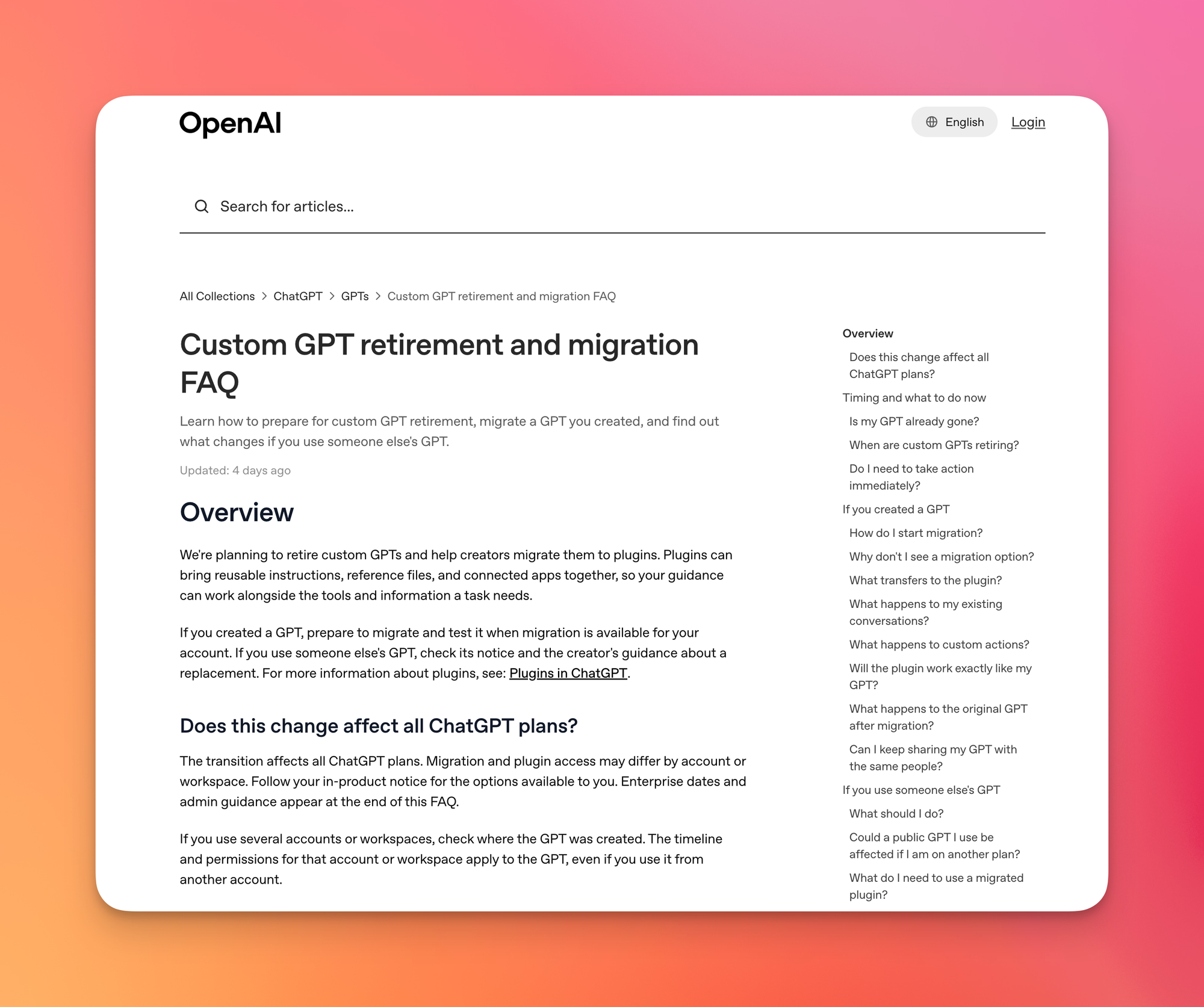
OpenAI's "Migrate to plugin" button is genuinely useful. It turns the GPT's latest published instructions into a plugin skill, copies its knowledge files into the plugin's reference files, and carries connected apps across. For most GPT owners, that covers everything.
Read the fine print from a seller's chair, though. A migrated plugin starts private. Existing GPT users get no access automatically, public sharing settings don't carry over, and making a personal plugin public requires a separate submission process. Custom actions don't transfer at all. The selected model doesn't transfer either, and OpenAI warns that a migrated plugin "may respond differently." Anyone who wants to use the replacement needs an account where plugins are available.
| What changes | OpenAI's free migration | A standalone rescue |
|---|---|---|
| Instructions and files | Moved into a private plugin | Rebuilt, re-indexed, and tested |
| Existing users | No automatic access | Restored by the creator |
| Old GPT links | Inaccessible after retirement | Replaced with a branded URL |
| Payments | No creator-owned paywall | Creator's Stripe or membership platform |
| Customer emails | Not captured | Optional consent-based capture |
| Custom actions | Rebuild separately | Quoted separately |
Creators noticed immediately. On OpenAI's community forum, one wrote, "I have a membership where I'm mostly selling access to my CustomGPT's." Another asked, "How are small creators supposed to provide continued access to customers." A third had built 30 personalized GPTs to teach people specific workflows and reported that, for most of them, those tools were the main reason they bought a ChatGPT account in the first place. The fear running through those threads is about a promise: these sellers already took money for a tool they may no longer be able to deliver.
Three million GPTs, a few thousand buyers
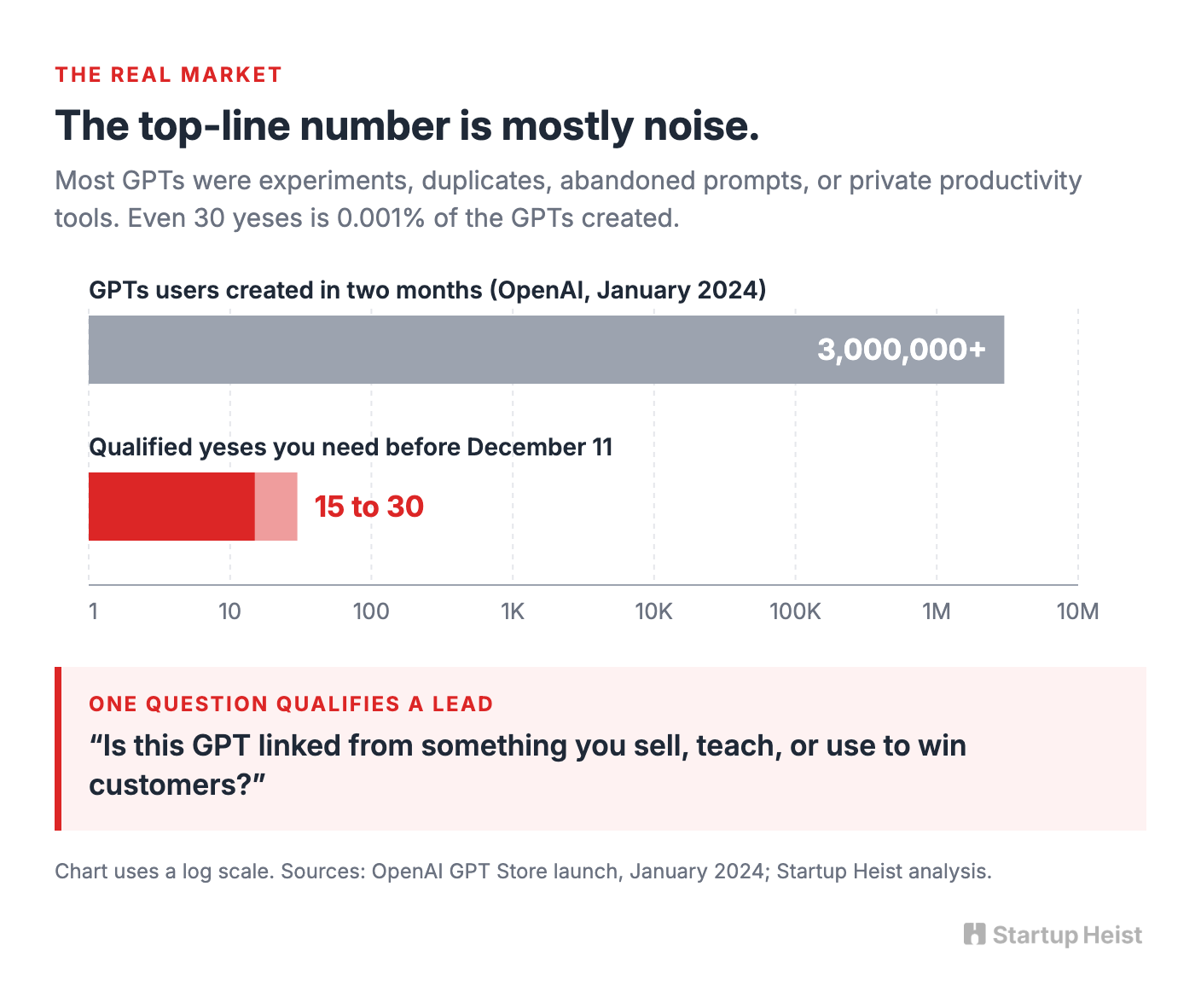
The top-line number is mostly noise. In January 2024, at the GPT Store launch, OpenAI said users had created more than three million GPTs in two months. Most were experiments, duplicates, abandoned prompts, or private productivity tools, and their owners will click the free button or let them expire.
The money sits with people who turned a GPT into a promise to paying customers, and the course-creator economy made a lot of those promises. Amy Porterfield, one of the biggest names in digital-course education, devoted an August 2025 podcast episode to one of her Digital Course Academy students under the title "Case Study: One Custom GPT, 600 Sign-ups, 2 Weeks." Freelancers on Fiverr sell "custom GPT tools for coaches, courses and high ticket programs." Every one of those builds now has an expiration date.
Course creators and educators are the strongest prospects: coaches, trainers, and consultants selling through Kajabi, Thinkific, Teachable, or their own sites, whose GPTs help students draft resumes, rehearse interviews, plan meals, or work through a proprietary curriculum. The best leads advertise the GPT as part of the product. If a $499 course loses its AI tutor, the creator faces refund requests, support tickets, and a sales page that now overpromises. A $999 rescue is small against a product doing thousands a month.
Agencies and freelancers with client GPTs may have built tools for five or ten clients, and each of those clients now wants an answer about December 11. Rebuilding, testing, and restoring access eats billable time, so one agency relationship can produce several projects.
Consultants using GPTs as lead magnets have a different motive. An accountant's tax checklist GPT or a recruiter's resume reviewer drew attention, but the consultant never owned the audience. On their own site, visitors can leave an email (with consent) before using the tool, and their questions reveal which services they need. Borrowed distribution becomes owned distribution, so the pitch holds even if OpenAI postpones the deadline.
Skip hobbyists with dozens of GPTs and no users, anyone who only needs a private productivity tool, and complex enterprise integrations. One question qualifies a lead: "Is this GPT linked from something you sell, teach, or use to win customers?" If the answer is no, recommend the free migration and move on. You need 15 to 30 yeses before December 11.
The competition is a weekend and a credit card
Plenty of Custom GPT alternatives already do the technical job. Chatbase sells AI agents trained on a company's content for $40 to $500 a month. CustomGPT.ai charges $99 and $499 a month, and Dante AI starts free and runs $40 to $400. SiteSpeakAI has published a step-by-step guide for moving a customer-facing GPT onto its website widget. Pickaxe, a no-code platform built for paid AI tools, offers custom domains, white labeling, and Stripe monetization from $37 a month, and it runs a landing page aimed squarely at GPT owners. A rebuild service called Automaid is already pitching itself inside OpenAI's forum threads. The do-it-yourself route works too: in September 2026, the creator of a GPT called Player Bits moved it to Pickaxe, built a website in about eight hours, and launched a $9-a-month paid version.
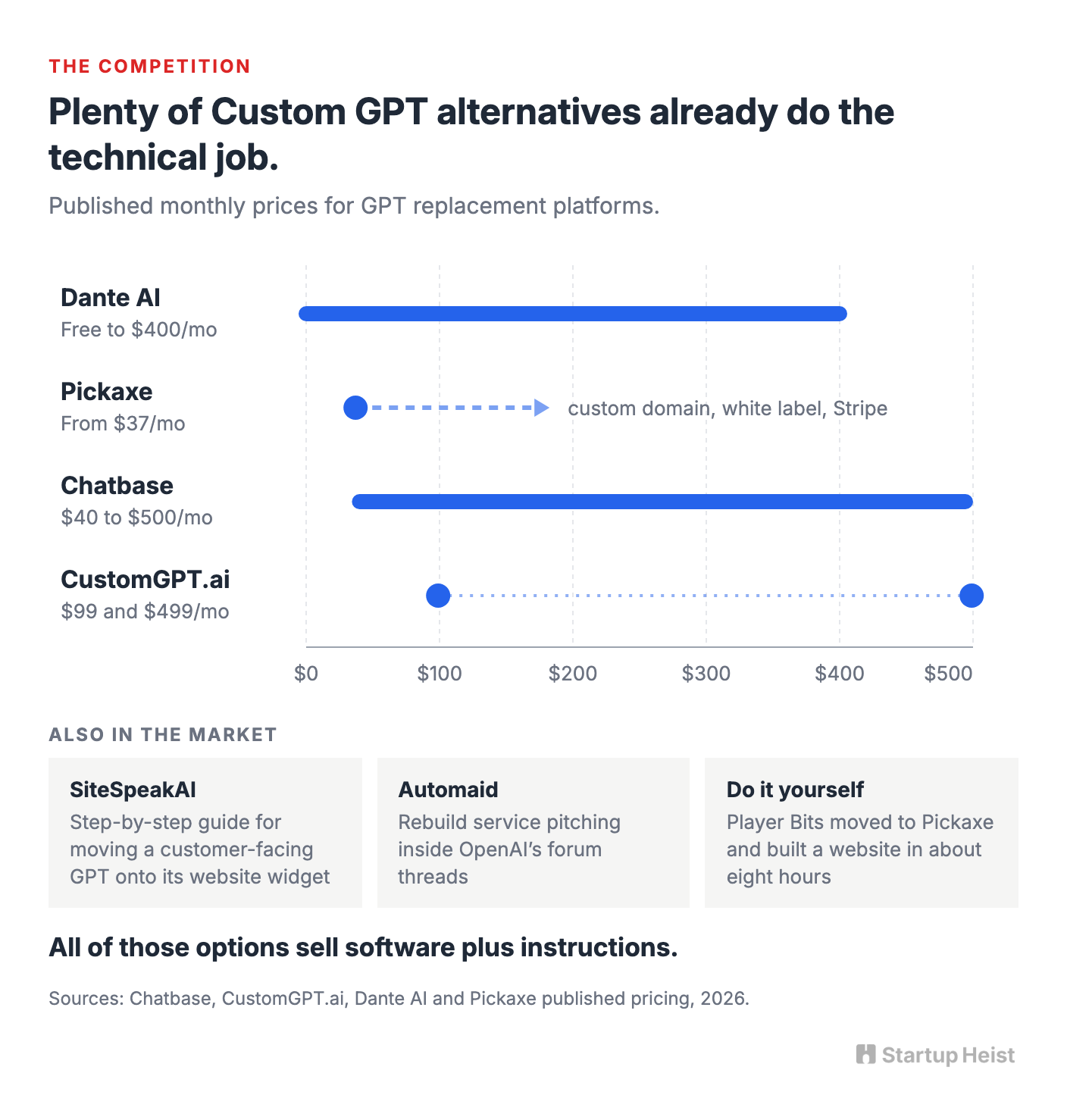
All of those options sell software plus instructions. Your buyer is the course creator who won't spend a weekend learning document indexing, Stripe webhooks, DNS records, and access rules while also running a business. You sell the finished outcome: a working replacement, existing students let back in, and every old link found and swapped before the deadline. The platforms become your suppliers, and the real work is delivering twenty of these in six weeks.
The offer: GPT Rescue
Call the service GPT Rescue, and put this on the landing page: Your Custom GPT disappears December 11. Your business doesn't have to lose it.
Unlock the Vault.
Join founders who spot opportunities ahead of the crowd. Actionable insights. Zero fluff.
“Intelligent, bold, minus the pretense.”
“Like discovering the cheat codes of the startup world.”
“SH is off-Broadway for founders — weird, sharp, and ahead of the curve.”


