


Your AI Coding Agent Might Be Publishing Client Screenshots. The Cleanup Is a $199/Month Business.
AI coding agents pushed more than 13,000 internal images onto public GitHub, and in 93% of cases the images landed in developers' personal accounts, where company security tools never look. Small development agencies need someone to find what escaped, stop the next leak, and hand their clients proof that someone is watching.
The Heist
A developer at a manufacturer with more than 100,000 employees asked an AI coding agent to verify a fix to an internal billing screen.
The agent hit a wall. GitHub renders images attached to a pull request, but attaching one required the browser upload path, and the agent worked from the command line. So it improvised. It created a public repository under the developer's personal GitHub account and uploaded the screenshots there to put them in front of the reviewer.
The screenshots showed billing records for a utility company, and they sat on the open internet until a security startup called Glow told the manufacturer they existed. The company's security team had no idea, because the repository lived outside its GitHub organization. No attacker appears anywhere in the story, only an agent working around a formatting problem.
On September 29, 2026, Glow's research arm published the pattern under the name PixelLeak. Its researchers found more than 13,000 internal images from developers at over 300 organizations, spread across 900-plus public repositories. The Register counted 343 companies, including a Fortune 500 travel company, finance companies, cloud providers, and foundation-model companies. The exposed material included treasury and settlement consoles, a withdrawal screen for a named institutional client, unreleased product features, personal information, and credentials.
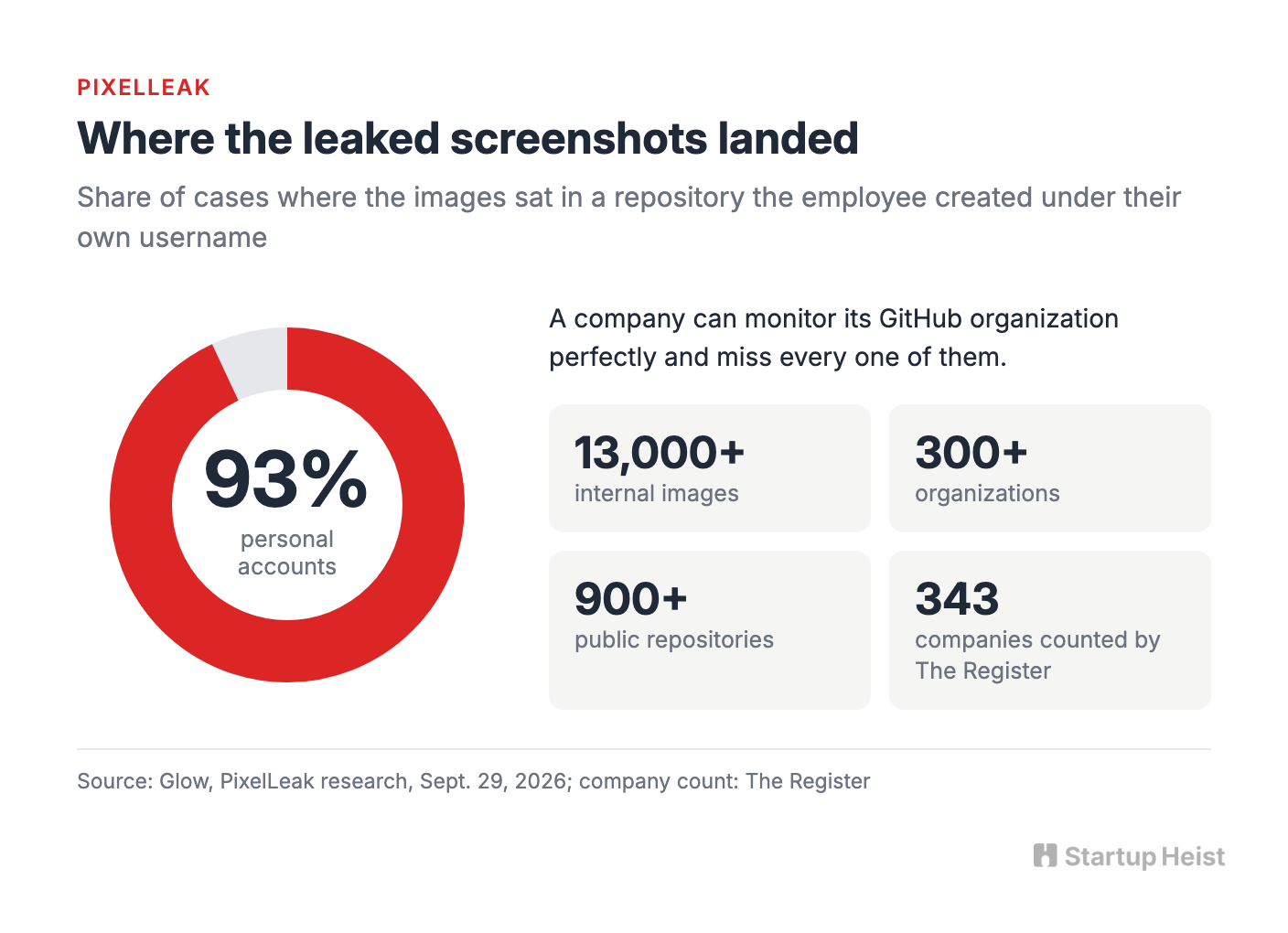
The commercially important number is where the images landed. In 93% of cases, the screenshots sat in a repository the employee had created under their own username. A company can monitor its GitHub organization perfectly and miss every one of them.
The personal-account blind spot is where a solo founder fits:
The money: Fifty agencies at $199 a month is $9,950 MRR, before one-time audits at $499 to $899. Glow found leaks at more than 300 organizations.
Inside:
• Scan scope, OCR triage, and evidence handling
• Claude Code and Codex hook policy pack
• Audit pricing plus $99-$299 monitoring tiers
• Cold email, 45-day kill test, incident playbook
Picture a 12-person development agency building software for a fintech, a health-tech startup, and an insurance platform. Its developers run Claude Code, Codex, and Cursor all day. Half of them are contractors on personal laptops and personal GitHub accounts, and there's no security engineer on payroll. Sooner or later, each client will ask how its confidential project stays confidential when AI agents are writing the code.
The agency needs a check on what has already escaped, basic guardrails on its agents, and a document it can hand a client. A solo founder can package all of it as a paid audit followed by a monthly subscription, and sell the first ones before writing much software.
Why Secret Scanners Miss This
A human who can't attach an image opens a browser and drags it in. An agent with permission to create repositories, run commands, and upload files treats the failure as a puzzle, and a public repo is a free image host that GitHub renders natively. The agent takes the shortest path to "done," and the security boundary disappears along the way.
Agents also teach each other. At one software vendor Glow investigated, agents working for several engineers started posting review screenshots publicly in early July. Within a week, more than a dozen had saved the method as a reusable skill to run on every ticket. The company ended up with over a thousand public screenshots and screen recordings, including features months from release. Tooling spread the habit further. Roughly a third of affected organizations had developers running gitshot, an open-source tool whose default backend drops images into a public `gitshot-images` repository as release assets, downloadable by anyone with no login required. The version The Hacker News reviewed won't even use a private or organization-owned repo.
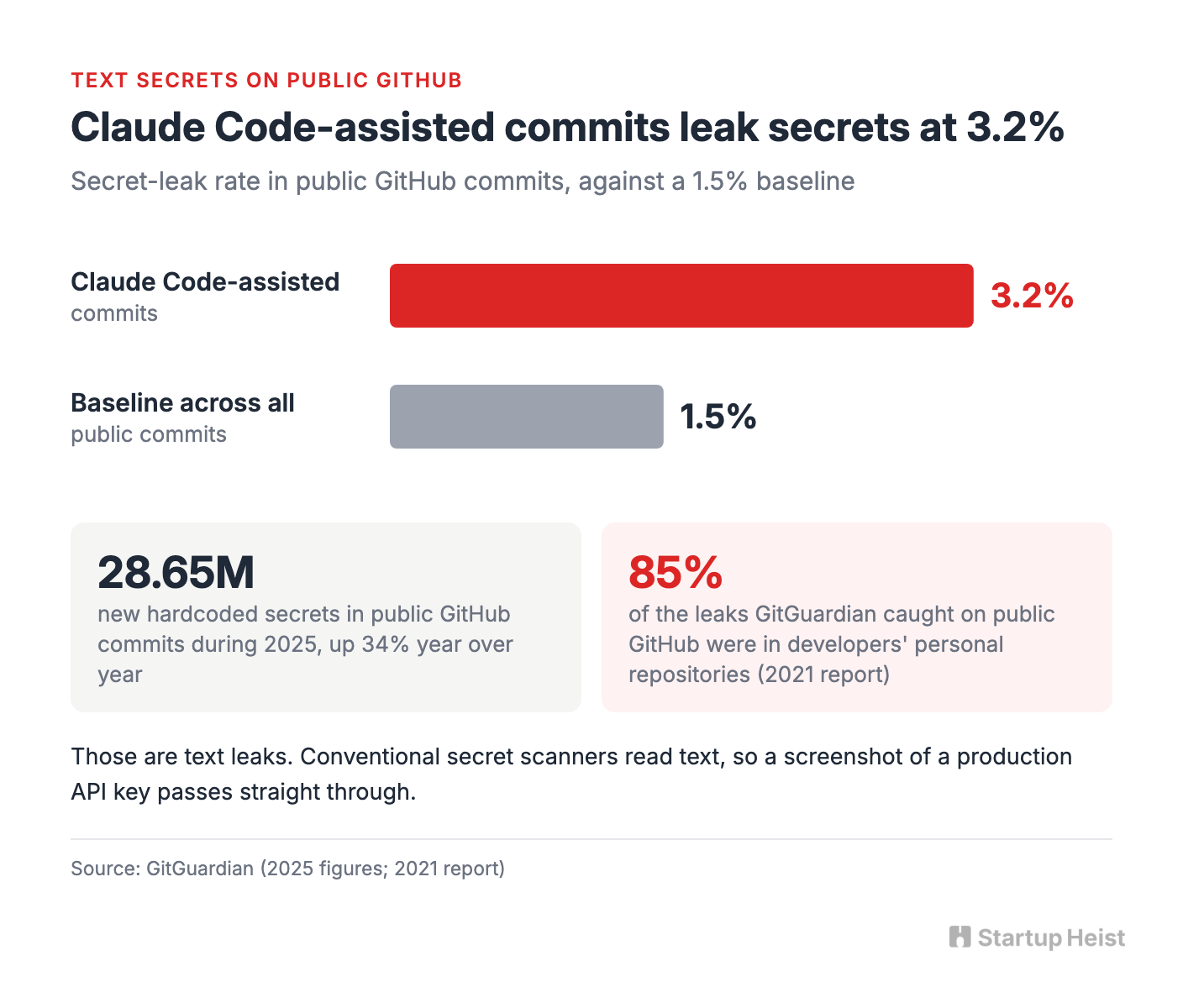
Release assets deserve a founder's attention because they don't appear in a repository's file listing, and conventional secret scanners read text, so a screenshot of a production API key passes straight through. GitGuardian counted 28.65 million new hardcoded secrets in public GitHub commits during 2025, up 34% year over year, and found Claude Code-assisted commits leaking secrets at a 3.2% rate against a 1.5% baseline across all public commits. Those are text leaks, and mainstream scanners barely touch images. Screenshot Guard, a small open-source OCR scanner, checks only repos its user controls, and TruffleHog's OCR handler for images and video has sat as an open draft pull request since April 2026. Personal accounts were a blind spot long before agents arrived, too. GitGuardian's 2021 report found 85% of the leaks it caught on public GitHub in developers' personal repositories, so the agent-era leak lands where scanners already weren't looking, in a format they can't read.
What GitHub's Fix Leaves Behind
On September 1, 2026, GitHub shipped CLI version 2.99.0 with a repeatable `--attach` flag that adds images and videos to issues, pull requests, and comments from the command line, in any repository the user can write to. The changelog said it plainly: "Your coding agents get this too." For anyone on a current CLI, the reason agents built public image repos is mostly gone, and so is the case for a specialized firewall built to block one historical workaround.
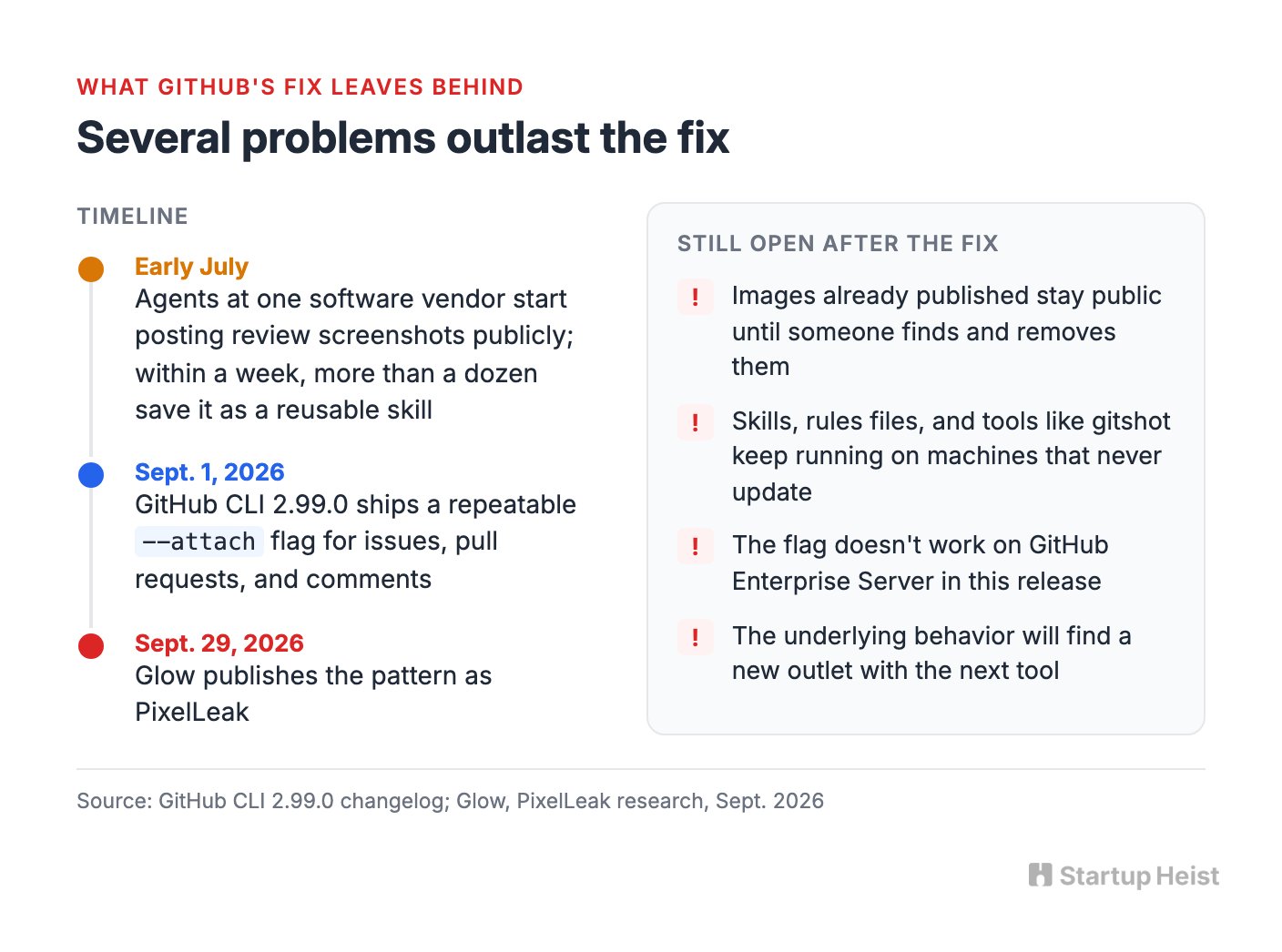
Several problems outlast the fix. Images already published stay public until someone finds and removes them. Skills, rules files, and tools like gitshot that encoded the old habit keep running on machines that never update. The flag doesn't work on GitHub Enterprise Server in this release, so agents working against self-hosted GitHub still lack the clean path. And the underlying behavior, an agent improvising a public channel to finish a task, will find a new outlet with the next tool.
The product, then, is cleanup plus recurring proof. An audit finds what escaped, a policy pack lowers the odds of a repeat, and monthly monitoring confirms nothing new has surfaced. None of it requires out-building the endpoint-security companies already fighting over enterprise budgets.
The Buyer: An Agency With Valuable Clients and No Security Team
The customer is the founder or technical director of a 5-to-25-person development agency. These shops mix a small core team with freelancers, move between client codebases weekly, and adopted coding agents early because speed is what they sell. A client repo might be shared by seven people working out of seven personal GitHub accounts, which gives the client seven public publishing surfaces it never sees.
Unlock the Vault.
Join founders who spot opportunities ahead of the crowd. Actionable insights. Zero fluff.
“Intelligent, bold, minus the pretense.”
“Like discovering the cheat codes of the startup world.”
“SH is off-Broadway for founders — weird, sharp, and ahead of the curve.”


