


The $979 Cremation and the Missing $320
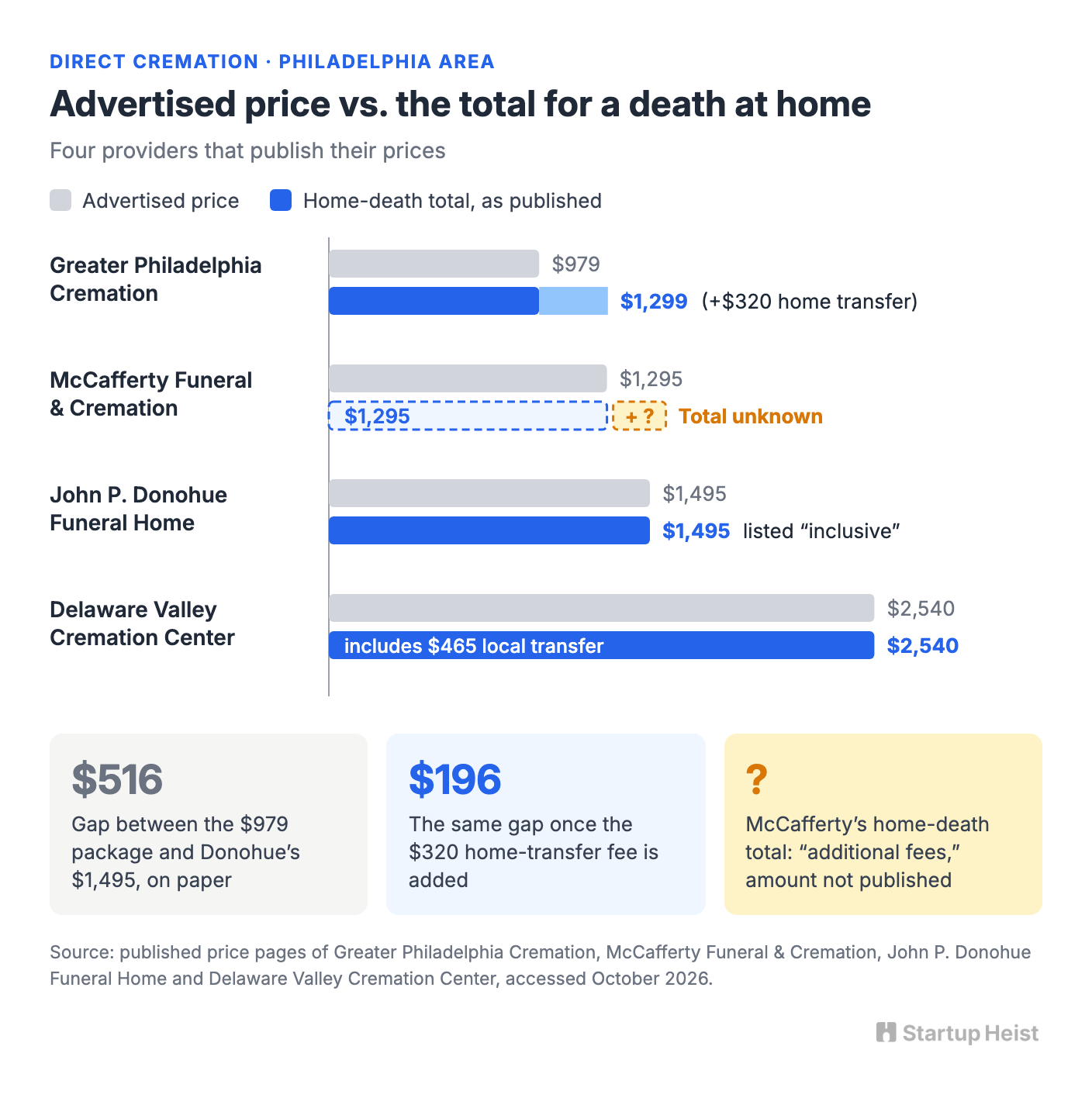
Greater Philadelphia Cremation advertises a direct cremation package starting at $979. The breakdown is unusually honest: a $200 removal fee, $409 in professional services, a $100 cremation container, a $50 vehicle fee, a $200 crematory charge, and a $20 base urn. Then comes a line most families will skim past. Transfers from a residence, hospice, or nursing home cost an additional $320, so if someone dies at home, the $979 cremation becomes a $1,299 cremation.
Three other Philadelphia-area providers publish prices too. McCafferty Funeral & Cremation lists direct cremation at $1,295 and notes that nursing-home, hospice, and residential deaths "would require additional fees," without saying how much. John P. Donohue Funeral Home lists $1,495 "inclusive," with removal, transportation, authorizations, and cremation bundled in. Delaware Valley Cremation Center publishes a $2,540 basic cremation service, itemized down to $1,445 in staff services and a $465 local transfer.
Now run the numbers for a family whose mother died at home. On paper, the gap between the cheapest advertised option and Donohue's inclusive price is $516. Add the home-transfer fee to the $979 package and it shrinks to $196. McCafferty's real total stays unknown until someone picks up the phone.
None of these providers is doing anything wrong, and each publishes more than most of the industry does. Funeral pricing in America is technically public and practically unreadable: four honest price pages still can't be compared without a spreadsheet and a phone call. Building that spreadsheet, and keeping it current, is the product. It also has a second customer, the funeral home owner who wants to know what every competitor within ten miles actually charges, and when that changes.
Here's the opportunity:
The money: 15 to 30 funeral homes paying $99 a month for price monitoring is $1,485 to $2,970 MRR, with $199 one-time pricing snapshots on top.
Inside:
• Two-scenario basket and nine-field price schema
• $199 snapshot and $99/month monitoring tiers
• Eight-week playbook with a go/no-go gate
• Outreach scripts for owners and hospices
A Big, Fragmented Market Moving Toward the Simplest Product
The National Funeral Directors Association counts 15,401 funeral homes in the United States, generating $16.3 billion in annual revenue, and roughly 75% are family- or privately owned. NFDA projected the 2025 cremation rate at 63.4%, rising to 82.3% by 2045.
A pricing startup's addressable market is far smaller than those totals, and the cremation trend matters to it for a different reason. A traditional funeral bundles embalming, viewing, ceremony, casket, cemetery, and a dozen optional services into something nearly impossible to standardize. Direct cremation is the narrowest product the industry sells: disposition with no viewing or ceremony. It still varies, but within bounds tight enough to compare line by line. Cremation's rising share pulls more families toward the one product in the business that can be priced side by side.
Two Problems: Finding the Price and Trusting It
The Federal Trade Commission has measured both halves of the funeral price transparency gap. In a review published in October 2022, FTC staff examined 187 funeral provider websites between June and September 2021. Of those, 114 (61%) showed no price information at all, and only 45 (24%) posted a General Price List or something close to one. Advertised direct cremation prices ran from $595 to $4,760, excluding the cost of an alternative container.
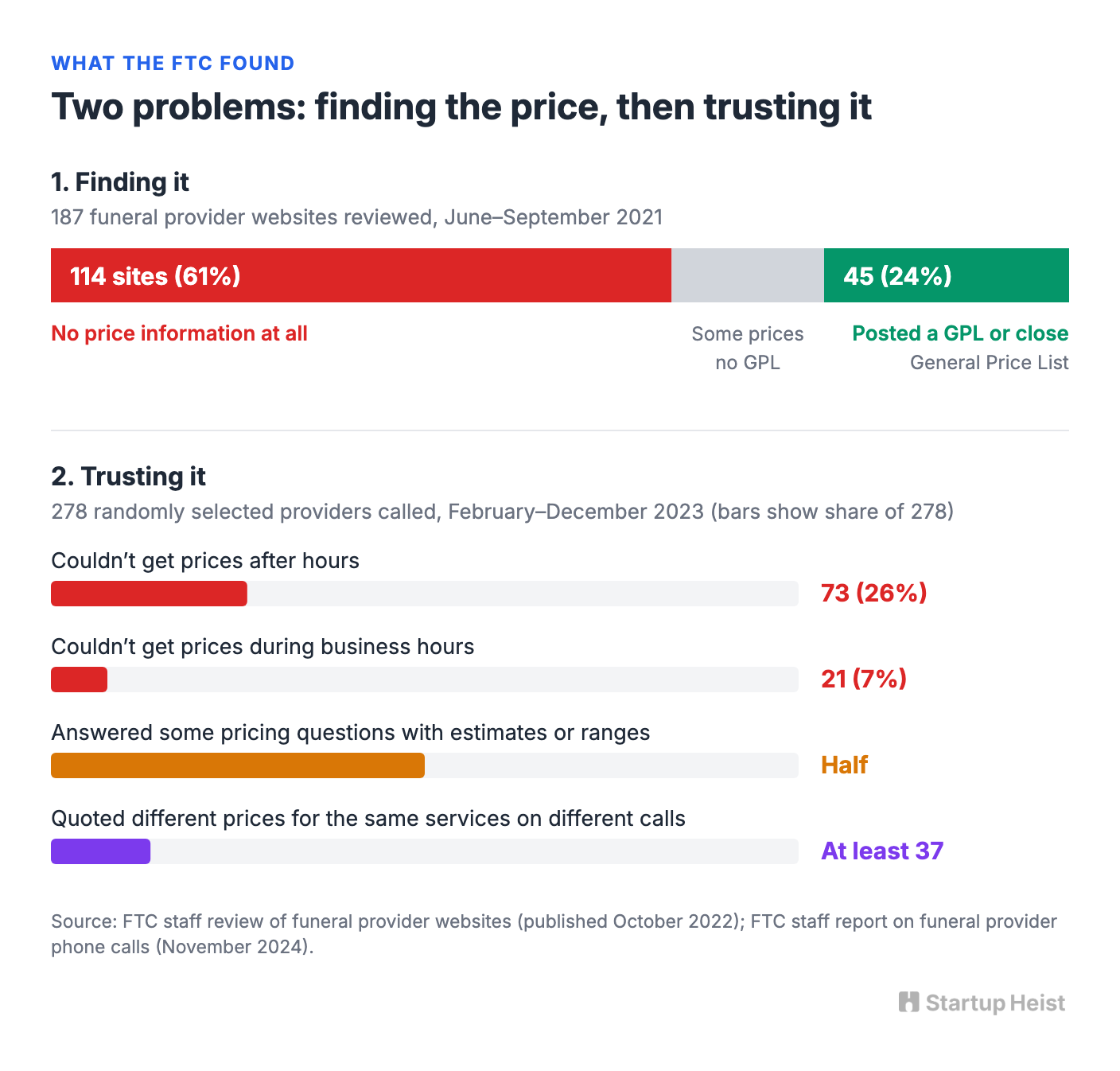
Then the FTC picked up the phone. In a November 2024 report, staff described calls to 278 randomly selected providers between February and December 2023. They couldn't get prices from 73 providers (26%) after hours and from 21 (7%) during business hours. Half answered at least some pricing questions with estimates or ranges. At least 37 quoted different prices for the same services on different calls.
Those 37 providers define the business. A directory tells a family where to find a price, and it can't tell them whether the price will hold. Trust requires source documents, consistent definitions, verification dates, and someone maintaining all of it, which is far harder for a competitor to copy than a list of phone numbers.
What the Law Gives You, and What It Doesn't
The FTC's Funeral Rule has been in force since 1984. Providers must give accurate price information to anyone who calls and asks, and they can't demand the caller's name first. They must hand a General Price List to anyone who asks in person. They aren't required to post prices online or to mail a price list in response to a call. The FTC opened a modernization effort covering online price disclosure in October 2022, and as of October 2026, it hasn't proposed or finalized an online-posting rule. Its May 2026 Funeral Rule notice was a routine paperwork renewal.
Automated calling is riskier territory. In February 2024, the FCC ruled that AI-generated voices count as "artificial" voices under the Telephone Consumer Protection Act, which puts AI calls under the statute's consent rules.
Build the collection workflow on public documents, voluntary submissions, and human follow-up calls, and add automated calling only after a lawyer has reviewed the exact workflow. The advantage lies in the verified data, whatever tool gathered it.
The Comparison Sites Already Exist
Funeral price comparison is an old idea, and the first attempts left a useful record. Parting launched in 2015 with prices for more than 15,000 funeral homes, gathered by phone, email, and fax. Its founder later concluded the consumer marketplace "still didn't quite bridge the expectations gap," and the company moved into Parting Pro, arrangement software sold to funeral homes. Funeralocity runs national cremation and funeral price comparisons and has earned revenue from enhanced provider listings and from fees when customers book through partners. Philadelphia's consumer advocates did the work by hand: in 2016, Funeral Consumers Alliance of Greater Philadelphia volunteers surveyed 125 local funeral homes, found direct cremation from $700 to $3,535, and reported they "sometimes had a hard time obtaining price lists."
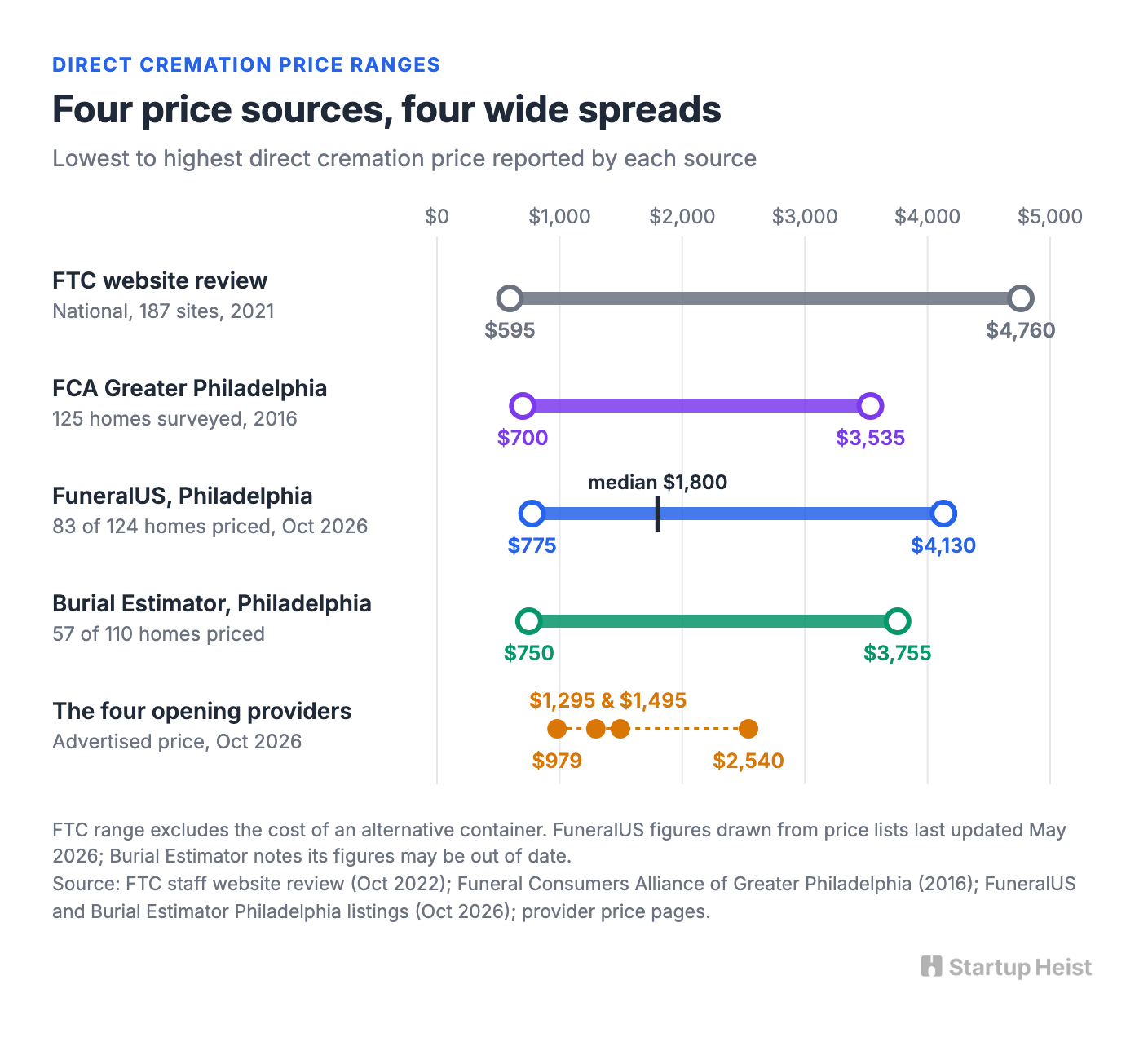
The directories are still crowded. As of October 2026, FuneralUS lists 124 Philadelphia funeral homes with direct cremation prices for 83, ranging from $775 to $4,130 with a median of $1,800, drawn from price lists last updated in May 2026. Burial Estimator shows prices for 57 of 110 providers, from $750 to $3,755, and warns that figures may be out of date and should be confirmed by phone. The consumer pioneer now sells software to funeral homes, the local survey dates from 2016, and the live directories tell families to call and check. The open lane is the slow, unglamorous version: a standardized total for a specific circumstance, with a source document and a date behind every number.
| Dimension | Typical directory | Price ledger |
|---|---|---|
| Displayed price | Starting or package price | Scenario total for hospital vs. home death |
| Provenance | Varies, often undisclosed | Source type, document date, review date |
| Optional charges | Family has to ask | Explicit included and excluded fields |
| Unknowns | Blank or omitted | Flagged as unresolved |
| Price history | Overwritten | Preserved and monitored |
| Business revenue | Leads, listings, referrals | Competitive pricing intelligence |
Whether that lane is really open in Philadelphia is the first thing to test, and the first two weeks of the playbook below are built to answer it.
The Product: A Local Cremation Price Ledger
Philadelphia makes a good pilot. It has visible price variation, active consumer advocates, and at least two directories to audit against. Skip the full Philadelphia-Camden-Wilmington metro for now, since it crosses state lines and licensing regimes. Define a Pennsylvania-side coverage zone, include 50 to 100 providers, and publish exactly which area and provider types are covered.
Unlock the Vault.
Join founders who spot opportunities ahead of the crowd. Actionable insights. Zero fluff.
“Intelligent, bold, minus the pretense.”
“Like discovering the cheat codes of the startup world.”
“SH is off-Broadway for founders — weird, sharp, and ahead of the curve.”


