


The Bank Login Is Closed. The Inbox Is Still Open.
Wall Street has shut the front door on AI agents, yet the records those agents need still land in every customer's inbox and downloads folder: bank alerts, receipts, Stripe payout notices, and monthly statement PDFs.
Build a local, read-only ledger from those records and hand it to Claude through MCP. Privacy-minded power users will pay $49 for the app. The real business is a $29-a-month edition for fractional bookkeepers who review a dozen clients' books every month.
Here's the opportunity:
The money: 300 fractional bookkeepers at $29 a month is $8,700 MRR, with $49 personal licenses on top. Monarch's $100 million ARR shows people pay for finance software.
Inside:
• Alert-to-statement reconciliation model
• A seven-tool read-only MCP server spec
• Pricing and outreach script for bookkeepers
• Six-week build plan with weekly exit tests
The banks pulled the plug
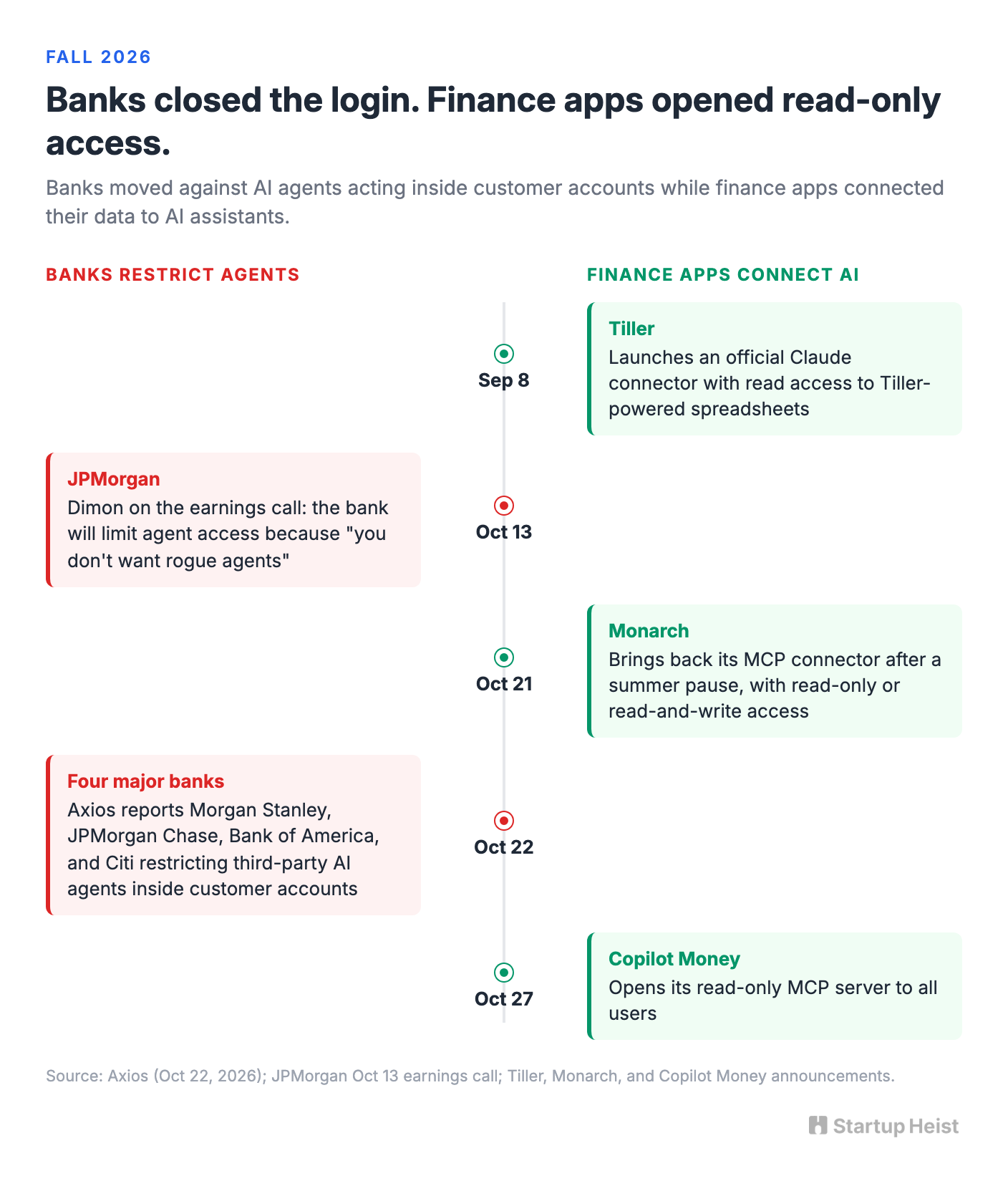
On October 22, 2026, Axios reported that Morgan Stanley, JPMorgan Chase, Bank of America, and Citi were restricting third-party AI agents from operating inside customer accounts. Morgan Stanley went furthest, and the others moved toward read-only access. Executives who spoke to Axios described agents logging in with customers' own credentials and sometimes taking steps beyond what the customer had asked for. One said the industry has "grave concerns." Banks couldn't reliably tell one agent from another, or confirm that a customer had authorized a given one.

On JPMorgan's October 13 earnings call, Jamie Dimon said the bank would limit agent access "because you don't want rogue agents and there could be thousands of them." Bank of America CEO Brian Moynihan told CNBC there should be "a human in the loop" before money moves out of a customer's account. Citi said it doesn't let third-party agents log in or transact on its platforms. Schwab began blocking unauthorized agents that tried to move client money, including Meta's Muse.
The fine print leaves one door open. Citi customers can still authorize "limited, read-only access" to their account data through approved open-banking providers. The banks object to software that logs in and acts like a human. Software that only reads still has room to operate, and the cleanest reading material never touches a bank portal at all.
The data already lives outside the bank
For most of the questions people actually want answered (what am I paying for, what went up, what looks wrong), the evidence already sits in the customer's own mailbox.
The product is a financial mirror: a small Mac menu-bar app that collects bank and card alerts, merchant receipts and processor notifications, and statement PDFs, parses them on the user's machine, strips sensitive details, and stores the clean transactions in an encrypted local SQLite database. It then exposes that database to AI assistants through a read-only Model Context Protocol (MCP) server. MCP is the open standard that lets assistants like Claude connect to outside data and tools.
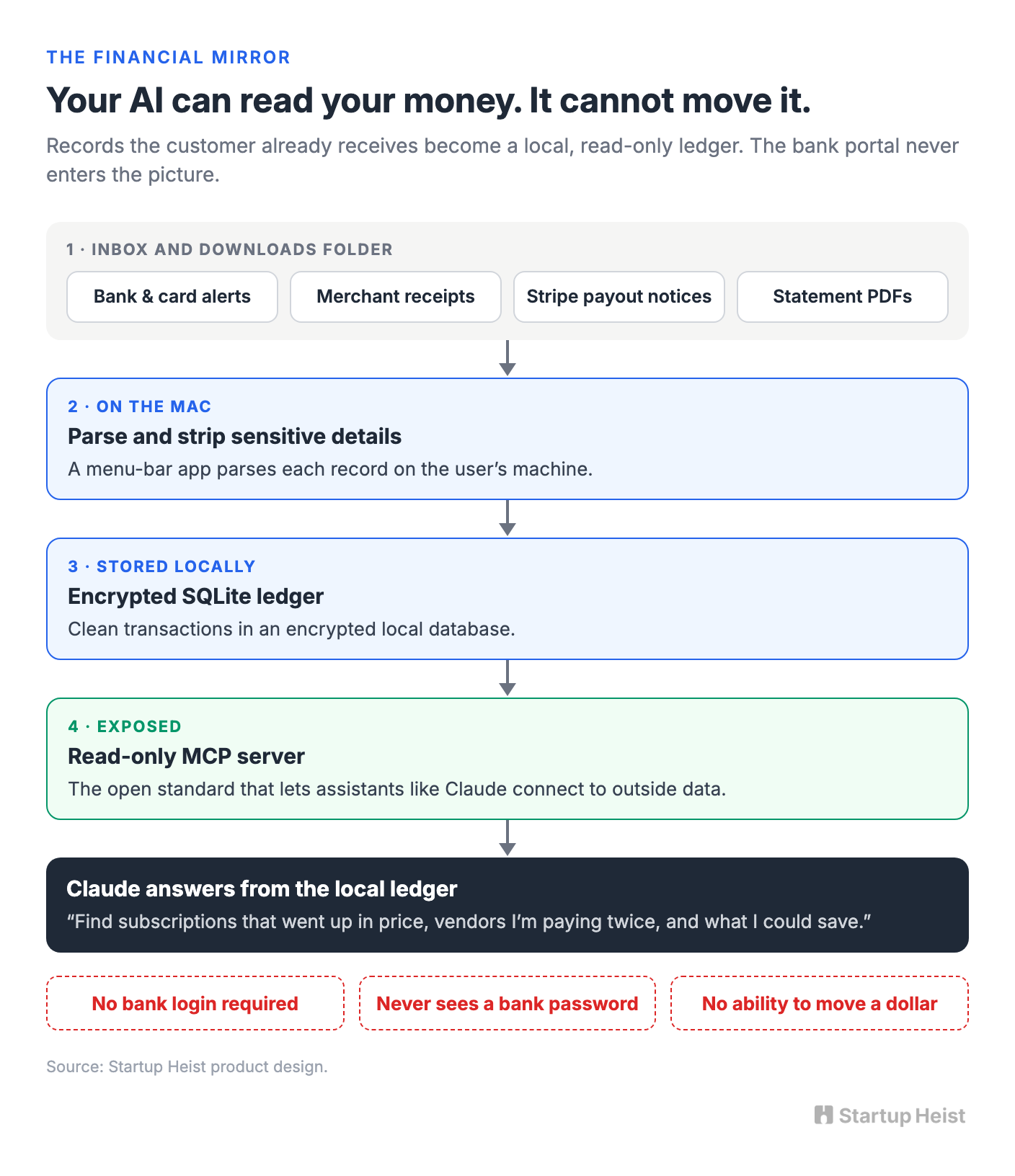
Once connected, a user can ask: "Look at my business expenses over the last six months. Find subscriptions that went up in price, vendors I'm paying twice, and what I could save." The assistant answers from the local ledger. It never sees a bank password, and the app has no ability to move a dollar.
The positioning fits on a sticky note: your AI can read your money; it cannot move your money; no bank login required.
The incumbents just trained the market
Tiller launched an official Claude connector on September 8, 2026, giving Claude read access to Tiller-powered spreadsheets. On October 21, Monarch brought back its MCP connector after a summer pause, letting users choose read-only or read-and-write access. On October 27, Copilot Money opened its read-only MCP server to all users, after testing it with Claude, ChatGPT, and Codex. A year ago, the hardest part of selling this product would have been explaining why anyone should connect an AI assistant to their money. Monarch, which announced more than one million members and $100 million in annual recurring revenue in early October, is now teaching that behavior at no cost to you.
The plumbing has a precedent too. Tidings, an MIT-licensed, self-hosted project, builds "a private finance journal from the transaction emails you already receive." It reads forwarded bank alerts over IMAP, parses them per bank, and stores the transactions in SQLite. It supports five Canadian banks, handles some PDF statements, and has two GitHub stars. Its docs name a bank changing its alert template as the most common failure, and its issue tracker includes duplicate entries from resent alerts and refunds recorded as purchases. Monarch, for its part, already matches forwarded receipts to transactions.
Every incumbent connector starts from the same premise: your accounts are already linked to the platform through a data aggregator. The open lane belongs to people who reject that premise, whether they distrust aggregators, juggle business accounts and payment processors that sync badly, or want occasional AI analysis without adopting another dashboard. Developers can clearly build the plumbing, but nobody has packaged it into something a non-developer would trust with a client's books. The access question is also unsettled. The CFPB's open-banking rule has been stayed in court since October 2025, and a revised proposal sent for White House review in August 2026 reportedly would let banks charge fees for some data access. A product that never asks for that access is insulated from whatever the banks and regulators decide next.
The real customer is the fractional bookkeeper
Take a fractional bookkeeper with twelve small-business clients. One uses Chase and Stripe. Another has a Bank of America account, two credit cards, and invoices landing in Gmail. A third runs two LLCs on separate cards with a pile of overlapping SaaS subscriptions. Every month, the bookkeeper reviews spending, hunts for anomalies, chases missing receipts, and explains changes to clients.
QuickBooks or Xero holds the official books, but the review work around it still runs on statement PDFs, forwarded emails, and manual cross-checks. Bookkeepers already collect monthly statements from clients, so the mirror's most reliable input is already in their hands. The question they want to ask is: "Across my clients, which vendors raised prices this quarter, which companies are paying for duplicate tools, and what spending looks unusual against the prior three months?"
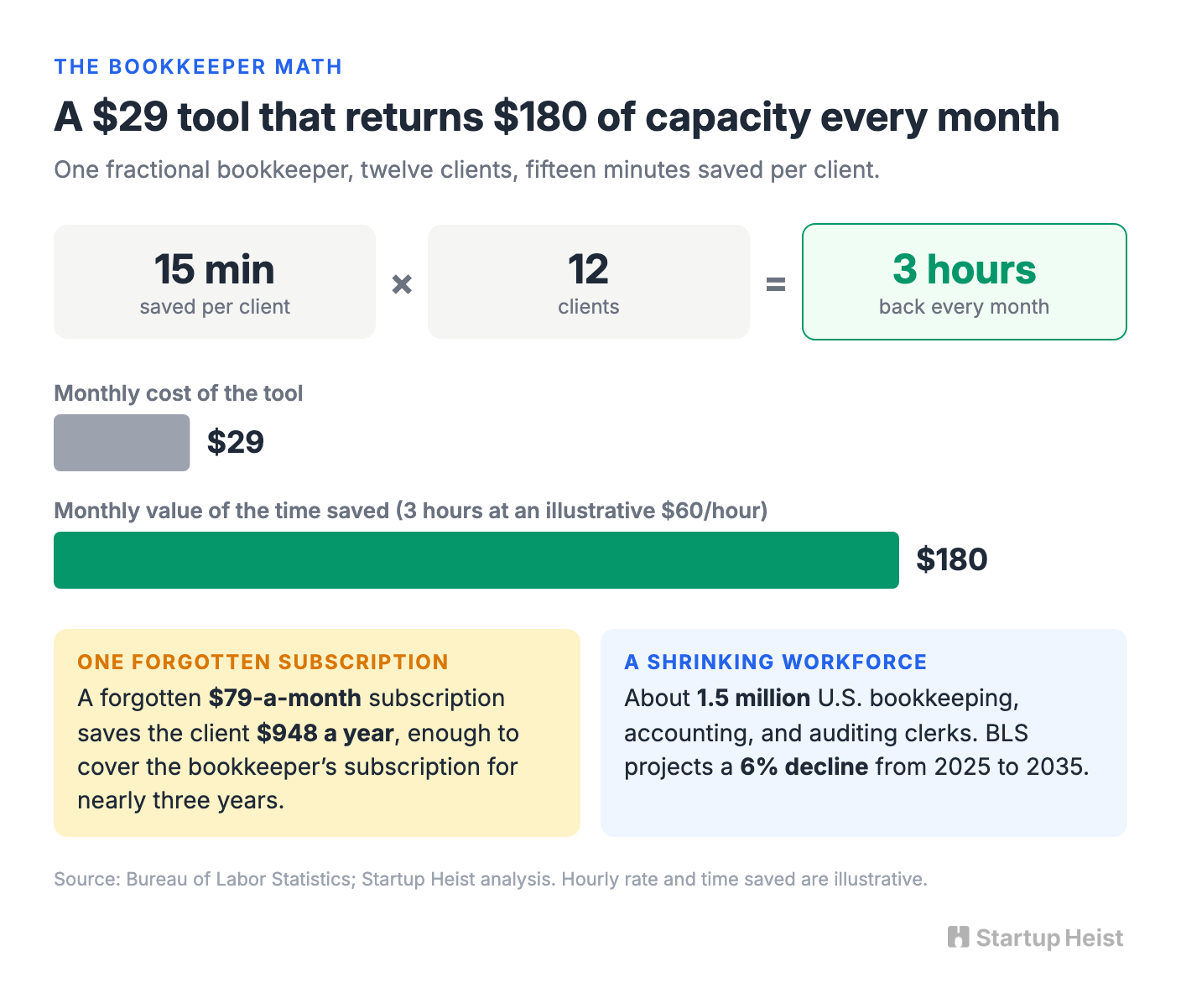
There are about 1.5 million bookkeeping, accounting, and auditing clerks in the U.S., and the Bureau of Labor Statistics projects that number to fall 6% between 2025 and 2035. The bookkeepers who stay in business will be the ones who serve more clients per hour, so a tool that turns a monthly review into a ten-minute conversation is a capacity purchase.
If the mirror saves fifteen minutes per client across twelve clients, that's three hours a month. At an illustrative $60 an hour of billable capacity, $180 of value comes from a $29 tool. Catch one forgotten $79-a-month subscription and the client saves $948 a year, enough to cover the bookkeeper's subscription for nearly three years.
Sell three jobs, in this order:
- Recurring expense intelligence: subscriptions, vendor price increases, duplicate software charges, and services nobody uses anymore.
- Monthly financial review: an evidence-backed summary of what changed in spending and recurring obligations, linked to source records.
- Exception discovery: transactions that break historical patterns, receipts with no matching statement entry, and gaps in the data.
The product insight: fast data plus slow data
Unlock the Vault.
Join founders who spot opportunities ahead of the crowd. Actionable insights. Zero fluff.
“Intelligent, bold, minus the pretense.”
“Like discovering the cheat codes of the startup world.”
“SH is off-Broadway for founders — weird, sharp, and ahead of the curve.”


