


Who's Liable? The $299-a-Month Content Engine for Personal Injury Lawyers
A delivery truck scrapes a parked car. Who pays: the driver, the delivery company, or someone else?
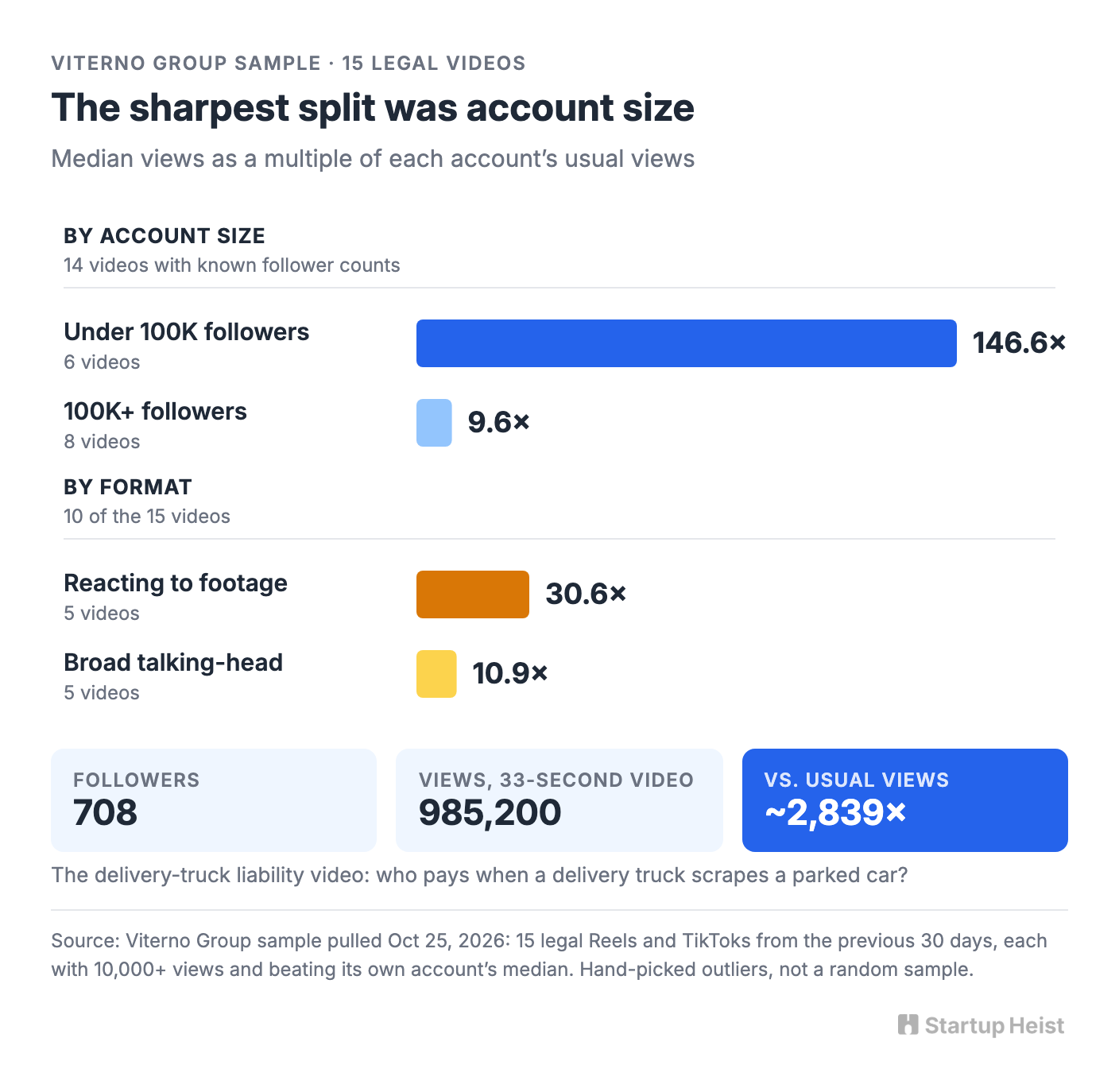
It sounds like a minor insurance dispute. An injury lawyer whose account had 708 followers posted a 33-second video answering that question, and it drew 985,200 views, roughly 2,839 times what the account normally gets.
The video surfaced in an October 25, 2026 sample pulled by Viterno Group, a Toronto short-form video agency. Viterno collected 15 legal Reels and TikToks from the previous 30 days, each with at least 10,000 views and each beating its own account's median. Five showed lawyers reacting to footage, and those posted a median of 30.6 times their account's usual views. Five broad talking-head videos managed 10.9 times. The sharpest split was account size: among the 14 videos with known follower counts, the six from accounts under 100,000 followers had a median multiplier of 146.6, against 9.6 for the eight larger accounts.
Fifteen hand-picked outliers prove no formula, and they say nothing about how many viewers became clients. They do show an asymmetry worth building on: a small lawyer explaining an ordinary dispute can earn attention that a polished firm ad has to buy.
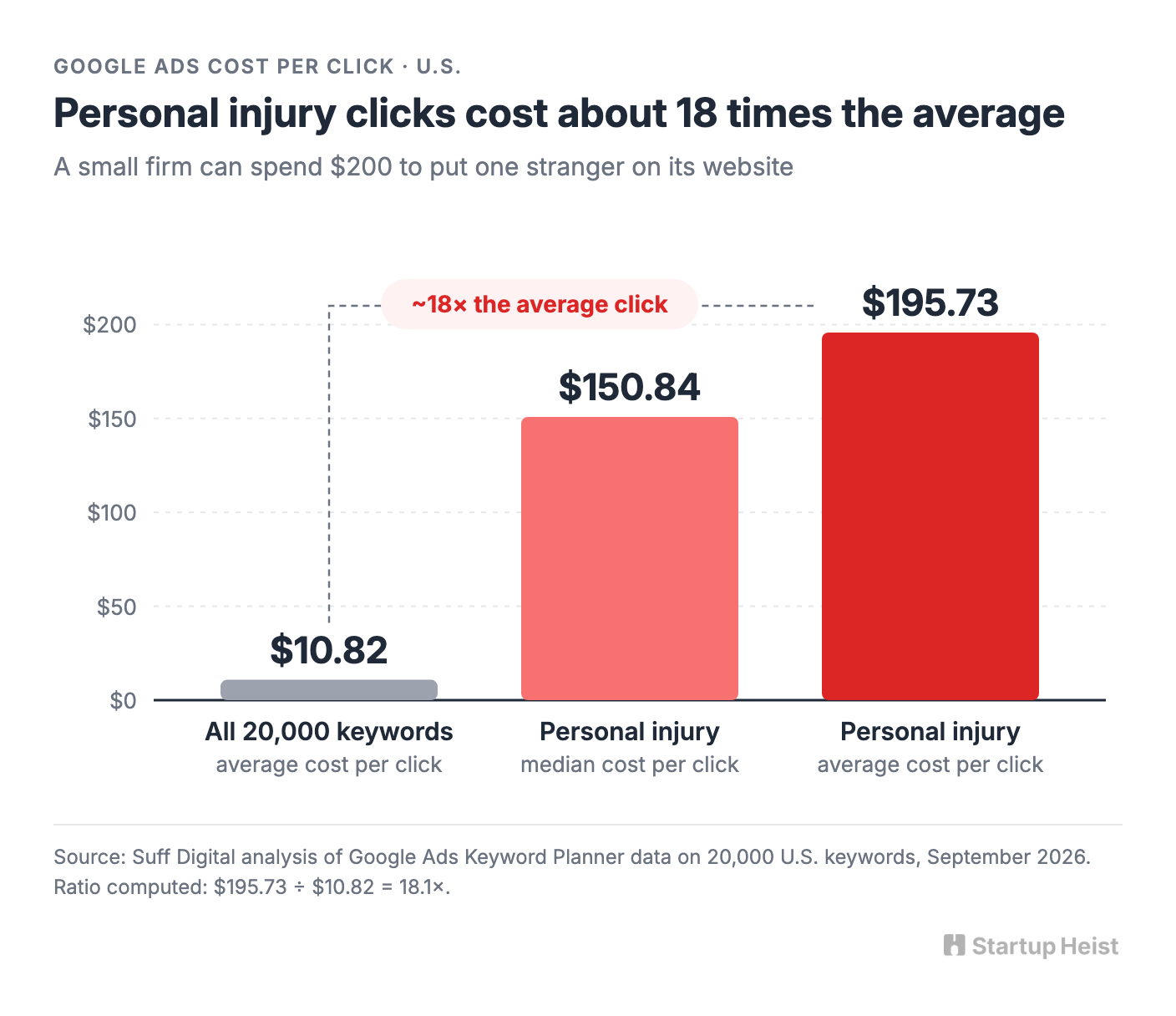
And buying that attention is brutal. In September 2026, Suff Digital pulled Google Ads Keyword Planner data on 20,000 U.S. keywords. The average click across all of them cost $10.82. Personal injury keywords averaged $195.73, with a median of $150.84. A small firm can spend $200 to put one stranger on its website.
Here's the opportunity sitting between free attention and $200 clicks:
The money: 60 firms at a blended $299 a month = $17,940 MRR; 100 firms = $29,900. Your buyers already pay an average $195.73 per Google click.
Inside:
• A Texas-first legal library architecture
• A sample Houston script, sources attached
• Pricing, territory rules, and agency tiers
• 90-day launch plan with outreach email
The product is narrow. It finds incidents people are already talking about, pulls out the legal question inside each one, matches it to that state's law, and hands the attorney a 35-second script to approve and record. It doesn't make videos with AI avatars or lift dashcam clips off Reddit. Its appeal is that it stays small while its customers fight in one of the most expensive ad markets in America.
What you're actually selling is a repeatable way for one lawyer to become the person their city hears from when something goes wrong.
Why Liability Content Works
Personal injury demand is episodic. Nobody spends months shopping for an injury lawyer. Someone gets hurt, starts asking questions, and eventually looks for help. Google catches them at the bottom of that funnel, ready to call, and charges accordingly.
Short-form video on TikTok and Instagram Reels reaches people earlier: before they have a legal problem, or while they're trying to figure out whether an everyday incident has become one. The best topics carry a built-in puzzle:
- Three cars collide. Is the last driver automatically at fault?
- Someone slips on a freshly mopped supermarket floor. When is the store liable?
- A delivery van hits a cyclist. Is the delivery company on the hook?
- A rideshare passenger gets hurt. Whose insurance pays?
Each one is a miniature case study. The viewer sees the problem, the attorney names the governing rule, then reveals the missing fact that could flip the outcome. Viewers stay for the uncertainty, and the careful resolution is what shows them a professional at work.
The attorney has to be on camera. Clio's 2026 Legal Trends Report, released October 26, 2026, found that 46% of U.S. consumers would consult AI before contacting a lawyer. But 82% want to know when their lawyer uses AI, 70% trust a lawyer more when that use is disclosed, and only 6% name technology or AI as a deciding factor when hiring. People will ask a chatbot first and still hire a person, so AI belongs in the research, with the lawyer on screen.
The Gap in the Market
Law firms already buy social media marketing, so this isn't an empty field. The market splits into three tiers, and none of them sells what an active video lawyer is missing.
At the top, full-service agencies like WEBRIS start at $2,500 a month per platform for planning, captions, scheduling, community management, and reporting, with on-site filming quoted separately. In the middle, Law Firm Ignite sells 12 AI-generated reels for $997 a month, built on a custom avatar of the attorney's face and voice. At the bottom, any marketing coordinator can open ChatGPT or Claude and get a passable script about a Texas car crash in ten seconds.
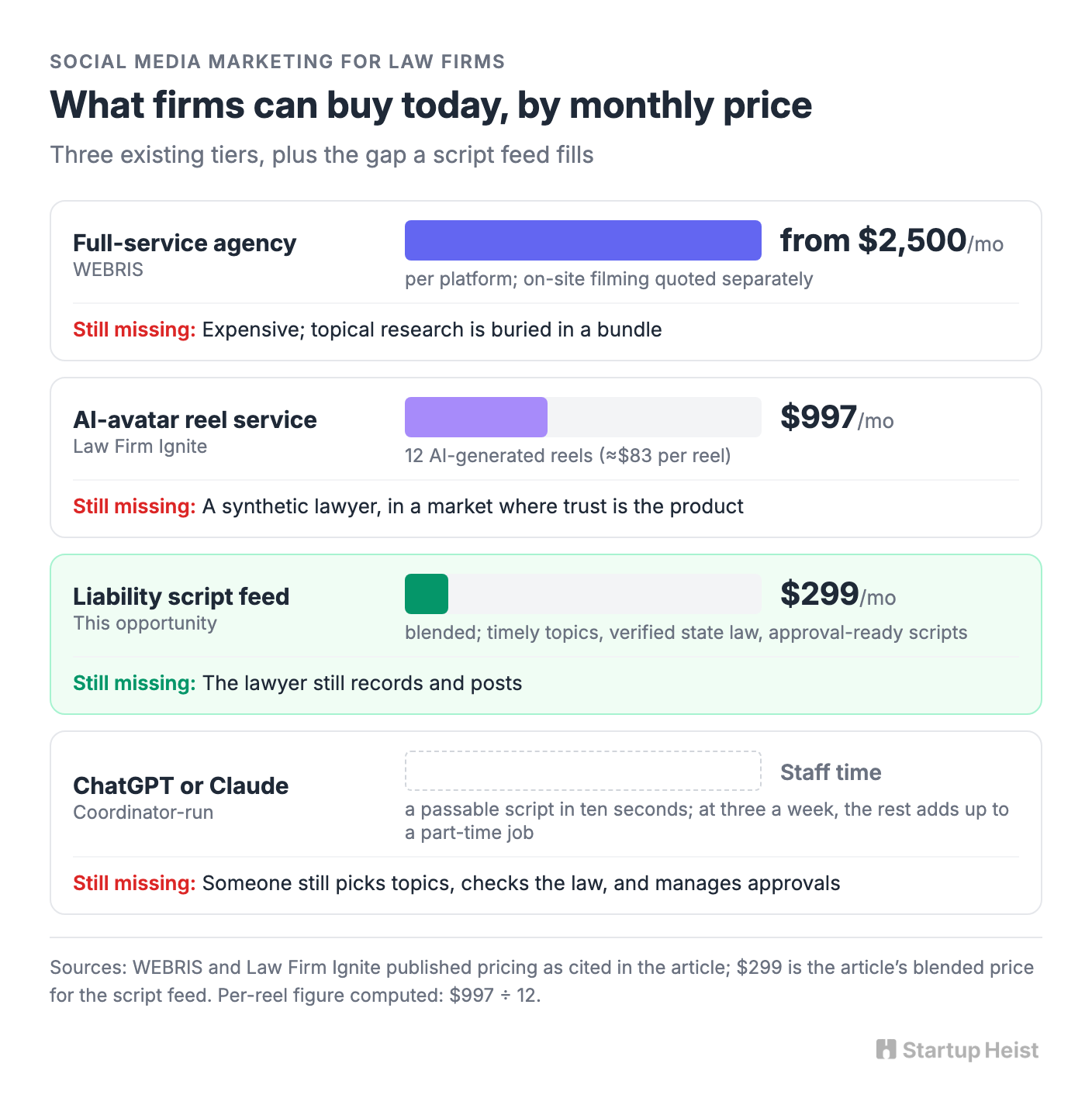
Writing quality alone won't beat the free option. The coordinator with ChatGPT still has to decide what to cover, find a credible source, judge local relevance, check the statute, flag advertising-rule problems, and get the attorney to sign off. Three times a week, that adds up to a part-time job, and firms will pay to have those recurring decisions made for them.
The Footage Trap
The reaction format posted the biggest multipliers in Viterno's sample, which makes the tempting version obvious: scrape viral dashcam clips and drop the lawyer in front of them on a green screen.
Start with ownership, because viral footage usually belongs to someone. Licensing houses like ViralHog take exclusive rights to submitted clips and pursue unlicensed use, and the U.S. Copyright Office treats fair use as a case-by-case, four-factor analysis, with no blanket pass for reaction videos. Then there's distribution. In March 2026, Meta tightened Facebook's originality rules for Feed and Reels: reaction clips and narrated reposts that add little get deprioritized, and repeat offenders can lose recommendations and monetization. Substantial commentary can still qualify as original, but a lawyer talking over someone else's clip is a coin flip.
Keep the reaction format and change where the footage comes from. Three clean sources work: NHTSA crash-test video, which is generally U.S. government work outside copyright (check each file's provenance, since some NHTSA-hosted footage is licensed from third parties); viewer-submitted dashcam clips collected through the firm's own form with a signed release; and simple diagrams or reenactments the firm shoots itself. The public event is only the premise, and the lawyer's explanation is what people watch.
Legal accuracy is the harder problem, and it shapes everything in the playbook.
The Product: TortReact
Call it TortReact: three timely, state-specific liability scripts a week, ready for attorney approval.
Unlock the Vault.
Join founders who spot opportunities ahead of the crowd. Actionable insights. Zero fluff.
“Intelligent, bold, minus the pretense.”
“Like discovering the cheat codes of the startup world.”
“SH is off-Broadway for founders — weird, sharp, and ahead of the curve.”


