


ChatGPT Is Sending Banned Instagram Users to Journalists. There's a Business in the Chaos.
Build the incident-response toolkit for social media agencies: account readiness before a ban, organized appeals after one. A focused $149–$299/month micro-SaaS with a clear buyer.
On October 26, 2026, Jason Koebler of 404 Media published an odd complaint. His newsroom kept getting emails from strangers with ordinary tech-support problems, and ChatGPT had written some of them.
One came from a man in Russia whose Instagram account had been banned. "I have now lost access to 13 years of personal photos, videos and memories," he wrote. When he asked ChatGPT how to get the account back, the chatbot said emailing Meta probably wasn't possible and suggested contacting journalists instead. It named 404 Media, supplied Koebler's address, and drafted the email.
Four days later, Radio New Zealand ran the business version of the story. Stan McDowall, a wedding photographer in Invercargill, had been locked out of his Meta accounts since May. He estimated more than $6,000 in missed bookings, and Meta had charged him $1,319.39 for ads he couldn't pause. New Zealand's Ministry of Business, Innovation and Employment had forwarded 457 suspension-related matters to Meta since September 2025, covering roughly 192 individuals and businesses.
The United States looks the same. In March 2026, the Massachusetts Attorney General's Office confirmed a rise in lockout complaints and began mailing affected users recovery tips with a blunt disclaimer: "The Attorney General's Office cannot help you recover your account." Amy Friend, who sells quilting patterns to an audience of nearly 30,000, got her account back several weeks after Boston 25 News contacted Meta on her behalf.
Newsrooms and government offices have become Meta's overflow support desk. Social accounts are now business infrastructure, and owners usually face the process of protecting and restoring them alone and in a panic, without records.
A small software business can turn that panic into a procedure. Call it AppealKit: account-readiness and incident-response software for social media agencies, sold on preparation and organized execution, with no recovery promises and no claims of secret contacts at Meta.
The money: Fifty agencies at a blended $199 a month is about $10,000 MRR; 150 agencies gets you near $30,000. Specialists already charge from $3,000 per account recovery.
Inside:
• Six-week MVP scope and build schedule
• Portfolio pricing at $149 and $299 a month
• Agency cold email and paid-pilot offer
• Moats, kill risks, and a 90-day test plan
The Escalation Desk Nobody Staffed
Some bans are correct. Meta removes accounts for fraud, spam, and exploitation, and any credible product has to accept that. The documented failure is procedural: people with valid complaints can't reach anyone able to review them.
In July 2025, the BBC heard from more than 100 people who said Instagram had wrongly banned them, some accused of breaching child sexual exploitation rules. Several accounts came back shortly after the BBC raised them with Meta. On June 4, 2026, Meta's Oversight Board issued its first ruling on a permanent account disablement. It upheld the ban, which involved threats against a female journalist, then called for detailed reasons for disablement, written appeal arguments, and more human review in edge cases.
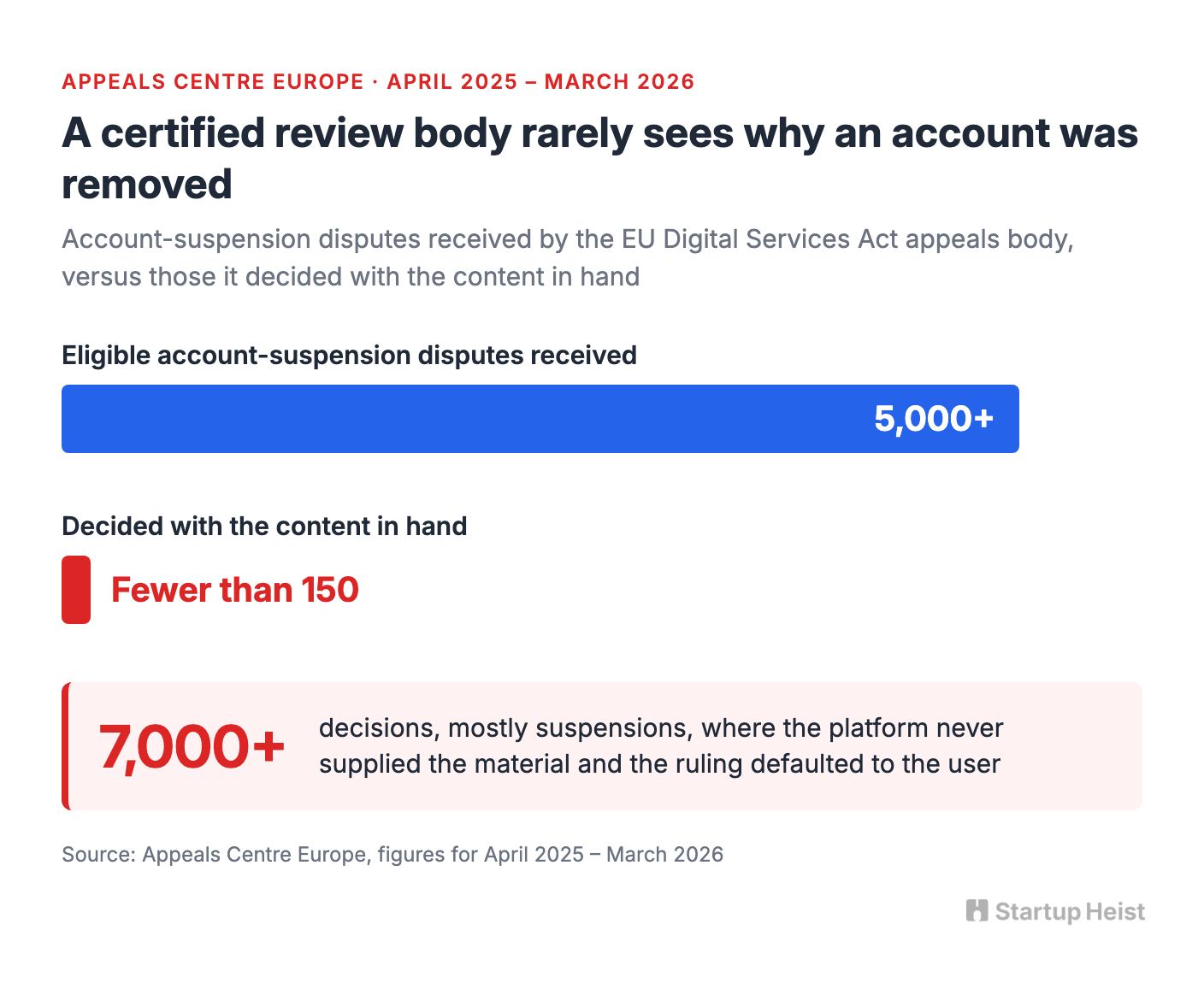
Europe's certified appeals system shows how little anyone outside Meta can see. Appeals Centre Europe, a dispute body certified under the EU Digital Services Act, received more than 5,000 eligible account-suspension disputes between April 2025 and March 2026 and decided fewer than 150 of them with the content in hand. In more than 7,000 decisions, mostly suspensions, the platform never supplied the material and the ruling defaulted to the user. If a certified review body can't see why an account was removed, a business owner working alone has little chance of figuring it out.
Why Agencies Are the Buyer
Suspended individuals make a poor market. Many are bots or bad actors, others fix the problem with free tools, and the legitimate ones rarely pay much for an uncertain outcome.
Agencies behave differently. One managing 20 businesses might administer 40 Instagram and Facebook assets, several ad accounts, and a tangle of business portfolios. When a client gets suspended, the agency inherits the problem whether or not it caused it. Campaigns stall, the client wants answers, and someone has to work out which process applies while the rest of the roster still needs posts.
The 2026 AgencyAnalytics benchmark, drawn from 494 agency professionals, 64% of them in the U.S., sizes the sweet spot. Of those surveyed, 49% work at agencies with 10 or fewer full-time employees, and 62% serve between 6 and 50 clients. Most (73%) sell paid ads, where a restricted ad account halts client campaigns outright. These shops have enough accounts to suffer real operational chaos and rarely keep a platform-policy specialist on staff, so the sale only requires them to believe that being unprepared is expensive.
Sell Continuity, Not Reinstatement
The obvious product is a $39 appeal letter: enter a username, describe the ban, download a PDF. It's easy to build and a weak business. ChatGPT writes a decent appeal for free, Creator Lane already offers a free generator with templates for hacked accounts, automation flags, and false positives, and the customer judges the purchase by an outcome you can't control. Meta rejects the appeal, and the refund request arrives the same afternoon.
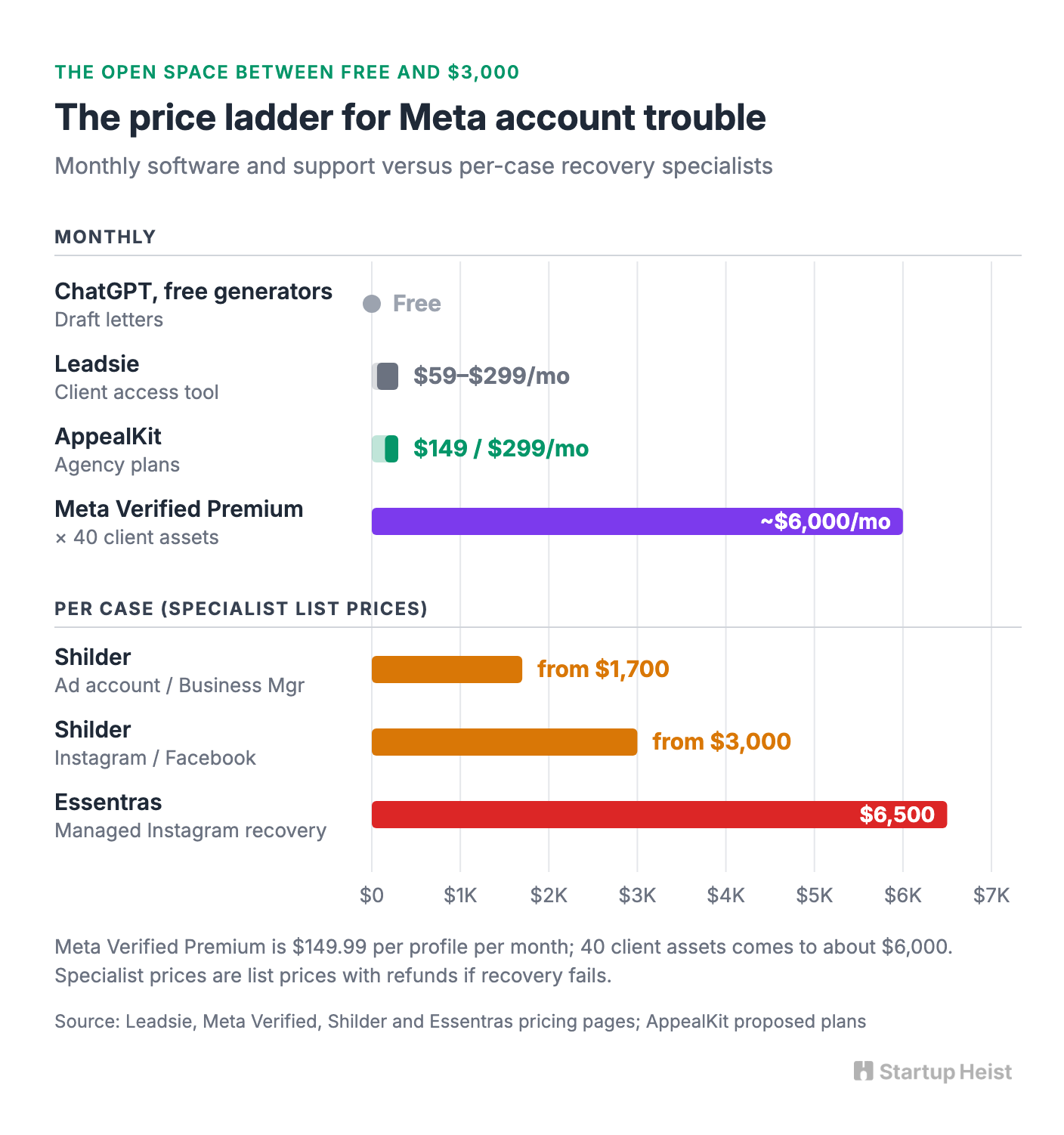
At the other end, specialists charge real money. Shilder lists recovery from $3,000 for Instagram and Facebook accounts and $1,700 for ad accounts and Business Manager, and Essentras advertises a $6,500 flat fee for managed Instagram recovery, both with refunds if they fail. List prices say nothing about success rates, but they show what a revenue-generating account is worth to its owner. A cheaper recovery service would inherit the same uncertainty without the margin. The open space between free and $3,000 belongs to software the agency runs itself, and agencies already buy software in this neighborhood. Leadsie charges $59 to $299 a month just to collect access to client Meta assets during onboarding, so Meta plumbing is already a budget line.
AppealKit sells something the agency keeps whatever Meta decides, through two workflows:
- Account Readiness (before): an inventory for every client recording who owns and administers each asset, current recovery methods, business IDs, connected third-party tools, and two-factor status, with gap flags and periodic review reminders.
- Incident Response (after): a structured case that classifies the restriction, captures evidence, builds a timeline, points to the official procedures that apply, drafts a factual appeal where one fits, and produces a client-facing status report.
Readiness gives the product a job in quiet months, and incident response supplies the urgency that gets someone to sign up. Neither would hold a subscription alone. Together they follow the logic of disaster-recovery and security incident-response software, which companies buy because improvising during a disaster is an expensive way to learn you have no process.
The Route Map Is the Product
PDFs are cheap. The valuable part is knowing what a user can legitimately do after Meta takes a specific action, and procedures vary by asset, enforcement reason, location, and review status. A hacked account belongs in Meta's dedicated hacked-account recovery flows for Instagram and Facebook; sending it through a policy appeal wastes days. A restricted ad account runs through Meta's business support and Account Quality tools. Deadlines come from the notice the user actually received, and a product that applies a blanket 30- or 180-day rule will eventually cost someone their only window.
Unlock the Vault.
Join founders who spot opportunities ahead of the crowd. Actionable insights. Zero fluff.
“Intelligent, bold, minus the pretense.”
“Like discovering the cheat codes of the startup world.”
“SH is off-Broadway for founders — weird, sharp, and ahead of the curve.”


