


The Working-Dog Combine: A Small Software Play Behind a $200 Million Bet
The U.S. military imports most of its working dogs. A new billion-dollar startup wants to engineer better ones. There's a smaller, faster opportunity in helping domestic breeders prove which dogs are worth a buyer's trip.
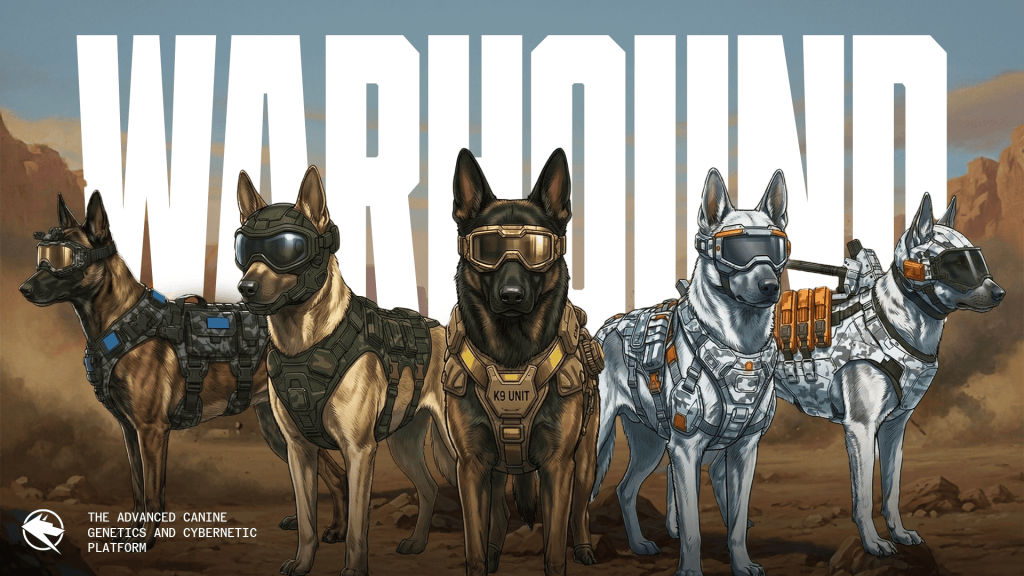
On October 22, 2026, a startup called Warhound came out of stealth with $200 million in funding and a $1.2 billion valuation. Sequoia, 8VC, Corner Ventures, and In-Q-Tel backed the round. Ben Lamm, who runs Colossal Biosciences, co-created the company with Palmer Luckey, and Colossal licenses its technology to the venture. Anduril will supply vests, goggles, and software. The plan is to clone working dogs and edit their genes for performance, possibly including sharper scent detection for bomb work.
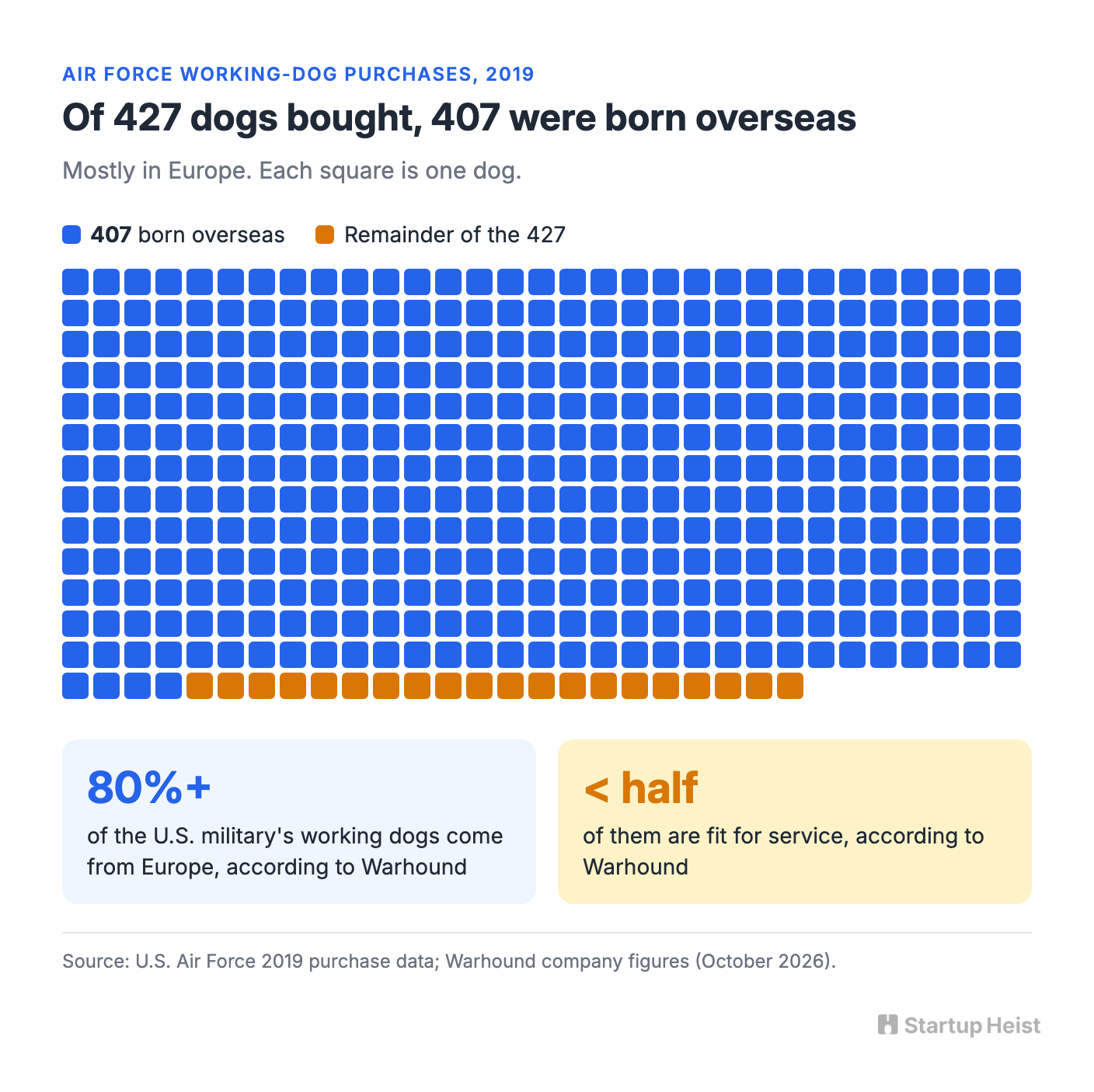
Warhound's pitch rests on a supply problem. According to the company, more than 80% of the U.S. military's working dogs come from Europe, and fewer than half of them are fit for service. Older Air Force data points the same way: of the 427 dogs it bought in 2019, 407 were born overseas, mostly in Europe, and American vendors import European dogs and resell them to the Defense Department at a markup.
The first engineered puppies are expected in early 2027, with service ideally beginning within two years. The selection problem Warhound wants to fix exists today. American breeders already raise dogs that could detect explosives and narcotics, and before any of them reaches a training program, a buyer has to decide which candidates deserve a closer look. Right now that decision runs on phone videos, emailed paperwork, and an experienced trainer's gut.
A small software company can attack that step now with a working-dog combine: a standardized evidence dossier, reviewed by independent experts, that lets a domestic breeder show a professional buyer why a dog is worth evaluating. Skip the AI that crowns eight-week-old puppies future heroes, and skip any certificate that pretends to government authority. Start as a modest software-plus-service business. If buyers come to trust the records, a more defensible company may be sitting underneath.
Here's the opportunity at a glance:
The money: Hypothetically, 100 breeder and trainer accounts at a blended $79/month is $7,900 MRR. The AKC's detection-dog breeder program alone counted 187 breeders in 2024.
Inside:
• MVP scope for a reviewed evidence dossier
• Pricing tests: $49 software, $89 reviews
• Buyer-first GTM with two outreach templates
• 90-day build plan with pilot exit criteria
The Expensive Step Nobody Has Organized
A detection dog needs far more than a good nose. It has to love searching, stay motivated through repetitive work, keep its nerve in unfamiliar places, and perform around crowds, noise, and vehicles. A dog that tears after a toy in a quiet backyard can lose interest in a busy terminal. Training is expensive, and many candidates wash out. TSA, which deployed 1,076 canine teams in 2025, puts the average cost of training a traditional explosives-detection canine and handler at $26,000. A passenger-screening canine and handler averages $65,000.
The government also buys untrained candidates, and the contract terms show who carries the risk. In August 2026, U.S. Customs and Border Protection sought up to 33 detection-dog candidates, aged 12 to 36 months, from breeds including Labrador Retrievers and Belgian Malinois. It was one of several CBP canine solicitations that summer, following July notices for up to 27 and up to 19 dogs. CBP runs its own medical and behavioral evaluations before acceptance. The vendor pays all transportation, takes back failed dogs at its own expense within 7 days, replaces rejects within 60 days, and warrants each dog for six months against medical and hereditary problems.
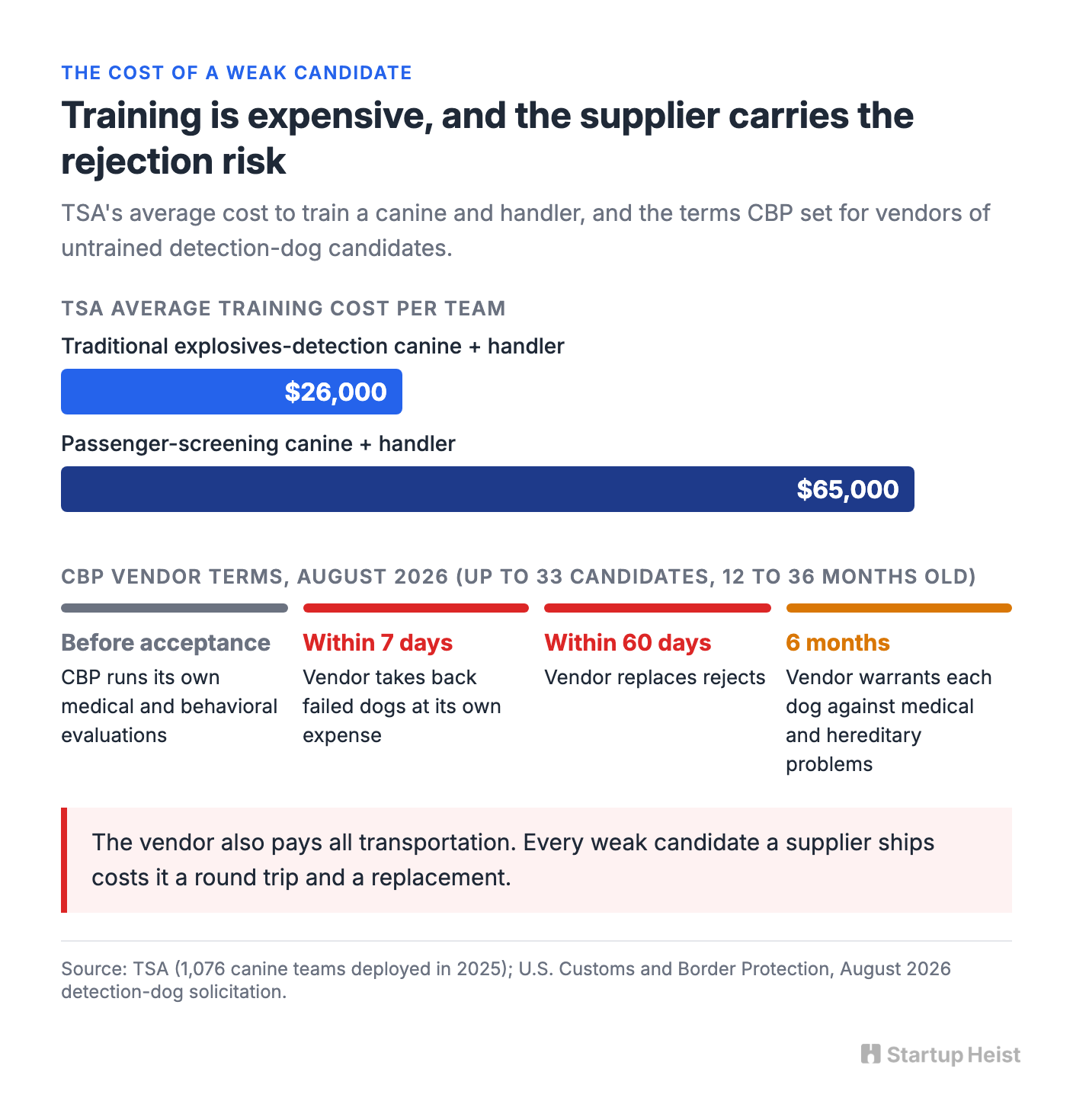
Every weak candidate a supplier ships costs it a round trip and a replacement. The buyer, meanwhile, has to decide which dogs are worth inviting before seeing any of them in person. Money leaks out of the gap between those two parties, and today nothing organizes that gap.
Buyers Already Screen by Video
The National Disaster Search Dog Foundation asks owners for videos of the dog performing specific tasks, along with medical and behavioral paperwork, and its canine training team reviews that package before inviting the dog to on-site screening at its National Training Center. Interquest Detection Canines tests toy focus in an unfamiliar indoor setting with distractions, and owners who live far away may need to send a similar video before Interquest makes a long trip to evaluate in person.
Neither organization needs to buy software from you, since both have processes that work. What they prove is that the habit already exists: buyers ask for clips, owners film them, and trainers review them. The layer in between is a mess. A small breeder keeps records in spreadsheets and videos on a phone, sends links by email, and answers the same development questions for every buyer. One clip shows the dog confident in a new building, another shows it distracted, and nothing records which came first or under what conditions.
A better version is a single link. It shows the dog's identity, age, and breed; dated task videos recorded under documented conditions; structured observations on detection traits; an independent evaluator's comments; pedigree and veterinary documents; and a plain list of strengths, concerns, and open questions. The buyer still makes the call. The dossier answers the question that comes before an expensive in-person evaluation: is this dog worth seeing?
Why the Science Favors a Dossier Over an AI Score
The tempting version of this business is to film a puppy doing four exercises, let AI assign a working-dog score, and sell a $59 certificate. The research makes that product hard to defend.
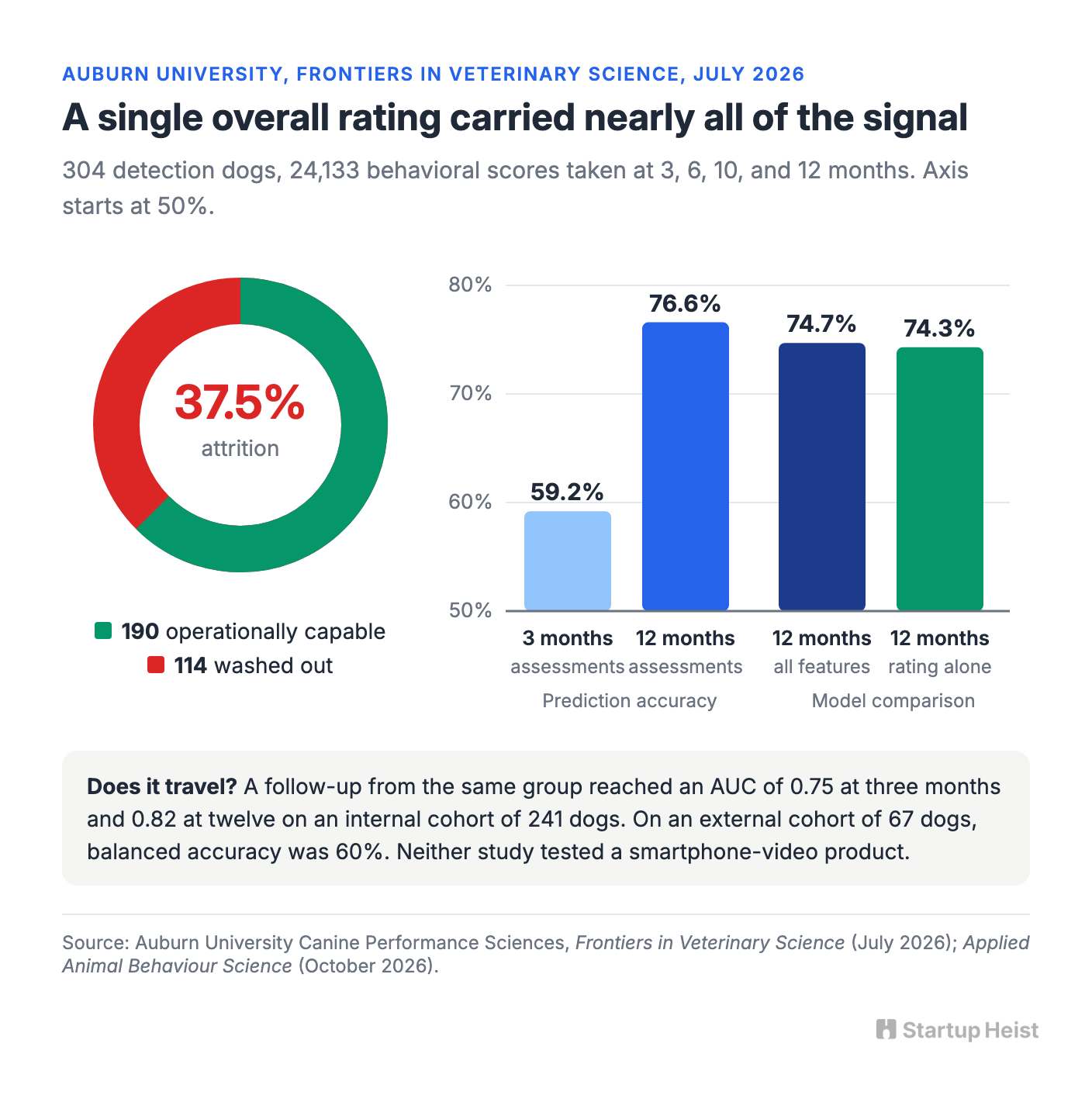
In July 2026, Auburn University's Canine Performance Sciences program published a study in Frontiers in Veterinary Science covering 304 detection dogs and 24,133 behavioral scores taken at 3, 6, 10, and 12 months. Of those dogs, 190 became operationally capable and 114 washed out, a 37.5% attrition rate. Behavioral assessments predicted training outcomes with 59.2% accuracy at three months and 76.6% at twelve. At twelve months, the suitability rating alone reached 74.3%, essentially matching the 74.7% from a model using every feature. A single overall rating, recorded consistently, carried nearly all of the signal.
A follow-up from the same Auburn group, published in Applied Animal Behaviour Science in October 2026, tested whether the approach travels. In an internal cohort of 241 dogs, the models reached an AUC of 0.75 at three months and 0.82 at twelve. On an external cohort of 67 dogs, balanced accuracy was 60%, a modest result for a model applied outside the program it learned from. Neither study tested a smartphone-video product.
The design rules follow from that evidence. Assess repeatedly, because a three-month snapshot shouldn't decide a dog's future. Keep qualified humans judging against a consistent rubric, with their reasoning written down. Put uncertainty in the report instead of hiding it inside a composite score. A serious buyer will trust that positioning far more than AI certification: document and review candidates consistently, and leave career prediction to the evidence.
The Wedge: Detection-Dog Candidates at Selection Age
Don't try to cover Malinois, German Shepherds, patrol dogs, search-and-rescue, service, and detection dogs at once. Each role needs different skills, and no universal aptitude score exists.
Unlock the Vault.
Join founders who spot opportunities ahead of the crowd. Actionable insights. Zero fluff.
“Intelligent, bold, minus the pretense.”
“Like discovering the cheat codes of the startup world.”
“SH is off-Broadway for founders — weird, sharp, and ahead of the curve.”


