


The Grid-Down Brain: Sell the Setup, Not the Software
Open-source AI now answers emergency questions with the internet off, and the software costs nothing. The money is in the done-for-you version: a $229 setup service and an $899 ready-to-run laptop that turn a household's scattered documents into a tested, offline emergency kit with a printed backup.
The Opportunity
Take a hypothetical homeowner in Ventura County in December 2026. They have a generator in the garage, a first-aid kit, a week of canned food, and a hand-crank radio. The flood policy is buried in an email from 2023, and the generator manual is a PDF on a cloud drive. Their mother's medication list is on a sticky note. The dog's vaccination records sit in a vet portal that needs a password and a working connection.
Everything this family needs already exists, but it lives in places that go dark when the power and the internet do.
In late October 2026, an open-source project called Survival LLM showed how cheaply that gap can now be closed. It puts a local AI assistant on an ordinary Mac or Windows laptop alongside an emergency library of FEMA guidance, medical and repair references, survival manuals, and about 930,000 of Wikipedia's most-read articles. The full library is a 9 GB download that takes 19 GB installed. It runs entirely offline, with no subscription or cloud account, and it reached the Hacker News front page with 539 points and more than 200 comments.
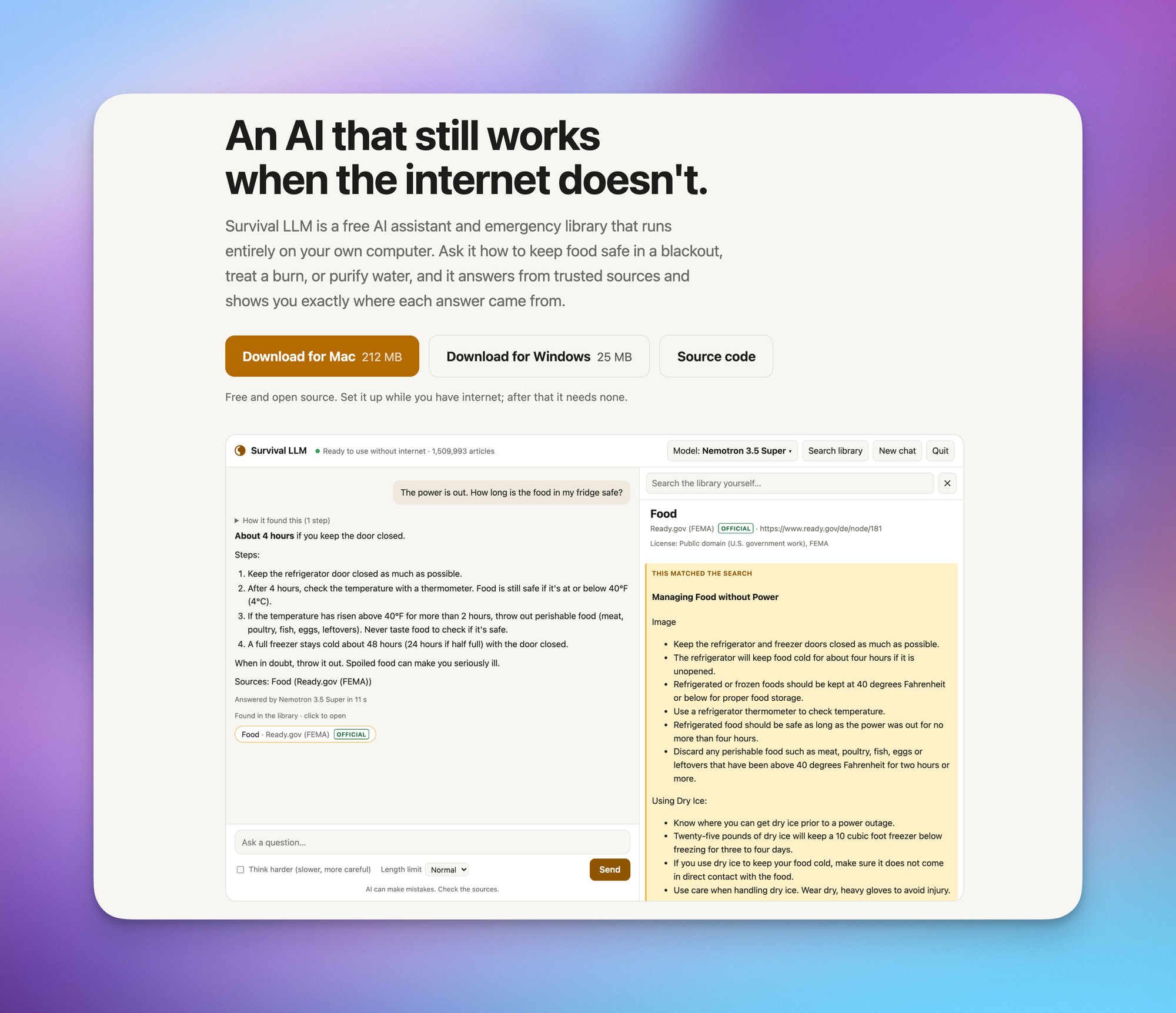
The software is free. The typical family will still never download it, click past the operating-system warnings, pick a model sized to their memory, gather their own documents, and test the whole thing with the router unplugged. Some of them will pay a person to hand them the finished result.
Call that service Go-Box. It loads a household's own emergency information onto an offline laptop, pairs it with a commercially licensed reference library, tests it with the internet off, and ships it with a printed 72-hour binder. You sell it two ways: a $229 concierge setup on a laptop the customer already owns, and an $899 complete kit built on a refurbished machine. Start with homeowners, and add property managers once the consumer workflow runs clean.
Treat it as a seasonal hardware-and-services business with recurring revenue from annual updates. It will never be a venture-scale AI platform, and the numbers work better for knowing that.
The money: 25 Complete kits and 20 concierge setups a month bring in about $27K in revenue and $6.5K in contribution, before ads and overhead.
Inside:
• Unit economics for the $229 and $899 tiers
• 45-day launch plan, first unit to deposits
• Partner outreach email for generator dealers
• A four-target, 30-day go/no-go test
Why the Window Is Open Now
Three pieces landed within five weeks of each other.
Survival LLM supplies the capability. It shows its sources, accepts the user's own PDFs, and installs in 20 minutes to about two and a half hours, depending on hardware and bandwidth. A developer finishes it over lunch. A family that wants to know the system works, without learning how it works, will keep pushing it to next weekend. A free, capable tool with a setup gap is the classic opening for a service business.
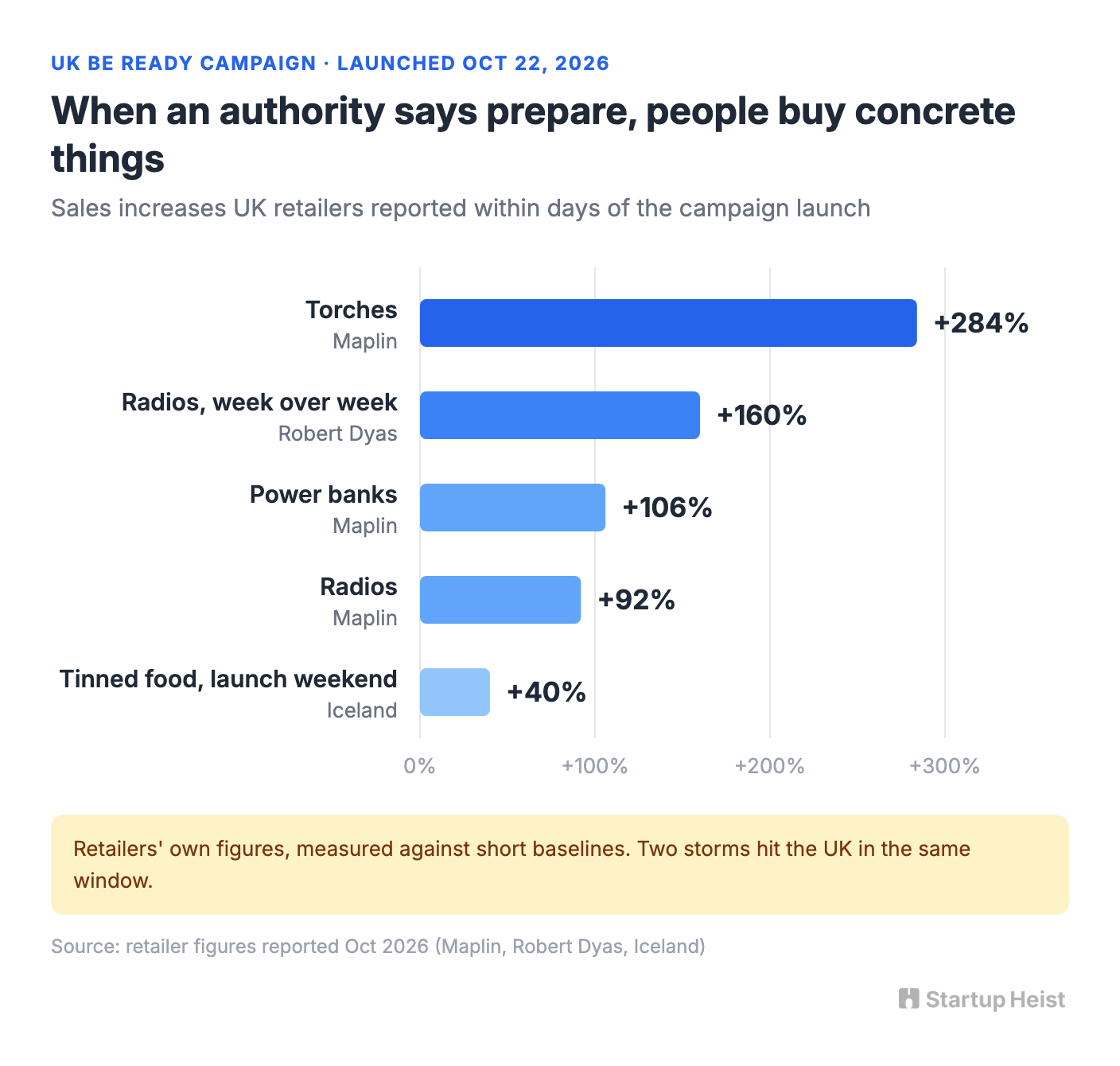
The UK supplied the proof of buying behavior. On October 22, 2026, the government launched its Be Ready campaign, asking households to keep three days of supplies for outages of power, water, and communications. Retailers felt it within days. Maplin reported torch sales up 284%, power banks up 106%, and radios up 92%. Robert Dyas said radio sales rose 160% week over week, and Iceland reported a 40% jump in tinned food over the launch weekend. These are the retailers' own figures, measured against short baselines, and two storms hit the UK in the same window. Discount them for all that and the pattern still holds: when an authority tells people to prepare, they buy concrete things they understand. Go-Box has to sell the way a torch does, as a finished object you can hold.
California supplies the reason to buy here. On September 21, 2026, Governor Gavin Newsom proclaimed a statewide emergency to get the state ahead of what his office called "a historic El Niño season." NOAA's winter outlook, released October 15, 2026, favors wetter-than-average conditions from California to Florida for December through February. The National Weather Service warns that heavy rain on dry soil can fuel flash floods and mudslides. A forecast guarantees nothing. It will keep storms, flooding, and emergency preparedness in the news all winter, though, and a product that organizes a family's emergency information can join that conversation without inventing a problem.
Use the timing as a launch window, and build a business that still works after it closes.
The Market Already Pays for Offline Knowledge
You don't need to prove people value offline information. A small prepper-tech industry already sells it.
| Product | Price | What you get |
|---|---|---|
| Docket Survival | $69.99 (sale) | Portable offline AI plus survival guides |
| PortableMind USB | $69–$139 | Offline AI that runs from a USB stick on your own computer |
| Prepper Disk Premium | ~$240–$300 by retailer | Raspberry Pi with 512 GB of survival content, served over local Wi-Fi |
| Kiwix Hotspot bundles | CHF 260–330 | Dedicated offline hotspot with prepper or medical libraries |
| PortableMind Survival Terminal | $699 target | Hand-built offline AI terminal; ordering closed, waitlist only |
The ladder runs from free DIY, through $70–$300 USB sticks and Raspberry Pi boxes, up to a hand-built terminal near $700. Every rung competes on more models, more gigabytes, and more manuals. You'd lose that fight. Prepper Disk already ships half a terabyte, and PortableMind sells offline AI for under $150.
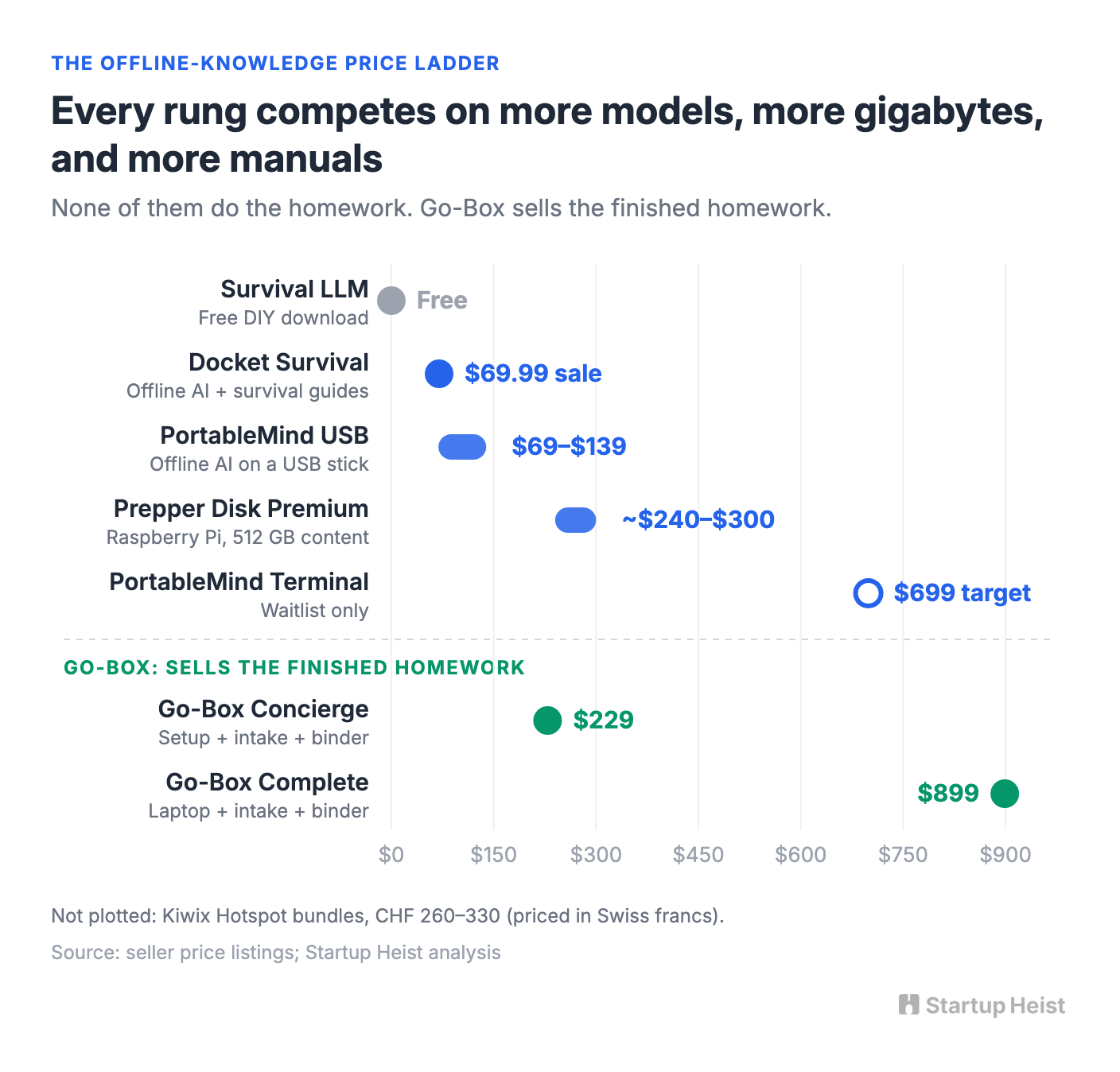
None of these products do the homework. Someone who buys a $99 AI stick still has to find the insurance policy, type up the contact list, download the generator manual, and decide what the family does when the lights go out. Go-Box sells the finished homework: deciding which information matters to this household, putting it where they'll look, and proving they can retrieve it with the internet off. A hardware seller can't put that in a box. Priced right, the homework also earns a far better margin than the laptop it ships on.
What You're Actually Selling
Go-Box has three parts, and the most valuable one is also the cheapest to produce.
Unlock the Vault.
Join founders who spot opportunities ahead of the crowd. Actionable insights. Zero fluff.
“Intelligent, bold, minus the pretense.”
“Like discovering the cheat codes of the startup world.”
“SH is off-Broadway for founders — weird, sharp, and ahead of the curve.”


