


The Elder-Care Benefit Built for the Factory Floor
There is a phone call that ends a workweek.
Your mother fell. Your father is being discharged tomorrow and the hospital says he cannot safely go home alone. In the next thirty-six hours you have to find home care, figure out what Medicare actually pays for, call three agencies that may or may not have staff, read a long-term-care policy you have never opened, arrange transportation, negotiate with a sibling, and tell your supervisor whether you are coming in Wednesday.

For a salaried manager with a laptop and a flexible calendar, this is a miserable week. For a machinist, a hotel housekeeper, or a medical assistant who has to be standing in a specific place at a specific hour, it is an employment crisis. You burn PTO, then unpaid days, then goodwill, then the job.
The last two steps in that sequence are what an employer will pay to prevent.
The money: Twelve 150-person employers on a $3 PEPM access fee plus paid case resolution clears $10,000 MRR after the broker's cut. PEOs serve 230,000 small businesses.
Inside:
• The four-bottleneck scope that keeps you narrow
• Hybrid pricing: $3 PEPM plus per-case fees
• Broker outreach email that books the pilot
• The provider graph competitors cannot buy
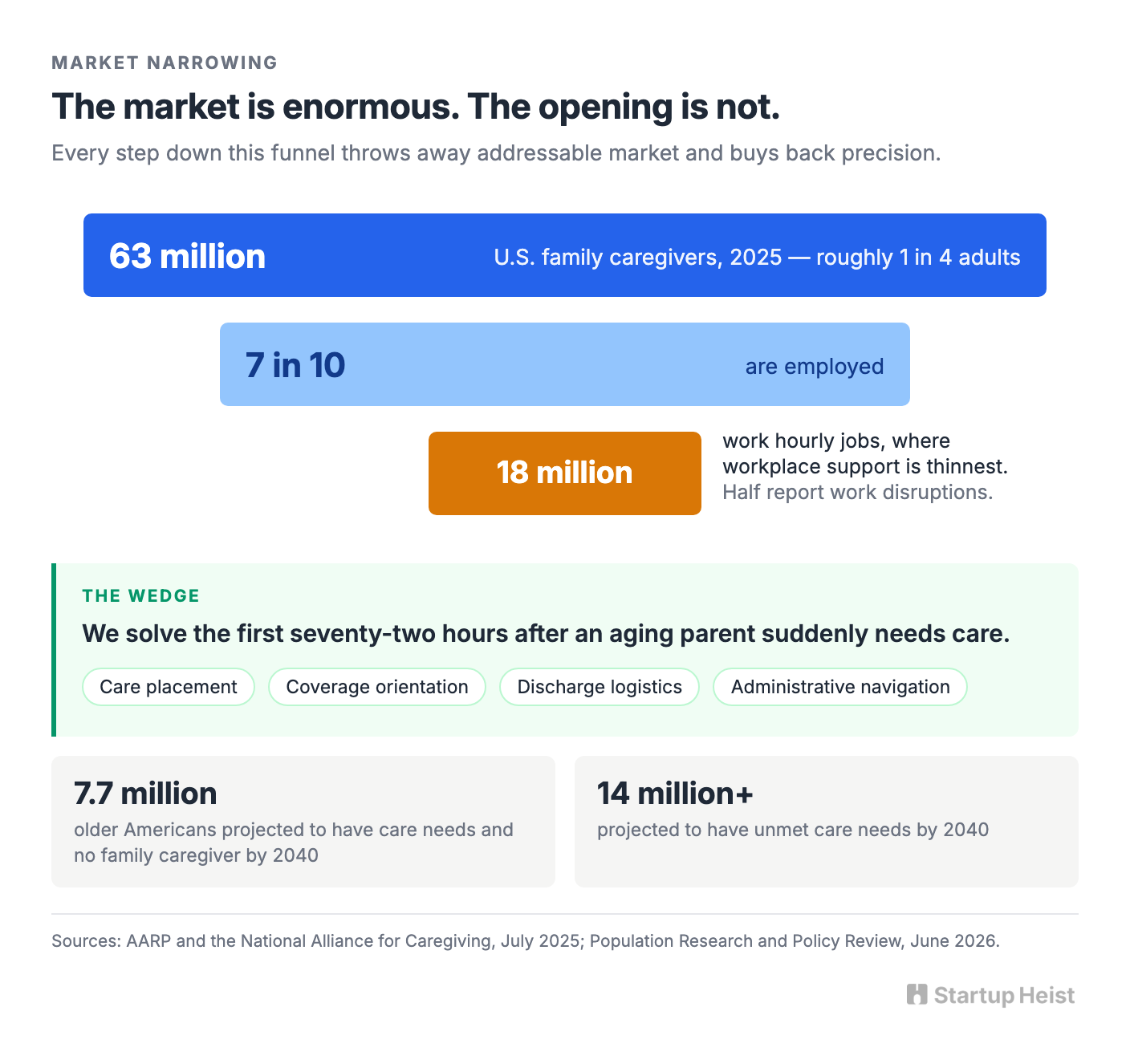
AARP and the National Alliance for Caregiving counted 63 million American family caregivers in their July 2025 report, roughly one in four adults and 20 million more than a decade earlier. Seven in ten are employed, and the report singles out one group: the 18 million working hourly jobs, where workplace support is thinnest. Half report work disruptions like arriving late or leaving early.
A June 2026 study in Population Research and Policy Review projects that by 2040, 7.7 million older Americans will have care needs and no family caregiver, and more than 14 million will have unmet needs. That is mostly arithmetic. There are more old people coming.
The problem is enormous, which is exactly why the obvious version of this business is a bad one. "Solve caregiving" is a market with funded incumbents and a decade of head start. The narrower opening is the better one: build discharge-to-stable-care navigation for frontline workers, sell it as an employer benefit through brokers and PEOs, and run it as a local service business with software hiding behind the curtain.
What you are actually building is a phone number an employee can text at 4:45 p.m. from a hospital parking lot, with a competent human on the other end who takes it from there.
Being Narrow Is the Whole Advantage
Plenty of companies noticed the employee caregiving benefit. Wellthy raised $25.5 million in May 2023 on a care-concierge platform covering two million lives across eldercare, childcare, complex health, and end-of-life. Cariloop closed a $20 million Series C in April 2024, pairing human Care Coaches with digital tools for clients including Procter & Gamble and KPMG. Homethrive sells employers Care Guides across children, adults, and aging relatives. Bright Horizons, the country's largest employer-sponsored childcare provider, runs a back-up care product for kids and seniors that more than 1,100 employers use.
Every one of them sells breadth to enterprise HR. That is the right strategy for a company with a national salesforce, and precisely what you cannot copy. It is also the seam. A product built to handle every life event for every employee handles no single event with local precision, and the hardest eldercare moment is aggressively local. The agency with a Thursday overnight opening in Delaware County is in nobody's national directory.
Your wedge is one sentence: we solve the first seventy-two hours after an aging parent suddenly needs care.
That narrows the job to four bottlenecks. Care placement: finding agencies, adult day programs, or respite capacity that will accept this family this week. Coverage orientation: which questions to ask about Medicare, Medicaid, and a long-term-care policy nobody has read. Discharge logistics: turning hospital instructions into a checklist for transport, home setup, and follow-up. And administrative navigation: forms, provider calls, documents, and routing anything legal or clinical to a real professional.
The boundary matters as much as the scope. You navigate. Clinicians practice medicine, lawyers practice law, and emergency services handle emergencies. Hold that line and the service stays describable, insurable, and measurable.
"Employee caregiving support" sounds like wellness. "Your employee's father is being discharged at 2 p.m. tomorrow and we found three agencies with overnight availability" sounds like operations. Employers fund operations.
The Buyer Is Paying for Attendance
The user is the employee caring for Mom. The customer is the employer who loses a trained worker every time Mom has a crisis. Confusing those two is how caregiving startups end up with a beautiful product and no renewals.
The employer already knows caregiving is hard. What they need is an answer to a budget question: why spend $10,000 here instead of on raises, premiums, or another recruiter? That budget is strained. KFF put average employer-sponsored family premiums at $26,993 in 2025, up 6% in a year. Family benefits stay thin at smaller firms as a result: BLS found childcare benefits reaching 8% of workers at establishments under 100 employees, versus 30% at establishments of 500 or more.
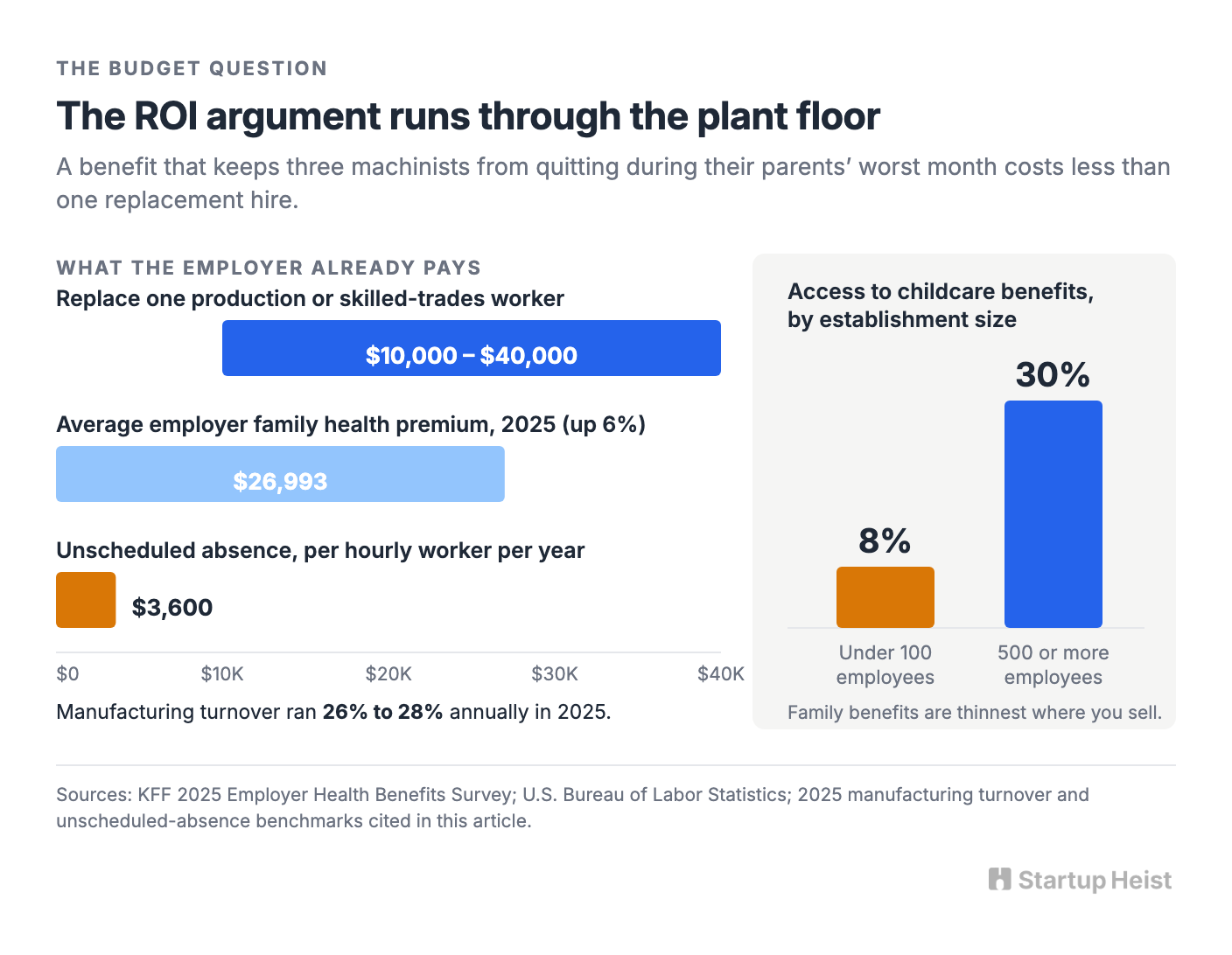
The ROI argument runs through the plant floor rather than through wellness. Manufacturing turnover ran 26% to 28% annually in 2025, and replacing a single production or skilled-trades worker costs $10,000 to $40,000, more for specialized trades. Unscheduled absence in hourly shift roles runs roughly $3,600 per worker per year in backfill, overtime, and lost output. Against those numbers, a benefit that keeps three machinists from quitting during their parents' worst month costs less than one replacement hire.
So pitch fewer avoidable absences, then measure them honestly. Every resolved case should produce an anonymized employer record: crisis category, response time, navigator hours, referral completed, resolution time, and employee-reported shifts preserved. Do not claim you cut absenteeism by some impressive percentage in year one, because you cannot know that yet. Report what you can count: the share of employees who used the service and said it saved at least part of a scheduled workday. Run the real study once employers trust you with attendance data. That evidence file is your sales asset.
Sell Through the Channel That Already Owns the Room
Unlock the Vault.
Join founders who spot opportunities ahead of the crowd. Actionable insights. Zero fluff.
“Intelligent, bold, minus the pretense.”
“Like discovering the cheat codes of the startup world.”
“SH is off-Broadway for founders — weird, sharp, and ahead of the curve.”


