


The Week-Two Problem Behind the Fiber Boom
On June 23, 2026, Google published its Summergeist trends report and dropped a genuinely useful number in the middle of it. U.S. searches for "dietary fiber" had hit an all-time high, and searches for "fibermaxxing" were up 115% in ninety days. The same report broke the interest out by ingredient: full-year search interest up 70% for inulin fiber, 50% for psyllium, 50% for chia.
Trend names are usually noise. This one sits on top of a real deficiency. More than 90% of American women and 97% of American men fail to hit recommended fiber intake, a gap wide enough that the federal Dietary Guidelines classify fiber as a nutrient of public health concern. The average shortfall runs close to half the target.

The supplement industry responded the way it always does. Psyllium husk, inulin blends, resistant starch, prebiotic powders, gummies, high-fiber bars, elaborate gut-health stacks. Coherent Market Insights puts the global fiber supplements market near $4.76 billion in 2026, though estimates across research firms run as high as $16 billion depending on what gets counted. Powdered prebiotics hold the largest share of a prebiotics category compounding at roughly 14.6% a year.
None of it solves the part that actually matters. Buying fiber is easy. Becoming a person who consumes significantly more fiber is not.
The gap between those two sentences is the business.
The money: Twenty merchants at $2,000 a month is $40,000 MRR. Pilots run $3,000 to $8,000 up front, and one brand's monthly cohort is worth multiples of that.
Inside:
• The 30-day ramp flow, screen by screen
• Pilot pricing: $3K-$8K, then platform tiers
• Cold email that gets the audit call
• Four moat layers, hardest one last
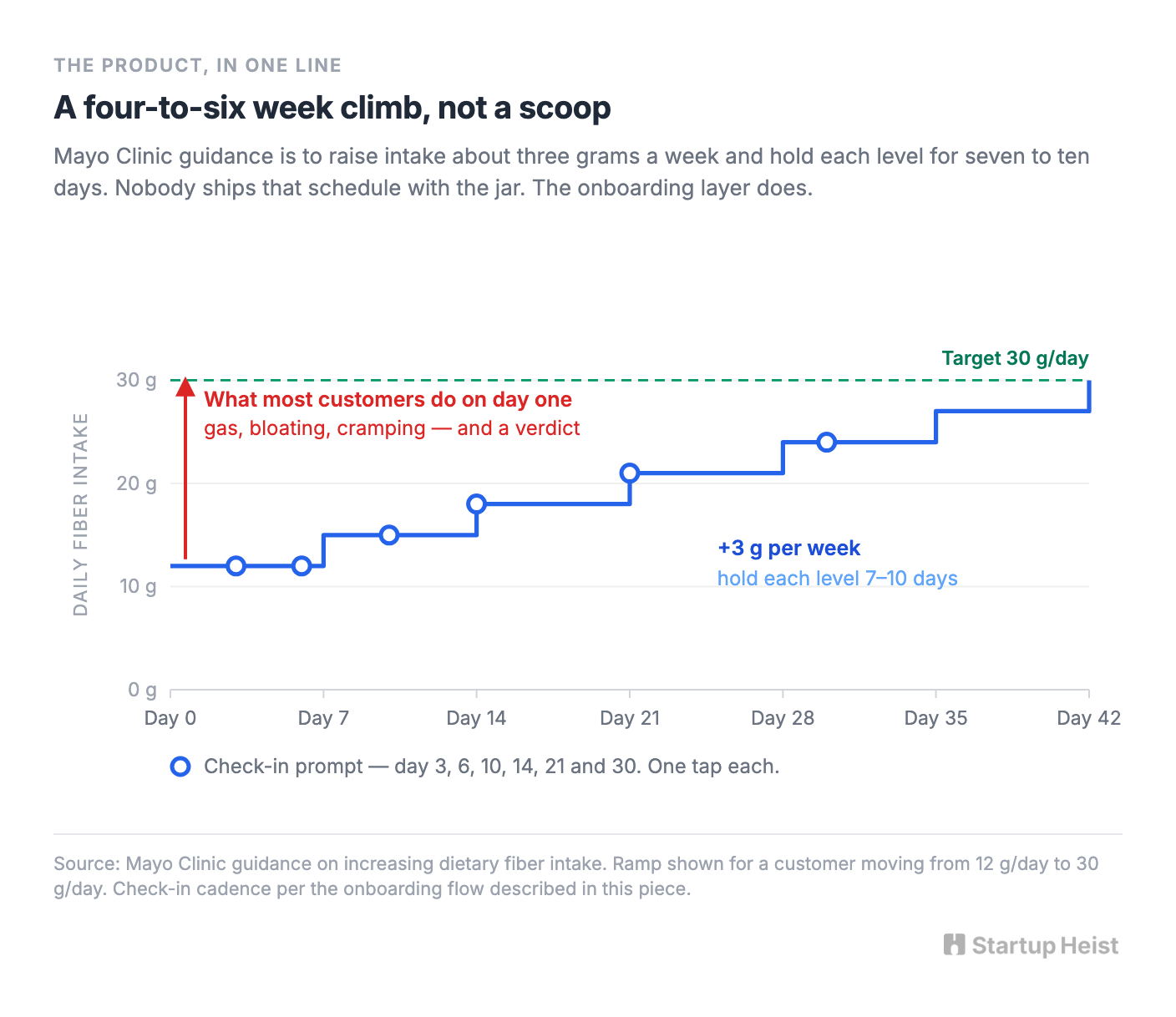
Push intake up too fast and you get gas, bloating, and cramping. Mayo Clinic's guidance is specific: increase by about three grams a week, hold each level for seven to ten days while your gut bacteria adjust, and raise fluid intake alongside it. For someone going from 12 grams a day to 30, that's a four-to-six-week ramp.
Nobody ships that schedule with the jar. Customers get a scoop and a shipping confirmation.
The opportunity sits downstream of the powder, in the software and service layer fiber brands run after it sells: a white-label onboarding system that walks new customers up the dose gradually, checks whether they're sticking with it, routes anything concerning away from automated advice, and measures whether the experience moves retention.
"Start low and go slow" is free advice, and nobody pays for it. What a brand will pay for is that advice turned into a measurable retention experiment.
The Retention Stack Stops at the Cancel Button
DTC supplement subscriptions bleed early. Across categories, 60% to 70% of subscribers are lost between the first and third order, and roughly 44% of all cancellations land inside the first ninety days. First-month churn runs 8% to 18% depending on vertical. Recharge, the largest subscription platform on Shopify, reported its health-and-wellness vertical at about 4.2% total monthly churn in 2023, which is a respectable steady state. Steady state is not where the money leaks.
Now look at where the retention tooling actually sits. Stay AI sells dynamic cancellation surveys, AI-generated rebuttals, and native multivariate testing on save offers. Ordergroove's pitch is crushing churn before, during, and after the point of cancellation, with autonomous agents proposing variants at 1% or 5% of traffic. Klaviyo's own case studies show the same shape: Happy V runs seven loyalty-triggered flows plus win-back sequences, and Humantra fires trial-pack offers off cancellation events.
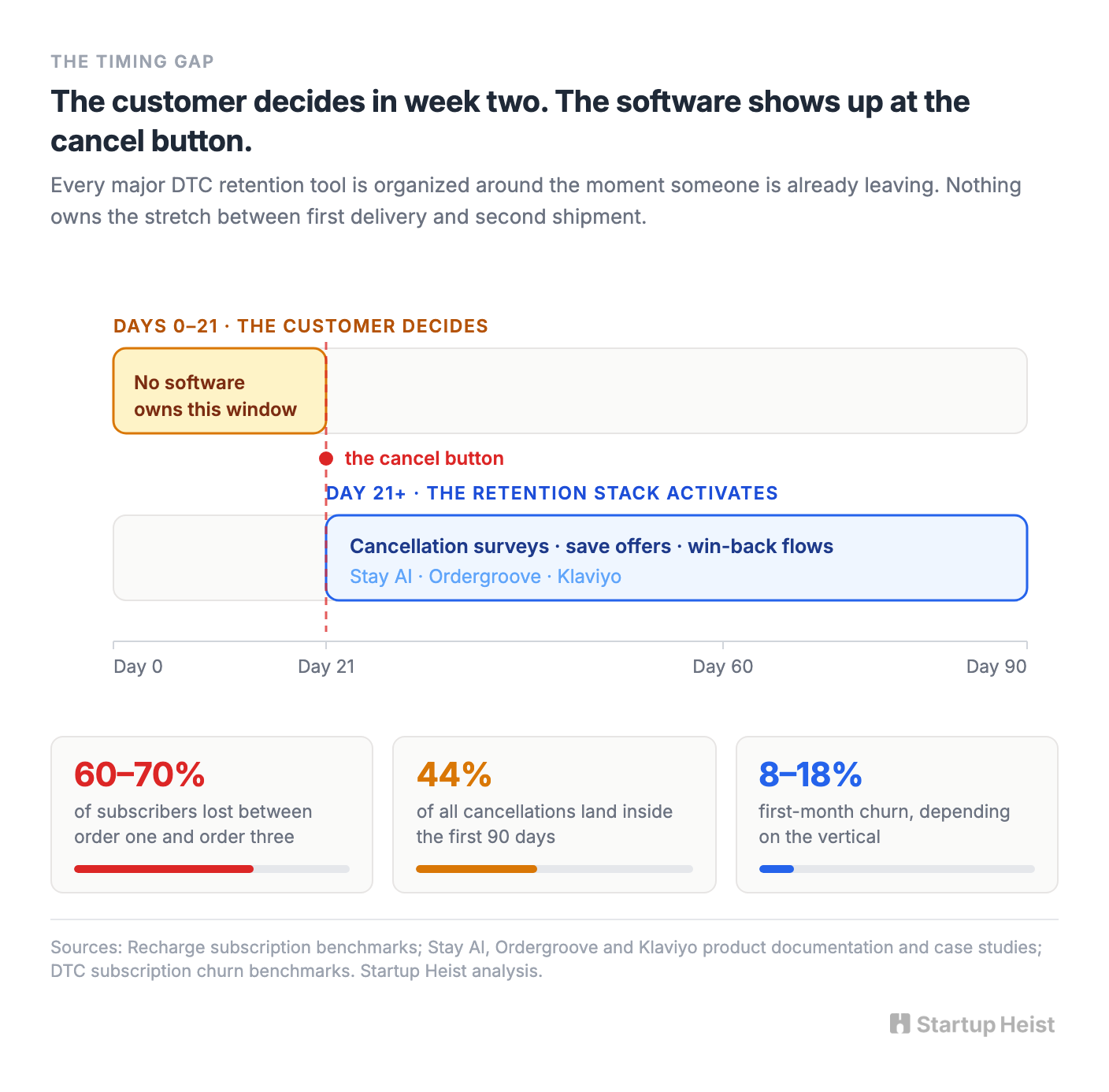
Every one of those systems activates when the customer is already reaching for the exit. The whole stack is organized around the cancel button.
But the customer who cancels in week three decided in week two, standing in a kitchen at 7 a.m., bloated, holding a jar that has so far made them feel worse than they felt before they bought it. By the time the save flow arrives with 20% off, you're negotiating with someone whose body already rendered a verdict.
The gap sits earlier: sophisticated lifecycle infrastructure in every direction, and nothing that owns what happens between first delivery and second shipment.
Don't Build the Consumer App
The obvious version of this is a consumer product. Take a quiz, estimate current intake, set a goal, get daily reminders, log symptoms, work upward. Couch to 5K for fiber.
It's the wrong company, and the reasons are competition and timing.
Anyone willing to track food already has cheap options. MyFitnessPal Premium runs $79.99 a year on top of a food database nobody is going to out-build. ZOE wraps nutrition guidance inside a broader gut-health membership at $9.99 a month on an annual plan. A dedicated fiber tracker has to convince consumers to install, learn, and pay for something narrower than the apps they already ignore.
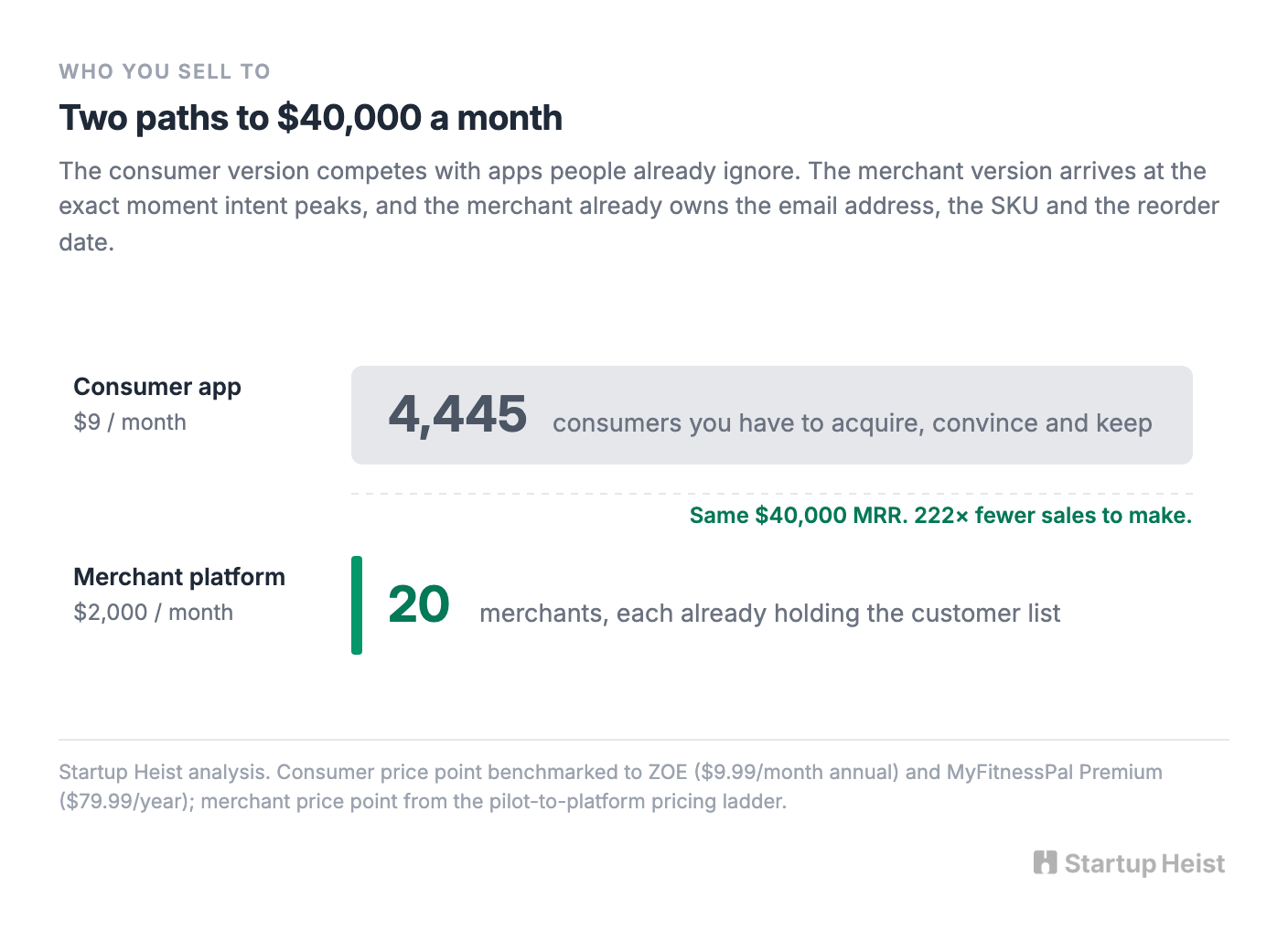
Timing is the deeper problem. The best moment to introduce fiber onboarding isn't when somebody abstractly decides fiber is good for them. It's the moment after they buy a fiber product, when intent is at its maximum and somebody else already knows their email address, their SKU, their grams per serving, their reorder date, and whether they're on subscription.
That somebody is the brand. Sell it to the brand and make the consumer experience free.
The economics flip completely. Instead of hunting thousands of consumers willing to pay $9 a month, you need a few dozen merchants willing to pay thousands a month, because a single monthly cohort's second shipment is worth many multiples of your invoice.
Sell the Experiment, Not the Software
Walk into a retention director's inbox with "we built a personalized fiber titration platform" and you've handed them three reasons to say no. It sounds medical, it sounds like another SaaS line item, and it sounds like something they could rebuild in Klaviyo over a long weekend.
Lead with this instead:
We run a sixty-day controlled onboarding experiment on your new customers. We build the flow inside your existing stack, split treatment and holdout cohorts, and measure whether guided onboarding moves second-order rate, refunds, pauses, and support volume.
Now you're selling an outcome, and the outcome arrives with a number attached.
Your competition isn't a missing email tool. Digioh already ships quizzes, conditional logic, and integrations across Shopify, Recharge, Klaviyo, and Attentive. Octane AI collects zero-party supplement data and pipes it into Klaviyo for triggered post-purchase messaging. The tools exist. Your competition is a retention manager saying "we can build this ourselves," and technically they can.
Quiz builders and drip campaigns aren't moats, and "increase gradually" is emphatically not one either.
What an internal team does not have sitting in Klaviyo is the complete experiment package: SKU-specific protocols, because psyllium is not inulin is not resistant starch. Reviewer-approved logic, where the merchant's own qualified nutrition or regulatory reviewer signs off on what consumers see. Structured tolerance data instead of an inbox full of free-text replies. Randomized treatment-versus-holdout assignment. And revenue attribution that connects check-in behavior to shipment two.
Assembling those five things is a quarter-long project for an internal team. Buying them is a purchase order.
Thirty Days, Two Screens
The consumer side is smaller than founders want it to be.
Unlock the Vault.
Join founders who spot opportunities ahead of the crowd. Actionable insights. Zero fluff.
“Intelligent, bold, minus the pretense.”
“Like discovering the cheat codes of the startup world.”
“SH is off-Broadway for founders — weird, sharp, and ahead of the curve.”


