


The 14 MB Model That Makes a Camera-Free Care Monitor Buildable
On July 20, 2026, Cactus Compute released Needle 2 under an Apache 2.0 license. It's a 45-million-parameter model built for tool calling, device control, and structured extraction. The whole thing ships as a 14 MB binary, holds a full session in roughly 28 MB of RAM, and decodes at about 500 tokens per second on a Raspberry Pi 5, with no network connection at all.
The obvious reaction is to build an offline AI baby monitor. The obvious reaction is wrong, and understanding why is where the business is.
Needle 2 can't listen to a bedroom. It has no audio encoder, so it can't determine that Grandma fell or that a baby is struggling to breathe. It's a controller. Feed it structured events and it decides what to do about them; point a microphone at it and nothing happens.
The constraint is the opportunity. The hard part of home monitoring was never the intelligence. It was the coordination layer between a sensor and a phone notification, and until now that layer had to live in a data center. Now it fits inside a $45 computer. Here's the opportunity:
The money: Sell the appliance once at $349. Ten thousand units is $3.49M, fifty thousand is $17.45M. A live competitor charges $99 a month.
Inside:
• Full MVP: hardware, perception stack, agent
• Why $349 once beats $99 a month
• The 10-week build to 20 pilot households
• The FDA claim line you can't cross
No continuous audio leaving the house, no cloud inference bill, no mandatory subscription, and no AI pretending to be a doctor. The first wedge is adult children helping a parent who still lives alone.
The unlock is cheap coordination
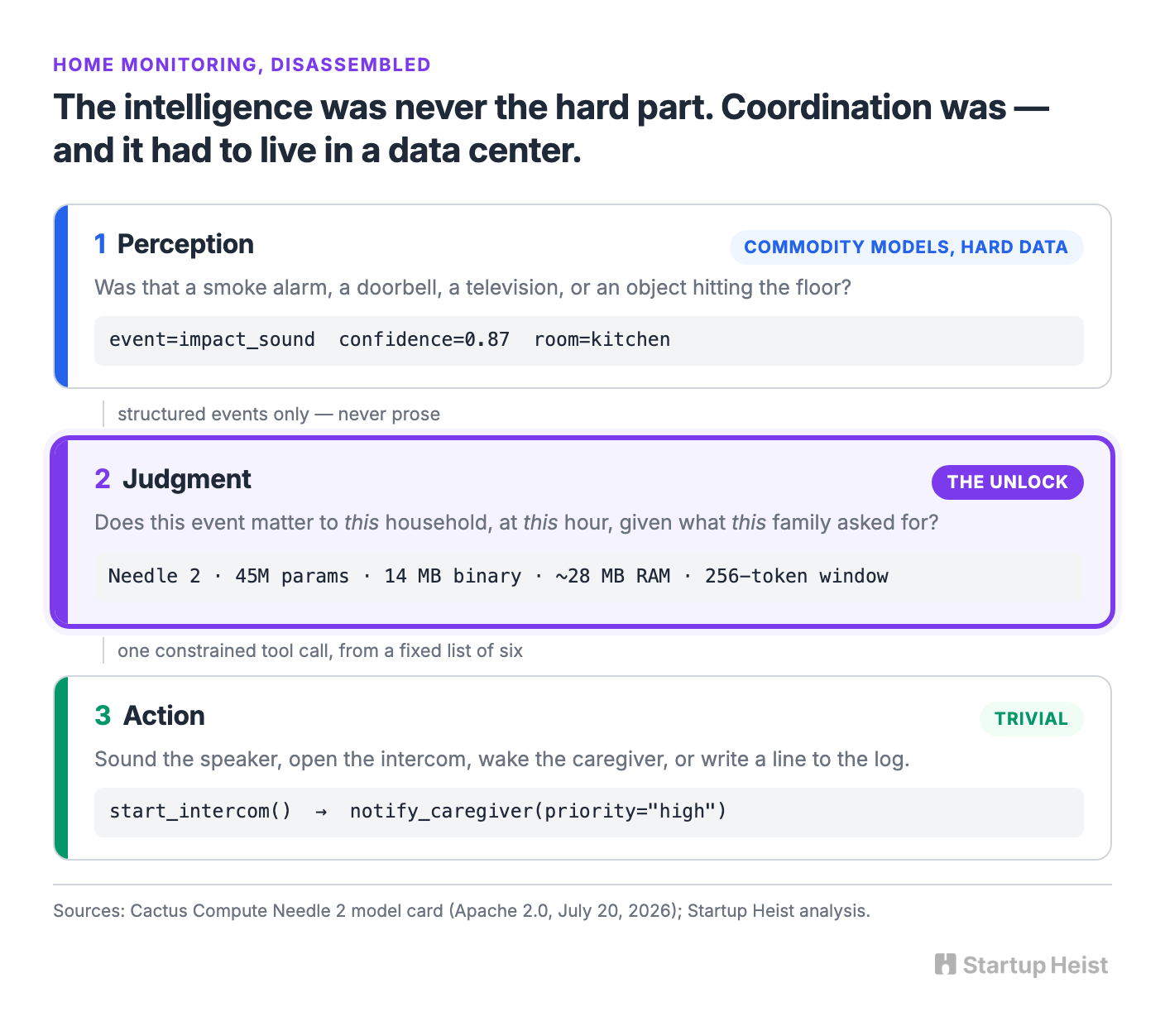
A home monitoring system has three layers: perception, judgment, and action. Perception answers factual questions. Was that a smoke alarm, a doorbell, a television, or an object hitting the floor? Did someone say "help"? Small acoustic models can run that tier on a Pi, though making them accurate inside a real house is a long project of its own. Action is trivial.
Judgment is where every product in this category has been stuck. Does this event matter to this specific household? Did anyone acknowledge it? Is the resident normally awake at 2 a.m.? Do you call the daughter, sound the speaker, or wait thirty seconds?
Until tiny agent models existed, you had two options, both bad. Hard-code an enormous rules engine and you're anticipating every configuration any family will ever want. Ship events to a cloud model and you buy inference costs, an internet dependency on a safety product, and a privacy story you can't honestly tell.
Needle 2 gives you a third. The device hands it structured state (`impact_sound: 0.87`, `resident_response: none`, `time: 02:14`, `quiet_hours: true`) plus the household's standing instruction, and it emits a constrained tool call: `start_intercom()`, then `notify_caregiver(priority="high")`, then `turn_on_hall_light(20)`.
Notice the division of labor. The AI isn't deciding whether Grandma fell. A dedicated acoustic classifier reports an impact-like sound at 87% confidence, and the tiny agent decides what that means in this house, at this hour, given what this family asked for. Far more achievable than fall detection, and a far better product.
The 256-token window is the actual design problem
Read Needle 2's model card past the headline numbers and the engineering reality shows up fast. The context window is a 256-token sliding window. Tool retrieval caps at the top five when your catalogue exceeds five. A request no declared tool can serve returns an empty response, with no free-text fallback.
Founders will read "45M parameters, runs on a Pi" and assume they can hand the model a household's full care plan in plain English. They can't. Two hundred fifty-six tokens is a long paragraph, and everything the model sees at decision time has to fit inside it.
The limit forces the architecture a safety product needs anyway. You never feed Needle a policy document. You compile the family's plain-English rules into a compact structured policy at setup time, show them the exact rule you created, and at decision time hand the model only the slice that applies. The refusal behavior becomes a feature of its own: a model that returns nothing rather than improvising is what you want holding the reins in someone's mother's kitchen.
The five-tool cap points the same direction. Your permitted action set should be five or six tools, permanently. Anyone tempted to give this thing thirty capabilities has misunderstood the product.
Why elder care beats the nursery
The caregiver market doesn't require an invented TAM slide. On July 24, 2025, AARP and the National Alliance for Caregiving published Caregiving in the US 2025: 63 million Americans, nearly one in four adults, provide ongoing care, up 20 million since 2015. Nearly one in four gives 40 or more hours a week, and out-of-pocket spending averages about $7,200 a year. AARP's 2024 survey found 75% of adults 50 and older want to stay in their current homes.
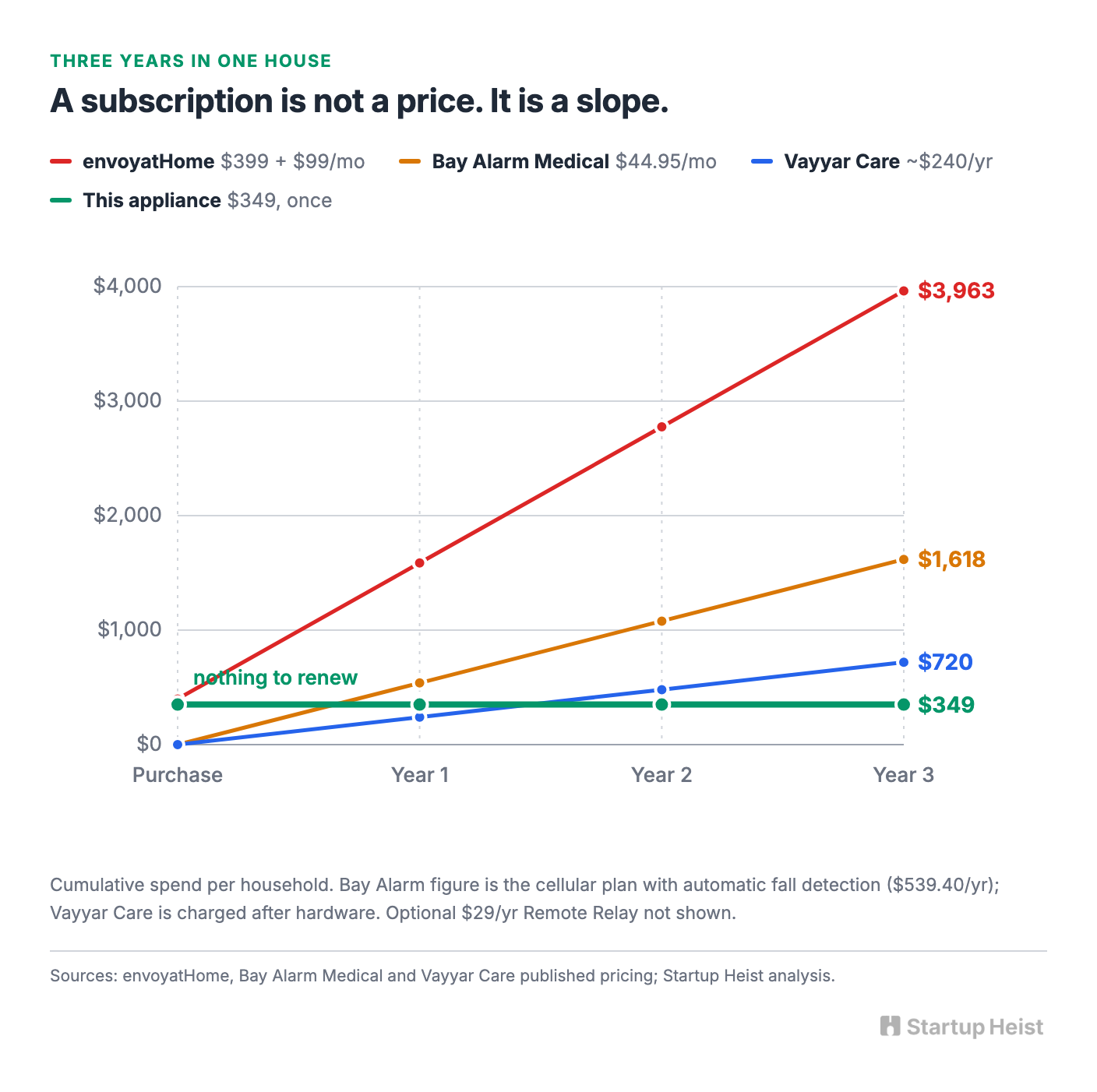
An industry already monetizes the anxiety in that gap. Bay Alarm Medical lists in-home landline service at $27.95 a month, cellular at $34.95, and cellular with automatic fall detection at $44.95, or $539.40 a year, every year, forever. Medical Guardian sells landline and cellular in-home systems with fall detection as a paid add-on and publishes no price at all. You call a salesperson to find out what it costs.
Those companies sell something real that you won't: professional 24/7 monitoring and cellular emergency escalation. Don't position against it. Your customer is a different person, and she sounds like this: "My 76-year-old mom is still independent. She refuses to wear a Life Alert. She doesn't want a camera in her house. I don't need a call center watching her. I just want to know when something unusual happens."
You're selling ambient awareness without ambient surveillance.
The nursery looks tempting because the buying emotion is louder, but that shelf is full. Nanit's $249 camera does live video, sound and motion alerts, and temperature with no subscription. Owlet's FDA-cleared Dream Sock is $299.99 with core readings included. Infant Optics sells a $199.99 closed-loop kit on an explicit no-Wi-Fi privacy promise. Privacy is table stakes in that aisle.
The field isn't empty, and anyone who says it is hasn't looked. Sensi.AI raised a $45 million Series C for always-on, camera-free, audio-based elder care, using Echo-Dot-sized pods that learn a senior's baseline and alert a care team. Two things keep the wedge open: it's cloud-processed, and it sells B2B through home-care agencies with no consumer price. envoyatHome comes from the other direction, camera-free passive sensors sold straight to family caregivers at $399 of equipment plus $99 a month, roughly $1,188 a year. A competitor already charging that makes "$349 once" a real differentiator. Vayyar Care runs 4D imaging radar at about $240 a year after hardware, while Nobi and Cherry Home market on privacy but are camera-based underneath.
Camera-free elder monitoring exists and audio-based elder monitoring exists. Nobody is shipping a one-time-price, on-device, audio-based, direct-to-consumer camera-free appliance. That box is empty.
Steal this wedge: the private care intercom
Unlock the Vault.
Join founders who spot opportunities ahead of the crowd. Actionable insights. Zero fluff.
“Intelligent, bold, minus the pretense.”
“Like discovering the cheat codes of the startup world.”
“SH is off-Broadway for founders — weird, sharp, and ahead of the curve.”


