


Washington Named the Duty and Skipped the Procedure
Some regulatory changes create software markets because companies suddenly have to do something new. Commercial-driver English proficiency is a better setup: the obligation already existed, enforcement suddenly got expensive, and the government still won't say how to comply.
Federal rules have required commercial motor vehicle drivers to read and speak English well enough to converse with the public, understand highway signs, respond to official inquiries, and complete required reports since 1936. What changed is the consequence. On June 25, 2025, the Commercial Vehicle Safety Alliance added failure to meet the English Language Proficiency requirement to its North American Standard Out-of-Service Criteria. A driver who fails the roadside check gets parked now, along with the truck and the freight.
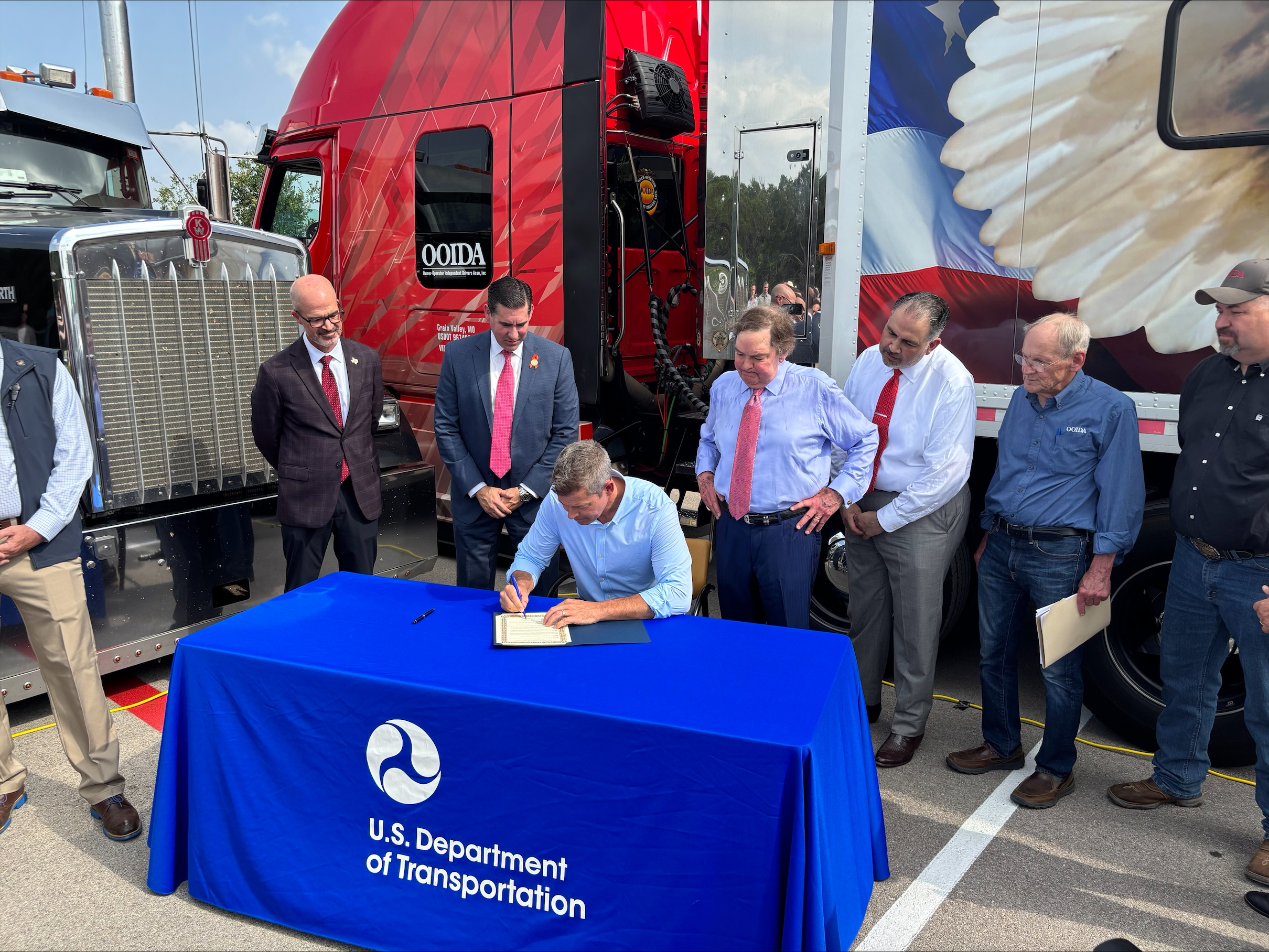
The enforcement numbers aren't subtle. FMCSA's regulatory analysis, published August 10, 2026, shows 7,812 ELP violations and 33 out-of-service orders between January 2025 and June 24, 2025. Between June 25, 2025 and March 19, 2026: 60,399 violations and 19,045 out-of-service orders. The Department of Transportation says more than 26,000 commercial drivers have now been pulled off the road, and FMCSA has proposed writing the out-of-service treatment into the Federal Motor Carrier Safety Regulations. Comments close October 9, 2026. Note the framing: the proposal "does not create new requirements or obligations for regulated entities but would codify" what is already happening. Whichever way the rulemaking lands, enforcement is already permanent, because the CVSA criteria and FMCSA's internal policy are in force today.
The agency described what competence looks like without giving anyone a system for producing it, verifying it, or proving they checked. That gap is the business.
The money: A thousand small fleets at $250 to $400 a year is $250K to $400K ARR before driver-direct sales. Iowa already fines carriers $10,000 per violation.
Inside:
• The 15-minute manager assessment workflow
• Event-based pricing across three tiers
• Consultant and CDL school distribution
• What never to claim about a DQ file
The States Made It a Bill, Not Just a Delay
A federal out-of-service order strands a truck. State law does something most operators haven't priced: it puts a fine in the carrier's own name.
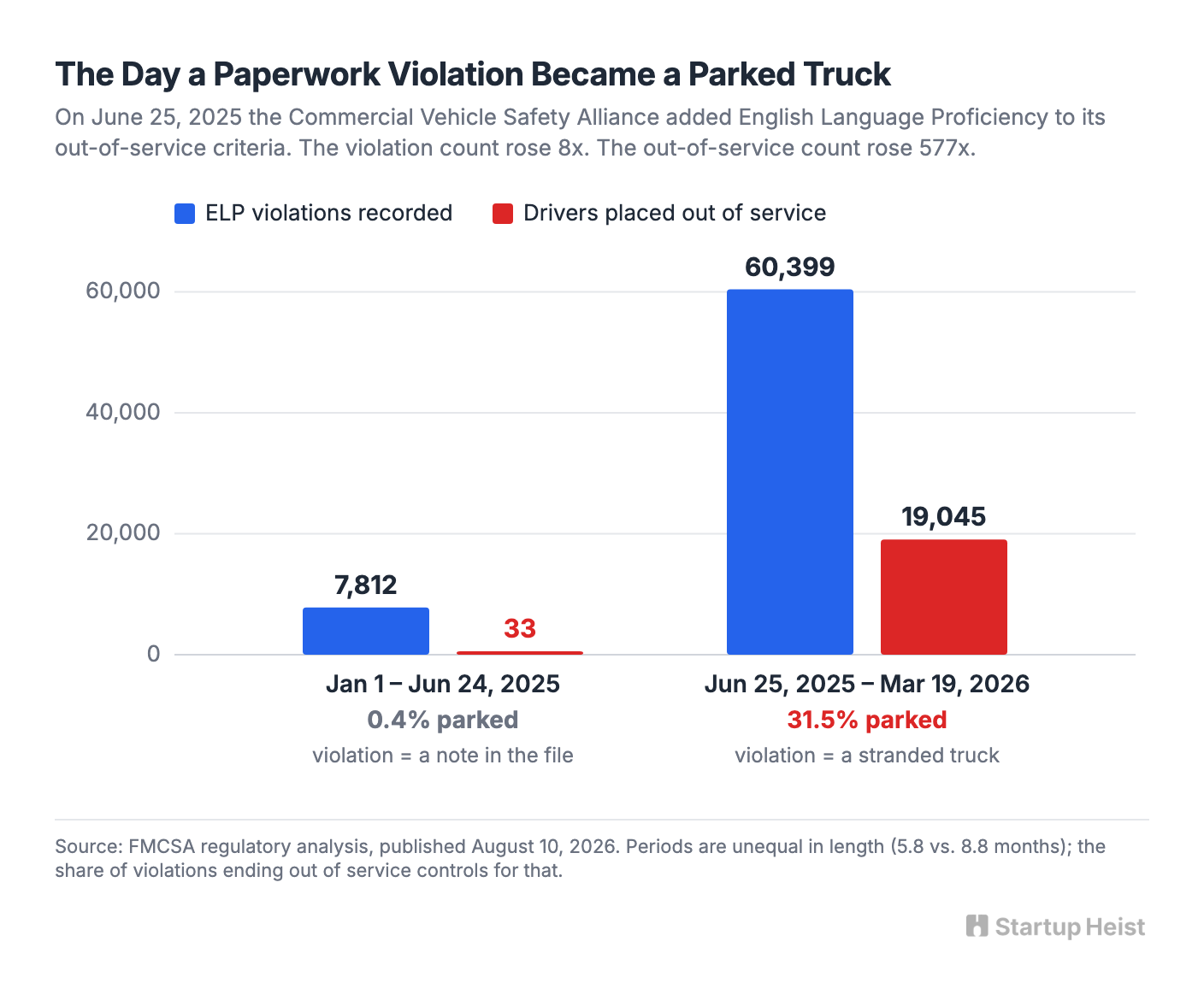
Arkansas and Oklahoma moved first in 2025. Then 2026 happened. Alabama's SB 242, signed by Governor Kay Ivey in March and effective October 1, 2026, carries a $1,000 carrier fine that doubles on repeat violations. Iowa went furthest: Governor Kim Reynolds signed Senate File 2426 on May 3, 2026, barring carriers from employing a driver who doesn't meet 49 CFR 391.11(b)(2), on pain of a simple misdemeanor, a civil penalty up to $10,000 per violation, and an order prohibiting operation in the state. Tennessee's SB 1748, signed by Governor Bill Lee in May 2026, caps carrier exposure at $500. Indiana, South Dakota, Utah, and Wyoming passed versions in 2026, Wyoming's by extending enforcement authority to local police rather than fining the carrier. Missouri's HB 2741, attaching $3,000 per violation to the carrier, cleared the House 104-22 in April 2026. At least ten states have enacted or advanced ELP legislation in eighteen months, and carrier-side penalties are already law in several.
The buyer changes as you move down that list. Federal enforcement lands on a dispatcher, who reshuffles the load and moves on. A state statute lands on the owner, who has to defend a hiring decision in writing, where a shrug becomes a five-figure answer.
580,000 Carriers, Almost None of Them With a Safety Department
FMCSA's guidance to carriers is genuinely useful, which makes the gap easy to miss.
A carrier should assess English proficiency during driver qualification. FMCSA recommends a manager interview the driver in English about trip origin and destination, hours of service and logbooks, the license, shipping papers, and vehicle equipment, then show signs from the Manual on Uniform Traffic Control Devices plus dynamic message signs and ask what they mean. Interpreters, I-Speak cards, cue cards, translation apps, and telephone interpretation are off the table, because they mask the ability the interview is supposed to measure. One nuance vendors skip: the driver's explanation of a sign may be in any language, as long as the manager understands it.
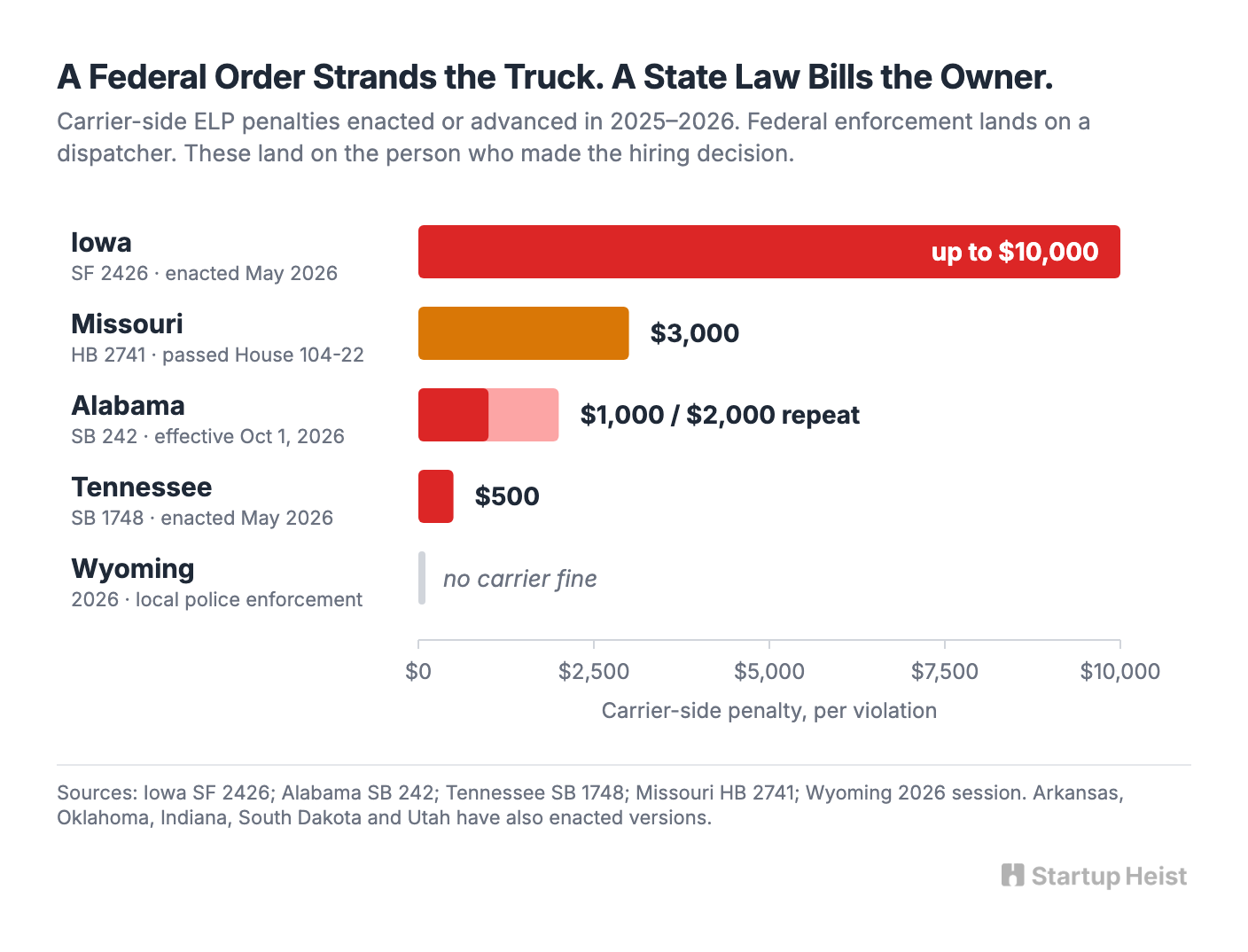
What FMCSA declines to provide matters just as much. There's no official question bank, no mandated number of questions, no passing score, and no federal certificate. The agency says carriers may use "various methods," and the guidance is nonbinding. That flexibility is a gift if you employ a safety director and outside counsel. It's a problem if you own four trucks, employ three drivers, and run the business out of QuickBooks.
That second description covers most of the industry. American Trucking Associations figures count roughly 580,000 active U.S. motor carriers registered with FMCSA operating at least one tractor as of mid-2025, and 91.5% run ten trucks or fewer. None are asking what §391.11(b)(2) requires. They're asking what to do with the new hire on Monday morning before putting him in truck 417.
The Incumbents Already Told You Where the Opening Is
Someone got here before you, which is good news. Zero competitors in a compliance niche usually means the buyers don't pay.
Trucksafe sells a $149 assessment pack with an administrator guide, eight questions, ten road signs, scoring sheets, and a completion certificate, and has since launched ELPReady, a browser-based voice assessment that transcribes and scores driver responses automatically. CNS sells a $20 driver course. DOT Compliance Group runs a 28-minute road-sign and roadside-communication course. SambaSafety gives ELP training away as an on-ramp to its fleet platform, and J. J. Keller publishes exhaustive free FAQs. Content is crowded at one end, automated scoring at the other.
Both obvious products are gone. Another video course competes with free, and another first-ever ELP assessment competes with a $149 PDF and a working voice product. What nobody has built sits between them, and the incumbent's lawyers wrote the brief.
ELPReady's public disclaimer states that it is a private commercial service, not approved, accredited, certified, or endorsed by FMCSA; that a passing result doesn't mean a driver will pass a roadside inspection, or a failing result that he'd fail one; that automated output shouldn't be the sole basis for adverse action against a driver; and that transcription and scoring errors are more likely where a driver's accent or speech pattern is less well represented in the underlying models. All of that is honest, and it's an admission that the machine can't make the decision the carrier is legally required to make.
The Position That's Open
The automated products converge on one promise: we test your driver and tell you whether he passed. A different promise is available, and it's the one small carriers need.
Unlock the Vault.
Join founders who spot opportunities ahead of the crowd. Actionable insights. Zero fluff.
“Intelligent, bold, minus the pretense.”
“Like discovering the cheat codes of the startup world.”
“SH is off-Broadway for founders — weird, sharp, and ahead of the curve.”


