


The Buyer Comes First: Building a Private Buy-Box Network for Buildable Lots
Every real-estate software company starts on the same side of the table. Parcels, owners, comps, and ten thousand phone numbers attached to people who may or may not want to sell their land.
Land investors don't have that problem. Finding dirt is the easy half. The hard question, the one that decides whether a deal makes money, is who will actually buy this parcel and exactly what they'll take.
A homebuilder might want lots inside three ZIP codes, fifty feet of frontage minimum, public sewer, no floodplain or septic or steep slope, finished-lot basis under $110,000. Five to twenty lots preferred, though they'll take a single infill parcel if it sits in one of two specific school districts.

A builder five miles away works from a completely different box.
Those requirements exist. They're just scattered across acquisition managers' inboxes, broker spreadsheets, text threads, and the memory of whoever answered the phone last time.
That gap is the opportunity: build a concierge-first network of verified builder acquisition criteria in one growth market, then use those buy-boxes to tell land sourcers whether a parcel has a likely buyer before they tie it up.
The closest analogy is a Bloomberg terminal for one small corner of the land market, except the most valuable data arrives by telephone rather than by feed. Here's the shape of it:
The money: Twenty land pros at $299 a month is $6,000 MRR. A hundred at $400 is $40,000, from a single metro.
Inside:
• The MVP that's 90% phone calls
• Four-tier pricing where builders pay nothing
• A 90-day playbook with kill criteria
• Why rejection data is the real moat
The Heist
The standard land-wholesaling workflow runs backwards: find a cheap parcel, contract it, then go hunting for someone who wants it. Reverse the sequence and you ask builders what they're buying this quarter before you source anything.
It sounds obvious. The reason nobody has industrialized it is that the entire data industry has spent a decade making the supply side searchable while builder demand stayed unstructured.
Builders still have a land problem. In NAHB's May 2025 survey, 64% of single-family builders called the supply of building lots low or very low, with 26% calling it very low, and 67% said the same about A-quality lots in the best locations. That's off the 76% panic reading of 2021, but higher than any measurement NAHB took between 1997 and 2016.
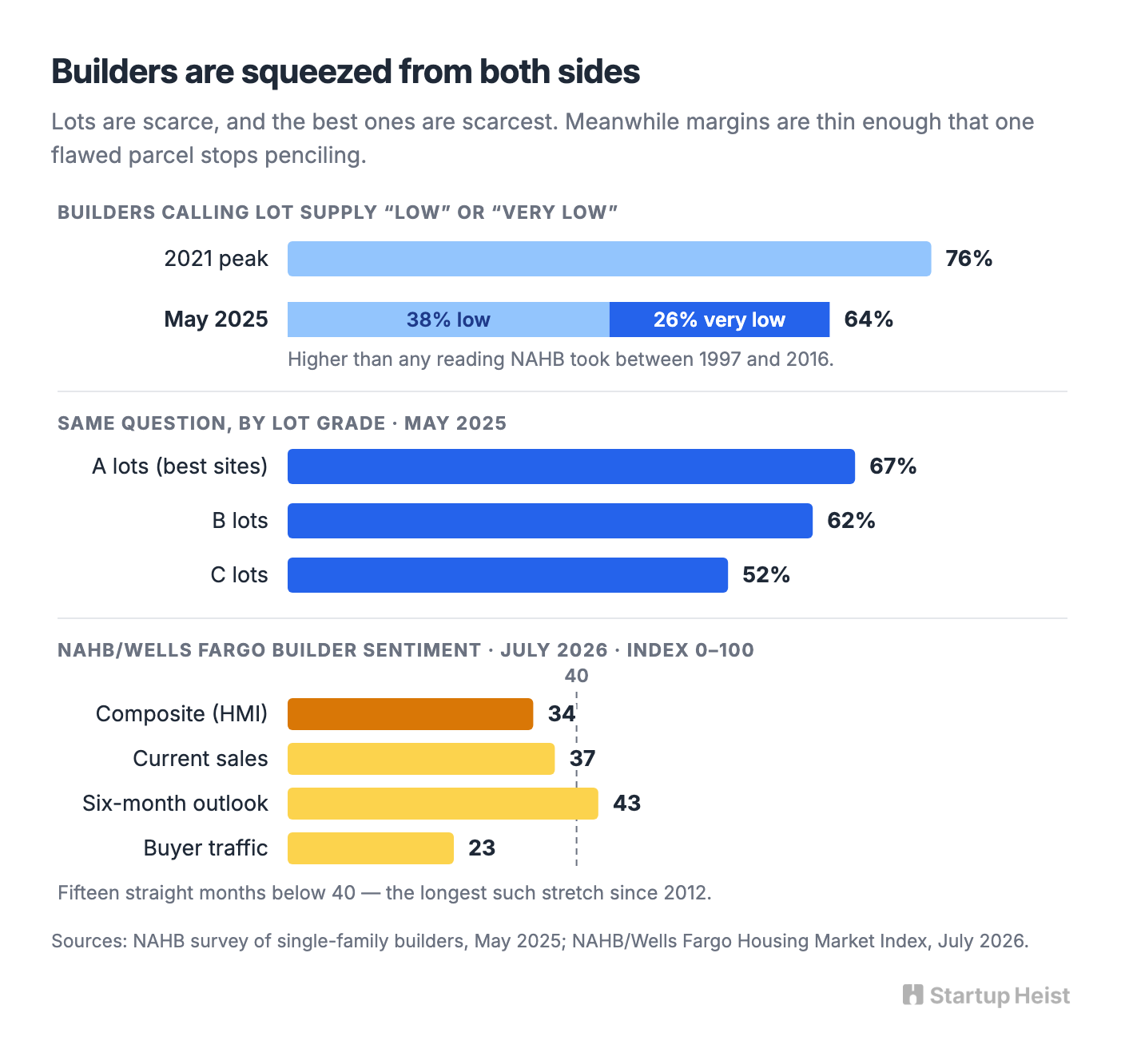
Builders don't need just any land, and right now their tolerance for a flawed parcel is unusually low. Builder confidence sat at 34 in July 2026, down two points from June, the fifteenth consecutive month below 40 and the longest such stretch since 2012. Buyer traffic registered 23. Margins are thin enough that a parcel with one extra problem stops penciling.
A boom rewards anyone willing to throw land at builders. A market this tight rewards only the person who knows which parcels a given builder can still make money on.
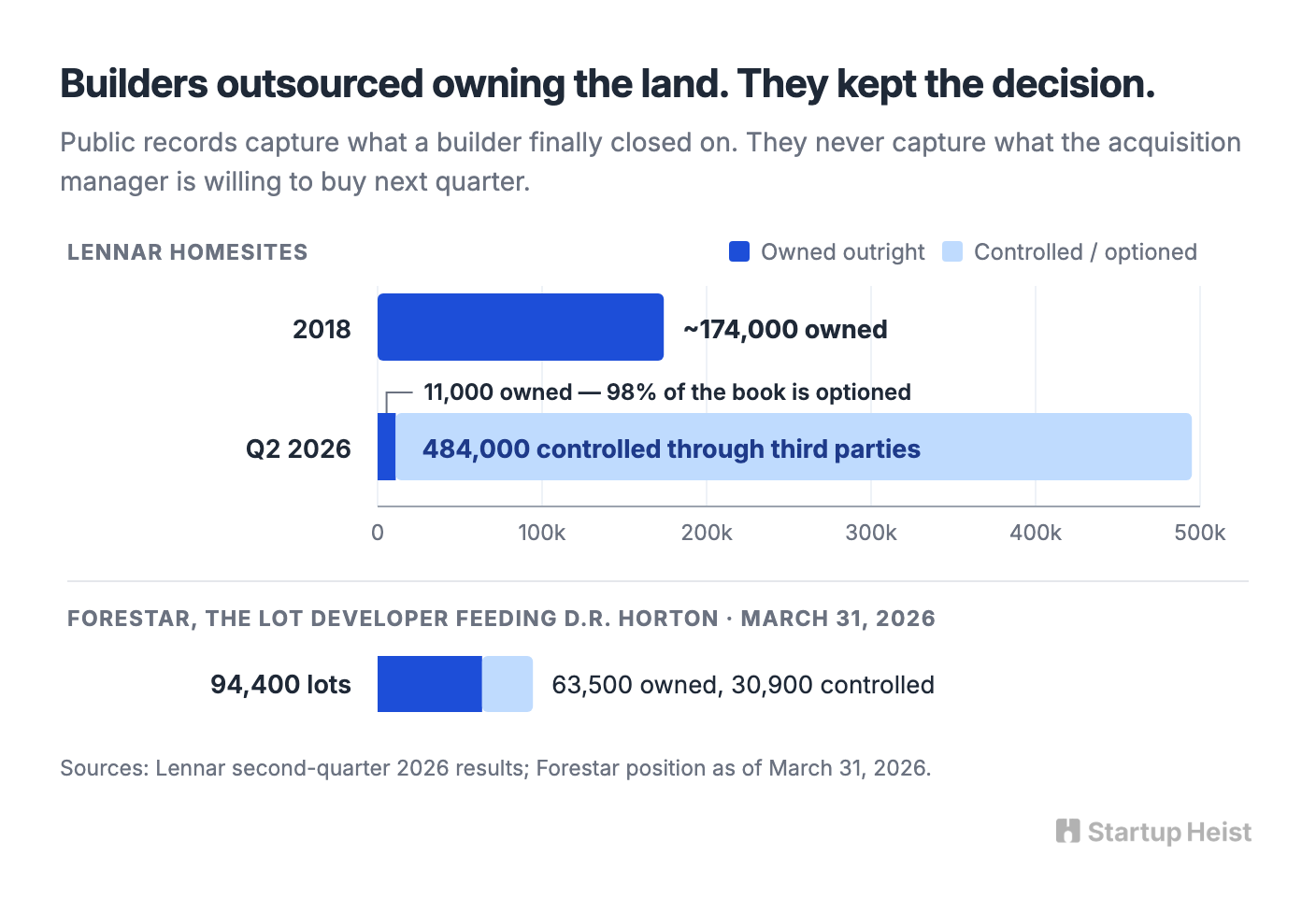
Public builders have meanwhile moved almost entirely off their own balance sheets. Lennar closed its second quarter of 2026 owning 11,000 homesites and controlling 484,000 through third parties, roughly 98% optioned. In 2018 it owned about 174,000. Forestar, the lot developer that feeds D.R. Horton, held 94,400 lots as of March 31, 2026, a third of them controlled rather than owned.
Builders have outsourced land ownership without outsourcing the decision about which lots they want. That decision still lives in a person's head, and that person's phone number is public.
Dirt Is Not the Product
Consider two adjacent three-acre parcels.
One has public sewer, 180 feet of road frontage, cooperative zoning, straightforward stormwater, and yields six finished lots. The other needs a rezoning, sits partly in floodplain, has no sewer connection, and requires a road improvement somebody has to pay for.
On a parcel map they look like twins. To a builder they're different species, and that gap is where the money sits.
Regulation shows how fast the economics diverge. NAHB's June 2026 study put the regulatory cost embedded in a typical new single-family home at $131,734, about 26.4% of the average sales price. Of that, $46,795 is incurred during land development, before a single foundation is poured. That number rose more than 40% in five years while disposable income rose 18.3%.
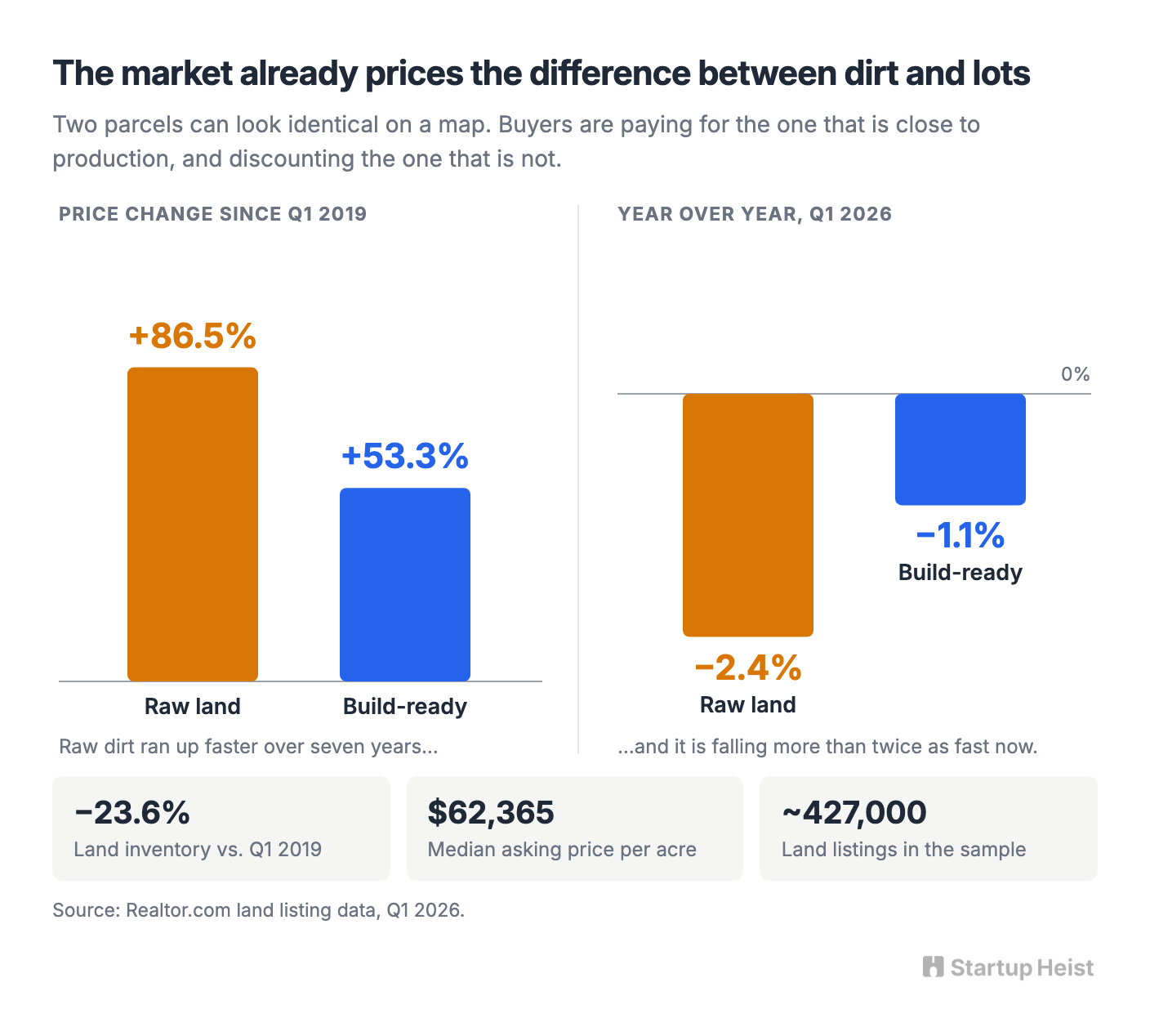
The market is already pricing the distinction. Realtor.com's first-quarter 2026 land data showed raw land down 2.4% year over year while build-ready parcels lost just 1.1%. Land inventory sat 23.6% below early 2019, at a median asking price of $62,365 per acre across roughly 427,000 listings. Buyers are discriminating between speculative dirt and something close to production, and paying for the difference.
A product built on this can't promise a parcel is buildable. That claim invites liability and will eventually be wrong. The narrower promise is worth more: which active buyers this parcel appears to fit, what information is missing, and what has to be verified before anyone spends money.
The Data Nobody Sells
There's already excellent parcel software, and pretending otherwise will get a founder killed.
Acres covers more than 150 million parcels and spent February 2026 adding building permits, traffic volumes, weekly satellite imagery, and skip tracing to its layer library. Its Pro plan runs about $95 a month billed annually, with zoning, infrastructure, and AI features held back for an unpriced enterprise tier. PropStream sells the investor research workflow from $99 to $699 a month. REsimpli stacks CRM, skip tracing, buyer search, and disposition tools from $149. LandTech filters off-market parcels against acquisition criteria across fifty-plus data layers.
Acres has gone further than most people realize. Its enterprise tier lets a builder type "200+ acre parcels with less than 10% flood plain, sewer access, and residential zoning" and get matches back. Its Home Builder Index sells verified builder acquisitions with entity unmasking, which pierces the shell LLCs builders buy through.
Everything the incumbents sell about builder demand is derived from the public record: what a builder bought, reconstructed after closing. That's the observed buy-box, useful for spotting which competitor is quietly assembling in your submarket, and by construction historical. It can't tell you that an acquisition manager paused townhome sites in August, dropped a school district, or picked up a mandate to buy nothing over $95,000 a lot.
Nobody sells that, because it can't be scraped. It has to be asked, written down, and asked again.
So the thing to build is not another parcel database. Flood maps and ownership records are solved, and a spreadsheet of builder names at $150 a month is a commodity the day after it ships. The dataset worth owning is the one that decays: what the actual buyer wants right now, timestamped, with the date they last confirmed it.
"Builder X confirmed on August 18 that it wants 45- to 60-foot lots in these five submarkets, public water and sewer, up to 30 lots, finished-lot basis under roughly $95,000."
The record has a shelf life, which is precisely what makes it valuable.
Why One Metro, and Why Charlotte
A company like this should refuse national scale at launch. You want one market where builders are active, population is growing, jurisdictions are fragmented enough that local knowledge is worth something, and you can physically learn the land business by driving it.
Unlock the Vault.
Join founders who spot opportunities ahead of the crowd. Actionable insights. Zero fluff.
“Intelligent, bold, minus the pretense.”
“Like discovering the cheat codes of the startup world.”
“SH is off-Broadway for founders — weird, sharp, and ahead of the curve.”


