


Stop Posting Jobs. Start Selling Introductions.
Something broke in hiring, and both sides feel it at once.
Employers post a role. Software syndicates it everywhere. Candidates use AI to tailor a résumé in nine seconds and fire it at forty openings. The employer receives four hundred applications and buys another layer of software to rank, filter, and auto-reject them. Volume climbed. Signal didn't.
LinkedIn's 2026 talent research puts numbers on it: applications per open role have roughly doubled since spring 2022, and two-thirds of recruiters say finding qualified candidates has gotten harder. More applicants, worse outcomes. None of that is a distribution failure. Distribution got solved years ago, and every job in America sits one click from every jobseeker in America.
What nobody sells is the answer to a much smaller question: who, within twenty minutes of my office, is qualified, wants $26 an hour, can work Monday through Thursday, and is willing to take my call this week?
No résumé answers that. The answer is a timestamped, consented, constraint-matched fact about one person, and it decays in about seven days.

So build the thing that holds it. A small verified directory of local workers who confirmed this week that they're open to a move, searchable anonymously, with a charge only when a worker agrees to be introduced. Call it a verified availability exchange. The first version shouldn't target software engineers or generic hourly labor. It should target a local, credential-heavy, high-turnover occupation where an empty seat costs real money every day. Dental assistants are the sharpest wedge available.
Here's the opportunity:
The money: Forty practices on a $299 monthly plan is roughly $12,000 MRR, sold against a replacement cost near $10,000 every time a chair empties.
Inside:
• The $79 accepted-introduction price ladder
• Weekly reconfirmation that kills stale rows
• Scripts for the first 50 candidates
• A 90-day plan and six kill criteria
The buyer is already in pain, and already paying
The occupation is large and it churns constantly. About 381,900 dental assistants work in the United States, with median pay of $47,300 in 2024. The Bureau of Labor Statistics projects 6% employment growth through 2034 and roughly 52,900 openings every year once you count growth, occupational switching, and exits.
In its first-quarter 2026 read on the dental economy, the American Dental Association found that 36.7% of dentists had tried to recruit a dental assistant in the previous three months. Among those who did, about 70% called the process very or extremely challenging.
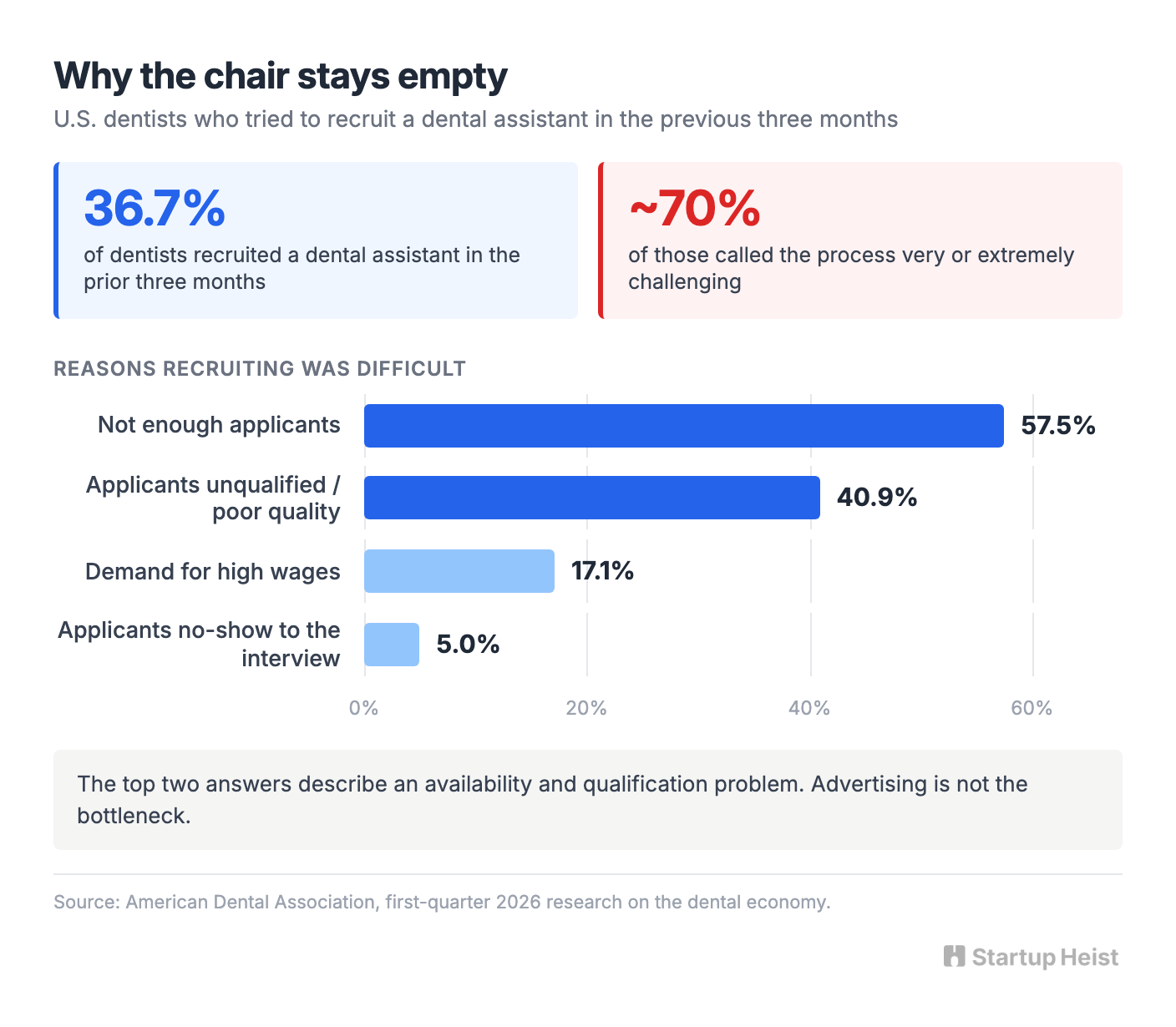
The reasons matter more than the headline. Not enough applicants: 57.5%. Applicants unqualified or poor quality: 40.9%. Demand for high wages: 17.1%. Applicants who never show up to the interview: 5.0%. The top two answers describe an availability and qualification problem. Advertising isn't the bottleneck. These practices don't need one more place to post "Dental Assistant Wanted, Competitive Pay, Great Team!!!" They need to know which specific qualified person nearby is actually movable right now.
One dentist quoted in that same ADA report described the workaround: "We now have to use a recruiter and pay 17% of first year's wage." On a $47,300 salary, that's roughly $8,000 to fill one chairside seat.
The full cost of losing an assistant runs higher. Industry estimates cluster between $8,000 and $20,000 once you count recruiting, onboarding, and the productivity drag while someone learns your operatory, though those figures come from staffing-industry blogs rather than a controlled study. The Dental Assisting National Board, the profession's national certifying body, puts direct replacement cost near $10,000 with more than $21,000 in at-risk revenue while the chair sits empty.
Turnover keeps the meter running. No survey body publishes a dental assistant turnover rate, but industry estimates land consistently around 20% to 30% a year, roughly triple what a practice would call healthy. The buyer doesn't hire once. The buyer hires again in fourteen months.
The honest part: this graveyard is full
Before the playbook, walk through the cemetery. This idea has a name in startup history, and the name has a body count.
Hired.com was the canonical version: candidates make a profile, employers browse and bid, apply-to-you replaces you-apply. It raised $133 million at a valuation around $500 million. Adecco's Vettery absorbed it in November 2020, and the marketplace was folded into LHH in June 2024. On the indie end, RailsDevs did the same thing for Rails developers, hit roughly $146,000 in its first year, peaked near $10,000 a month, and was archived in July 2025.
Four things kill reverse recruiting marketplaces, and you should be able to recite them before you write a line of code.
Inventory perishes on success. A job post stays useful for its full sixty-day life. A candidate profile dies the moment that candidate gets hired, and your best profiles leave first.
The cold start is two-sided with no cheat. You can scrape job postings to fake demand. Consent can't be scraped.
Demand is cyclical and it collapses. When hiring froze in 2022 through 2024, employer willingness to pay for outreach went to zero, and the tech-talent marketplaces went with it.
Trust doesn't franchise. These businesses work because one founder is credible inside one community. City two starts at zero.
RailsDevs left the most useful autopsy detail: roughly 90% of its revenue came from hiring success fees, not subscriptions. It was a lightweight recruiting agency that looked like a marketplace, and its founder said so.
Those are the odds you're playing against. The dental version changes three of them.
Three of the four failure modes don't apply here
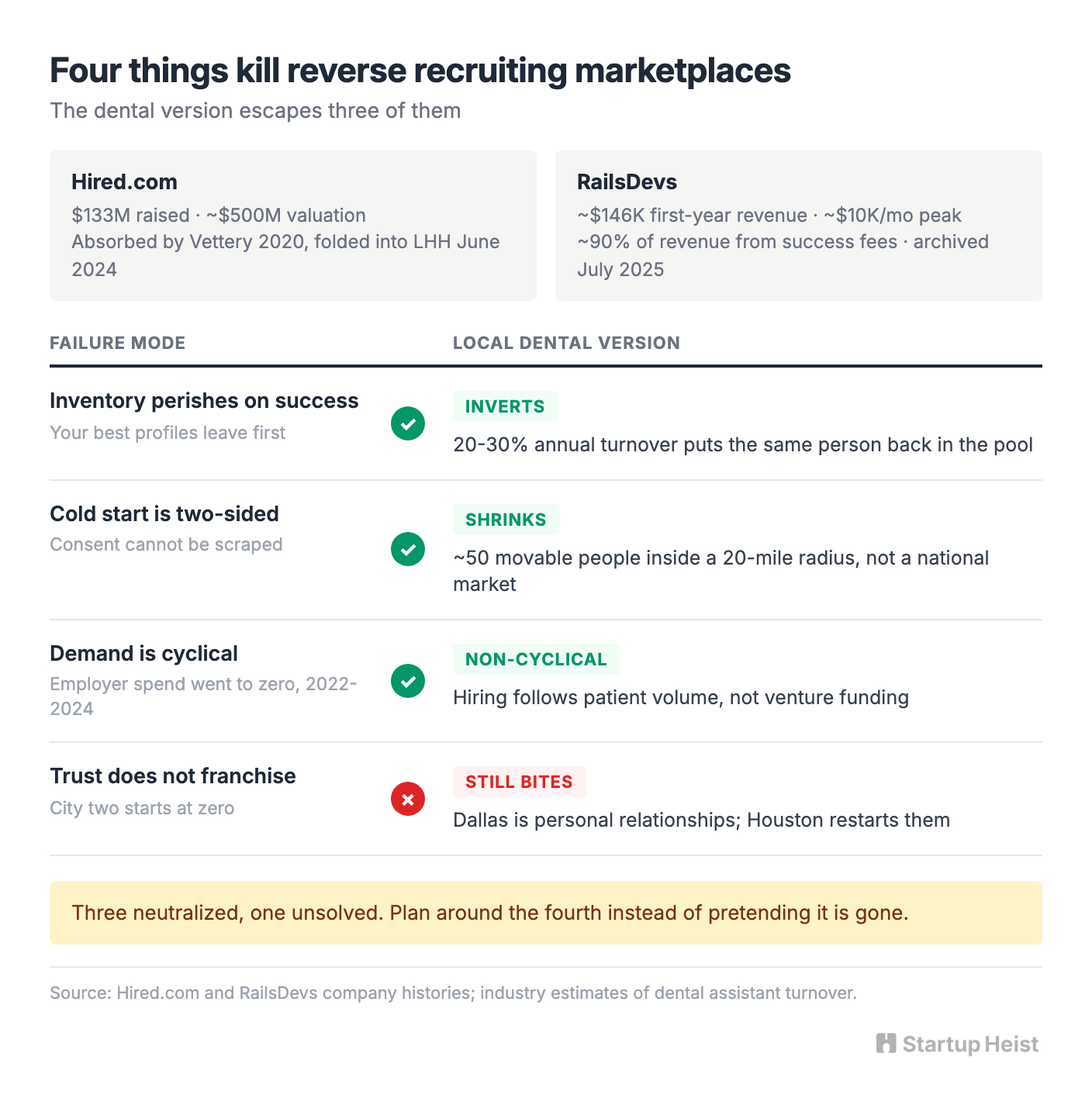
Perishability inverts. In tech, a hired engineer is gone from the pool for four years. A hired dental assistant is statistically back inside two. At those turnover rates, your inventory doesn't just spoil, it regrows. The same person cycles through your database repeatedly, and each time she returns you know her real pay floor, her real commute limit, and which practices she already declined.
Demand is non-cyclical. Dental hiring follows patient volume and hygiene schedules. Venture funding has nothing to do with it, and people get their teeth cleaned in a recession. The demand collapse that killed the tech marketplaces has no equivalent mechanism here. Practices aren't flush, though. ADA research shows costs outrunning reimbursement into 2026, with roughly 41.5% of dentists naming overhead a top-three challenge. That's margin compression rather than a hiring freeze, and it means you sell this as money saved against a replacement cost, never as a discretionary tool.
The cold start is small. Hired needed liquidity across a national engineering market. You need roughly fifty movable people inside a twenty-mile radius. Fifty people is a founder with a phone and six weeks, not a Series A.
The fourth failure mode still bites. Trust genuinely doesn't franchise. Your Dallas market will be built on relationships you personally made, and Houston starts from zero. Plan around that constraint instead of writing a deck that ignores it.
The ADA data offers one more piece of honesty: perceived difficulty in recruiting assistants is easing, down from 77.2% in early 2024 to 69.8% in early 2026. The pain is persistent and it isn't accelerating. Build a business that works at 70% rather than one that requires 90%.
Your product is the timestamp
Every competitor in this category sells a database. You're going to sell a date.
Set two products side by side. Database A holds 18,000 dental assistant profiles. Database B holds 73. Every person in Database B has confirmed availability within seven days, named a minimum hourly rate, set exact working days and a commute radius, verified a credential, listed practice-management software, and pre-approved employer outreach. Database A has more résumés. Database B has more truth per row.
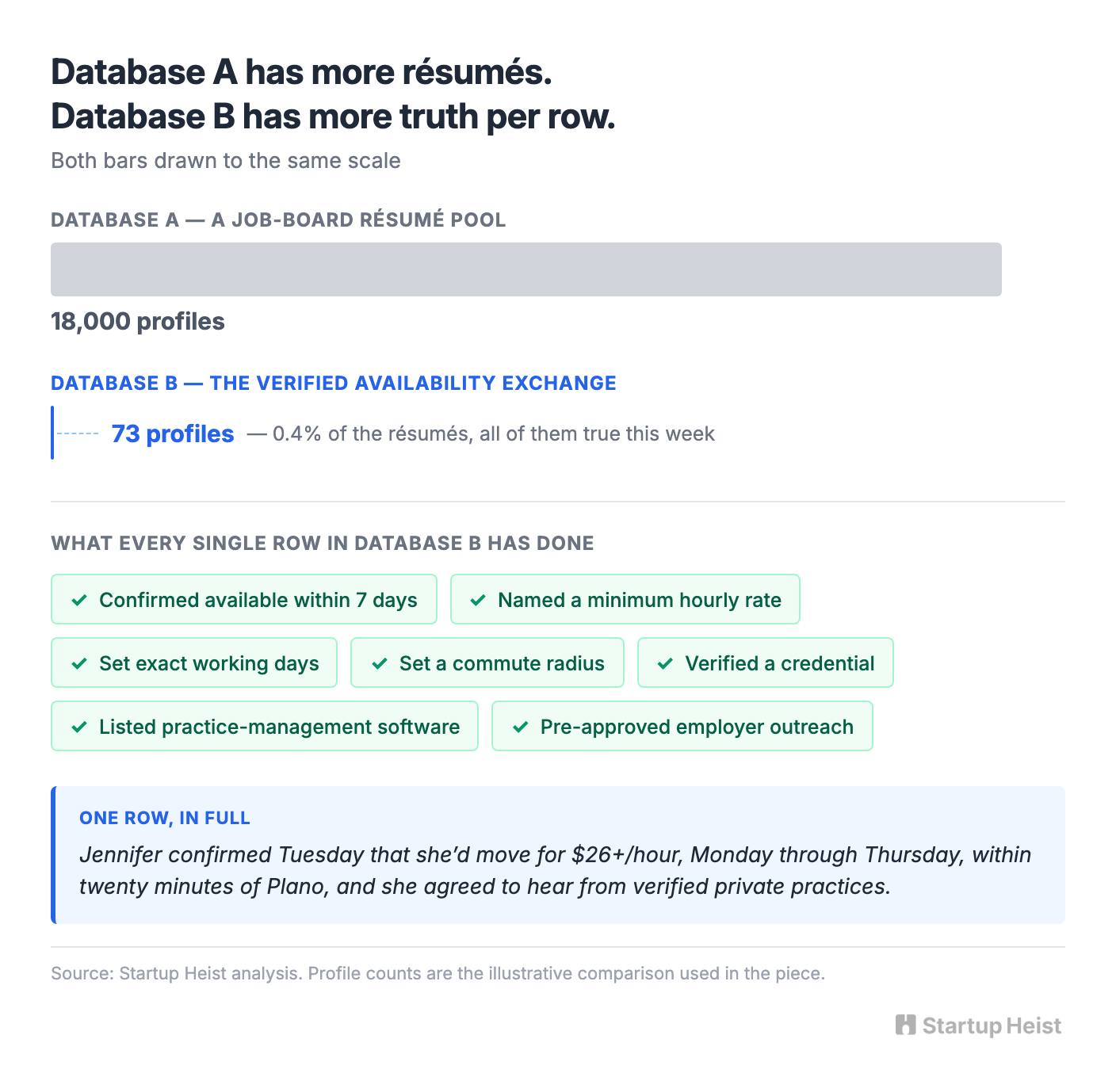
A profile in your system should never mean "Jennifer made an account eleven months ago." It should mean: Jennifer confirmed Tuesday that she'd move for $26+/hour, Monday through Thursday, within twenty minutes of Plano, and she agreed to hear from verified private practices. Nobody is currently selling that unit of inventory.
Start absurdly narrow
The temptation is to launch TalentNearYou, the reverse marketplace for local workers, which hands you a cold-start problem in forty cities and two hundred occupations at once. That's how the graveyard got full.
Unlock the Vault.
Join founders who spot opportunities ahead of the crowd. Actionable insights. Zero fluff.
“Intelligent, bold, minus the pretense.”
“Like discovering the cheat codes of the startup world.”
“SH is off-Broadway for founders — weird, sharp, and ahead of the curve.”


