


Turn a Layoff Into a B2B Media Asset
A layoff hands a senior operator a strange combination of assets: time, urgency, fifteen years of domain knowledge, credibility that survives the termination letter, and a network built one relationship at a time.
What almost none of them have is a way to package it. So they update LinkedIn, call recruiters, and post something about exploring advisory opportunities. The knowledge they spent a decade accumulating stays locked inside private conversations, where it earns nothing.
There's a productized service business sitting in that gap, and it's small enough for one person to run.

Sell newly independent experts a two-week publication launch sprint for $1,500 to $3,000. You interview them, find the narrow slice of their expertise that other professionals will actually pay attention to, and package it into a credible B2B publication. Write the first three issues, build the distribution list, hand it over.
The publication itself is free, and that's deliberate. It sits at the top of a far more valuable funnel: advisory work, consulting, sponsorships, research, training, licensing. The pitch that lands with a former VP is closer to "turn your career into a commercial media asset" than "start a Substack."
Here's the opportunity:
The money: Four $2,500 sprints a month is $10,000. Add five retainers at $1,500 and a solo operator is at $17,500 a month.
Inside:
• The $350 wedge audit that filters buyers
• Full two-week sprint deliverable list
• Five-tier pricing ladder, $350 to $5,000
• Cold outreach script for the layoff trigger
What Matt Brown Actually Built
Vox Media laid Matt Brown off in April 2020. Seventy-two hours later he launched Extra Points, covering the business, policy, and economics of college sports. It now clears more than $25,000 a month across all its revenue lines.
That number arrived slowly. Brown didn't hit $25K a month in three days; he launched in three days. The business compounded over six years into something that looks nothing like one guy writing a paid Substack.
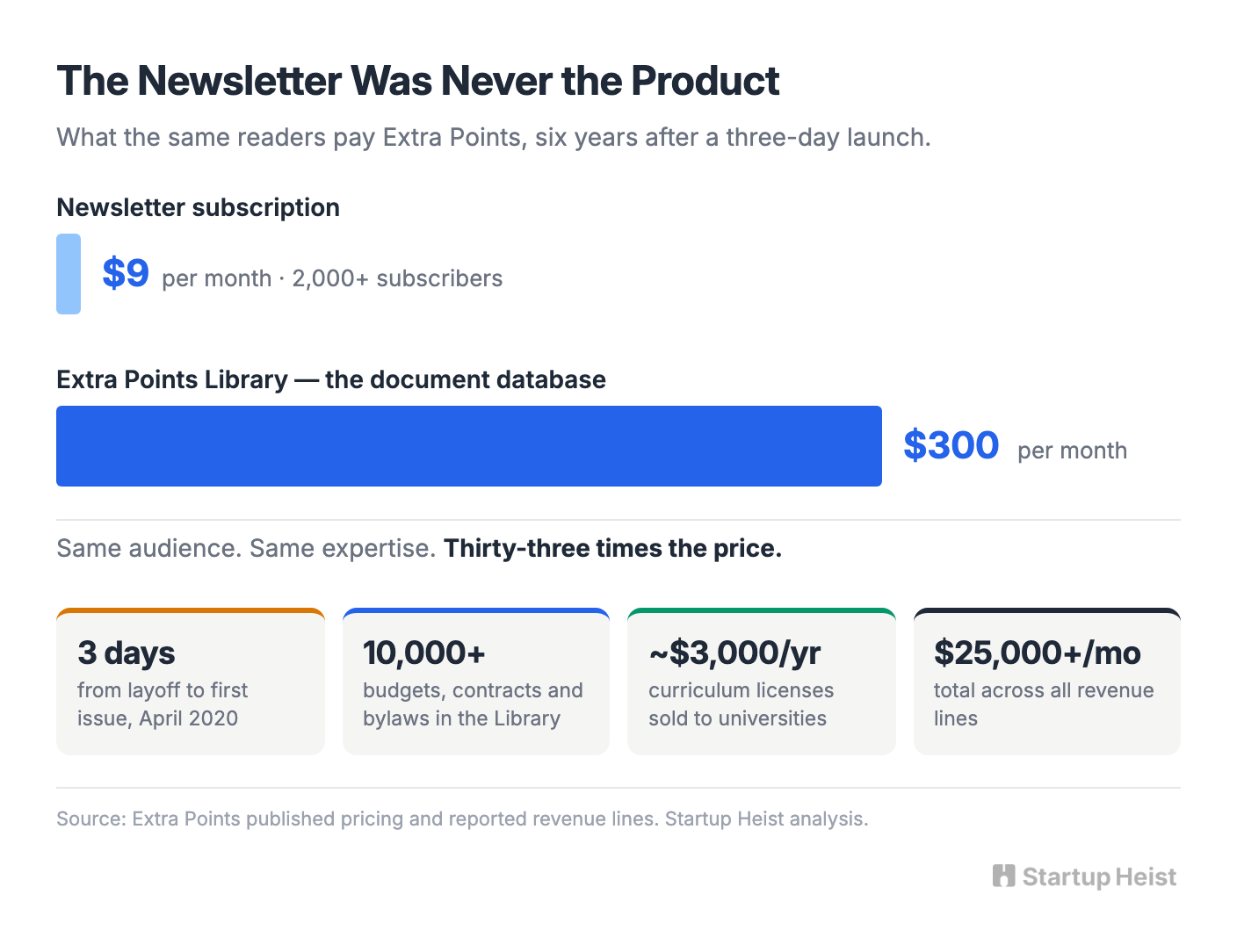
Extra Points has more than 2,000 paying subscribers at $9 a month or $84 a year. It sells direct sponsorships. It licenses curriculum supplements to university programs at roughly $3,000 a year. And it runs the Extra Points Library, a database of more than 10,000 documents: athletic department budgets, coaching contracts, league bylaws. That library costs $300 a month or $3,000 a year, and it's the fastest-growing line in the business.
The newsletter is $9 and the database is $300. Same audience, same expertise, thirty-three times the price. Growth came from original reporting, earned media, and word of mouth. Facebook ads and audience arbitrage never worked, because the niche is too small for them.
The newsletter was the beachhead. The business only got valuable when Brown converted specialized knowledge into products a corporate budget line could absorb.
The Trigger Event Refreshes Itself Every Week
Two markets are colliding, and your opening sits in the gap between them.
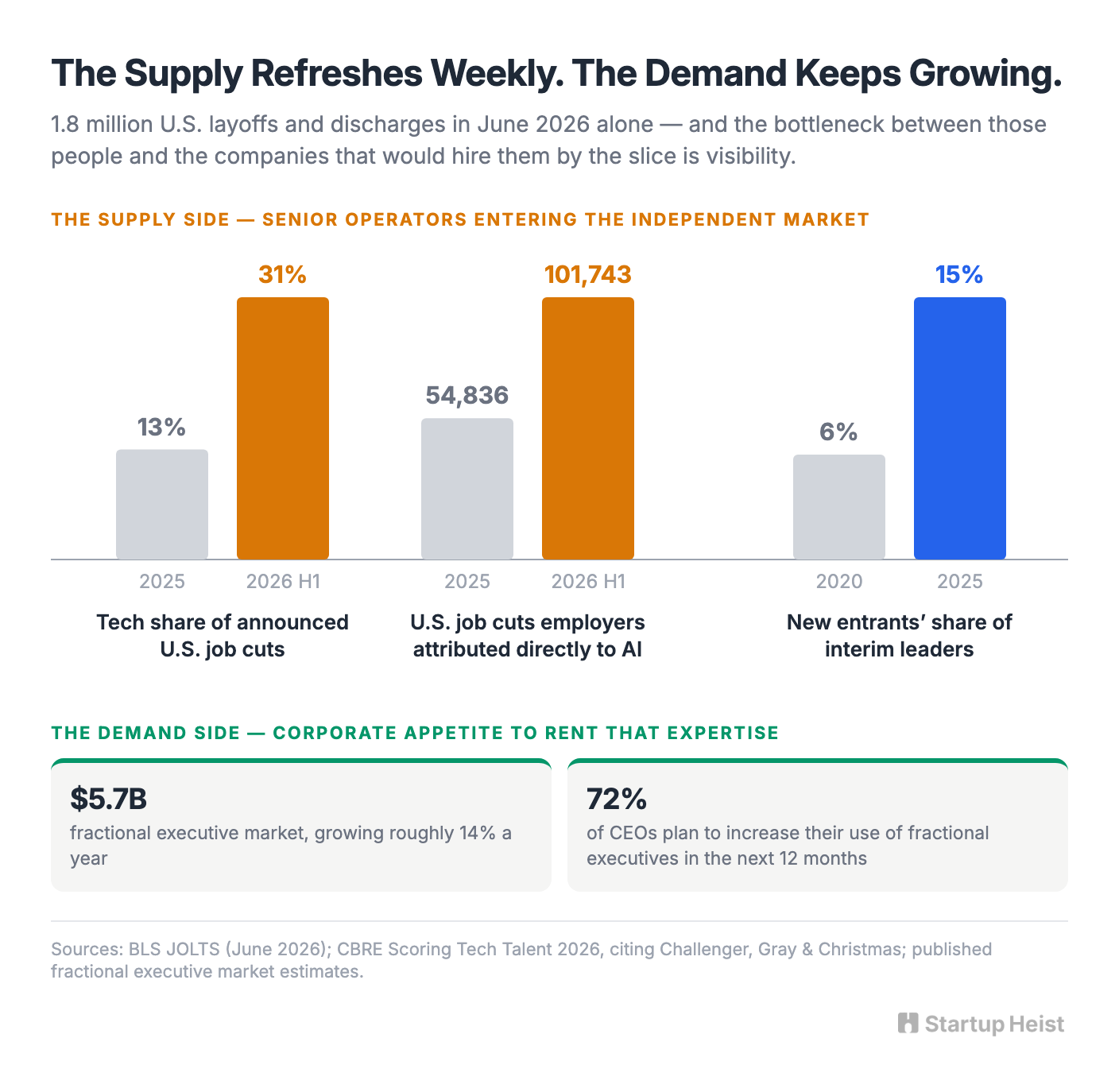
The first is professional dislocation, and it isn't a spike so much as a new baseline. The Bureau of Labor Statistics counted 1.8 million layoffs and discharges in June 2026, a figure that has held roughly steady month over month. Technology is where it concentrates: CBRE's Scoring Tech Talent 2026 report, drawing on Challenger data, found tech accounted for 31% of the 443,604 announced U.S. job cuts through June 2026, against 13% for all of 2025. Cuts employers attributed directly to AI hit 101,743 across all industries in that same stretch, against 54,836 in all of 2025.
Your prospect list publishes itself. LinkedIn departure posts. Company announcements. WARN notices, public filings that trackers already index by the tens of thousands. Startup shutdowns. Acquisition departures. Alumni Slack groups.
The second market is what those people do next. The fractional executive market is estimated at around $5.7 billion and growing roughly 14% a year. Seventy-two percent of CEOs plan to increase their use of fractional executives over the next twelve months. The share of interim leaders who are new entrants jumped from 6% in 2020 to 15% in 2025. So the supply of senior people going independent refreshes itself while corporate appetite to buy their expertise by the slice keeps growing. The bottleneck between them is visibility. Nobody hires the fractional CISO they've never heard of.
The Software Layer Is Worth Nothing Now
Publishing infrastructure got boring, and that's the reason this business exists.
Substack costs nothing to start and takes 10% of subscription revenue. Add Stripe's 2.9% plus 30 cents and a 0.7% recurring billing fee, and a creator keeps roughly 84 cents on the dollar. beehiiv's free tier runs to 2,500 subscribers, and its $43-a-month Scale plan takes zero percent of subscription revenue. Ghost starts at $18 a month billed annually, with paid subscriptions unlocking at $29 and no platform cut beyond the processor.
Nobody will pay you $2,500 because you know where the "Create publication" button is.
The scarce skill moved upstream, into a single question: what should this specific person publish that other valuable people will actually read? Answering that well is hard, and hard is billable.
Who Actually Qualifies
There are millions of layoffs. You want about 5% of them.
The ideal client has commercially useful knowledge that has never been packaged in public. VP of compliance. Procurement director. Pharmaceutical market-access executive. Supply chain operator. Ad-tech operator. Vertical SaaS GM.
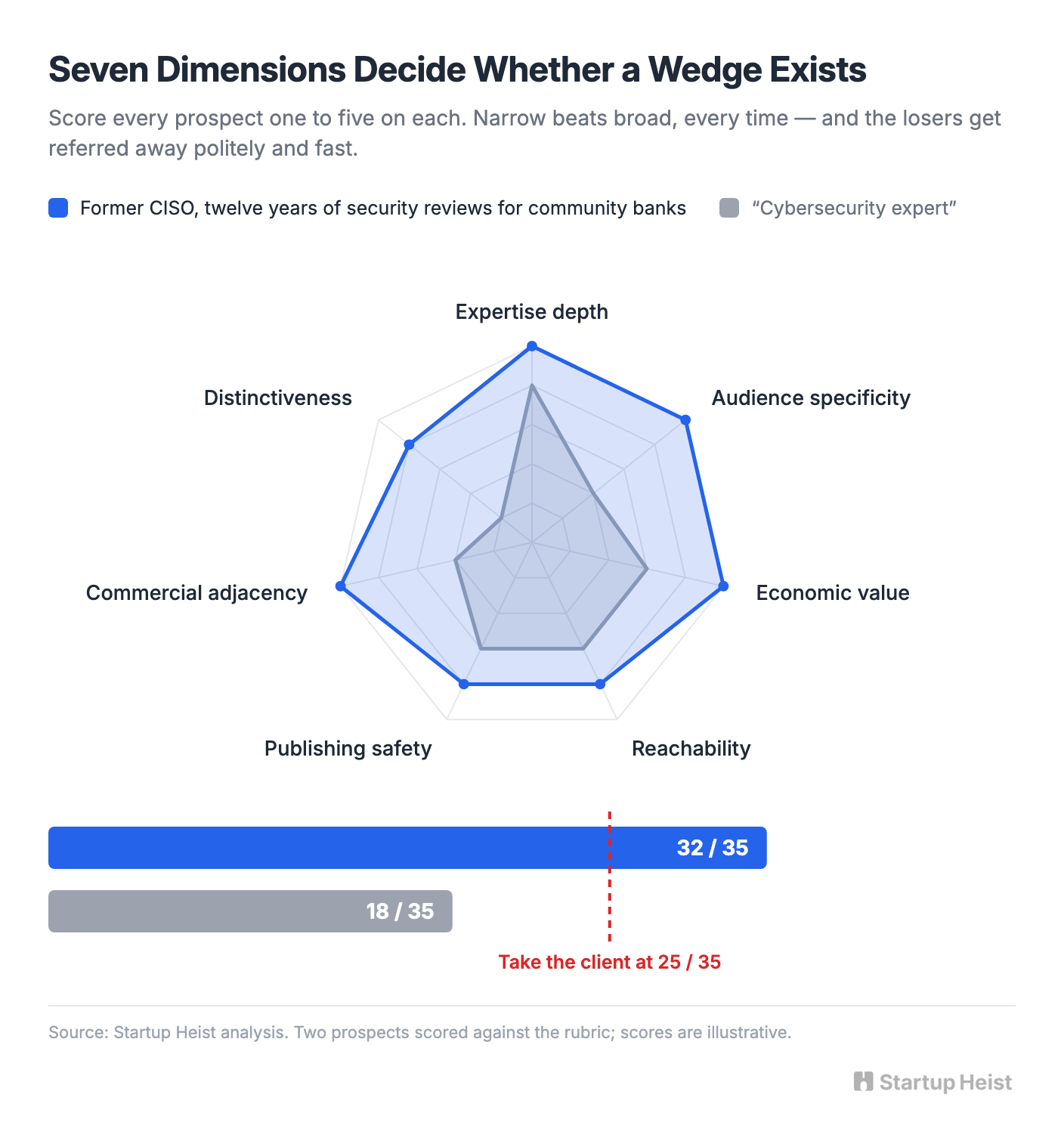
Narrow beats broad. "Cybersecurity expert" describes a few hundred thousand people. "Former CISO who spent twelve years shepherding security reviews for community banks" comes with a reader, a problem, and a buyer standing behind it.
Score every prospect one to five across seven dimensions:
- Expertise depth. Eight or more years doing something genuinely difficult.
- Audience specificity. You can name the reader by job title and organization type.
- Economic value. Solving the reader's problem creates or protects real money.
- Reachability. LinkedIn, trade associations, conferences, professional communities.
- Publishing safety. They can be useful without touching employer-confidential material.
- Commercial adjacency. Consulting, sponsorship, research, or licensing sits naturally behind the audience.
- Distinctiveness. It isn't another generic LinkedIn newsletter.
Take clients scoring 25 or higher out of 35. Refer the rest away, politely and fast.
The scoring process is valuable enough to sell on its own, and that's where the offer ladder starts.
Product One: The $350 Wedge Audit
Before selling a $2,500 sprint, sell a small decision.
Unlock the Vault.
Join founders who spot opportunities ahead of the crowd. Actionable insights. Zero fluff.
“Intelligent, bold, minus the pretense.”
“Like discovering the cheat codes of the startup world.”
“SH is off-Broadway for founders — weird, sharp, and ahead of the curve.”


