


Build the Feature After the Platform Builds It
The oldest micro-SaaS playbook is four steps long: find a big platform, find a feature its users beg for, ship that feature before the platform does, charge $15 a month. It works right up until it doesn't.
The flaw is that the loudest feature requests are visible to the platform too. When thousands of customers ask for a scheduling button, an export option, or a better dashboard, you haven't discovered a market so much as read the incumbent's roadmap six months early. Now you're racing a company with a hundred engineers toward a finish line it drew.

There's a better version of this play, and the price of admission is patience: let the platform ship the feature, then build what serious users discover they need next.
The opportunity is the missing workflow layer. Software that sits above a creator platform's native functionality and delivers the batching, collaboration, attribution, portability, and cross-platform execution the platform has no real incentive to perfect. It still starts as a $19–$29/month micro-SaaS. Unlike a missing-feature clone, it has somewhere to go when the incumbent catches up.
Here's the shape of it:
The money: 500 operators at $29 a month is $14,500 MRR. WriteStack reached $11,000 by August 2026 after Substack shipped the feature it was built on.
Inside:
• The full MVP scope, and what to refuse
• A 90-day plan from interviews to launch
• Three-tier pricing built on a 44% ARPU lift
• The agency segment worth more than creators
Substack just ran the experiment for you, in public, with revenue numbers attached.
The Scheduler That Got Eaten
For years, Substack writers had a strangely basic problem. They could schedule long-form newsletters, but they couldn't schedule Notes, the platform's Twitter-like short-form feed. If you wanted a Note live at 8am Tuesday, you woke up and posted it at 8am Tuesday, or you paid somebody else for the workaround.
Indie developers moved in and sold that workaround. On April 8, 2026, Substack announced native Notes scheduling across web, iOS, and Android, shipping post templates in the same update. Write in advance, set a time, walk away. Anyone launching a standalone Substack Notes scheduler that week watched their entire thesis evaporate in a changelog entry.
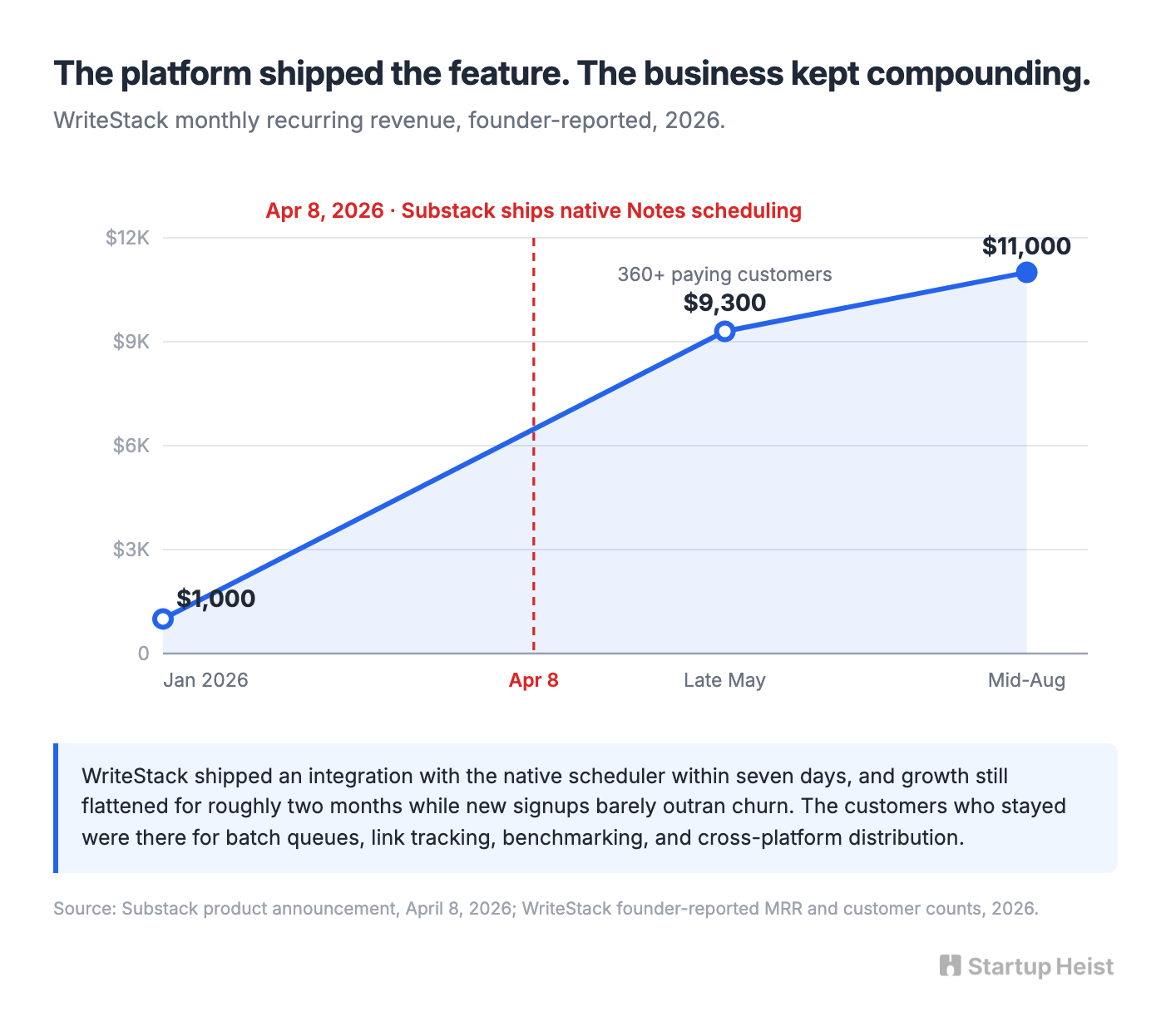
Orel Zilberman had already built WriteStack into a real business around Substack creators, with scheduling as its strongest acquisition hook. When native scheduling arrived, he thought the company might be finished. Customers who'd subscribed for the workaround started leaving, and growth flattened for roughly two months while new signups only barely outran churn. He shipped an integration with the native scheduler inside seven days and still watched the numbers stall.
The customers who stayed were using WriteStack for the things the native scheduler didn't touch: batch queues, link tracking, benchmarking, and cross-platform distribution. By late May 2026, WriteStack had passed 360 paying customers and roughly $9,300 in monthly recurring revenue. By mid-August, Zilberman reported $11,000 MRR, up from $1,000 at the start of that year.
The platform copied the headline feature and the business grew anyway, because the headline feature was never the whole job.
Why Platforms Stop at Eighty Percent
Large platforms optimize for the median customer, and they're right to. Substack can't turn its Notes composer into a marketing operations console without making the product worse for millions of ordinary writers who publish once a week and want a text box.
Professional users have the opposite problem. Once somebody publishes five times a week, runs multiple publications, manages clients, or distributes across four channels, small inefficiencies compound into an operation. Scheduling one Note is a click; scheduling forty is a job. Publishing a newsletter is a click, but coordinating that newsletter alongside five social posts, a client approval, tracked links, and a performance report is work somebody is doing by hand on a Sunday night.
The same five wedges open up in that gap every time.
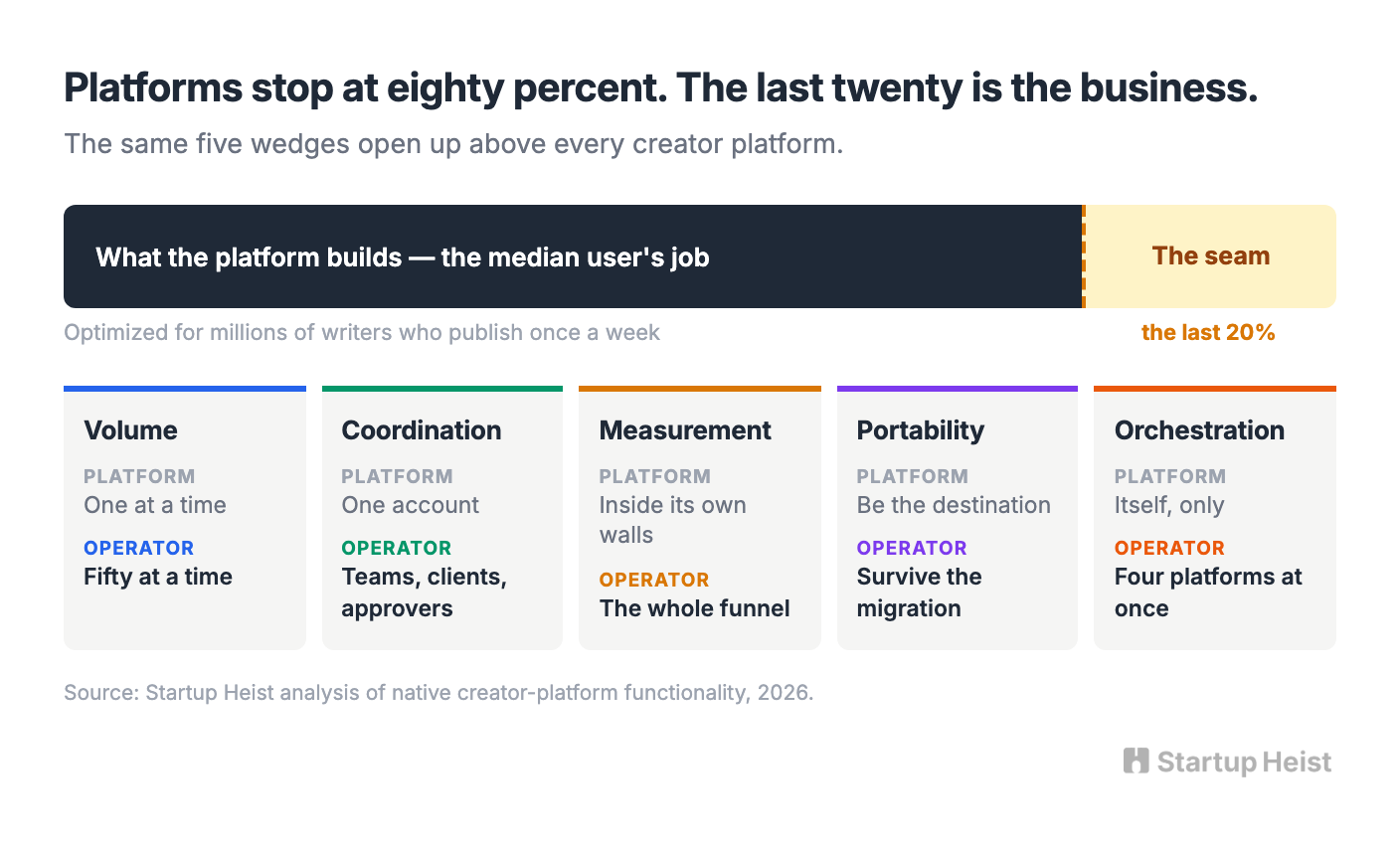
Volume. Native tools handle one item well, and power users need fifty. Coordination. Platforms are built around a single account, while businesses run on teams, clients, approvers, and freelancers. Measurement. Platforms report what happened inside their own walls, and operators need to know what actually produced a subscriber. Portability. Every platform wants to be the final destination; customers want their work to survive the next migration. Orchestration. Substack is good at Substack and beehiiv is good at beehiiv, and nobody has any reason to make the two work together.
Anything you build should live in one of those seams. What it should never do is size itself off the creator economy.
Grand View Research puts the global creator economy at $310.4 billion in 2026, on the way to $1.3 trillion by 2033. Ignore it. The person who buys this has a publishing workflow expensive enough to justify another line item on the corporate card, which describes a far smaller group than "creators."
Substack crossed five million paid subscriptions in March 2025 and raised $100 million that July at a valuation above $1.1 billion. Impressive, and almost entirely irrelevant to your sizing. Subscriptions aren't creators, and the overwhelming majority of newsletter writers will never pay $29 a month for operational tooling. The real buyer is narrower: monetizing newsletter operators, creators shipping multiple times a week, small media teams, and newsletter agencies.
The small market is the point. Two hundred customers at $29 a month is $5,800 MRR. Five hundred is $14,500. Add a hundred agencies at $99 and you've got another $9,900 on top. Nothing here requires millions of creators, only several hundred people with an expensive workflow and a credit card, which is a list you can work through by hand.
The Product: Campaign Operations
Don't build another Substack scheduler or another AI writing assistant, and think hard before launching a broad "publish everywhere" platform. Narrareach already sells multi-platform publishing, analytics, and automation starting at $19 a month, climbing to $89 for its agentic tier. The generic creator-tool bundle is crowded and getting worse.
The sharper wedge is a campaign operations layer, and the unlock is changing the unit of work from the post to the campaign.
A professional publishes a newsletter on Tuesday. That newsletter spawns three Substack Notes, two LinkedIn posts, an X thread, a sponsor link, a lead magnet, and a Friday repost. Today those artifacts live scattered across Google Docs, spreadsheets, platform drafts, Buffer queues, Slack threads, and somebody's memory. Your product turns them into one object.
The operator imports a newsletter or a source URL and creates a campaign. Every derived post inherits the campaign tag and a consistent UTM convention automatically. A collaborator reviews the queue. Publishing happens through documented APIs where they exist, browser-assisted handoff where they don't, and manual handoff where automation would create platform risk.
Then the campaign reassembles on the other side, so the operator can see which Note generated clicks, which LinkedIn post produced subscribers, which campaign sold memberships, and what's worth repeating next week.
AI can rewrite the source material for each channel, and it should sit inside the product as a button. The business you're actually running is the operational record.
That record only stays yours if the host platform has a reason to leave it alone. A good ecosystem product does something the platform is structurally unwilling to do, and skipping that filter is how micro-SaaS companies get eaten.
Substack adding a scheduler sits perfectly inside Substack's incentives. Substack building an elegant migration path to Ghost does not, and neither does beehiiv building unified reporting across beehiiv, Substack, and Ghost. Optimizing an agency's workflow across five competing publishing platforms is, by definition, somebody else's job.
The incentive mismatch is your protection, and it's the only protection on offer. With $100 million in the bank and an explicit commitment to better creator tools, Substack will keep closing obvious feature gaps on a schedule you don't control.
So stop asking whether Substack could build your product. Of course it could. Ask whether Substack would want your product to work just as well for somebody on beehiiv. The answer to that one separates a business from a countdown.
Build for the Day the API Breaks
The second hazard in building on creator platforms is integration risk, and it lands entirely on you.
Substack has no public API for publishing. Its only developer API, launched in 2026, does nothing but look up a creator's public profile. WriteStack publishes Notes through a Chrome extension that acts from the user's own browser and IP address, handing content into Substack's native scheduler rather than posting server-side. Competing tools use variations of the same architecture, often leaning on internal endpoints that power Substack's own dashboard and were never meant for third parties. The approach works. It also means a DOM change, an auth update, or a permissions tweak can turn into a support crisis on a Tuesday morning with no warning and no changelog.
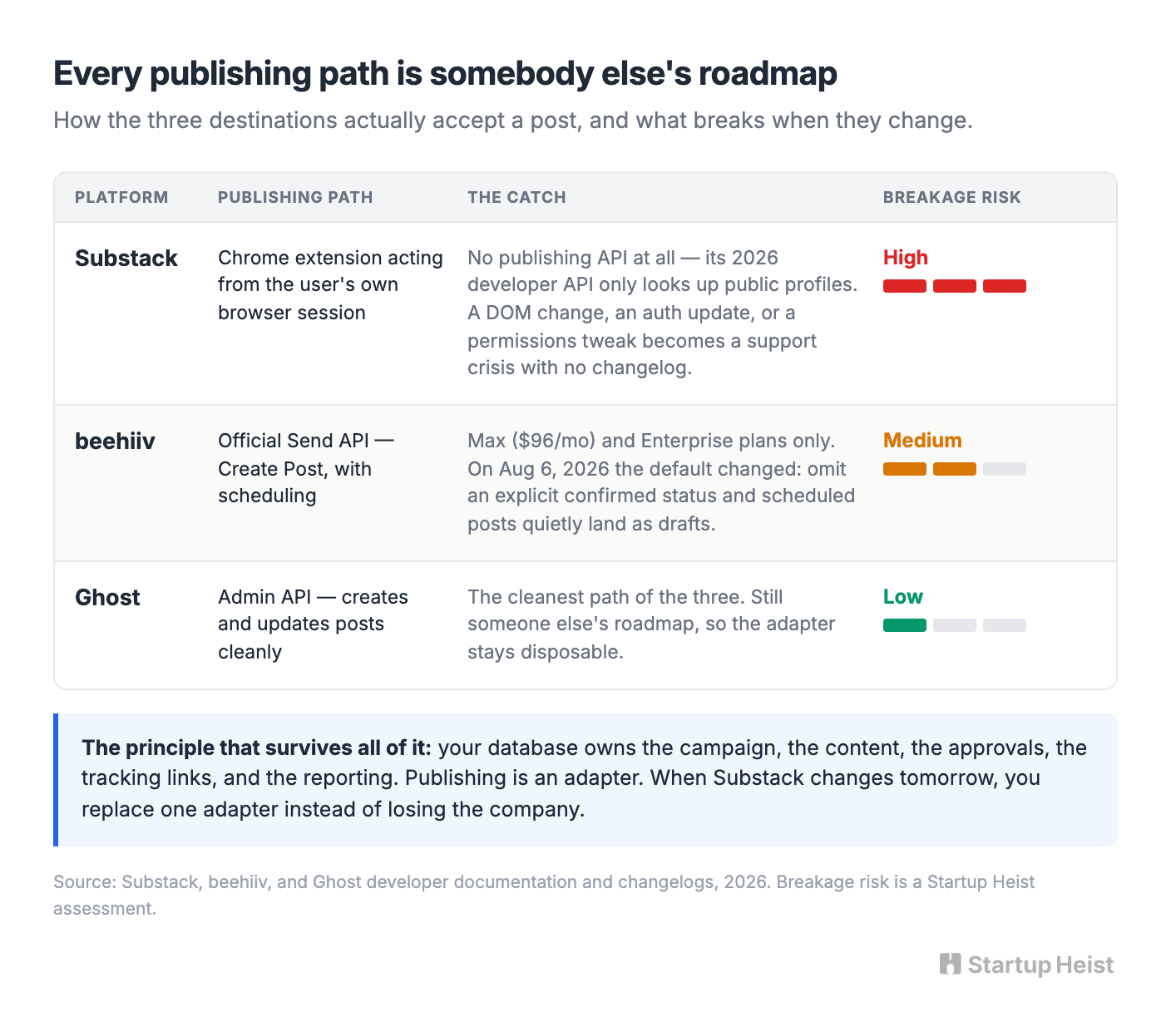
Official APIs are better, though they're not safe either. Ghost exposes an Admin API that creates and updates posts cleanly. beehiiv offers a Create Post endpoint through its Send API, with scheduling support, but only on Max and Enterprise plans, so your customer needs to be on a $96/month tier before you can touch it. beehiiv also changed the endpoint's default behavior on August 6, 2026: omit an explicit confirmed status and your scheduled posts now quietly land as drafts. Anyone who'd hard-coded the old assumption shipped a silent failure to every customer.
The principle that survives all of this: your database owns the campaign, the content, the approvals, the tracking links, and the reporting. Publishing is an adapter. When Substack changes tomorrow, you replace one adapter instead of losing the company.
Architecture is the easy half. The half that kills these companies is deciding what goes into version one, and what you have to refuse to build.
The MVP
Unlock the Vault.
Join founders who spot opportunities ahead of the crowd. Actionable insights. Zero fluff.
“Intelligent, bold, minus the pretense.”
“Like discovering the cheat codes of the startup world.”
“SH is off-Broadway for founders — weird, sharp, and ahead of the curve.”


