


The Longevity Clinic Doesn't Have a Lead Problem. It Has a Plumbing Problem.
Somewhere in Scottsdale there's a three-provider longevity clinic spending $12,000 a month on advertising and convinced the leads are garbage.
The leads are probably fine. What's broken is everything that happens after the lead arrives.
A prospect fills out the contact form at 9:47 p.m. Someone calls back two days later and gets voicemail. Another prospect phones during lunch, reaches a recorded message, and never calls again. A third books a consultation, never completes the intake paperwork, and quietly disappears. A fourth shows up, converts into a $9,000 program, and nobody records which channel produced her. A fifth says "let me think about it," and nothing happens on day seven, or day thirty.

The clinic owner sees a rising ad bill and a flat patient count, and reaches the wrong conclusion.
That gap is the opportunity. Build the operating layer that sits between a stranger's first inquiry and a clinician's first consultation. It isn't an EHR or a diagnostic tool, and it never decides whether someone should be prescribed testosterone or a GLP-1. It's a tightly scoped revenue operations system for the administrative journey: inquiry, response, booking, reminders, attendance, follow-up, and attribution. Then it stops at the exact point where medicine begins, and that stopping point is the product. Everything past it is commodity software someone else already sells.
So here is the shape of the business:
The money: Twenty clinics at $499 a month is roughly $10,000 MRR, fifty is $25,000, plus $1,500 to $3,000 per install. One operator can run it.
Inside:
• Seven-module MVP built on existing tools
• Two-tier pricing that survives HighLevel fees
• The audit offer that opens the first sale
• Three moats, ending in a benchmark dataset
The numbers behind the leak
The failure is measurable, and the measurements are ugly.
An industry survey of roughly 7,000 calls across 22 medical practices put unanswered incoming calls at 42%. Solo practices and small groups run worse. Commonly cited estimates hold that when nobody picks up, only about 14% of new patients leave a voicemail, and 85% never call back. Healthcare's average response time to an inbound inquiry gets benchmarked around two hours and five minutes, in a category where the classic MIT and InsideSales research found that contacting a lead within five minutes makes qualification roughly 21 times more likely than waiting thirty.
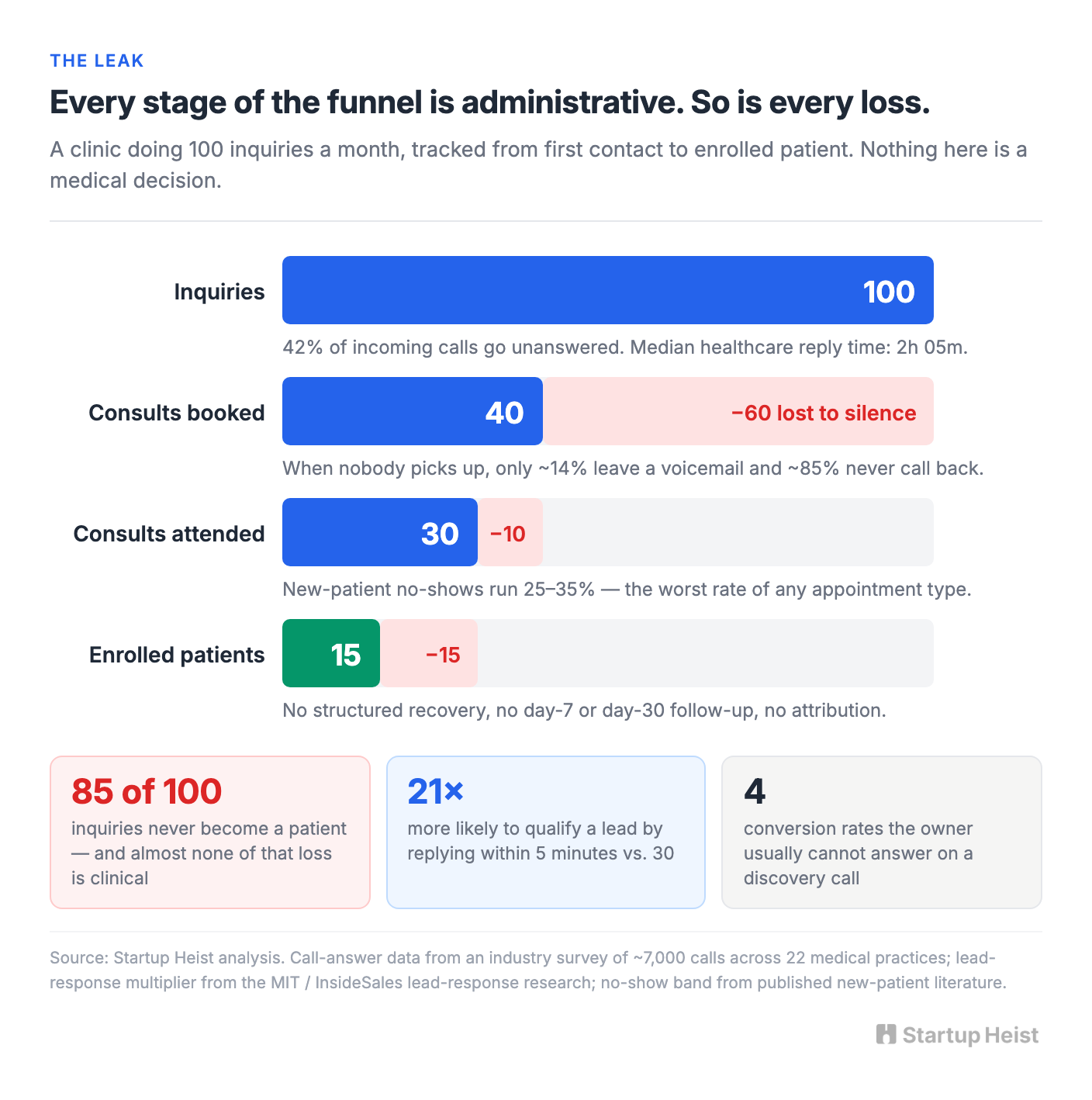
Then there's attendance. Consultations booked by brand-new prospects carry the highest no-show rate of any appointment type, and the general literature puts new-patient no-shows somewhere in the 25% to 35% band. A clinic can win the ad auction, win the click, win the form fill, win the booking, and still lose a third of what it paid for at the last possible step.
Now attach money to those percentages. Fountain Life lists its APEX membership at $21,500 a year, and a mid-market functional medicine program runs a few thousand. Even at the modest end, a clinic generating 100 inquiries a month and converting 15 into patients is leaving a second cohort on the floor through silence, bad timing, and missing follow-up.
Nobody at the clinic is measuring any of this, which is precisely why you can sell it.
Why the window is open right now
Two forces are converging, and neither of them is "AI is here."
The first is that cash-pay preventive medicine has become a genuine category with a genuine middle. Function Health cut its membership to $365 a year for 160-plus lab tests, dragging sophisticated diagnostics toward the mass market, while Fountain Life proves a five-figure premium tier exists at the top. Between those poles sits a large, fragmented population of independent practices: functional medicine, menopause care, hormone optimization, physician-led weight management, executive physicals, integrative and concierge medicine. Direct primary care alone has grown from roughly 100 practices in 2009 to more than 3,000 mapped today, and the broader longevity clinic market is estimated at about $6 billion in 2026, growing at a low-double-digit clip.
None of those clinics can win on biomarker count anymore. A venture-funded platform will always test more for less. What they sell instead is physician access, interpretation, continuity, and a relationship, and that relationship is won or lost in the four days before anyone puts on a gown.

The second force is that marketing a healthcare practice got legally messier, in a way most agencies haven't caught up to.
On March 3, 2026, the FDA issued warning letters to 30 telehealth companies over promotional claims about compounded GLP-1 products, specifically targeting marketing that implied compounded versions were equivalent to FDA-approved drugs. During the week of June 15, 2026, the agency issued another 25. On April 30, 2026, the FDA proposed excluding semaglutide, tirzepatide, and liraglutide from the 503B bulks list entirely; the comment period closed on July 30, 2026, with a final determination still pending. Marketing language in this vertical is now an enforcement surface.
The data side is where most people get the story backwards. Everyone points to the HHS Office for Civil Rights bulletin on online tracking technologies as the reason clinic funnels are dangerous. In June 2024, a federal court in the Northern District of Texas vacated the most aggressive portion of that guidance: the part treating an IP address combined with a visit to an unauthenticated public webpage about a health condition as protected health information. OCR later withdrew its appeal. The federal HIPAA threat against a public marketing page is weaker than the compliance-industrial complex claims, and the real exposure moved somewhere far less forgiving.
The risk moved to the plaintiffs' bar
State wiretapping and consumer-privacy statutes filled the gap, and they come with a private right of action, which means every aggrieved website visitor is a potential class member.
The settlements are not theoretical. Sutter Health settled for $21.5 million, finalized in early 2026, over third-party tracking tools on its web properties. Inova's $3.1 million deal reached final approval in April 2026. Wellstar has agreed to settle for $4.25 million covering roughly 870,000 patients. Advocate Aurora's $12.2 million settlement remains the reference point people cite. Washington's My Health My Data Act makes any violation a per se violation of the state consumer protection act, and the first class actions under it are already working through the courts.
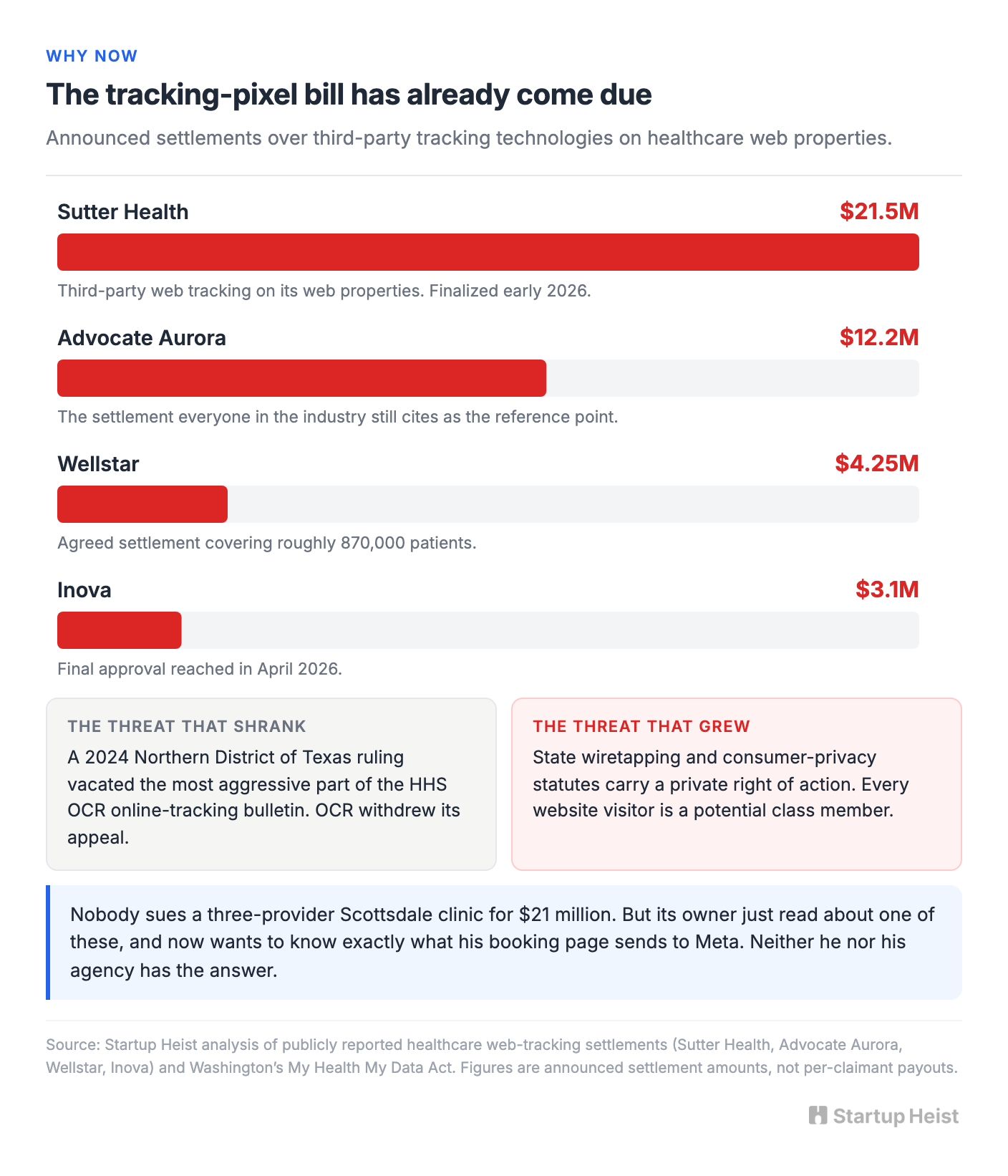
Read that as an entrepreneur, not a lawyer. Nobody is going to sue a Scottsdale clinic for $21 million. But every one of those settlements produces a wave of consultant emails, a nervous practice manager, and an owner who now wants to know exactly what his booking page transmits to Meta. He doesn't have an answer, and neither does his marketing agency, because the agency installed the pixel.
You show up with the answer, and it isn't "buy this compliance software." It's a map of where his data actually goes, plus a funnel rebuilt so the sensitive parts never leave his clinical system in the first place. That opens a conversation in a way "we'll get you more peptide leads" never will.
The wall is the whole product
Unlock the Vault.
Join founders who spot opportunities ahead of the crowd. Actionable insights. Zero fluff.
“Intelligent, bold, minus the pretense.”
“Like discovering the cheat codes of the startup world.”
“SH is off-Broadway for founders — weird, sharp, and ahead of the curve.”


