


Stop Counting People. Start Triggering Decisions.
A quiet category of sensor is spreading through commercial buildings. It registers that a person walked into a room without ever seeing their face, picks up activity through a wall, and reports whether a space is empty, occupied, or busy, with no camera anywhere in the ceiling.
The hardware got cheap. A 24GHz mmWave radar module runs about twelve dollars, and an ESP32 development board costs less than a sandwich. Thermal arrays, doorway beams, and in some rooms the ordinary Wi-Fi signal already bouncing off the walls will all produce a usable occupancy reading.
So the obvious pitch writes itself: turn Wi-Fi into a privacy-preserving people counter. Don't build that. The business sits one layer up. Build a locally installed, camera-free occupancy system that converts simple events into operational decisions for small commercial venues.
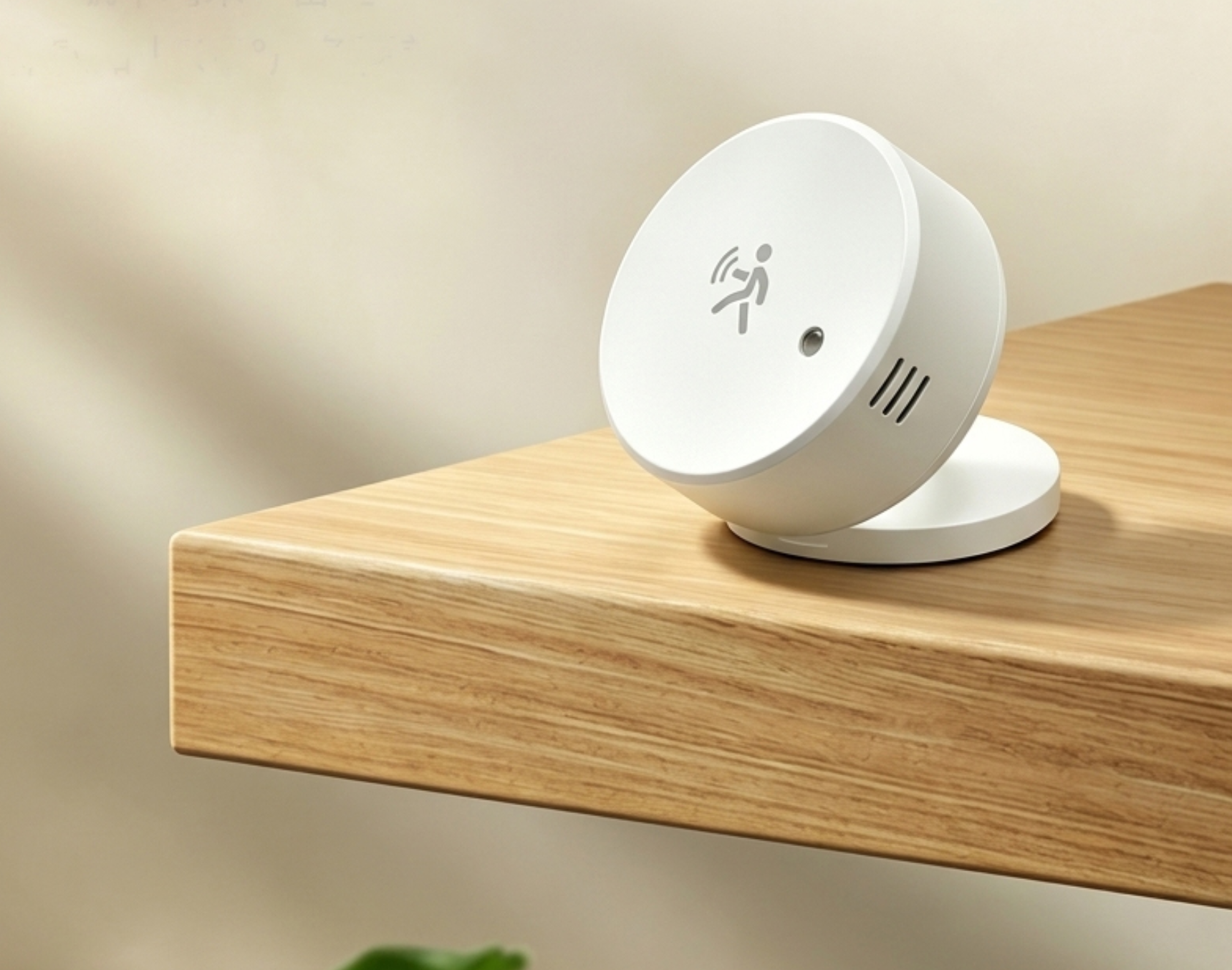
What the customer buys is a sentence they can act on:
- Clean restroom #2 now.
- Studio B is occupied and nobody booked it.
- Skip this room. It hasn't been used since the last clean.
- You booked this room fourteen times last month. People showed up four times.
That distinction decides which hardware you buy, who you sell to, what you promise, how you price, and whether you end up with a good little company or a fiddly science project. The best version of this business is deliberately boring, which is also where the money is.
The money: 500 venues running four zones at $59 a month is $118,000 MRR. A hundred venues at three zones is $17,700.
Inside:
• Five-part MVP scope for occupancy triggers
• Pilot-to-standard pricing with real margins
• The 200-venue list that lands your first 20
• Janitorial contractors as the second act
The Heist
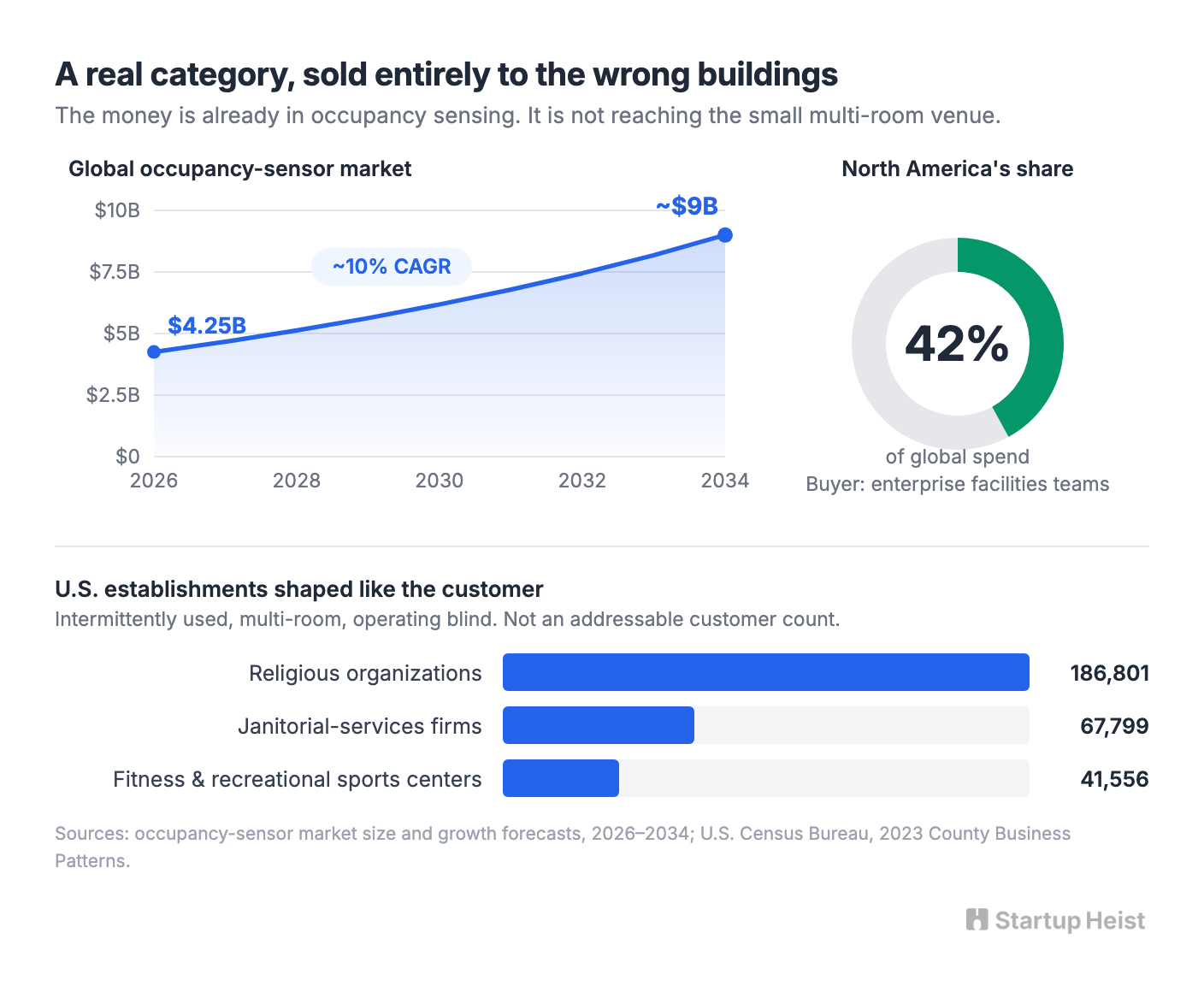
Occupancy sensing is already a real category with real money in it. The global occupancy-sensor market is tracking from $4.25 billion in 2026 to roughly $9 billion by 2034, growing near 10% a year, with North America holding about 42% of it.
Venture capital found the space years ago. Butlr, an MIT Media Lab spinout, has raised $68 million total, including a $38 million Series B led by Foundry, selling anonymous thermal sensing into workplaces and senior living. Density sells a compact radar sensor and a workplace analytics platform. Occuspace runs two sensor types at once: passive Wi-Fi and Bluetooth for large open areas, mmWave for small enclosed rooms. All of them sell to enterprise facilities teams who own portfolios, run procurement cycles, and have a job title containing the word "workplace."
Underneath that sits a much larger population of buildings operating blind. A three-room dance studio knows its class schedule. It does not know that Studio 3 sat empty for eleven hours last week. A gym cleans restrooms on a clock instead of on use. A venue manager walks down the hall to check whether the restroom is slammed, because walking down the hall is the sensor. None of these operators are shopping for a spatial intelligence platform. They want one reliable answer wired to one useful action.
That gap is the heist: take a category being built as expensive building intelligence and compress it into a local operational appliance.
The population underneath is deep enough to matter. The 2023 County Business Patterns count 41,556 employer establishments classified as fitness and recreational sports centers, 67,799 janitorial-services firms, and 186,801 religious organizations, most of them running exactly the kind of intermittently used multi-room building this product fits. Don't mistake any of that for an addressable customer count. Most locations won't care, some are too small, and plenty already have cameras.
You don't need hundreds of thousands of them anyway. Five hundred locations running four monitored zones at $59 a month is $118,000 in monthly recurring revenue. A hundred locations at three zones each is $17,700 a month, which is a genuinely good owner-operated business if installation and support stay under control. That "if" is the whole game.
Cleaning Is the Wedge
On July 14, 2026, Butlr launched a Smart Cleaning module. The pitch is narrow and specific: use anonymous restroom traffic to change when facilities teams clean, instead of cleaning on a fixed rotation. Butlr cites a Wakefield Research survey finding that 66% of facilities managers clean every area at the same frequency regardless of actual use, and reports average savings of $1,400 per restroom per year. Treat the savings number as vendor-reported. The operational problem underneath it is not in dispute.
Offer a studio owner a dashboard of utilization patterns and they'll say that's interesting, then never think about it again. Tell them their staff can stop walking a fixed route every two hours and instead get a cleaning prompt after actual use, and you've proposed to delete a job from their week.
The value of an occupancy event is set entirely by the decision attached to it. The same reading is worth close to nothing as a chart and several dollars as the trigger that cancels an unnecessary staff round.
The labor math is not exotic. U.S. janitors and building cleaners had a median wage of $17.71 an hour in May 2025, before payroll burden, supervision, and management overhead. Kill ten unnecessary ten-minute checks a week and you recover about 87 hours a year, roughly $1,500 in direct wages at median pay, and considerably more once you count the manager who schedules it. That's the moment the sensor stops being a gadget and starts behaving like labor-routing software.
The Technical Trap
Search for Wi-Fi people counting and you'll hit one headline result: roughly 90% accuracy in line-of-sight conditions and 94% in non-line-of-sight. Impressive, and also a 2020 IEEE conference paper produced with a purpose-built 5GHz Wi-Fi pulse-Doppler radar feeding range-Doppler images into a 3D convolutional neural network. Neither recent nor built from anything you can buy off a shelf, and no evidence at all that a pair of $8 development boards will count 27 people in an arbitrary CrossFit gym.
The 2026 evidence points the other way. In January 2026, researchers at the University of Huddersfield published a systematic study of commodity ESP32 sensors across seven scenarios spanning one to ten people. Six different signal-separation methods landed between 39% and 56% accuracy on multi-person identification, with feature-space overlap of 97% to 99% between subjects. Their conclusion is the useful part: the ceiling is set by sensing quality and spatial diversity in the hardware itself, not by picking a better algorithm.
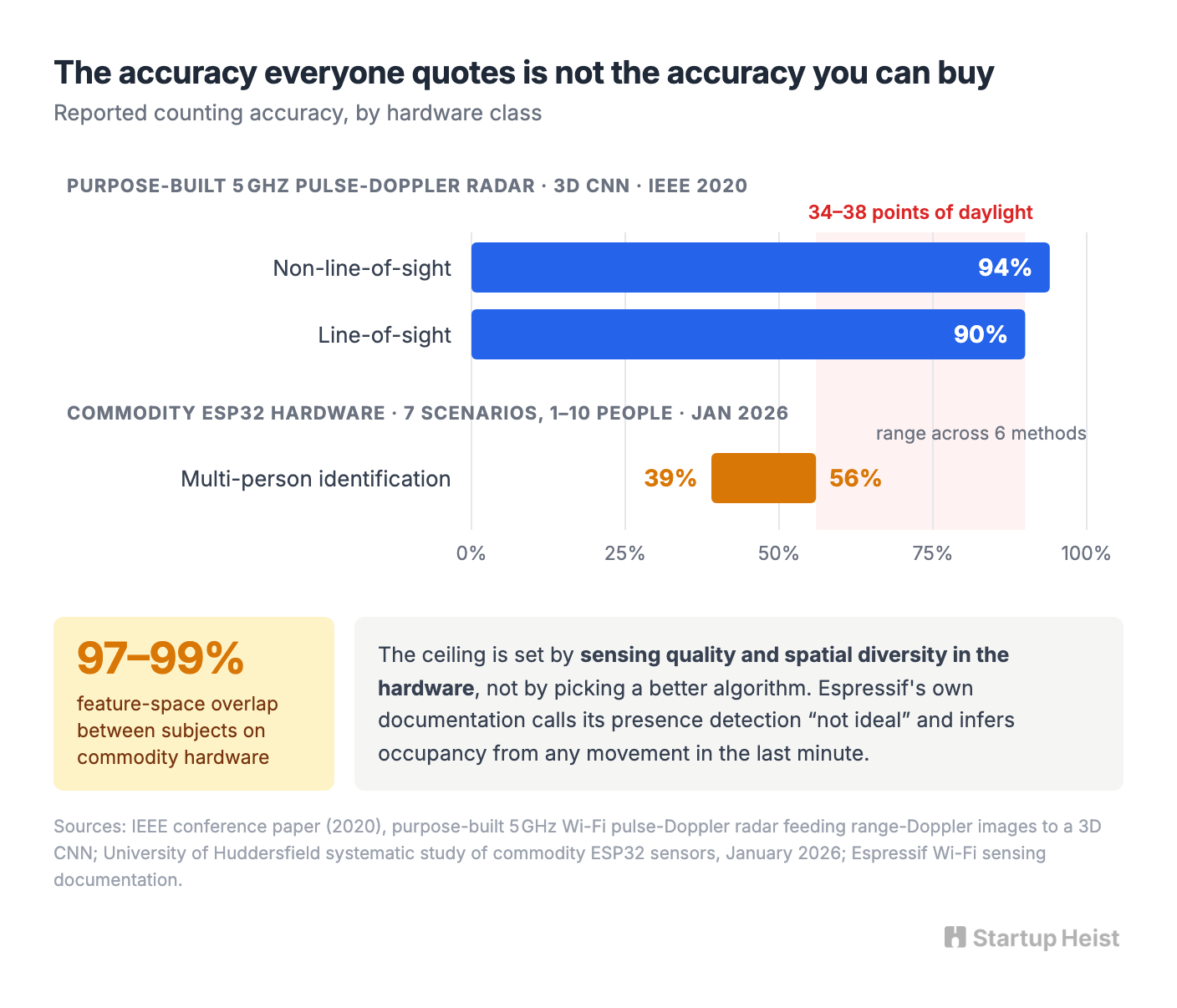
Espressif, which ships the chips, is blunt in its own documentation. Its Wi-Fi sensing example states that "the current algorithm for human presence detection is not ideal," and that presence is therefore inferred from whether any movement occurred in the last minute. The calibration procedure requires an empty room. That requirement tells you what you're signing up for. Move the furniture and the radio environment changes. So does swapping the router, propping a metal door open, or having one person sit perfectly still through a meditation class.
There's a second reason not to bet the company on the sensing layer: the standards body already commoditized it. IEEE 802.11bf, the Wi-Fi sensing amendment, was published on September 26, 2025. It defines how a sensing measurement gets requested and shared between devices from different vendors. Within a few product cycles, "the room knows someone is in it" becomes a router feature rather than a startup.
So don't build a company whose proposition is that an ESP32 beats commercial occupancy sensors. Build this instead: use the cheapest privacy-preserving sensor that reliably produces the operational event the customer needs, whether that turns out to be Wi-Fi CSI, mmWave, a doorway beam, or thermal. The hardware is an implementation detail, and treating it as one is a competitive advantage.
Density Sets Your Price Floor
Density's Waffle sensor sells for $229 a unit, self-installable, with room software at $8 per unit per month on an annual plan. It reports 0, 1, 2, or 3-plus people over a 120-degree field of view. A well-funded incumbent will sell your prospect a polished, anonymous, self-install occupancy sensor at that price and pocket change per month. So "we have a cheap anonymous occupancy sensor" describes a commodity with a price tag already stapled to it, not a thesis.
Unlock the Vault.
Join founders who spot opportunities ahead of the crowd. Actionable insights. Zero fluff.
“Intelligent, bold, minus the pretense.”
“Like discovering the cheat codes of the startup world.”
“SH is off-Broadway for founders — weird, sharp, and ahead of the curve.”


