


The $599 Product That Makes a One-Person Business Survive Its Founder
Something strange happens when a one-person internet business starts working. Revenue climbs. The founder hires software instead of people. Stripe collects the money, AWS runs the product, GitHub holds the code, Cloudflare points the domain, Google Workspace owns the inbox, and a password manager guards the keys. Margins go up. Headcount stays at one.
The company gets more valuable every quarter. It also gets more fragile, because the only thing holding the stack together is one person's memory of how it connects.

If that person disappears for a week, the problem is not that nobody has the passwords. Plenty of founders solved the password problem years ago. The problem is that nobody knows what to do with them.
There's a clean product hiding in that gap: a Founder Continuity Kit priced between $199 and $599, sold to profitable one-person internet businesses. A guided inventory, an emergency-access configuration process, an operational runbook, and an attorney-reviewed handoff framework that lets a spouse, an executor, or a trusted operator keep the company alive long enough to stabilize it or sell it.
Here's the opportunity:
The money: 750 self-serve kits and 250 guided setups is roughly $299,000 in year one, plus about $52,000 recurring from annual reviews. One founder, no engineers.
Inside:
• Five modules, from business map to legal handoff
• Access matrix: turning critical reds green
• The Continuity Score and why it decays
• Pricing ladder: $199, $599, $149 a year
Don't call it digital estate planning for indie hackers. That framing is too small, and it puts you in a category where customers expect to pay $99 for a Notion template. Call it what it is: business interruption insurance for operational knowledge. The difference from actual insurance is that it doesn't pay out after the disaster, it keeps the machine operable by somebody who isn't you.
The market is narrower than 30 million and richer than it looks
Census Bureau data for 2023 counted 30.4 million U.S. nonemployer businesses generating $1.75 trillion in receipts, up from 29.8 million and $1.7 trillion the year before. Close to four in five American business establishments have no employees at all.
Most of them will never buy this. A part-time rideshare driver doesn't need a continuity audit.
Move up the revenue curve and the picture changes. The same Census tables show roughly 4.03 million nonemployer establishments cleared at least $100,000 in receipts in 2023: 2.61 million in the $100,000 to $249,999 band, 892,000 between $250,000 and $499,999, and another 529,000 above $500,000. Roughly 3.9 million sit in the $100,000 to $1 million range that matters here.
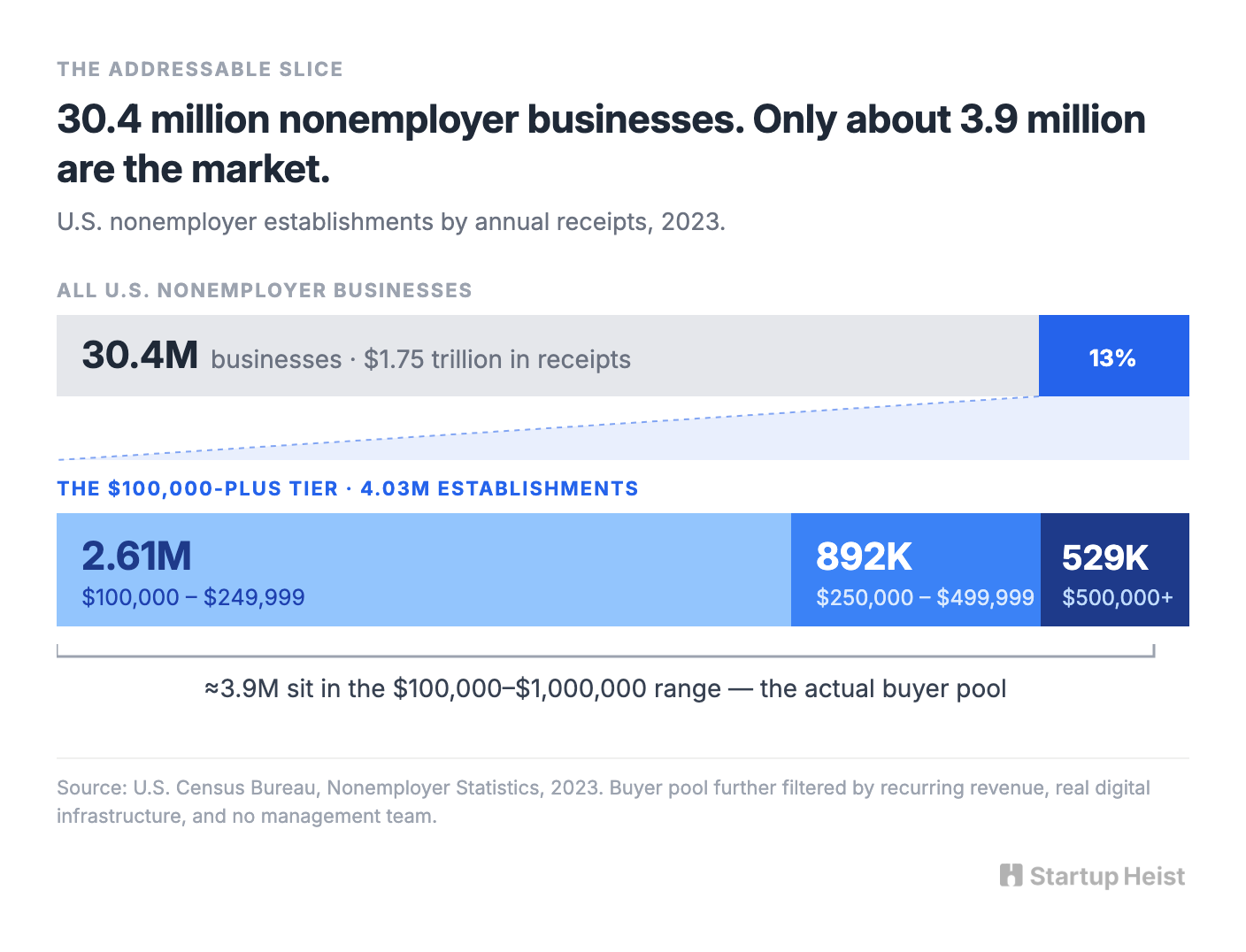
Your buyer sits inside that band and passes a few more filters: recurring or repeat revenue, meaningful digital infrastructure, no management team, and somebody in their life who'd care whether the asset survives. In practice that means bootstrapped B2B SaaS, paid newsletters, small ecommerce brands, one-person agencies, plugin businesses, niche data products, communities, directories, and courses with real retention. These companies routinely carry six- and seven-figure valuations while holding zero institutional redundancy. You can run 80% margins and still have worse continuity than the pizza place on the corner.
What the password manager doesn't tell you
Credential vaults already solved their half of this, and they solved it well. 1Password ships an Emergency Kit, a one-page PDF holding the sign-in address, account email, and Secret Key, and the company suggests storing a copy with your passport or handing one to a spouse. Keeper lets you name up to five emergency contacts with a waiting period of up to three months, after which they get read-only vault access. LastPass runs a similar mechanism on a waiting period the owner sets in advance, which the owner can decline while the clock runs and can't change once a request has been filed. Proton added its own emergency access in 2025, which makes four major vault vendors shipping some version of a trusted-contact handoff.
Every one of those features works as designed, and none of them solves a business problem.
The handoff they actually produce looks like this. A nontechnical spouse opens a vault holding a couple hundred logins on a Monday morning. Which Stripe account is the live one. Whether ad spend can be paused without breaking attribution. Who is allowed to move money. What to do when AWS sends a billing alert. Where the database backups live and whether anyone has restored one. Which repository is production. Who answers customers. The vault opened the warehouse without saying which crate holds the oxygen.
The vendors already built the other half
The platforms these companies run on have already documented the continuity path. Almost nobody follows it, and that gap is what turns a checklist into a business.
Stripe will transfer account ownership to another Super Administrator, and when the existing owner is unreachable the replacement has to go through support with documentation and identity verification. AWS tells account holders to stop using the root user for daily work, to protect account-recovery contact details, and in serious environments to use multi-person approval so that no single individual holds both the root password and the MFA device. GitHub is blunt: an organization with a single owner can become inaccessible if that owner is unreachable, so keep at least two. Google says the same about Workspace super admins, each on a separate person, so one can recover the other.
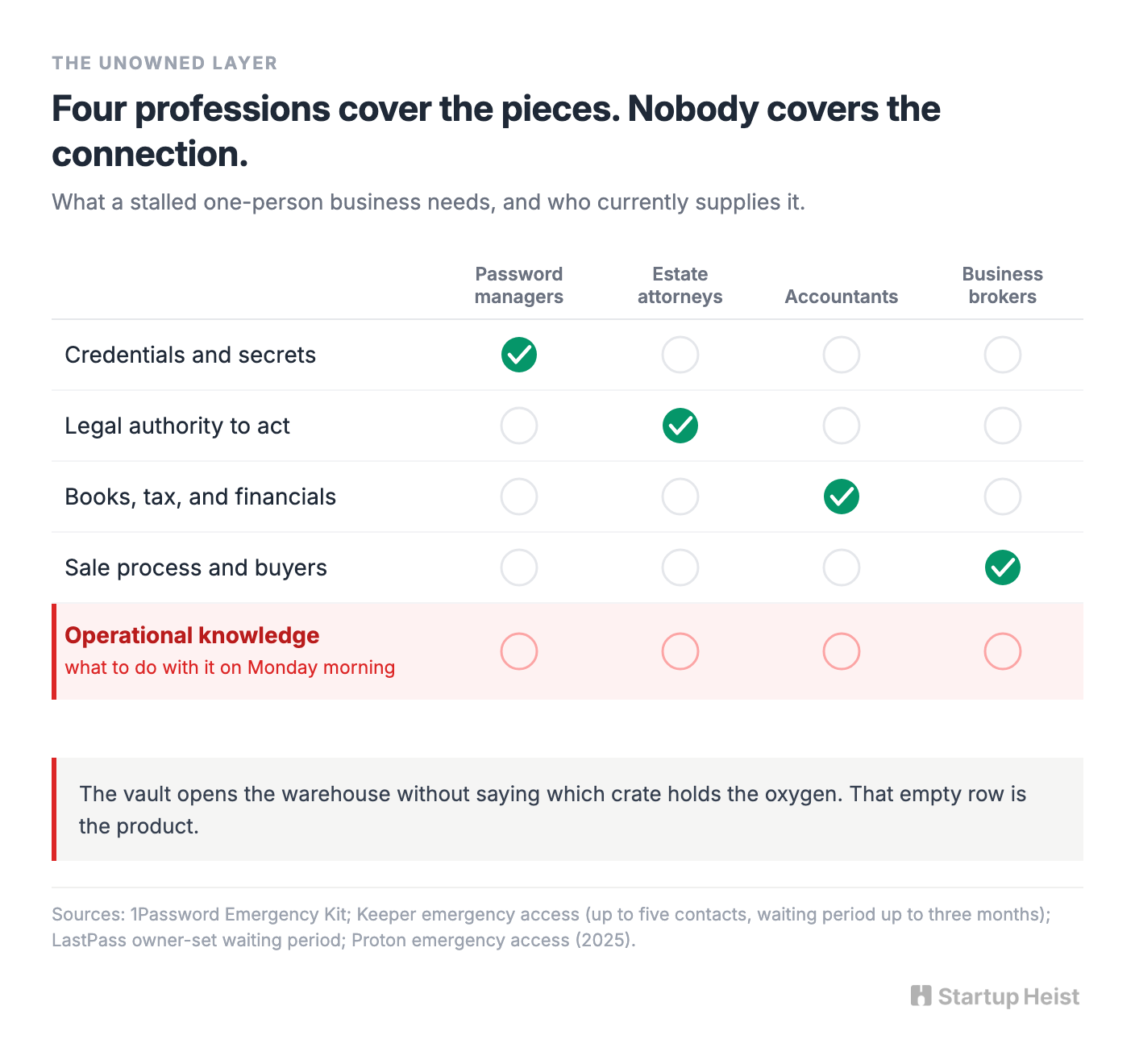
Four vendors, four published answers, and one very consistent failure to implement them. Password managers secure credentials, estate attorneys establish legal authority, accountants understand the books, and brokers handle the sale. Nobody owns the operational layer that connects those four, and that layer is where the product lives.
It also rules out the obvious build. A dead man's switch that emails out passwords when the founder stops clicking a link sounds clever right up until you think about security. The question worth building an entire product around is whether each critical service has been configured so another authorized human can recover the business without impersonating anyone.
Sell readiness, not mortality
The marketing trap here is tempting. Put an ambulance on the landing page. Ask what happens to the SaaS if a bus finds the founder. It gets attention, and it turns the product into a novelty people share instead of buy.
The real obstacle is procrastination, and it's well documented. Trust & Will's 2026 report, based on a survey of 5,000 U.S. adults conducted in early 2026, found 56% of Americans have no estate planning documents at all, essentially flat against the prior year. Will ownership actually dropped from 31% to 26%. Meanwhile 73% said estate planning matters to them personally. Knowing has never translated into doing.
So don't sell another obligation. Sell an outcome the founder can test this week: your business can survive 72 hours without you.
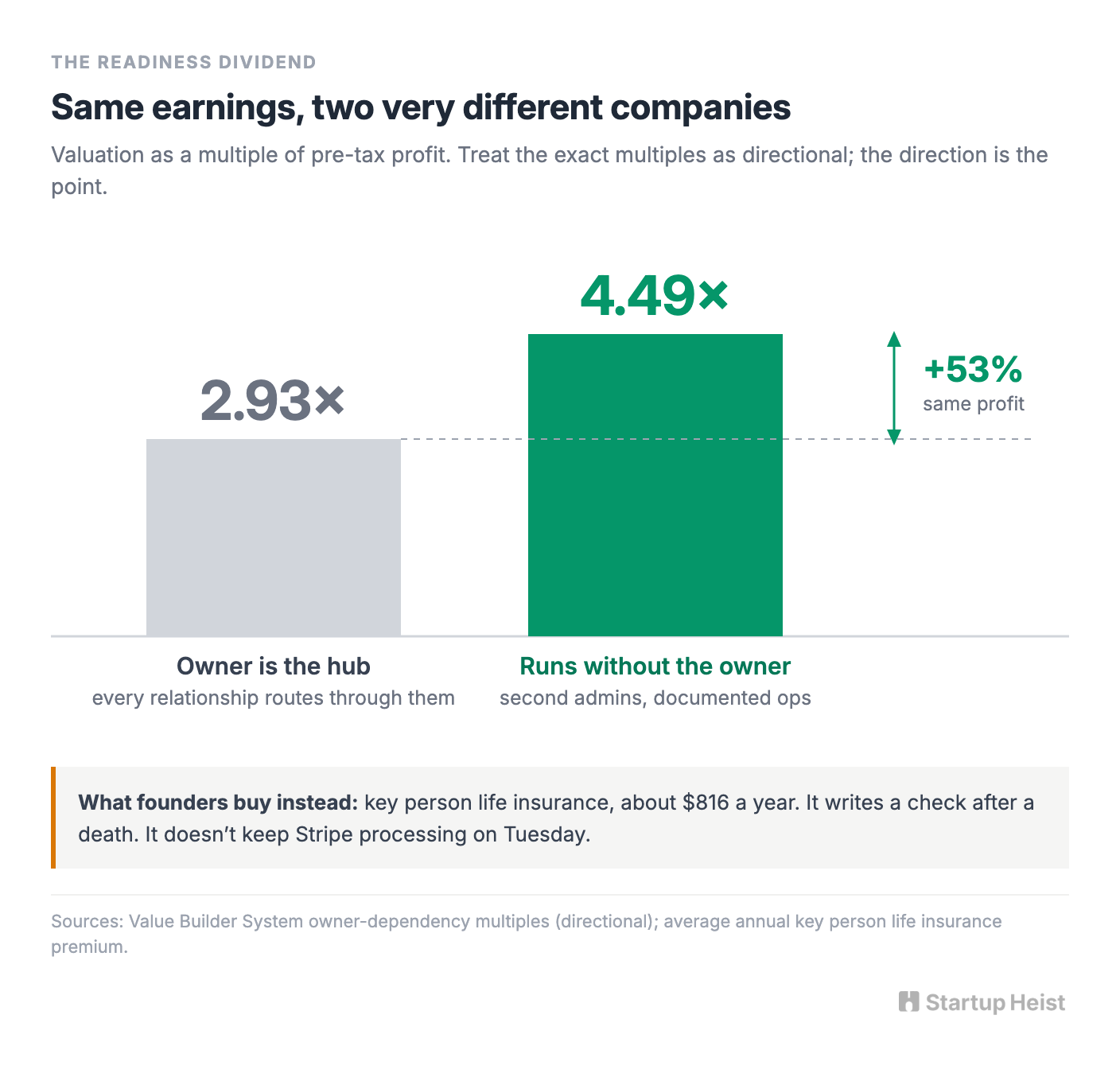
That version of the promise pays off while the founder is perfectly healthy. A company configured this way is easier to travel away from, easier to delegate, easier to recover after a credential loss, and materially easier to sell. Exit advisors cite owner-dependency figures from the Value Builder System constantly on that last point: companies that run without the owner have been valued around 4.49 times pre-tax profit, against 2.93 times when the owner is the hub every relationship routes through. Treat the exact multiples as directional. The direction is a swing of more than 50% on the same earnings.
Compare that to the alternative product founders already buy. Key person life insurance runs about $816 a year on average. It writes a check after a death. It doesn't keep Stripe processing on Tuesday.
The kit: five modules, no software
Don't start by building software. Building software first is founder muscle memory getting in the way of the opportunity. Version one lives in Notion or Coda, and the workflow is the entire product.
Module 1: The Business Map. A structured inventory of the company, built around dependencies rather than secrets.
Unlock the Vault.
Join founders who spot opportunities ahead of the crowd. Actionable insights. Zero fluff.
“Intelligent, bold, minus the pretense.”
“Like discovering the cheat codes of the startup world.”
“SH is off-Broadway for founders — weird, sharp, and ahead of the curve.”


