


The Diary Is Already Written. Nobody Owns the Reading of It.
The obvious version of this business is a private AI journal app. Don't build that one.
The category is crowded and well-capitalized. Day One, owned by Automattic, launched a Gold tier in 2026 at $74.99 a year bundling Daily Chat, Entry Highlights, and multi-entry summaries. Rosebud charges around $12.99 a month and has taken $6 million from Bessemer. Mindsera lists its Genius tier at $14.99 monthly. Every one of them wants to be the place you write.

There's a better position one layer down: the local intelligence layer that reads the journals people already own.
The product is a desktop app. You point it at an Obsidian vault, a folder of Markdown files, or a Day One export. It indexes everything on your machine, then gives you semantic search, source-linked answers, weekly reviews, and long-range retrospectives, and it never uploads a word. No account, no cloud database. Turn off Wi-Fi and it still works.
The raw material is already sitting on millions of hard drives, and nobody has built the good tool for reading it. Here's the opportunity:
The money: 2,000 customers a year at a $65 blended price clears $130K with no server bill. Day One Gold charges its users $74.99 every year, forever.
Inside:
• The eight-week MVP scope, five features
• Perpetual license pricing at $49 and $79
• Free-scanner launch play and outreach email
• Four moats: import, retrieval, citations, time
People are telling AI things they won't tell people
DuckDuckGo surveyed 1,944 U.S. adults between June 17 and June 27, 2026. Thirty-two percent of AI users said they had shared something with a chatbot that they had kept from a close friend, a parent, or a medical professional. Among self-described AI enthusiasts, that number hit 56%. Among parents with children at home, 43%, nearly double the rate for non-parents.
The same survey found the trust side of the ledger empty. Fifty-three percent didn't know or weren't sure that chatbot conversations can be used to train models. Fifty-eight percent were uncomfortable once they found out. Only 14% said they mostly or completely trust large AI companies with their data, while 39% reported no trust at all.
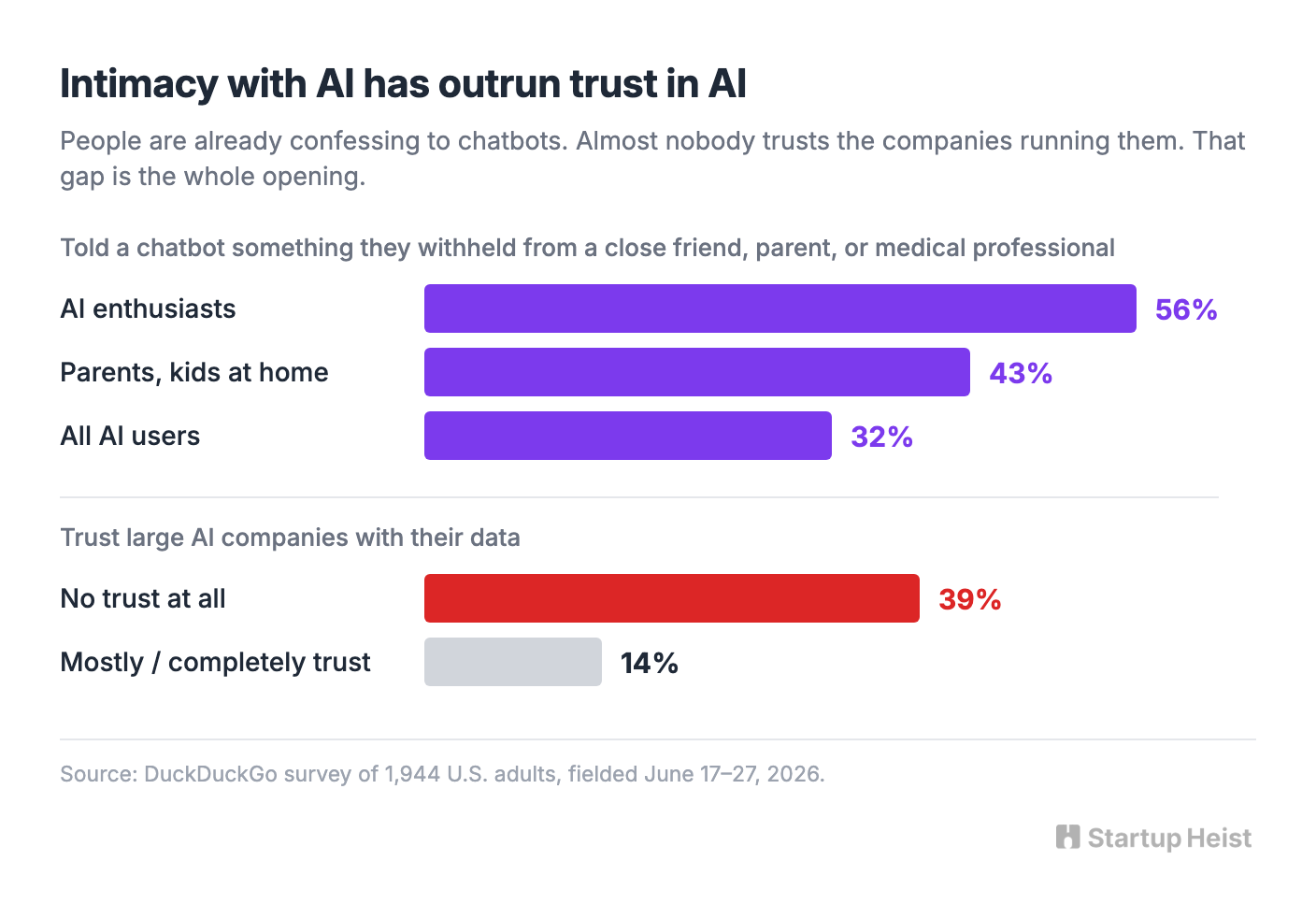
Intimacy with AI has outrun trust in AI by a wide margin, and that gap is where a product lives.
Journals sit at the extreme end of it. A password manager holds credentials and a banking app holds transactions. A journal holds the divorce, the fear about a kid, the health scare, the thing never said out loud to anyone. The standard pitch asks a buyer to upload fourteen years of that to a company's servers so its AI can explain them to themselves. A meaningful slice will decline. They understand exactly what they'd be handing over, and they want the analysis anyway.
The market timing helps. An Epoch AI/Ipsos poll fielded March 3–6, 2026 found that 50% of Americans had used an AI service in the previous week. Three years ago you had to convince someone that talking to their own archive would be useful. That work is done. What remains is convincing them they can do it without surrendering the archive.
"Private AI journal" is already commoditized
Apple's Foundation Models framework gives any developer access to an on-device language model through a few lines of Swift, with no per-token cost and no network round trip. Apple showcases journaling as a use case, Automattic already uses it inside Day One, and Stoic uses it for prompts.
So the incumbent journaling app is already private-by-default on Apple hardware, shipped by a company with a beloved brand, mobile apps, sync, encryption, and years of accumulated edge cases. Launching another journal and shouting PRIVATE AI just gets you a slower version of what Day One already ships.
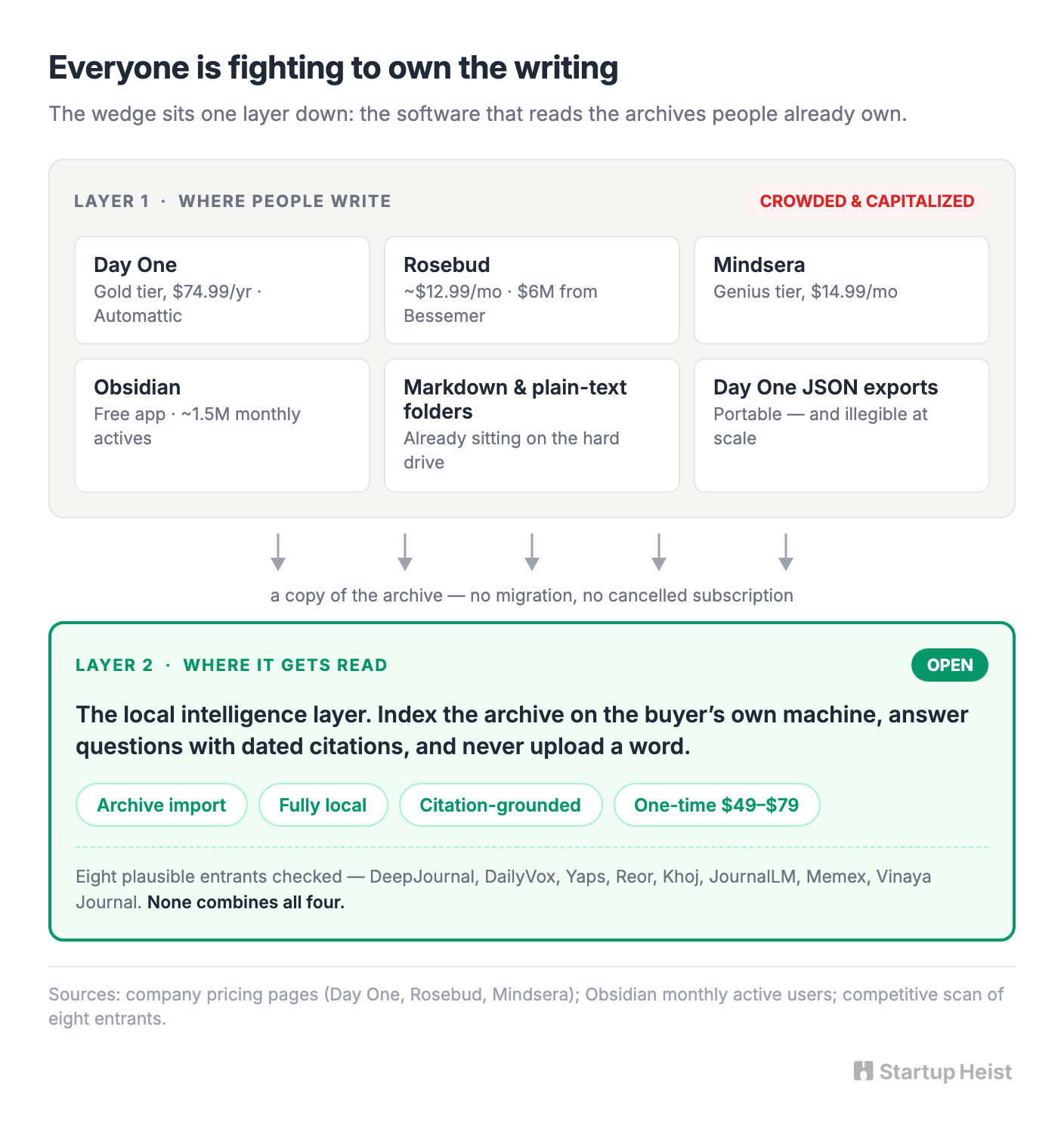
Change the battlefield instead. Day One wants to own the journal; the opening is in owning the reading of it.
The promise changes completely: keep writing wherever you already write, and we'll analyze a copy of your archive locally. The Obsidian user doesn't migrate and the Day One subscriber doesn't cancel. Your app is a lens they point at the home they already chose.
The supply side is unusually cooperative. Obsidian stores notes as ordinary Markdown in local folders, which has trained roughly 1.5 million monthly active users to expect exactly this kind of data ownership. Day One exports complete journals as JSON, and a small ecosystem of community converters already parses that format. The archives are portable. They're just illegible at scale.
Auditable insight is the entire product
The first screen asks for one thing: choose your journal folder. Then:
14 years found. 3,842 entries. 1.7 million words. Everything will be processed on this computer.
That's the moment the product earns its price.
Ask the archive. The value is in retrospective questions with real answers: when did I first start complaining about this job, show me the three months before I quit.
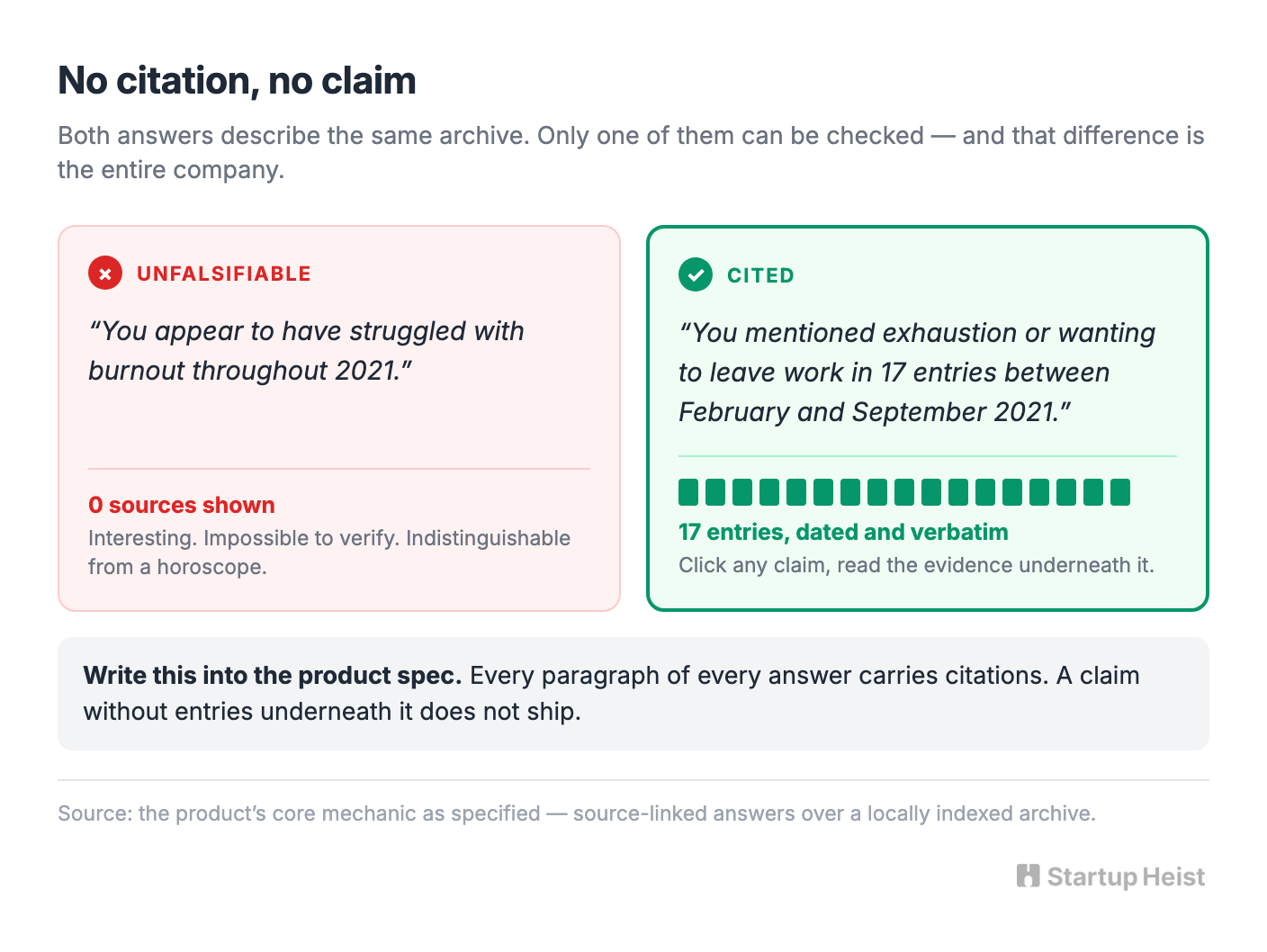
Every paragraph of every answer carries citations. Click a claim and you see the entries underneath it, dated, verbatim. This sounds like a UX detail. It's actually the whole company. A chatbot that says "you appear to have struggled with burnout throughout 2021" is interesting and unfalsifiable. A product that says "you mentioned exhaustion or wanting to leave work in 17 entries between February and September 2021," and then shows all seventeen, is something a person can trust with their own history. No citation, no claim. Write that into the product spec.
Weekly and monthly reviews. Most journals are write-only databases. Change the retrieval loop: every Sunday, the app surfaces the week's entries, the subjects that recurred, and any theme that jumped from its four-week baseline, with a short written review linking to the supporting entries.
Long-range pattern detection. Pick a year or five and ask what changed. Compare 2024 to 2025: more mentions of travel and family, fewer of client work and insomnia. Descriptive, never clinical. The system should never say "you were depressed in 2023." It can say "you used the words exhausted, hopeless, and stuck substantially more often in this period," and then show the entries.
Curated retrospectives. This is probably what people pay for. Select a period and generate a source-linked narrative: my year in review, the first year of parenthood, our move to New York. Closer to a personal historian than a therapist, which is both a better product and a much safer place to stand.
What local AI can actually do on a laptop
Unlock the Vault.
Join founders who spot opportunities ahead of the crowd. Actionable insights. Zero fluff.
“Intelligent, bold, minus the pretense.”
“Like discovering the cheat codes of the startup world.”
“SH is off-Broadway for founders — weird, sharp, and ahead of the curve.”


