


The Midnight Courier Network
DoorDash has never been stronger. In the quarter that ended June 30, 2026, it processed 970 million orders and $33.1 billion in marketplace gross order value, up 27% and 36% year over year. The National Restaurant Association reports 37% of American adults order restaurant delivery at least weekly. LendingTree's September 2025 survey of 2,000 consumers found half of Gen Z ordering delivery at least once a week.
A second marketplace has nothing to attack. DoorDash owns the customers, the couriers, the merchant contracts, the subscriptions, the fraud stack, the routing software, and the reflex of opening an app when you're hungry. None of that is available to steal. One piece of the transaction is still loose: fulfilling a restaurant's own orders inside an absurdly small area during a few violently busy hours.
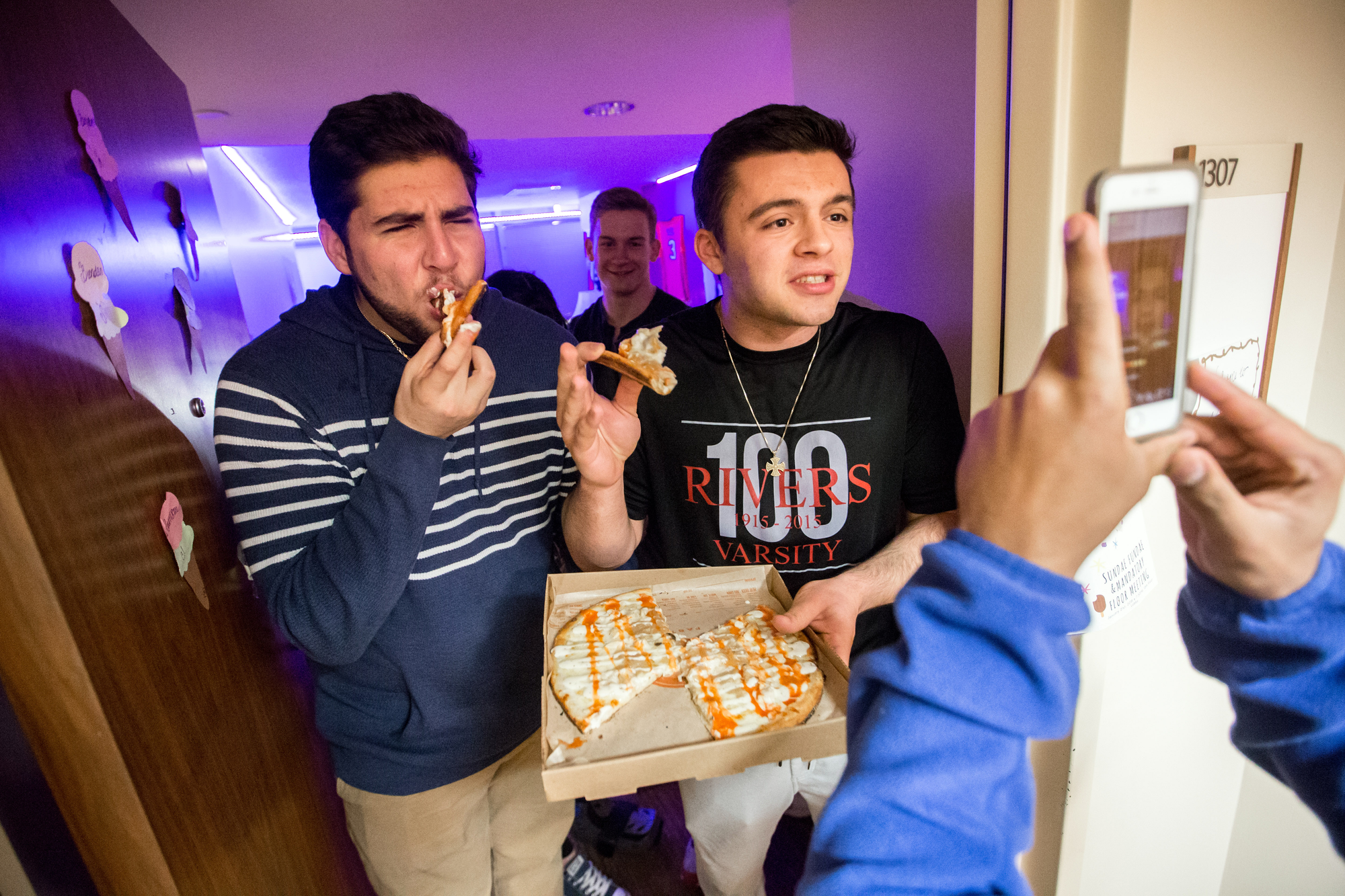
Five independent restaurants ring a college campus. Pizza, wings, halal, cookies, sandwiches. Twelve blocks, several thousand students. Between 10 p.m. and 2 a.m. each of those restaurants gets enough delivery demand to matter and not enough to keep a dedicated driver moving. So they hand the shift to the marketplaces and pay third-party commissions of 15% to 30%.
The play is a shared late-night courier network: several merchants pooled into one fleet of e-bike riders, orders batched toward the same dorm and apartment clusters, restaurants keeping their own ordering channels and their own customers. Thursday through Saturday, five hours a night, under a square mile. That tight boundary is what makes the economics work at all.
Here's the opportunity:
The money: One district runs $2,980 to $4,100 a month before fixed costs, and a well-run zone can reach $5K to $10K in owner-operated income.
Inside:
• Unit economics at 3, 3.5, and 4 drops/hour
• The 8-point scorecard for your first merchants
• An eight-week launch with the outreach email
• Five operational moats inside twelve blocks
The capacity that's about to disappear
On June 11, 2026, Starship Technologies announced it was pulling more than 1,200 delivery robots off more than 60 U.S. college campuses to concentrate on grocery. Campus service runs through the 2026-27 back-to-school season, then stops.
Those robots were doing precisely this job: short, dense, repetitive food runs, used hardest at night. Starship's own survey of 5,000 students found 97% liked or loved them, and one in four said contactless delivery made them feel safer during late-night study sessions.
Sixty-plus campuses are about to lose a delivery layer students were trained to expect, and the expectation will outlast the robots by years. Whoever is standing in that gap during move-in week owns the semester.
Owning the order isn't the same as delivering it
Restaurant owners have already been sold the direct-ordering story, and it mostly worked.
ChowNow sells commission-free direct ordering with branded apps, sites, and marketing, its annual plans starting around $229 a month and Flex Delivery priced at $7.98 an order. Toast lets a restaurant take the order itself and push fulfillment to Uber Direct at $6.99 inside six miles or DoorDash Drive at $7.49 inside five, before additional fees. Relay built an entire company on the same split, running its own courier network for restaurants across New York, New Jersey, Philadelphia, Miami, Chicago, and Washington, D.C.
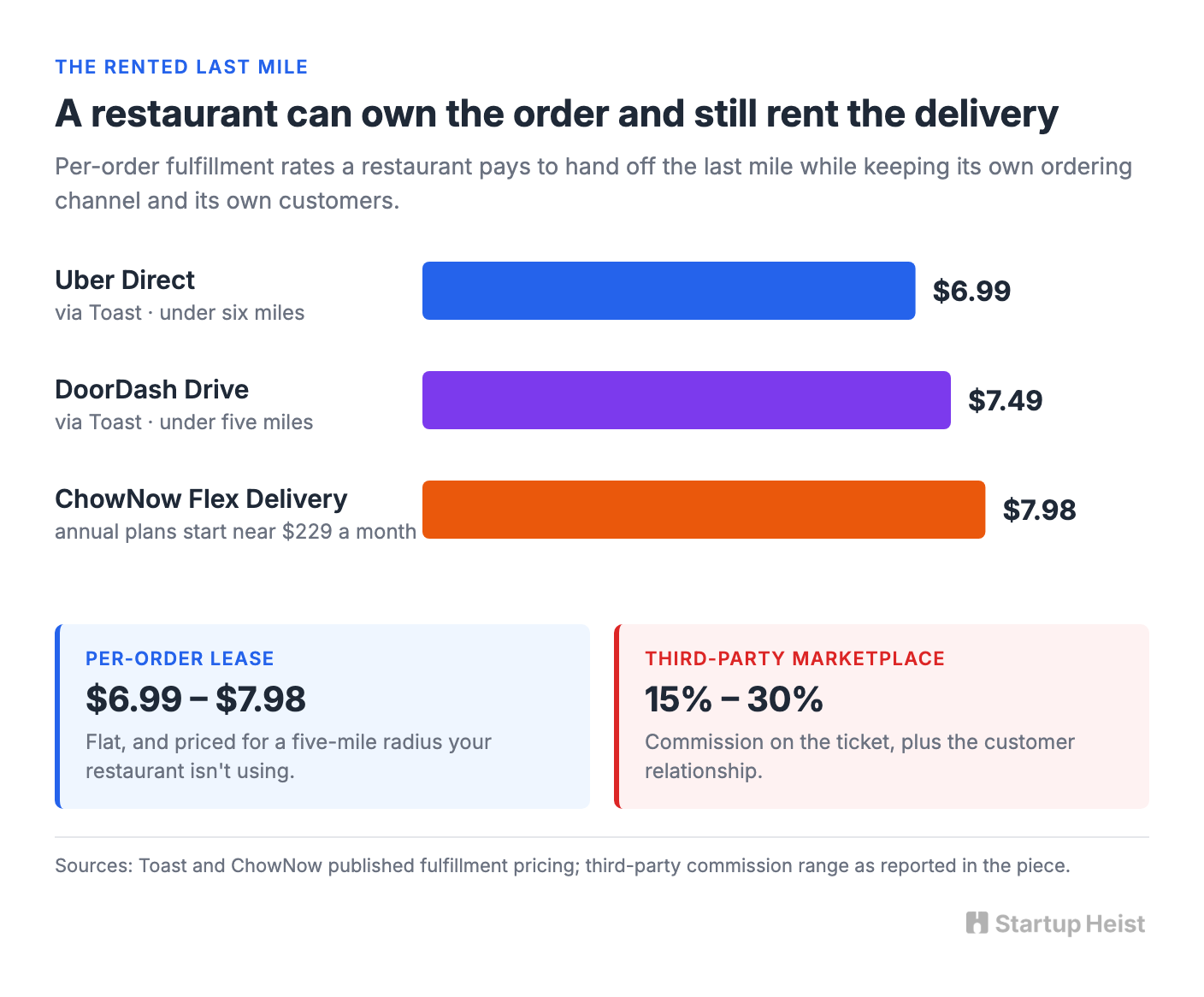
The industry solved order ownership and rented out the last mile. Every one of those fulfillment options is a per-order lease on somebody else's citywide fleet, priced for a five-mile radius your restaurant isn't using.
So the unsolved problem sits one layer down:
A restaurant can own its online orders completely and still have no economical way to deliver them at 1 a.m.
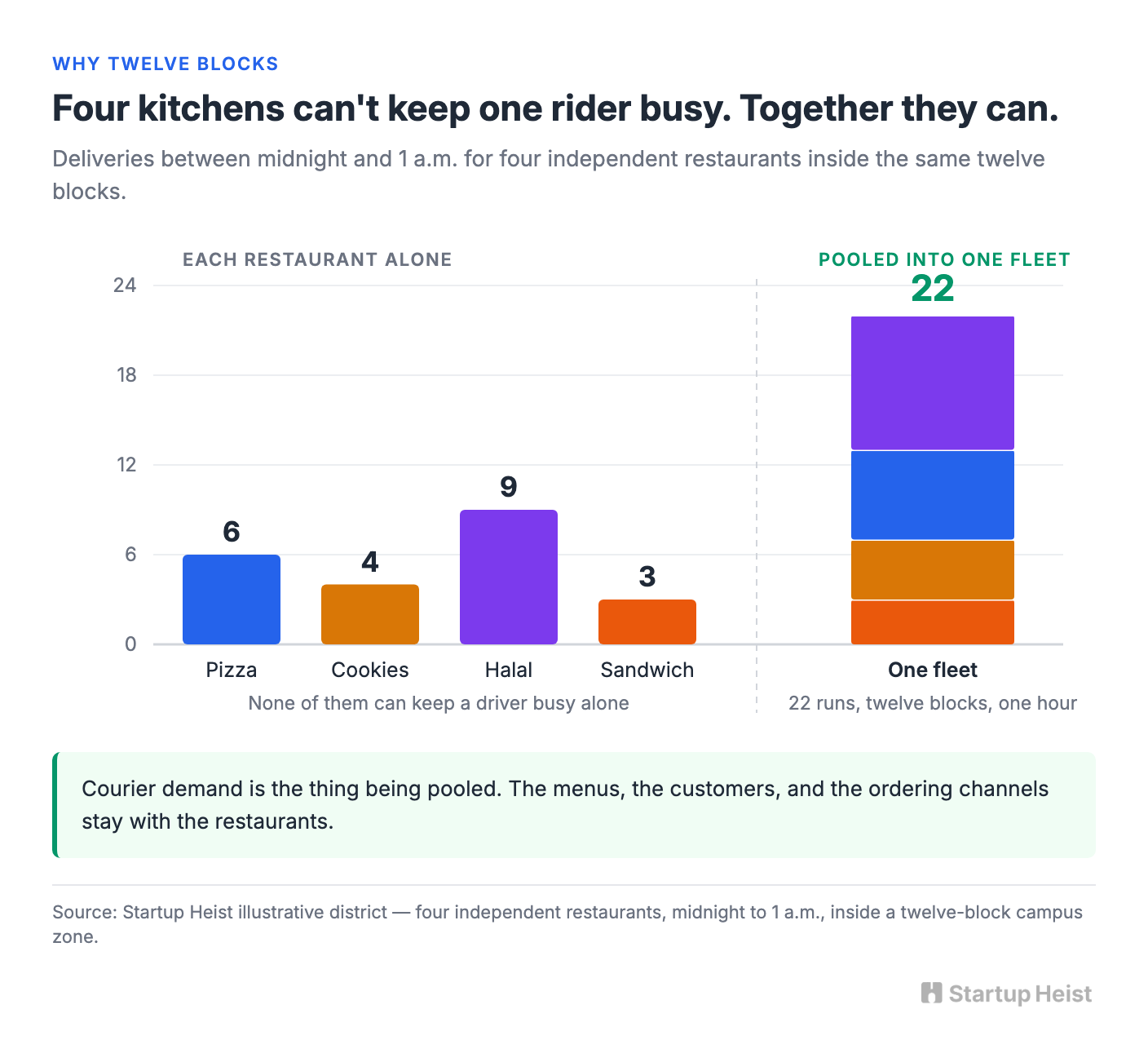
Between midnight and 1 a.m., the pizza shop runs six deliveries. The cookie shop does four, the halal place nine, the sandwich counter three. None of them can keep a driver busy alone. Together they have twenty-two runs inside twelve blocks. Courier demand is the thing being pooled here, and the menus stay with the restaurants.
Why twelve blocks beat a whole city
Traditional delivery networks optimize across an entire metro. In hyperlocal delivery, your advantage comes from refusing almost all of it.
A launch zone has to deliver four things at once. Thousands of customers living within minutes of each other, hundreds of them sharing one dorm complex or apartment lobby. Demand that spikes at the same hours on the same nights, so riders are never half-busy. Repeat behavior, where one student orders from the same six places thirty times a semester. And trip lengths short enough that an e-bike beats a car outright.
College districts hit all four. They also come with one hard boundary worth knowing before you sign a lease on a bike rack: Grubhub Campus serves more than 400 campuses and lets students spend meal-plan credits through its app. You aren't winning meal-plan dollars. That business is contracted at the university level and you have nothing to bid with.
So don't chase it. The order you want is the cash-paying, off-campus, 12:45 a.m. repeat order from a student who already knows what she wants and is only using an app because there's no other way to get it delivered. LendingTree found delivery in Philadelphia costs 82.8% more than picking up the same meal. That's the fee fatigue you're selling against, and it's the reason a transparent $6 charge lands better than it should.
Run it like a bus route, not an app
Don't promise instant dispatch. Instant dispatch is how you rebuild DoorDash's cost structure with none of DoorDash's volume.
Run waves instead. During peak, riders leave the strip every 8 to 12 minutes, and when the dispatcher sees three orders heading toward the same building they go out together. Restaurants learn roughly when the next pickup lands, and students get an honest ETA instead of an optimistic one.
You trade a few minutes of theoretical speed for a large gain in rider utilization, and utilization is the entire company. A rider doing two deliveries an hour loses money on every trip; the same rider doing four makes the business work. Everything downstream of that number is decoration.
The only metric that matters
Unlock the Vault.
Join founders who spot opportunities ahead of the crowd. Actionable insights. Zero fluff.
“Intelligent, bold, minus the pretense.”
“Like discovering the cheat codes of the startup world.”
“SH is off-Broadway for founders — weird, sharp, and ahead of the curve.”


