


The Store Has No Clerk. Sell It 90 Seconds of Human Judgment.
Automation has a habit of eliminating 90% of a job and making the remaining 10% more valuable.
A self-checkout kiosk scans thousands of items, accepts every payment method, prints receipts, tracks inventory, and works at 2 a.m. without overtime. Then somebody gets charged twice. Or the barcode won't scan. Or the shelf tag says $3.49 and the screen says $4.99. At that moment the kiosk needs the one thing the operator deliberately removed from the store: a person.
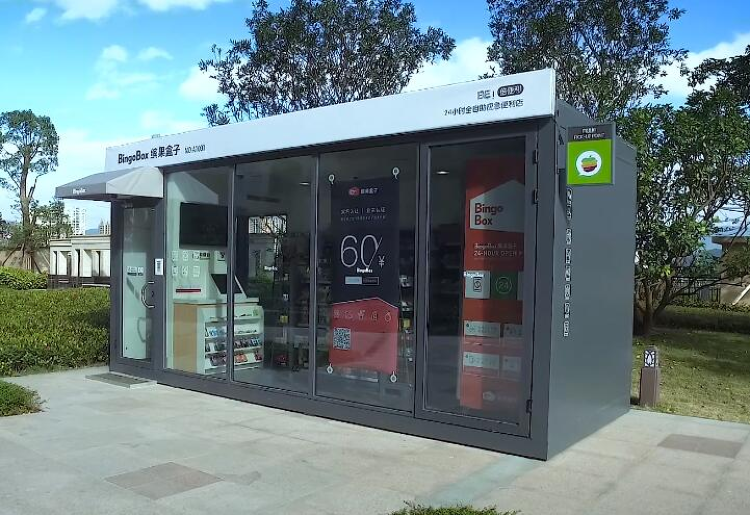
That residual human work is the opportunity. The reflex is to capture it with another machine. The better answer is an exception-resolution layer for unattended retail. A QR code beside the kiosk lets a shopper report a problem, and the link already knows which operator, which building, which machine. Routine issues resolve through structured workflows. The small share that needs judgment routes to a shared remote desk staffed across many operators at once.
The beachhead is the U.S. micro-market industry: the unattended mini-convenience stores now standard in offices, factories, hospitals, apartment buildings, and campuses. The timing is better than it has ever been, for a reason almost nobody in this industry is talking about yet.
Here's the opportunity:
The money: 400 locations at $249 a month is roughly $100K MRR, run on pooled coverage at 70% gross margin.
Inside:
• Read-only MVP scope you can build for $15K
• Pricing: $2,500 pilots up to $249 per site
• The queueing math that kills 24/7 offers
• Five moat layers, starting with FTC access
Automation leaves a residue
South Korea is the preview. By late 2024, the National Fire Agency counted roughly 9,030 fully unstaffed outlets in just the ten largest local governments. Broader tallies from Statistics Korea and the Ministry of SMEs and Startups put unmanned retail past 50,000 locations, and by early 2026 more than 80,000 Korean restaurants and bars had installed unmanned payment kiosks. Labor economics drove all of it.
Machines handle deterministic transactions beautifully. Scan, tap, print, open. Ambiguity is another matter: "I think I got charged twice," "the door still won't open," "did that go through?" Self-service doesn't eliminate customer service. It concentrates it into exceptions, then leaves nobody standing there to handle them.
The beachhead: 55,000 American stores with nobody in them
The U.S. numbers are already large enough to build a company against.
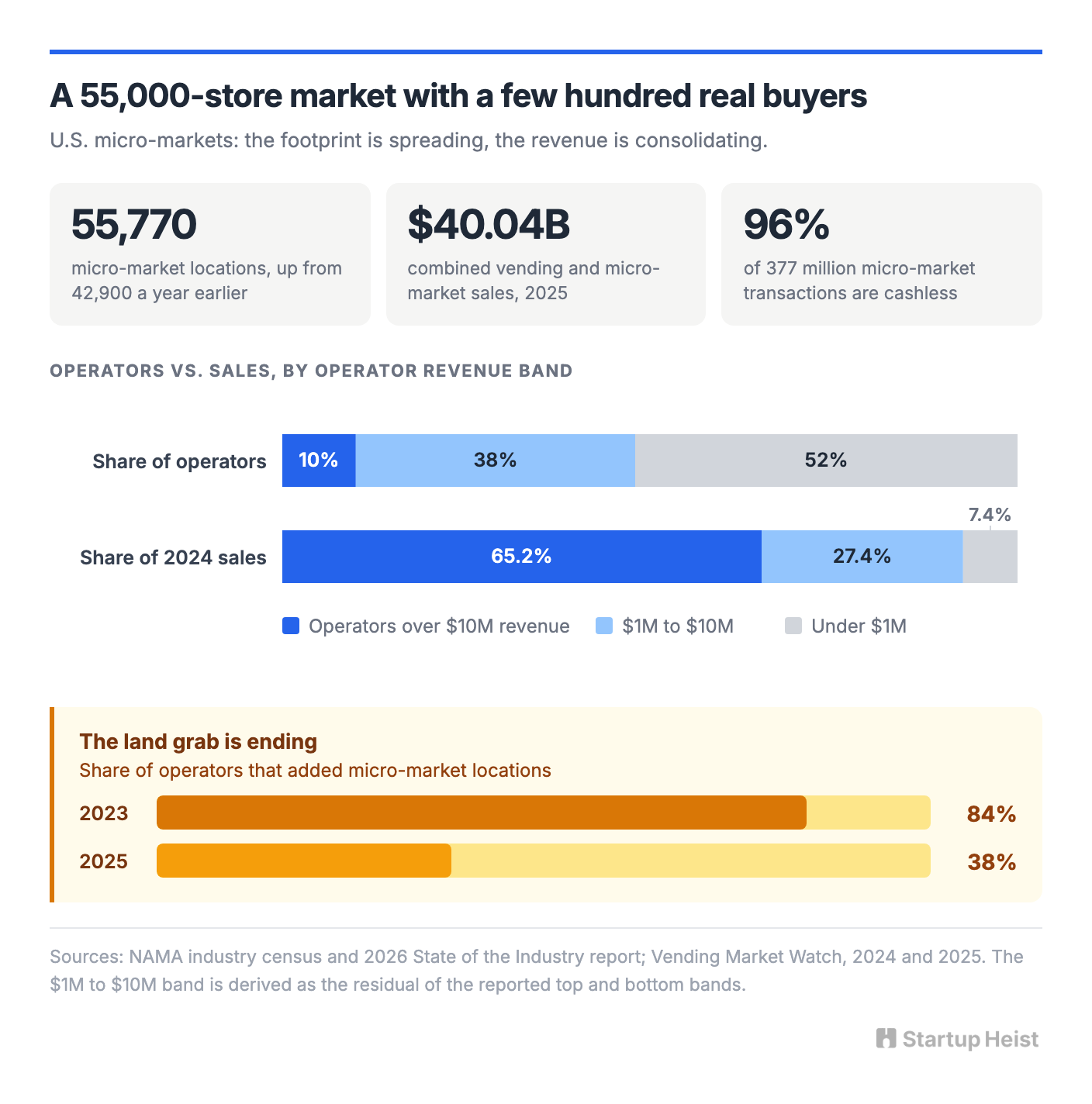
The National Automatic Merchandising Association's industry census puts convenience services, meaning vending, micro-markets, office coffee, and pantry, at $31.1 billion in 2025, up from $26.6 billion in 2023. Combined vending and micro-market sales tracked by Vending Market Watch hit $33.85 billion in 2024 and $40.04 billion in 2025. Micro-market locations grew from 42,900 to 55,770 in a single year, a 30% jump. Micro-market sales crossed $1 billion for the first time in 2024 across 377 million transactions, 96% of them cashless.
Every structural feature of these stores favors an exception product. They are unattended, remotely managed, digitally paid, spread across hundreds of physical sites, run by companies managing portfolios rather than by individual shopkeepers, and dependent on technology that occasionally fails in front of a customer. Unlike a vending machine, a micro-market looks and behaves like a tiny convenience store, so shoppers walk in expecting store-like service. There's no clerk to ask, and there never will be.
You don't need to sell this 55,000 times. Operators with more than $10 million in annual revenue represent 10% of the businesses in this industry and 65.2% of 2024 sales. Operators under $1 million are 52% of the businesses and 7.4% of sales. The revenue sits with a few hundred regional and national companies, each running dozens or hundreds of locations under a single contract.
Your first customer is the regional micro-market operator running roughly 20 to 150 locations, not the guy with three vending machines. That operator is large enough that support requests arrive from every direction and get absorbed by whoever picks up the phone, and too small to have built a real 24/7 customer-operations function. One signature deploys hundreds of QR codes and generates enough exception volume to learn what actually breaks.
The market is also cooling in a way that helps you. In 2025, only 38% of operators added micro-market locations, down from 84% in 2023, and the industry's own 2026 report describes micro-market growth as maturing. Land-grab growth is ending. Operators who spent three years opening sites now have to make the installed base work, which pushes service quality and account retention to the top of the agenda.
What the incumbents already do, and exactly where they stop
This is not greenfield, and pretending otherwise will get you killed.
365 Retail Markets sells the dominant self-checkout hardware and has started shipping products aimed at the ugly downstream consequences of unattended retail. Its MarketSight system, announced in May 2025, uses computer vision on the MM6 Mini to catch missed scans before checkout completes, in a business where operators report about 4% shrink on average. Its 365Pay app handles stored-value accounts and now includes in-app refunds and a consumer support line. Some operators have stuck a customer-service QR code on the kiosk themselves, and the operator-run support lines that exist today typically quote a next-business-day response. In the adjacent self-storage vertical, OpenTech has run a live remote-assistance call center out of Phoenix for years, serving hundreds of facilities.
Both the validation and the gap are in that list. Every existing support path either requires the shopper to already have an account with the hardware vendor, or it routes to an operator's own inbox on a next-business-day clock. The account requirement is fatal on its own. Nobody publishes a tap-versus-app split for micro-markets, but tap-to-pay accounts for 77% of cashless vending sales, and mobile payments, while growing over 300% in vending, are climbing from a small base. The reasonable read is that most of those 96% cashless micro-market transactions are card taps from shoppers who have no app, no account, and no relationship with anyone in the chain. Meanwhile that shopper is standing in front of the machine right now, holding a phone, with a $4 problem and a whole company's credibility riding on it.
The FTC just pried the door open for ten years
On May 11, 2026, 365 Retail Markets closed its $848 million all-cash acquisition of Cantaloupe, combining the two largest providers of micro-market kiosks, software, and payments. The Federal Trade Commission didn't block it. It did something more useful to you.
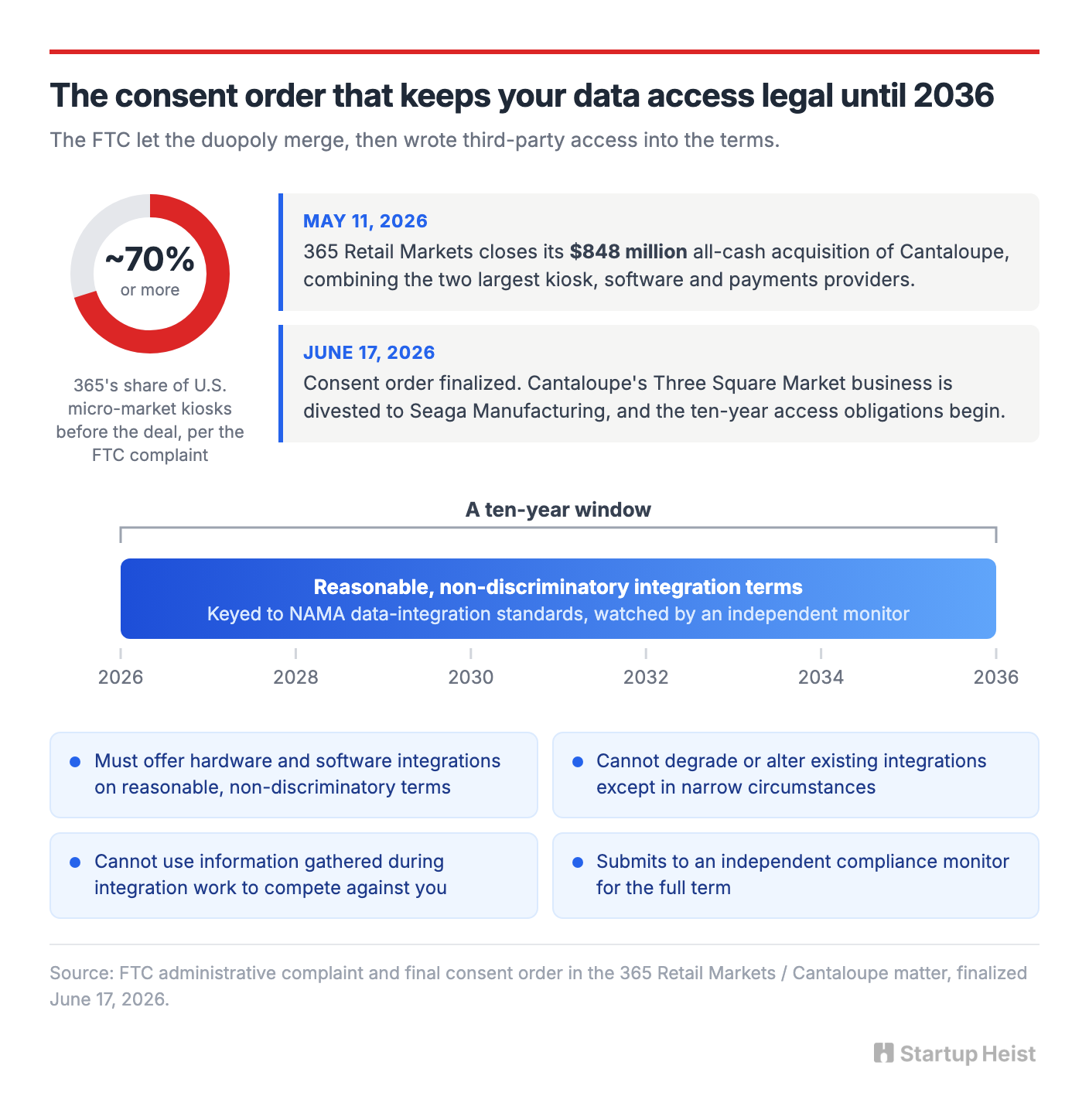
The FTC's complaint described the market as essentially a duopoly, with 365 already holding roughly 70% or more of micro-market kiosks and Cantaloupe as its closest competitor. The consent order finalized on June 17, 2026 forced 365 to divest Cantaloupe's Three Square Market business to Seaga Manufacturing. Then it went further. For ten years, 365 must offer integrations between its hardware and software and those of third parties on reasonable and non-discriminatory terms, cannot degrade or alter existing integrations except in narrow circumstances, cannot use information gathered during integration work to compete against the party it integrated with, and must submit to an independent compliance monitor. The obligation is keyed to the industry's own NAMA data-integration standards.
In plain terms: the single biggest risk to any third-party layer sitting on top of unattended retail, that the platform owner cuts off your data access the moment you become interesting, is now illegal for the dominant player until 2036, with a federal monitor watching. That's a decade-long window, and windows close.
The context is the product
Unlock the Vault.
Join founders who spot opportunities ahead of the crowd. Actionable insights. Zero fluff.
“Intelligent, bold, minus the pretense.”
“Like discovering the cheat codes of the startup world.”
“SH is off-Broadway for founders — weird, sharp, and ahead of the curve.”


