


The Mystery Box Is Being Sold to the Wrong Customer
The heist: Build a Shopify app that reframes mystery products as things friends open together, then proves with controlled experiments whether social framing actually moves conversion, order value, and gross profit.
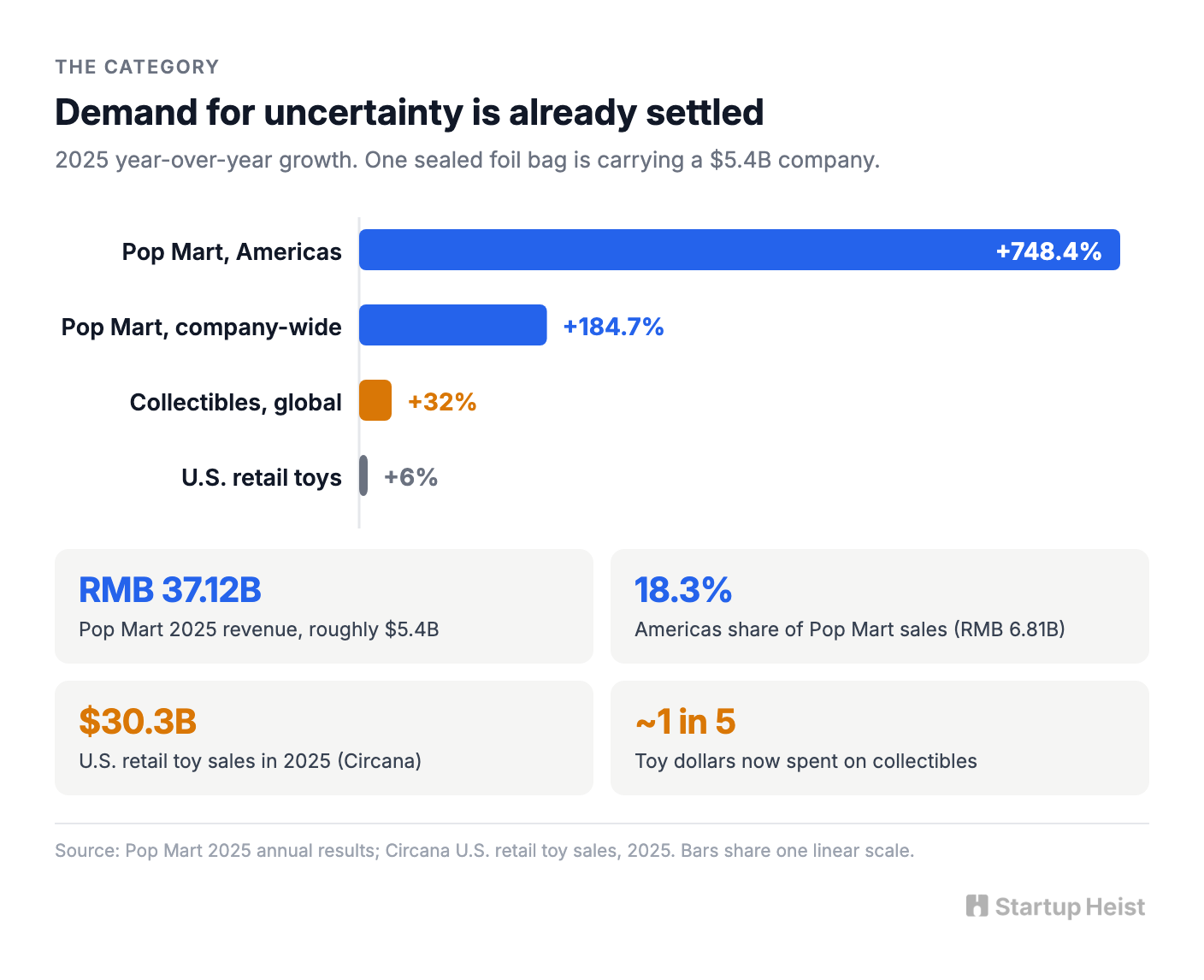
Pop Mart booked RMB 37.12 billion in 2025 revenue, roughly $5.4 billion, up 184.7% year over year. Its Americas business grew 748.4% to RMB 6.81 billion and now makes up 18.3% of company sales. The product driving that is a sealed foil bag. You do not know what is inside until you have paid for it and torn it open.
The category around it moved the same way. U.S. retail toy sales tracked by Circana reached $30.3 billion in 2025, up 6%, and collectibles grew 32% globally to approach one-fifth of every toy dollar spent. Trading cards, sports cards, and blind-box figures carried most of that growth.
Demand for uncertainty is settled. People will pay real money for a box whose contents they cannot see. What nobody has systematized is the condition under which they pay more for it. A paper published in 2026 answers that with unusual precision, and the answer has almost nothing to do with the box.
Here is the opportunity sitting in that gap:
The money: Base case is a $5,000 to $30,000 MRR niche SaaS. Five hundred merchants at $59 average is $29,500 a month, with $1,000 test sprints funding the build.
Inside:
• Five-component MVP, nothing else
• The merchant filter that runs backwards
• Three experiment families, run in order
• The $750 sprint that funds the build
When Uncertainty Stops Feeling Like a Risk
Yanzheng Liu and Ying Ding ran eight main studies and two supplementary studies with 5,787 participants, published in the Journal of the Academy of Marketing Science under the title "The social mystery effect." Their methods included a large-scale survey, field observation, controlled experiments, and an incentive-compatible design where participants put actual money behind their choice.
The result held across all of it. People chose mystery products more often when they expected to consume them socially rather than alone.
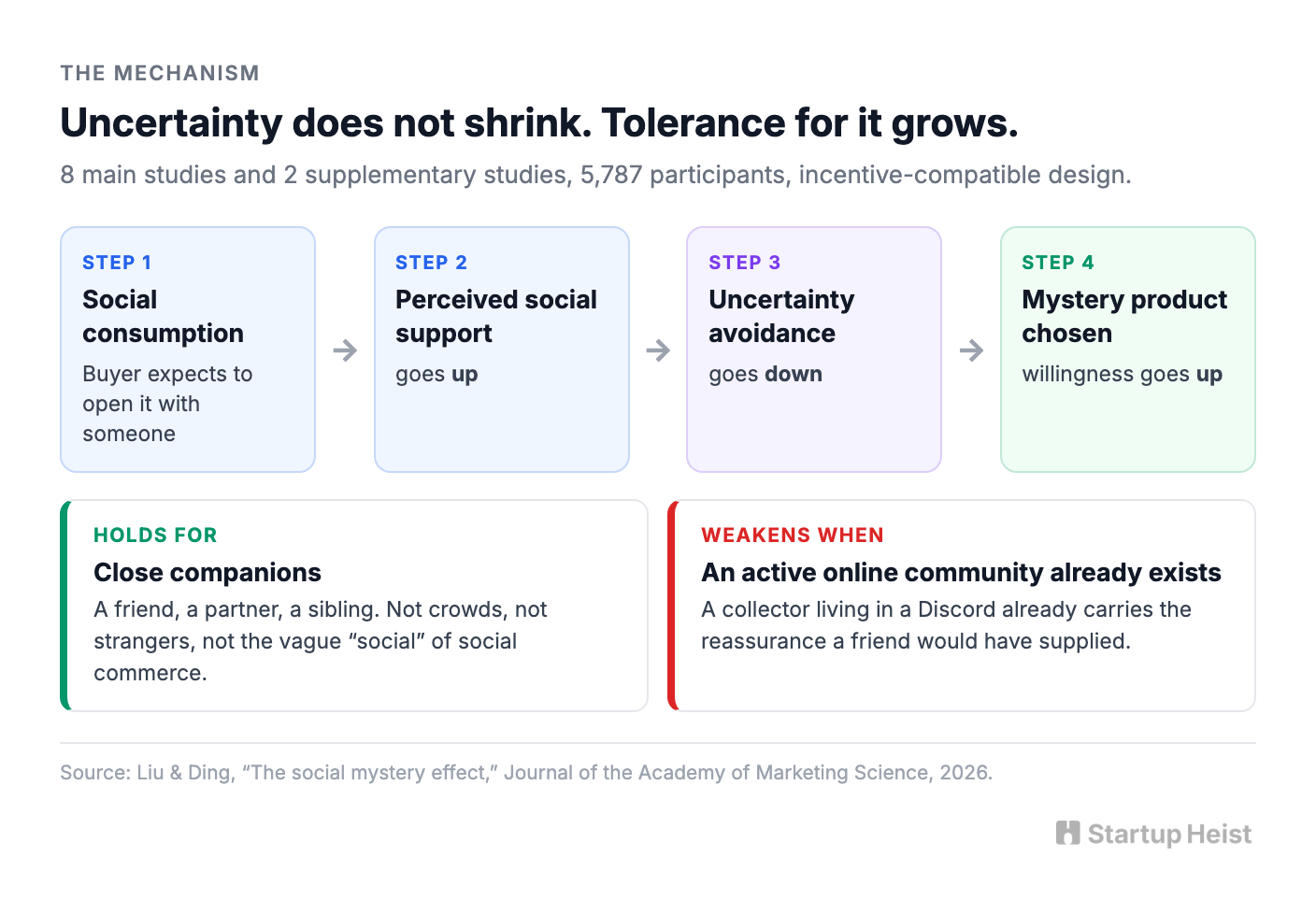
The mechanism is what makes this commercial rather than merely interesting. It runs in sequence: social consumption raises perceived social support, higher social support lowers uncertainty avoidance, and lower uncertainty avoidance raises willingness to pick the unknown item. Uncertainty does not shrink. What grows is the buyer's tolerance for it, because someone else is standing next to them while they open the box.
Two boundary conditions turn the finding into a product spec.
The effect showed up primarily with close companions: a friend, a partner, a sibling. It does not extend to crowds, to strangers, or to the vague sense of "social" a marketer means when they say social commerce.
And the effect weakened when buyers already drew social support from an active online community. A collector who spends every evening in a Discord full of other collectors is already carrying the reassurance a friend would have supplied. Give that person a second dose and nothing much happens.
Those two conditions end up deciding which merchants are worth selling to, and they run backwards from intuition.
Everything Around This Already Exists
Shopify merchants can already build mystery boxes. Chancey builds inventory-backed blind boxes where merchants commit real units from their catalog, publish live odds calculated from the committed pool, and run an animated reveal after checkout, with provably fair draws buyers can verify. Mysbox covers similar territory with rarity tiers, disclosed drop rates, four reveal animations, and a buyback flow that lets merchants repurchase unwanted pulls before they ever ship. Both meter the merchant's mystery revenue, though they meter different things: Mysbox counts boxes, free at ten a month and running to $149.99 at a thousand, with a quarter per box past the tier, while Chancey counts dollars, free up to $100 of box sales a month and $49.99 for $5,000 of sales included, then 2% of box value beyond that. A merchant selling mystery inventory is already paying a toll on it, and will notice anyone else reaching for the same line.
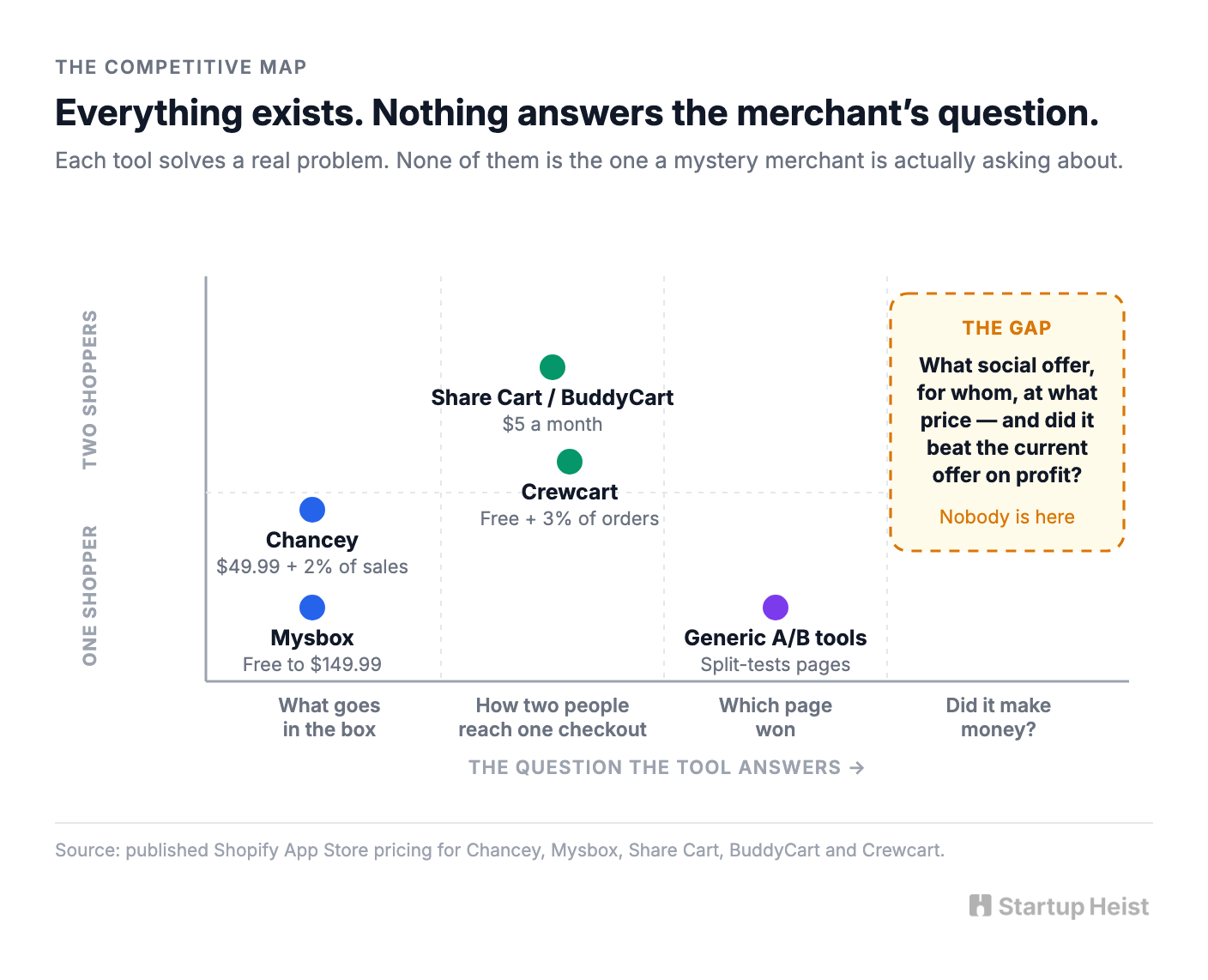
Shared carts exist too, and they are cheap. Share Cart runs $5 a month to let one shopper send a cart to someone else, and BuddyCart and RedChamps do variations on the same link-and-restore mechanic. Crewcart goes further into live collaborative sessions where several people add to one cart and one person checks out, priced at free-to-install plus 3% of every order placed through it. Generic A/B tools will split-test your Shopify pricing, templates, and funnels.
Everything a social mystery offer needs has already been built by somebody. That is the standard argument against the opportunity, and it is wrong. Every one of those tools answers a different question than the merchant is actually asking.
A mystery-box builder answers what goes in the box. A shared-cart app answers how two people reach one checkout. An A/B tool reports which page won. The merchant sitting on a warehouse of giftable inventory is asking something none of them touch: what kind of social mystery offer to run, for whom, at what price, with what reassurance copy, and whether it made more money than the offer already running.
The Product Is Context, Not Contents
Nobody needs a better blind box. The business is the merchandising and measurement layer that sits on top of whatever mystery inventory a merchant already has.
If they use Chancey, let them keep using Chancey. If they hand-built three SKUs in a spreadsheet, fine. You supply the framing, the shared-session flow, the copy variants, and the profit math that says whether any of it worked.
The offer stops sounding like this:
"YOU NEVER KNOW WHAT YOU'LL GET!"
And starts sounding like this:
"Two boxes. Open them together."
"Pick one with a friend."
"A curated discovery set for date night."
"Build your game-night mystery pack."
Same inventory, same cost of goods, a different customer at a different price point, and a testable claim about margin.
What Version One Actually Does
Resist the urge to build a social shopping platform. Five components, nothing else.
Unlock the Vault.
Join founders who spot opportunities ahead of the crowd. Actionable insights. Zero fluff.
“Intelligent, bold, minus the pretense.”
“Like discovering the cheat codes of the startup world.”
“SH is off-Broadway for founders — weird, sharp, and ahead of the curve.”


